Ranking the Top 10 Players at the 2026 World Cup
Update log (3)
- — Rewritten now that the tournament is over. The previous version was last updated on 8 July with the quarter-finals still to play, so every forward-looking sentence in it — 'France into the quarter-finals to face Morocco', 'the live Golden Boot race', 'Argentina go on to face Switzerland' — had been wrong for six weeks. The top 10 is now ranked on tournament performance rather than club form, the awards and knockout results are added, and a section has been added on what the original ranking got wrong. The old pre-tournament ranking chart and the FIFA Power Rankings explainer have been removed: the first is superseded and the second described a live in-tournament tool.
- — Round of 16 complete — holders Argentina advance after coming from 2-0 down to beat Egypt 3-2 (Messi missed a penalty but assisted one goal and scored the equaliser), so Egypt and Salah are out; Colombia's exit to Switzerland ends Luis Díaz's run. Four of the ten are now eliminated; the Golden Boot race is led by quarter-finalists Mbappé and Haaland on seven. Argentina next face Switzerland.
- — Updated as quarter-finalists lock in — Haaland's brace vs Brazil sends Norway through, and Vinícius Júnior joins Musiala as eliminated after Norway beat Brazil 2-1.

- Spain won the 2026 World Cup, beating Argentina 1-0 after extra time on 19 July at MetLife Stadium. Ferran Torres, a substitute, scored in the 106th minute. It is Spain’s second title and their first since 2010.
- Rodri won the Golden Ball without scoring a goal all tournament. He captained Spain through eight matches and completed 747 passes, the most on record at a World Cup since 1966.
- Kylian Mbappé won the Golden Boot with 10 goals — the first player to win it twice — and is now the all-time World Cup leading scorer on 22, having passed Lionel Messi. France finished fourth.
- This list was wrong in one very specific way. It ranked Lamine Yamal second on club form and pedigree; he finished the tournament with one goal, and a winner’s medal. Jamal Musiala was ranked eighth and was dropped for the knockout tie Germany then lost on penalties.
- Messi took the Silver Ball and Silver Boot at 39, in his record sixth World Cup, and retired from international football afterwards. Unai Simón conceded one goal in eight matches — the fewest any team has conceded winning a World Cup.
- England finished third, beating France 6-4 in a play-off with more goals than any third-place match in World Cup history. Bukayo Saka scored a hat-trick; Jude Bellingham’s seven goals are the most by an England player at a single World Cup.
Spain won the 2026 World Cup, beating Argentina 1-0 after extra time at MetLife Stadium on 19 July. Ferran Torres, on as a substitute in the 62nd minute, scored the only goal in the 106th.
That settles a list that spent the tournament being wrong. This page originally ranked the top 10 on club form and career pedigree, because that was all anyone had before a ball was kicked. Below is the ranking redone on what players actually did — followed by an honest look at what the original got wrong, because it got one thing very wrong indeed.
The 10 best players of the 2026 World Cup
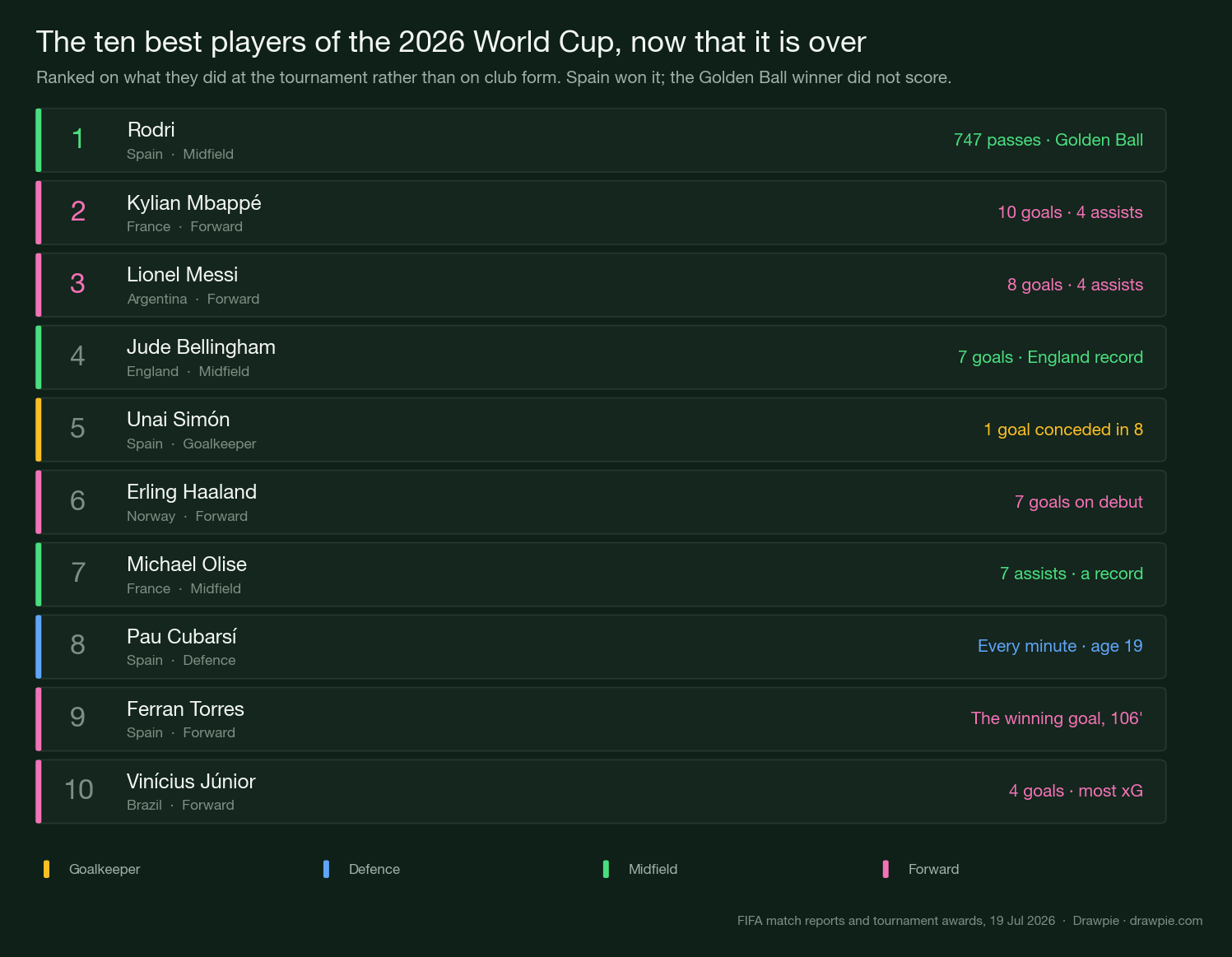
1. Rodri (Spain) — The Golden Ball, won without scoring a goal. He captained the champions through all eight matches and completed 747 passes from 799 attempted, the highest total on record at a World Cup since 1966. A holding midfielder winning player of the tournament is unusual; doing it without a goal or an assist is close to unheard of.
2. Kylian Mbappé (France) — The Golden Boot with 10 goals and 4 assists in 8 matches, making him the first player ever to win the award twice. He also passed Messi to become the all-time World Cup leading scorer on 22 goals, and took the Bronze Ball. France lost the semi-final to Spain and then the third-place match.
3. Lionel Messi (Argentina) — Silver Ball and Silver Boot at 39, in his record sixth World Cup, with 8 goals and 4 assists. He scored his first World Cup hat-trick in the opening 3-0 win over Algeria, and dragged Argentina through the semi-final against England with a hand in both goals. He finished the final without a goal or an assist — his first World Cup match in twelve without either — and retired from international football afterwards.
4. Jude Bellingham (England) — The Bronze Boot with 7 goals, the most by an England player at a single World Cup, beating Gary Lineker’s 1986 record of six. None came from the penalty spot. He scored twice at the Estadio Azteca, twice in the extra-time quarter-final win over Norway, and again in the third-place play-off.
5. Unai Simón (Spain) — The Golden Glove, with seven clean sheets and one goal conceded in eight matches. That is the fewest any team has conceded on the way to winning a World Cup. His scoreless run reached 650 minutes before Charles De Ketelaere finally beat him in the quarter-final.
6. Erling Haaland (Norway) — Seven goals on a World Cup debut, the first player to manage that since Grzegorz Lato in 1974. He scored both goals that knocked Brazil out and took Norway to their first quarter-final, in their first tournament in 28 years. Level with Bellingham on goals, he lost the Bronze Boot on the assists tiebreak.
7. Michael Olise (France) — Seven assists, the most in a single World Cup since assist records began in 1966, passing Pelé’s 1970 mark. The most under-discussed individual performance of the tournament.
8. Pau Cubarsí (Spain) — The Young Player award at 19, and reported to be the first defender ever to win it. He played every minute of Spain’s campaign and completed 668 passes at 97% accuracy.
9. Ferran Torres (Spain) — He came off the bench and scored the goal that won the World Cup. Only the second Spaniard after Andrés Iniesta to do that.
10. Vinícius Júnior (Brazil) — The best player on a team that went out early. He scored in all three group matches, the fifth Brazilian ever to do so, and generated more expected goals than anyone else at the tournament. Brazil still lost to Norway in the round of 16.
What this list got wrong
The version of this page that ran through the tournament ranked players on club form and pedigree. Here is how those ten actually finished.
| Ranked | Player | How it ended |
|---|---|---|
| 1 | Kylian Mbappé | Golden Boot, 10 goals — fourth place |
| 2 | Lamine Yamal | One goal all tournament — and a winner’s medal |
| 3 | Erling Haaland | 7 goals, Norway’s first quarter-final |
| 4 | Jude Bellingham | 7 goals, an England record — third place |
| 5 | Vinícius Júnior | 4 goals, out in the round of 16 |
| 6 | Mohamed Salah | Out in the round of 16 |
| 7 | Lautaro Martínez | Runner-up; scored the semi-final winner |
| 8 | Jamal Musiala | Dropped, then Germany lost on penalties |
| 9 | Lionel Messi | Silver Ball and Silver Boot |
| 10 | Luis Díaz | Out in the round of 16 |
Three honest observations.
The top pick held up. Mbappé was ranked first on the argument that he had the most complete attacking résumé in the field. He won the Golden Boot and became the all-time World Cup top scorer. That one was right.
The second pick is the interesting failure. Lamine Yamal was ranked second, with the note that he was “racing back from a spring hamstring injury, but his ceiling is unmatched.” He finished the tournament with one goal and no assists in eight appearances — and a World Cup winner’s medal, having started the move that led to the winning goal. He is the youngest player ever to win both the World Cup and the European Championship, and the third-youngest to appear in a World Cup final, after Pelé and Giuseppe Bergomi. Both things are true at once: the ranking was too high on output, and he won the tournament anyway.
Nobody on the list saw Rodri coming. The player of the tournament was not in the original ten. Neither were Unai Simón, Michael Olise, Pau Cubarsí or Ferran Torres. That is what a list built on club form and pedigree does: it recruits famous attackers and misses the holding midfielder, the goalkeeper and the 19-year-old centre-back who actually decide a World Cup.
Who won the individual awards?
| Award | Winner | Detail |
|---|---|---|
| Golden Ball | Rodri (Spain) | Won it without scoring |
| Silver Ball | Lionel Messi (Argentina) | |
| Bronze Ball | Kylian Mbappé (France) | |
| Golden Boot | Kylian Mbappé (France) | 10 goals, 4 assists |
| Silver Boot | Lionel Messi (Argentina) | 8 goals, 4 assists |
| Bronze Boot | Jude Bellingham (England) | 7 goals, 1 assist |
| Golden Glove | Unai Simón (Spain) | 1 goal conceded in 8 |
| Young Player | Pau Cubarsí (Spain) | Age 19, played every minute |
| Fair Play | Netherlands | Three yellow cards all tournament |
The Bronze Boot was decided on assists: Bellingham and Haaland both finished on seven goals, and Bellingham had one assist to Haaland’s none.
FIFA also published a fan-voted Dream Team: Vozinha (Cape Verde); Pedro Porro, Lisandro Martínez, Dayot Upamecano, Marc Cucurella; Rodri, Michael Olise, Jude Bellingham; Lionel Messi, Erling Haaland, Kylian Mbappé. It is worth stressing that this was a public vote rather than a technical panel — Vozinha, a 40-year-old free agent who had spent two seasons in Portugal’s second tier, topped the goalkeeper poll ahead of the Golden Glove winner.
How the tournament finished
Quarter-finals: France 2-0 Morocco; Spain 2-1 Belgium; England 2-1 Norway after extra time; Argentina 3-1 Switzerland after extra time.
Semi-finals: Spain 2-0 France in Arlington, through an Oyarzabal penalty and a Pedro Porro finish on 58 minutes. Argentina 2-1 England in Atlanta, Anthony Gordon putting England ahead on 55 before Enzo Fernández equalised on 85 and Lautaro Martínez headed a Messi cross in at 90+2.
Third-place play-off: England 6-4 France. England led 4-0 at half-time, Bukayo Saka scored a hat-trick, and the ten goals are the most in any World Cup third-place match ever played. It is England’s best finish since they won the thing in 1966.
Final: Spain 1-0 Argentina after extra time. Goalless after 90. Enzo Fernández was sent off for a second yellow at 90+3, so Argentina played the whole of extra time with ten men, and Ferran Torres finished a Nico Williams header back across goal on 106. Emiliano Martínez made 11 saves, reported as a record for a World Cup final, and still lost.
Who was the best player at the 2026 World Cup?
Rodri, on the official award — he won the adidas Golden Ball as the tournament’s outstanding player.
What makes it a genuine debate is that he did it without scoring or assisting a goal in eight matches. His case is volume and control: 747 completed passes, the most recorded at a World Cup since 1966, as captain of a team that conceded once in the whole tournament. If you weight goals more heavily, Mbappé’s 10 or Messi’s 8-and-4 are the answer instead, and FIFA’s own voters put those two second and third.
Did Lamine Yamal have a good World Cup?
He won it, and he scored once.
Both halves of that sentence matter. Yamal arrived as the most hyped teenager in the sport and finished with one goal and no assists in eight appearances, having carried the effects of a spring hamstring injury into the tournament. He also began the passage of play that ended with Spain’s winning goal in the final, and left with a winner’s medal at 19 — the youngest player ever to hold both a World Cup and a European Championship.
Why isn’t Lionel Messi first?
Because Rodri won the Golden Ball and Mbappé won the Golden Boot, and Messi finished second in both.
At 39, in his sixth World Cup, he scored 8 goals with 4 assists, took the Silver Ball and Silver Boot, and put Argentina in the final almost single-handedly in the semi against England. He then went through the final without a goal or an assist for the first time in twelve World Cup matches, and retired from international football afterwards. Third on this list is not a criticism of a 39-year-old; it is what happens when two players ahead of you win the two biggest awards.
The bottom line
Spain won it with a defence that conceded one goal in eight matches, a holding midfielder who was named the best player without scoring, a 19-year-old centre-back who played every minute, and a substitute who scored the only goal of the final.
That is a very different story from the one a pre-tournament ranking of famous attackers would have told you — which is the useful thing to take from a list like this. Mbappé was correctly placed first and delivered. The rest of the top ten was a reasonable guess about club form, and the tournament was decided by people who were not on it.
For more, see our look at Lamine Yamal’s rise and net worth and our wider 2026 World Cup coverage .