2026 Wisconsin Governor Race: Crowley vs Tiffany, Polls and Swing Voters
Update log (2)
- — Add a second entry dated 2026-09-02: "Rechecked after the canvass and the first post-primary poll. The Wisconsin Elections Commission certified the 11 August primary on 27 August: Crowley 315,413 (39.81%) to Hong 311,740 (39.35%), a 3,673-vote margin — the AP-called figures originally published here moved by less than a tenth of a point. Marquette released its first Crowley-Tiffany survey on 26 August, fielded 12-20 August: Crowley 49 to Tiffany 44 among likely voters, 44-44 among all registered voters. Sabato's Crystal Ball moved the seat from Toss-up to Lean Democratic on 1 September; Cook and Inside Elections still have it a Toss-up." Also set lastmod to 2026-09-02T00:00:00Z.
- — Primary results here are the AP-called figures with 98.2% of the expected vote counted, published the morning after the 11 August primary. Wisconsin's official county canvasses had not been completed when this was written, so the vote totals and percentages will shift slightly.

- David Crowley won the Democratic primary by 3,673 votes — 39.81% to Francesca Hong’s 39.35%, a margin of 0.46 points on the certified canvass. That is inside Wisconsin’s 1% recount window, but Hong conceded rather than request one, and AP called the race at 3:34 a.m. ET on 12 August. He faces Republican Tom Tiffany, who took 95.3%, on 3 November.
- The last published primary poll had Hong ahead 44-22. Crowley was at 7% in Marquette’s late-July survey and was not on Marquette’s mid-July questionnaire at all, because he had quit the race four days before it went into the field and did not re-enter until after it closed.
- Marquette has now polled the matchup. Its survey of 12-20 August, released 26 August, has Crowley 49 to Tiffany 44 among 738 likely voters (±4.5) — and a 44-44 tie among all 891 registered voters (±4). The earlier RMG Research poll, fielded 20-24 July for the conservative Institute for Reforming Government, had Crowley 46, Tiffany 43 among 800 registered voters (±3.5). Cook Political Report and Inside Elections still rate the seat a Toss-up; Sabato’s Crystal Ball moved it to Lean Democratic on 1 September.
- A third of Wisconsin’s electorate is the whole ballgame, and it is the least likely to turn out. In Marquette’s August survey, 84% of Democrats and 82% of Republicans said they were certain to vote in November, against 59% of independents — a gap that widened from 84 / 79 / 69 in July. Among the independents who did make its likely-voter screen, Crowley led 55-16.
David Crowley beat Francesca Hong by 3,673 votes — 0.46 percentage points — to win the Democratic nomination for governor of Wisconsin, and will face Republican Tom Tiffany on 3 November 2026.
The Associated Press called it at 3:34 a.m. Eastern on 12 August, after delayed absentee ballots from Milwaukee County finished uploading. Crowley is the Milwaukee County Executive.
Four days before the vote, the last published poll of that primary had him losing by 22 points.
Who won the Wisconsin governor primary?
Crowley took 39.8% to Hong’s 39.4%, with Kelda Roys third on 7.5%, at 98.2% of the expected vote. On the Republican side Tom Tiffany won 95.3% against Andy Manske’s 4.6%.
| Primary | Result | Note |
|---|---|---|
| Crowley (D) | 39.8% | AP-called winner |
| Hong (D) | 39.4% | conceded |
| Roys (D) | 7.5% | third |
| Tiffany (R) | 95.3% | AP-called winner |
| Manske (R) | 4.6% | second |
That 0.4-point gap sits inside Wisconsin’s recount window. State law lets a candidate within 1 point request a recount, and makes the campaign pay for it when the margin is above 0.25 points. Hong was eligible and declined, conceding instead — which is what allowed the race to be called overnight rather than dragging into a canvass fight.
The result is now official. The Wisconsin Elections Commission’s canvass of the 11 August primary, published on 27 August, puts Crowley on 315,413 votes (39.81%) to Hong’s 311,740 (39.35%) and Roys on 59,394 (7.50%). Tiffany took 468,019 (95.32%) to Andy Manske’s 22,573 (4.60%). The AP-called figures published the morning after the primary held up to within a rounding point.
Why did the polls miss David Crowley?
Because most of them were taken during a version of the race he was not in. This is not a story about a polling failure so much as a story about a candidate field that changed four times in five weeks.
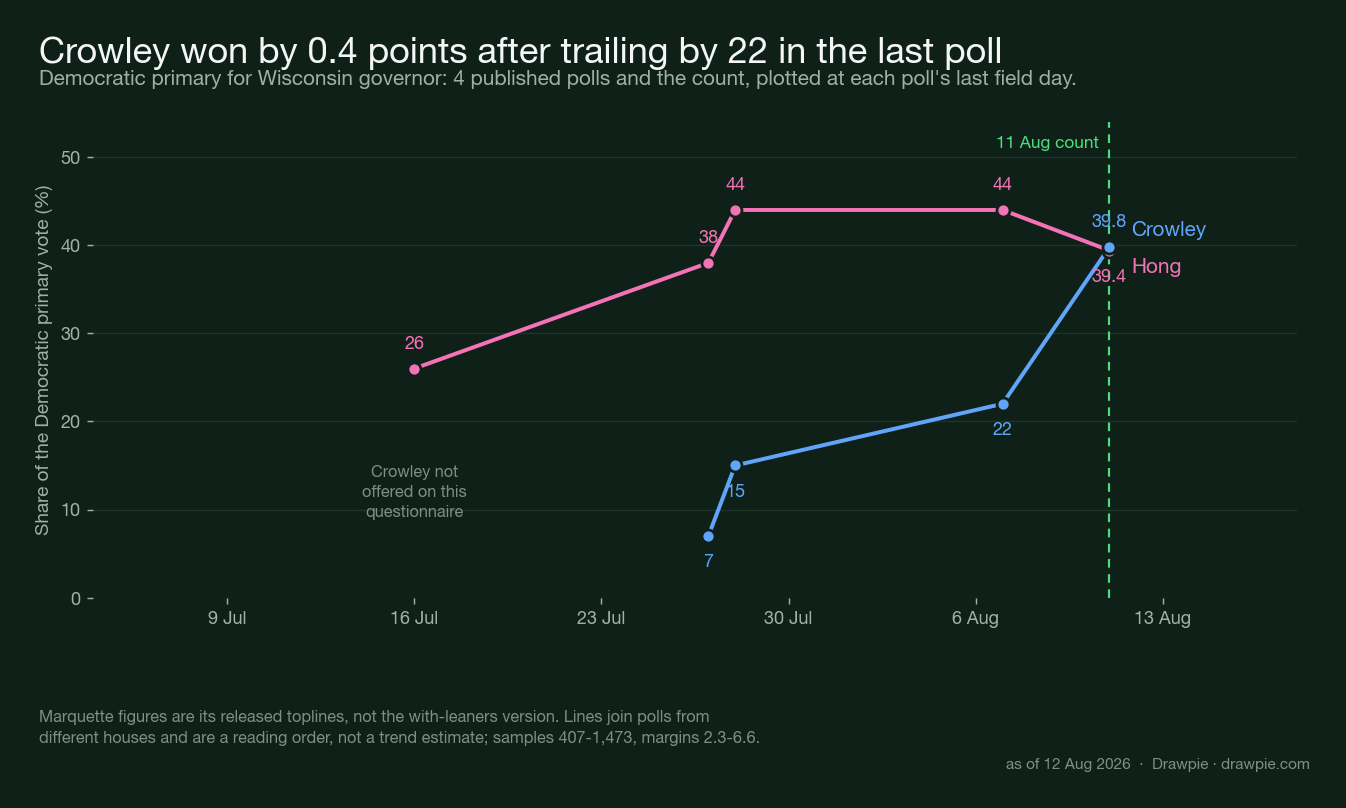
| Poll | Field | Hong | Crowley |
|---|---|---|---|
| Marquette | 8–16 Jul | 26% | not asked |
| Marquette | 22–27 Jul | 38% | 7% |
| State Navigate | 28 Jul | 44% | 15% |
| State Navigate | 7 Aug | 44% | 22% |
| Count | 11 Aug | 39.4% | 39.8% |
The sequence matters. Crowley quit the race on 8 July and endorsed Lieutenant Governor Sara Rodriguez. On 13 July Rodriguez said she had fired her campaign manager after discovering the campaign had hundreds of thousands of dollars less on hand than expected. On 18 July she dropped out and Crowley re-entered, with Governor Tony Evers’ endorsement.
Marquette’s mid-July survey went into the field on 8 July — the day Crowley quit — and closed on 16 July, two days before he came back. Its release says so plainly: he “dropped out of the race prior to the poll being conducted, reentering the race after it was completed, and so is not included.”
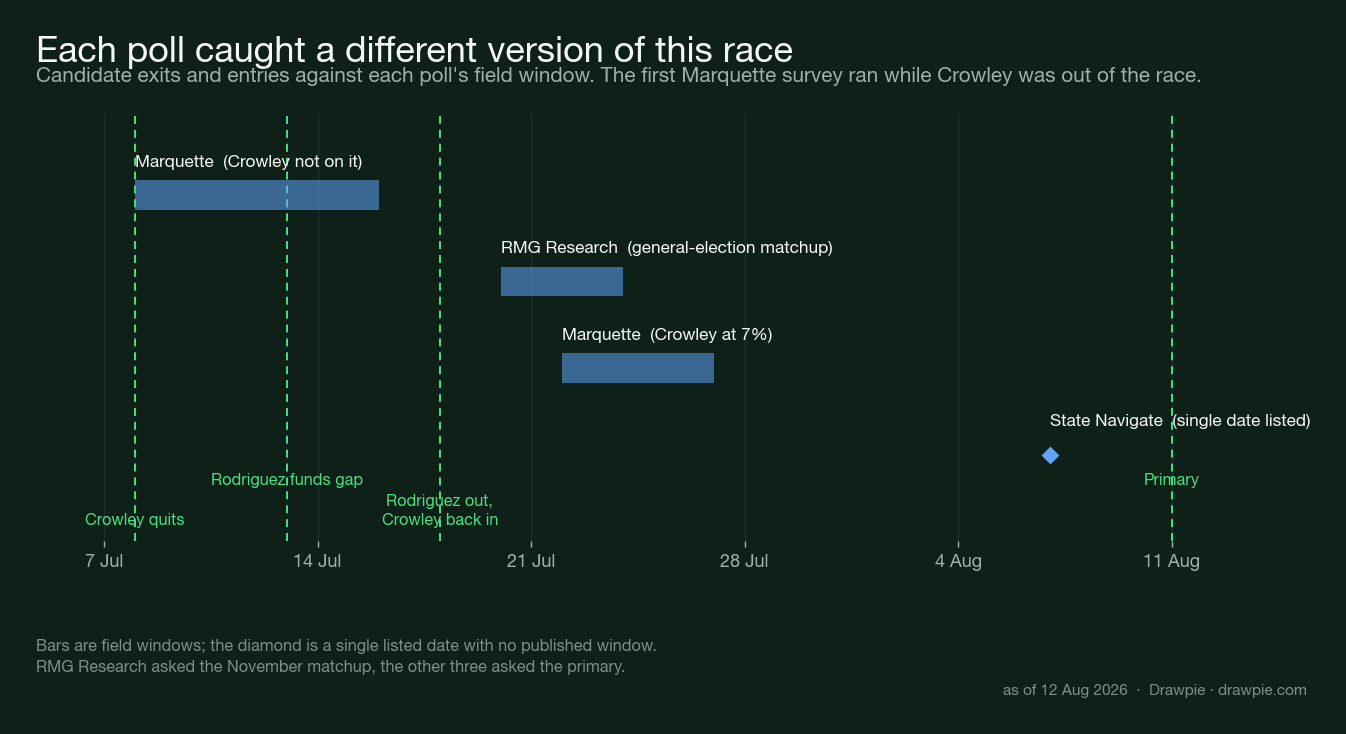
| Poll | Field | Measured |
|---|---|---|
| Marquette | 8–16 Jul | Crowley not on it |
| RMG Research | 20–24 Jul | November matchup |
| Marquette | 22–27 Jul | Crowley at 7% |
| State Navigate | 7 Aug | single date listed |
So the honest reading of that 44–22 figure is not that the pollsters were wrong by 22 points. It is that a candidate who re-entered on 18 July with the governor’s backing, and whose home county holds the largest bloc of Democratic votes in the state, had roughly three weeks to consolidate — and the last survey caught him partway through it. Marquette also had 34% of Democratic primary voters undecided in late July, down from 45% a fortnight earlier. A third of the electorate had not chosen when the last authoritative poll closed.
What do the polls say about Crowley vs Tiffany?
Three polls have now tested this matchup. Marquette’s, the newest, is the first with a lead outside its own margin of error — and only on its likely-voter screen. Among all registered voters the race is tied. The oldest of the three was taken before Crowley had left and re-entered the race.
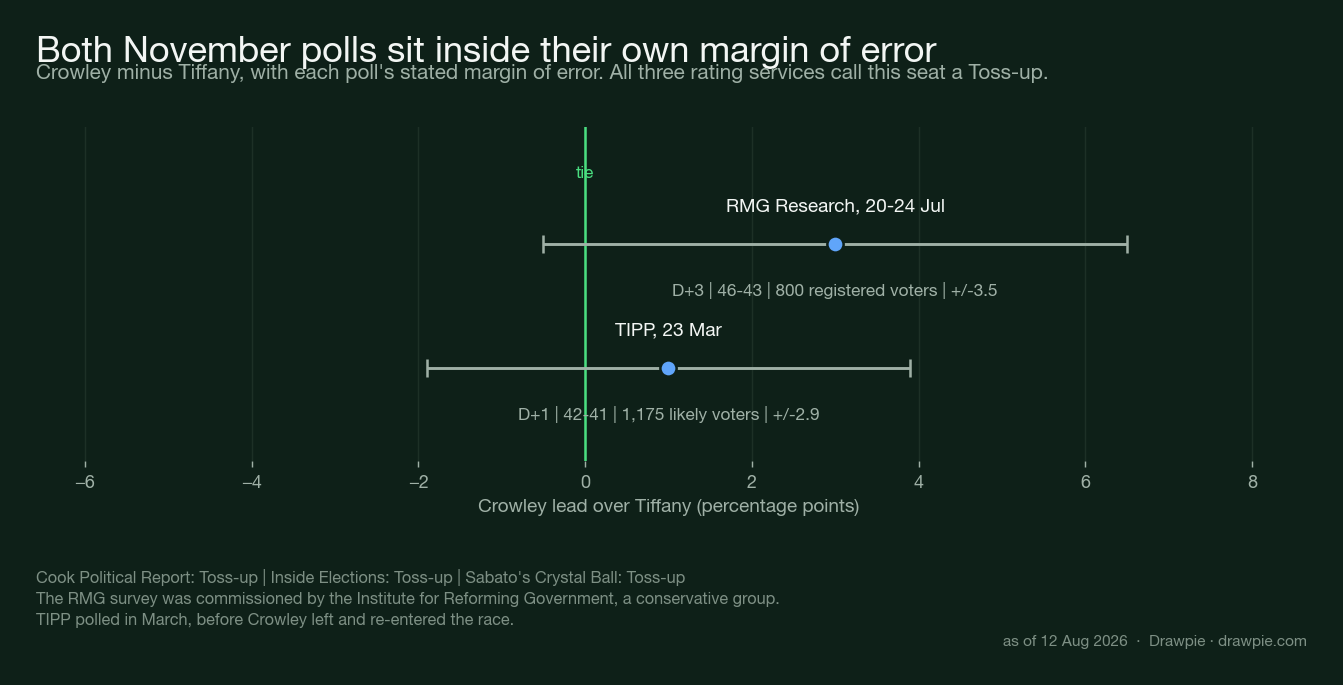
| Poll | Crowley | Tiffany |
|---|---|---|
| Marquette LV, 12–20 Aug | 49% | 44% |
| Marquette RV, 12–20 Aug | 44% | 44% |
| RMG, 20–24 Jul | 46% | 43% |
| TIPP, 23 Mar | 42% | 41% |
Marquette surveyed 891 registered voters at ±4 points, of whom 738 passed its likely-voter screen, at ±4.5. RMG surveyed 800 registered voters at ±3.5; TIPP surveyed 1,175 likely voters at ±2.9. The July and March leads are smaller than the error attached to them. Marquette’s likely-voter lead is not — and it disappears entirely when the screen comes off.
The RMG survey is the only one fielded while Crowley was a declared candidate, and it was commissioned by the Institute for Reforming Government, a conservative group, for the Napolitan News Service. The TIPP poll dates from 23 March, before the field had taken anything like its final shape.
Marquette published its first Crowley–Tiffany number on 26 August. In that survey Crowley was still unknown to 38% of registered voters (33% favourable, 29% unfavourable), against Tiffany’s 39% favourable, 42% unfavourable and 18% unfamiliar. In late July, before it could ask about Crowley, Marquette published every other Democrat against Tiffany, among registered voters:
| Matchup | Democrat | Tiffany | Net |
|---|---|---|---|
| Barnes | 44% | 40% | D+4 |
| Rodriguez | 42% | 41% | D+1 |
| Brennan | 39% | 42% | R+3 |
| Hong | 40% | 43% | R+3 |
| Roys | 38% | 42% | R+4 |
Every one of those is inside the poll’s ±4.5-point error. The useful conclusion from the set is not which Democrat did best; it is that Marquette found the same close race whoever it substituted in. Among likely voters the same survey moved every matchup a few points towards the Democrat, because 84% of Democrats said they were certain to vote against 79% of Republicans.
The rating services no longer agree. Cook Political Report (last updated 27 August) and Inside Elections (6 August) still classify Wisconsin as a Toss-up. Sabato’s Crystal Ball moved it to Lean Democratic on 1 September, after Marquette’s poll. Inside Elections has a separate “Tilt” category for races that lean slightly, and has not used it here.
Who are the swing voters in Wisconsin?
Independents are a third of the electorate and the least likely of the three groups to turn out — and the gap has widened since July. Marquette’s August sample was 36% Republican, 32% Democratic and 32% independent. Certainty to vote in November ran 84% among Democrats, 82% among Republicans and 59% among independents, against 84 / 79 / 69 in July. Republican certainty rose three points while independent certainty fell ten.
| Group | Share (Aug) | Certain to vote, Jul | Certain to vote, Aug |
|---|---|---|---|
| Republican | 36% | 79% | 82% |
| Independent | 32% | 69% | 59% |
| Democratic | 32% | 84% | 84% |
Two things follow from that gap, and they cut in opposite directions. A Democratic turnout edge is why Marquette’s likely-voter screens were friendlier to Democrats than its registered-voter numbers. But the persuadable third is the least committed, so the size of the actual electorate in November is not settled by anything measured in July.
Wisconsin’s primaries are open, which is why this matters even in a nomination fight: among people who told Marquette they would vote in the Democratic primary, 13% were independents and 6% were Republicans.
One measured attitude is worth putting beside the result. Marquette asked about the “Democratic socialist” label that Hong uses for herself. Among independents, 13% were favourable, 52% unfavourable and 31% had not heard enough. Among Democrats it was 54% favourable. Hong won 45% of primary voters who viewed Democratic socialists favourably and 8% of those who did not — a coalition that was strong enough to lead every published poll and 3,000 votes short in the count.
When is the Wisconsin governor election?
Tuesday 3 November 2026, with polls open 7 a.m. to 8 p.m. The winner takes a four-year term beginning 5 January 2027.
This is an open seat. Crowley runs with Secretary of State Sarah Godlewski, who won the Democratic lieutenant governor primary with 99.6%; Tiffany’s running mate is David Varnam. Tony Evers, the two-term Democratic incumbent, announced on 24 July 2025 that he would not seek a third term — making it Wisconsin’s first governor’s race with no incumbent since Tommy Thompson retired in 2002. Tiffany, who represents Wisconsin’s 7th congressional district, has President Trump’s endorsement.
It is one of 36 states electing a governor this year, out of 39 gubernatorial races counting the three territories. For the other half of the November map, our 2026 Senate control breakdown covers the four seats that decide the chamber.
What none of this tells you
The last four weeks are a reasonable argument for reading polls by their field dates rather than their headlines. Every number in the primary table above was accurate about the electorate it sampled; the electorate simply kept changing underneath them.
The general election is nine weeks out. Marquette has now asked the question that actually exists, and its answer depends on which electorate you assume: Crowley by five among the people it screened as likely to vote, level among everyone registered. That gap between the two screens is the size of the whole result. It is why two of the three rating services still decline to pick, and why the third has started to.
Sources
Read on 12 August 2026, rechecked 2 September 2026.
| Source | What it supports here |
|---|---|
| Marquette Law School Poll, 22 July release | Field dates 8–16 July, samples and margins, Hong 26% and the 45% undecided, Tiffany 67% in the Republican primary, all five Tiffany matchups, party composition and certainty-to-vote figures, the Democratic socialist favourability numbers, and the statement that Crowley was not included |
| Marquette Law School Poll, 29 July release | Field dates 22–27 July, 407 respondents ±6.6, Hong 38% / Barnes 16% / Crowley 7%, and 34% undecided |
| NBC News: Wisconsin governor primary results | Crowley 39.8% / Hong 39.4% / Roys 7.5%, Tiffany 95.3% / Manske 4.6%, 98.2% of expected vote, outstanding ballot estimates, Evers’ retirement and Trump’s endorsement of Tiffany |
| 270toWin: 2026 Wisconsin governor polls | The State Navigate and TIPP entries, and the existence of the two Crowley–Tiffany general-election polls |
| Institute for Reforming Government: IRG poll release | RMG Research field dates 20–24 July, 800 registered voters ±3.5, Crowley 46 – Tiffany 43, and the sponsor’s own identity |
| Ballotpedia: Wisconsin gubernatorial election, 2026 | Cook, Inside Elections and Sabato ratings, the 3 November general and 11 August primary dates, poll hours, and the 36-governorship count |
How we verified this
Every poll on this page is reported with its house, field dates, sample, universe and margin of error, and the release date is kept separate from the field window. That distinction does real work here: the RMG Research poll is widely dated 30 July, which is when it was released — it was in the field 20-24 July. Treating the release date as the field date would place it after Marquette’s second survey rather than before it, and would change which version of the race it was measuring.
The Marquette figures used are its released toplines, not the with-leaners numbers. Marquette’s 29 July release gives Hong 38%, Barnes 16%, Crowley 7%. Pushing undecideds for a lean puts Hong at 46%, and aggregators carry that second set. Both are Marquette’s own; they are not interchangeable, and mixing them across a time series would manufacture a trend. Only the toplines appear here.
Crowley’s absence from the mid-July Marquette poll is stated by Marquette, not inferred. Its 22 July release says he “dropped out of the race prior to the poll being conducted, reentering the race after it was completed, and so is not included”. On the chart that survey carries no Crowley point at all rather than a zero, because a candidate who was not on the questionnaire has no measured support.
We nearly published a wrong negative. An early pass concluded that no poll existed of Crowley against Tiffany. Two do — RMG Research in July and TIPP in March — and both are in the article. The claim that survived is narrower and checkable: of the two polls that existed when this was written, only the RMG survey was fielded while Crowley was a declared candidate, because TIPP polled on 23 March, months before he left and re-entered. Marquette’s 12-20 August survey, added later, was fielded after he had won the nomination.
The RMG poll’s sponsor is named in the text and on the chart. It was commissioned by the Institute for Reforming Government, a conservative organisation, and conducted for the Napolitan News Service. The result is favourable to the Democrat, which is not a reason to omit who paid for it.
The TIPP figures rest on one aggregator, and that aggregator does not fail cleanly. The RMG numbers were checked against the sponsor’s own release, but the March TIPP poll appears here only via 270toWin’s Wisconsin table. Requesting a deliberately invalid state page on that site returns HTTP 200 rather than a 404, so a status code cannot distinguish a real page from a fake one there; the table was read in a browser and the row is reported with its house, date, sample and margin so it can be checked. Nothing in the conclusions depends on the TIPP row — it is the older of the two polls and predates the candidate changes.
State Navigate’s two surveys are reported with a caveat we could not resolve. They carry the largest samples in the primary table (1,085 and 1,473 likely voters) and the tightest stated margins, but the aggregator lists a single date for each with no published field window, and we could not verify the house’s methodology. They are labelled by name so readers can weigh them; nothing in the article’s conclusions rests on them alone.
The primary result was certified after this article was first published. The figures here are now the Wisconsin Elections Commission’s canvass of 27 August, which moved the AP-called numbers by less than a tenth of a point. The original AP figures, at 98.2% of expected vote with roughly 15,000 Democratic and 9,000 Republican ballots outstanding, are preserved in the update note. Wisconsin’s recount statute allows a losing candidate within 1 point to request one, at their own cost above a 0.25-point margin; Hong’s concession removed that possibility rather than the margin doing so.
No betting or prediction-market prices appear here, and this article makes no forecast of its own. What it reports is what named pollsters measured, when they measured it, and how three rating services currently classify the seat.