Why Sandisk Stock Suddenly Crashed Today (June 23, 2026)

Sandisk (SNDK) stock crashed roughly 11% on Tuesday, June 23, 2026, falling to around $2,000 just one day after closing at a record high. The trigger wasn’t anything wrong with Sandisk’s business — it was a dramatic memory-chip selloff that started in South Korea and swept up every memory stock, hitting a name that had gone parabolic this year especially hard. Here’s what actually happened. (This is news and context, not investment advice — see the note at the end.)
Did Sandisk stock really crash today?
Yes. Sandisk fell about 11% intraday on June 23, sliding from a record-high close the day before. It wasn’t alone: the entire memory-chip group sold off hard at the same time.
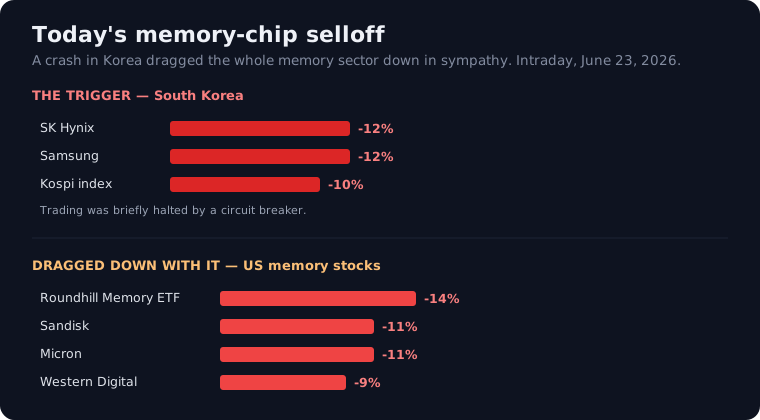
| Stock | Intraday move |
|---|---|
| Roundhill Memory ETF (DRAM) | ~ -14% |
| Sandisk (SNDK) | ~ -11% |
| Micron (MU) | ~ -11% |
| Western Digital (WDC) | ~ -9% |
The fact that Sandisk, Micron, and Western Digital all fell together is the key tell: this was a sector-wide event, not a Sandisk-specific one. (Figures are intraday and move through the session.)
Why did Sandisk stock crash today?
The selloff traces straight to South Korea. The country’s Kospi index closed about 10% lower — bad enough to trigger a circuit breaker that briefly halted trading — as memory giants SK Hynix and Samsung Electronics each plunged more than 12%. Because those two companies physically manufacture much of the world’s DRAM and NAND flash memory, when their shares crater, every memory-related stock tends to fall in sympathy. Sandisk, as a pure-play NAND storage maker, sits squarely in that group.
Two things amplified the move. South Korean regulators had recently approved leveraged single-stock ETFs that make 2x bets on these chip names, and when the stocks dropped, those products magnified the selling into a panic. On top of that, investors are cautious ahead of Micron’s earnings report due June 24, the next big checkpoint for the whole memory sector — so many chose to take risk off the table first and ask questions later.
Is the Sandisk crash about high AI spending?
Not really, and this is worth untangling. Sandisk has been one of the biggest winners of the AI boom, not a victim of AI spending — surging demand for data-center storage sent its most recent quarterly datacenter revenue up a staggering 645% year over year, with gross margins near 78%. Its business is booming.
What’s true is that the broader market mood has soured on stretched AI valuations lately — a disappointing outlook from another chipmaker kicked off the tech selloff a day earlier, and some big AI spenders have been punished over capital-expenditure worries. That nervous backdrop made high-flying AI names more vulnerable to a sharp pullback. But Sandisk’s specific crash today is about the Korean memory rout and profit-taking, not a sign that AI spending is hurting the company. The stock fell again in August for a different reason, and that one really was about how AI is valued: SanDisk and the AI valuation question .
Why would a huge run-up make a stock crash this hard?
Because Sandisk hadn’t just risen — it had gone parabolic, which sets up exactly this kind of violent reversal.
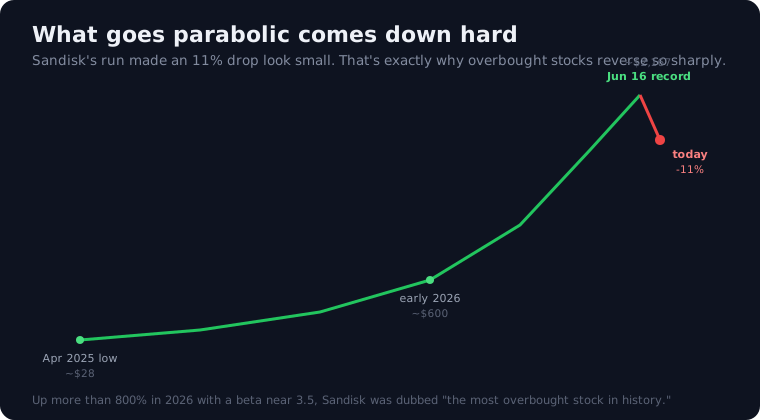
Spun off from Western Digital in early 2025, Sandisk traded as low as about $28 in April 2025. By June 16, 2026, it had hit a record near $2,167 — a gain of more than 800% in 2026 alone, earning it the label “the most overbought stock in history,” with a beta around 3.5 (meaning it tends to swing far more than the overall market). Stocks that climb that steeply are priced for perfection, so any wobble in confidence can spark heavy “sell-the-news” profit-taking. An 11% drop sounds severe, but against a run like that, it barely dents the chart — which is precisely why analysts are debating whether today is a blip or the start of a real correction.
What happens next for Sandisk and memory stocks?
The honest answer is that nobody knows yet, and the next clue comes fast: Micron reports earnings on June 24, and that report is expected to set the tone for the entire memory complex. Several analysts characterize today’s move as sentiment-driven contagion from Korea rather than a fundamental break — Sandisk’s underlying numbers remain strong — but the “blip versus correction” question won’t be settled in a single session, and volatility is likely to stay high. None of that is a prediction of where the stock goes from here, which no one can reliably call.
The bottom line
Sandisk crashed about 11% today, June 23, 2026, because a memory-chip rout in South Korea dragged the whole sector down and triggered profit-taking in a stock that had soared more than 800% this year. It wasn’t caused by weak results or by AI spending — Sandisk’s business is still growing fast. The drop says more about how stretched the stock had become and how jittery markets are about AI valuations than about anything broken at the company. The next real test is Micron’s earnings on June 24.
For more market context, see our explainer on why the S&P 500 fell today and the great rotation from crypto into AI hardware .
This article is news and general context, not investment advice, and does not recommend buying or selling any security. Stock figures are intraday and change continuously; values cited reflect a snapshot during trading on June 23, 2026.