Why Is the Invesco QQQ ETF Sliding Today? (June 23, 2026)

The Invesco QQQ Trust (QQQ) is sliding today, Tuesday, June 23, 2026 — down roughly 2.8% in early trading — pulled lower by a sharp selloff in the big technology stocks that dominate its Nasdaq-100 benchmark and by a jump in bond yields. The drop has also reignited a louder argument: that the “AI business model is collapsing.” Below is what’s actually moving QQQ today, plus an honest, two-sided look at that bigger claim. (This is news and context, not investment advice — see the note at the end.)
Is QQQ really down today, and by how much?
Yes. QQQ fell about 2.8% in early trading on June 23, after recently trading near its 52-week high around $748. It’s not an isolated move — it’s part of a broad, tech-led selloff that also dragged down the S&P 500 and hammered semiconductor stocks the same day.
Because QQQ is so concentrated in megacap technology, it tends to fall harder than broader indexes when tech leads the market down — which is exactly what happened today.
Why is QQQ sliding today?
Several forces are pushing in the same direction:
- A broad tech and AI selloff. Selling that began the prior session intensified overnight as a memory-chip rout in Asia spread worldwide, hitting the AI-related names that make up much of QQQ.
- Rising bond yields. The 10-year U.S. Treasury yield climbed to around 4.50%, fueling expectations that the Federal Reserve may keep rates higher. High-growth tech is especially rate-sensitive, because higher rates reduce the present value of future profits — so these stocks often sell off first when the rate outlook turns hawkish.
- A rotation out of expensive growth. Investors pulled money from high-valuation names — Amazon and Alphabet each fell about 5% in the prior session — and moved toward areas seen as cheaper or safer.
Why is QQQ so sensitive to interest rates and tech?
This is worth understanding beyond today, because it explains why QQQ swings the way it does. QQQ tracks the Nasdaq-100, essentially the 100 largest non-financial companies on the Nasdaq — a list dominated by AI and megacap tech.
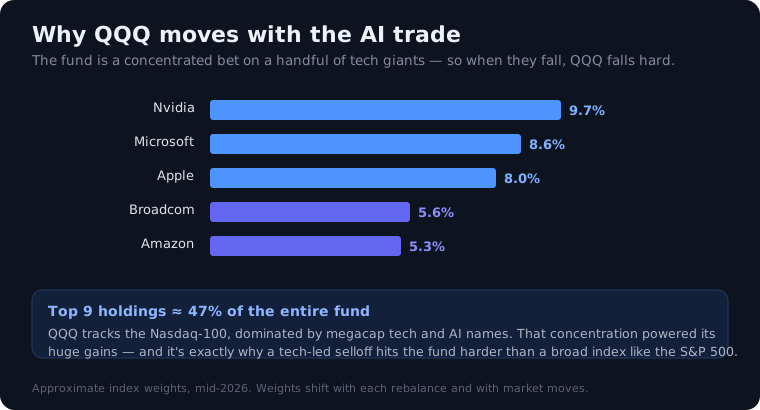
| Top holding | Approx. weight |
|---|---|
| Nvidia | ~9.7% |
| Microsoft | ~8.6% |
| Apple | ~8.0% |
| Broadcom | ~5.6% |
| Amazon | ~5.3% |
The top nine holdings make up roughly 47% of the entire fund. That concentration is what drove QQQ’s enormous gains over the past year — but it’s a double-edged sword: when those few giants fall together, the fund has little to cushion the blow. And because they’re high-multiple stocks priced on future growth, they’re unusually sensitive to interest rates. Rising yields hit them first and hardest.
Does this mean the AI business model is collapsing?
This is the dramatic claim circulating today, so it’s worth treating carefully — and honestly, it’s a genuine debate, not a settled fact. A single down day is not evidence that an industry is collapsing.
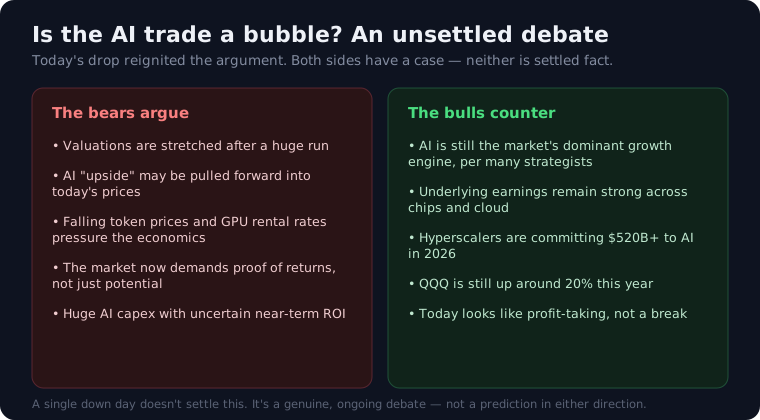
On the bearish side, some analysts argue the AI trade has gotten ahead of itself: valuations are stretched, much of the future upside may already be priced in, and there are real questions about the economics — with falling token prices and GPU rental rates pressuring margins, and enormous AI capital spending whose near-term return on investment is unproven. In this view, the market has shifted from pricing in potential to demanding proof.
On the bullish side, many strategists still call AI the dominant growth engine of the 2026 market. Underlying earnings across chips and cloud remain strong, the largest tech companies are committing more than $520 billion to AI in 2026, and QQQ is still up around 20% this year. In this view, today’s drop looks more like profit-taking and rotation after a huge run than a fundamental break.
The honest takeaway: both cases are real, and neither is proven by one volatile session. Calling the AI model “collapsed” today would be a prediction dressed up as a fact — and predictions about markets are exactly what no one can reliably make.
What should investors watch next?
The near-term signposts are clear even if the outcome isn’t. Micron reports earnings on June 24, which should set the tone for AI-linked chip names. The path of bond yields and the Fed’s stance will keep steering rate-sensitive tech. And market-watchers will be looking at whether dips in these stocks keep getting bought — a sign confidence is intact — or stop being bought, which would suggest sentiment is genuinely turning. None of these is a recommendation; they’re simply what’s likely to move the fund next.
The bottom line
QQQ is down about 2.8% today, June 23, 2026, because a tech-led selloff and rising bond yields hit the AI and megacap names that dominate the fund. The slide also revived the “is AI a bubble?” debate — a real argument with credible voices on both sides, but not something a single day’s drop can settle. For QQQ holders, today is a reminder of the trade-off baked into the fund: the same concentration that fueled its gains makes it fall hard when tech wobbles.
For more market context, see our explainers on why the S&P 500 fell today and why Sandisk stock crashed .
This article is news and general context, not investment advice, and does not recommend buying or selling any security. Market figures are intraday and change continuously; values cited reflect a snapshot during trading on June 23, 2026.