Why Nvidia Stock Slipped Below $200 as Competition Fears Grow

Nvidia (NVDA) stock has slipped below $200, falling roughly 15% from its May 2026 high of about $235.74, as investors grow increasingly worried that rising competition could chip away at its dominance in artificial intelligence hardware. The immediate trigger is a shift in sentiment rather than a collapse in the business: Nvidia still supplies an estimated 90% of AI accelerators, and spending on AI keeps climbing. So is the worry justified? Here’s what’s behind the slide, what the competition fears are really about, and an honest look at both sides. (This is news and context, not investment advice — see the note at the end.)
How far has Nvidia stock fallen?
After failing to hold momentum above $230, Nvidia shares retreated steadily toward and then below the closely watched $200 level.
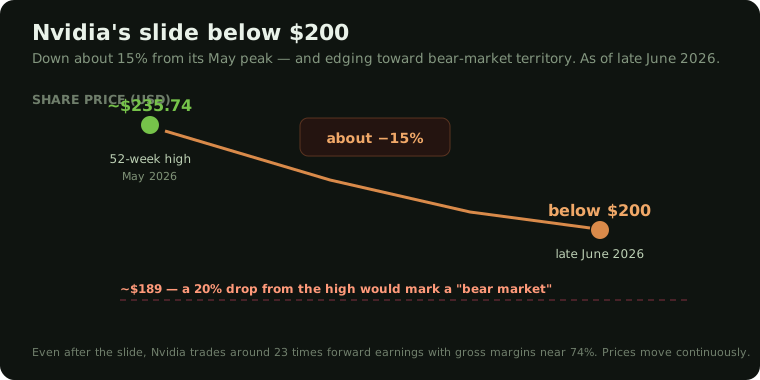
At around the $200 mark, the stock sits roughly 15% below its 52-week high. A further drop of about 5%, to near $189, would put it 20% below that peak — the traditional definition of a bear market. Yet it’s worth keeping perspective: even after the decline, Nvidia still trades at roughly 23 times forward earnings, with gross margins near 74%, and remains up on the year. In other words, this is a pullback from extraordinary highs, not a sign that the underlying business has broken.
Why is Nvidia stock falling?
Several pressures have combined at once, and competition is only one of them. Alongside the competition fears, a more hawkish interest-rate outlook has made investors warier of expensive, growth-dependent stocks, since higher rates make the debt-funded AI build-out harder to justify. Geopolitics adds another layer: export restrictions mean Nvidia expects little to no data-center revenue from China, and its business there has drawn scrutiny from US lawmakers. Rising internal costs, a broader “valuation reset” across AI stocks as the initial euphoria cools, and even the huge SpaceX IPO drawing investor cash elsewhere have all played a part. Tellingly, even Nvidia’s launch of its next-generation Vera Rubin platform drew only a muted market reaction — a sign that, with expectations so high, innovation alone no longer moves the stock the way it once did.
What are the competition fears about?
This is the heart of the story, and it centers on a specific shift: Nvidia’s biggest customers increasingly want to reduce their reliance on it.
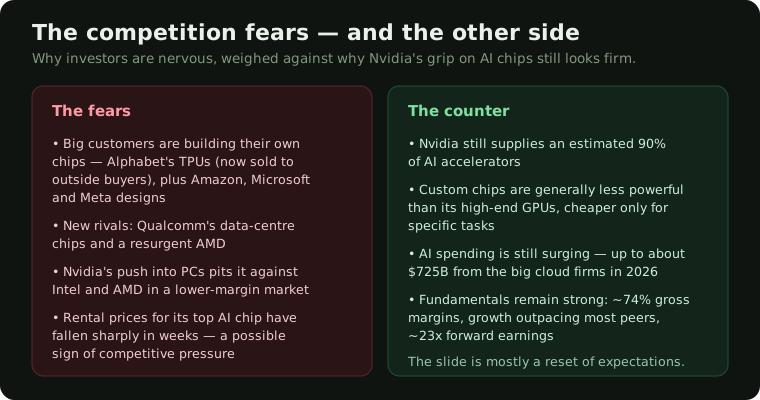
The most prominent worry is custom, in-house chips. Alphabet has been promoting its own Tensor Processing Units (TPUs) as an alternative to Nvidia’s GPUs, and has begun selling them directly to select customers — news that helped send Alphabet’s shares up around 10% and its market value above $4.65 trillion, closing in on Nvidia. Amazon, Microsoft, and Meta are all developing proprietary AI chips too. Beyond the cloud giants, Qualcomm has launched new AI data-center chips, and AMD remains a persistent rival. Adding to the unease, Nvidia’s own move into the PC market with a new processor pushes it into direct competition with Intel and AMD in a mature, lower-margin business. And the rental price of Nvidia’s flagship AI chip has fallen sharply over just a few weeks, which some read as an early sign of competitive pressure on pricing.
Are the competition fears justified?
The honest answer is that the threat is real but easy to overstate, so here’s both sides plainly. On the bearish side, the push toward custom chips is genuine: hyperscalers have every incentive to lower costs and reduce dependence on a single supplier, and Nvidia’s stretched valuation leaves little room for any slip in growth. On the bullish side, Nvidia still captures around 90% of AI accelerator demand, and the custom chips emerging as alternatives are generally less powerful than its high-end GPUs, offering savings only for specific workloads rather than replacing Nvidia wholesale. Crucially, the overall pie is still growing fast: the largest cloud companies are projected to spend up to roughly $725 billion on AI infrastructure in 2026, and Nvidia remains the central beneficiary. Its fundamentals — strong revenue growth, high margins, a reasonable forward valuation for a market leader — remain intact. The fairest read is that the recent slide reflects a reset of sky-high expectations and a rotation of investor money, more than evidence that Nvidia’s position is actually crumbling.
Is Nvidia in trouble?
By the numbers, no — at least not yet. According to its most recent results, Nvidia’s revenue growth continues to outpace most large technology peers, and AI spending remains elevated. A deeper decline would likely require one of a few things to actually happen: AI infrastructure spending slowing materially, customers delaying chip purchases, or earnings growth falling short of expectations — none of which has shown up in the reported figures so far. That doesn’t mean the stock can’t keep falling; markets can push prices below fair value for a while when sentiment sours, and a slide into technical bear-market territory is entirely possible. But there’s a meaningful difference between a stock being re-rated by nervous investors and a company whose business is deteriorating. For now, Nvidia is firmly in the former camp.
The bottom line
Nvidia slipped below $200 because investors are reassessing a very high bar, with competition from custom AI chips, a tougher rate environment, and geopolitical friction all weighing on sentiment. The competition threat is worth watching, but it hasn’t yet dented Nvidia’s roughly 90% grip on AI accelerators or the surging spending that drives its business. The slide looks more like a cooling of extraordinary expectations than a verdict on the company itself — and where it goes next will hinge on whether AI spending holds up, not on a single quarter’s mood.
For more market context, see our coverage of Micron’s record earnings and the great rotation into AI hardware .
This article is news and general context, not investment advice, and does not recommend buying or selling any security. Prices and figures are as of late June 2026 and change continuously; analysts disagree about the outlook, and past performance does not predict future results.