Why MSTR, PLTR, and NFLX Stocks Fell to 52-Week Lows

Strategy (MSTR), Palantir (PLTR), and Netflix (NFLX) all touched fresh 52-week lows on June 24, 2026, as investors rotated out of high-growth, momentum-driven stocks and into AI chipmakers. But it’s worth being precise here, because the headline grouping flattens an important difference: the three did not fall anywhere near equally. MSTR dropped about 9%, PLTR about 3%, and NFLX only about 1.35% — and each declined largely for its own reasons. Here’s what really drove each stock, and the common thread that ties them together. (This is news and context, not investment advice — see the note at the end.)
What happened to MSTR, PLTR, and NFLX?
All three shared a backdrop: a broad market rotation on June 24 saw investors take profits in expensive, fast-growing names and shift money toward semiconductor and AI-hardware stocks. That pushed all three to annual lows on the same day. But the magnitude of the moves was very different.
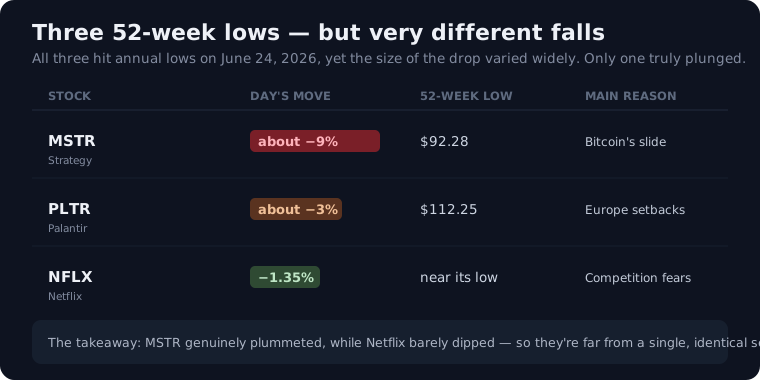
| Stock | Day’s move | 52-week low | Main reason |
|---|---|---|---|
| MSTR (Strategy) | about −9% | $92.28 | Bitcoin’s slide |
| PLTR (Palantir) | about −3% | $112.25 | Europe setbacks + rotation |
| NFLX (Netflix) | about −1.35% | near its low | Competition concerns |
As the table shows, only MSTR genuinely plunged, while Netflix’s decline was modest. Calling all three a single dramatic sell-off overstates what happened to two of them — so it’s more accurate to treat this as one shared backdrop with three separate stories.
Why did MSTR (Strategy) stock fall?
Strategy was by far the biggest faller, and the reason is straightforward: the company is effectively a proxy for Bitcoin. It holds a massive Bitcoin position — roughly 847,000 coins worth about $53 billion — so its share price tends to swing with the cryptocurrency. On June 24, Bitcoin fell below $60,000, its lowest level since October 2024, and Strategy’s stock dropped about 9% to a 52-week low of $92.28, its weakest in more than two years and a sixth straight session of declines. Compounding the pressure are concerns about how the company funds its Bitcoin buying: a preferred-stock vehicle it has relied on slipped below its $100 face value, raising its financing costs, and the company recently made a small, symbolic Bitcoin sale that ran counter to its long-standing pledge never to sell.
Why did PLTR (Palantir) stock fall?
Palantir’s roughly 3% decline to a 52-week low of $112.25 had two layers. The first was the same market-wide rotation out of high-growth names, which hit Palantir hard given its premium valuation — the stock had already fallen sharply over the month. The second was company-specific and centered on Europe. France’s domestic intelligence agency recently replaced Palantir’s software with local alternatives, part of a stated push to reduce reliance on American data and AI companies and build “digital sovereignty.” On top of that, lawmakers in the UK have been pressing to end Palantir’s contract with the country’s National Health Service. Together, those regulatory and contract setbacks added a layer of pressure specific to Palantir on top of the broader sell-off.
Why did NFLX (Netflix) stock fall?
Netflix is the one that least fits the “plummet” description. Its shares slipped only about 1.35%, bringing it near its own 52-week low rather than crashing through it. The pressure came from a mix of mounting concerns about competition in the streaming market and setbacks on the acquisition front, layered on top of the same broad rotation affecting growth stocks. It’s a meaningful decline in the context of a stock near its annual low, but it’s a modest one-day move, and lumping it in with Strategy’s near-double-digit drop gives a misleading impression of what actually happened.
What’s the common thread?
The unifying factor is the rotation itself.
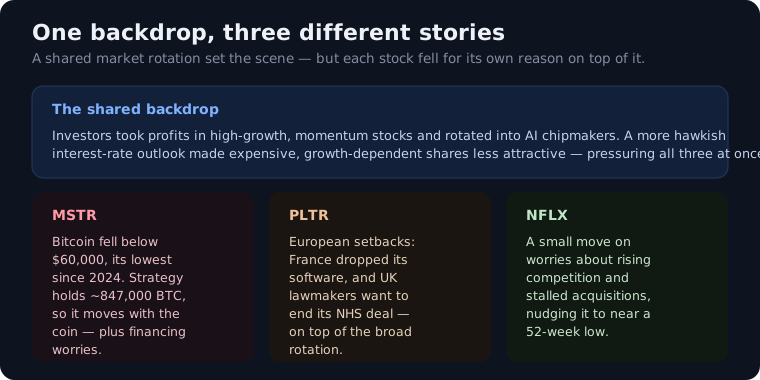
After a long run in high-flying growth and momentum stocks, investors have been taking profits and moving money into AI chipmakers and semiconductors, the part of the market currently capturing the most enthusiasm. A more hawkish interest-rate outlook reinforces this, because higher rates make expensive, growth-dependent shares less appealing relative to safer returns elsewhere. That shared backdrop is why three very different companies — a Bitcoin-holding software firm, a defense-and-data-analytics company, and a streaming giant — all landed at 52-week lows on the same day. But the rotation only set the stage; each stock’s own catalyst, from Bitcoin’s drop to Palantir’s European losses, determined how far it actually fell.
The bottom line
MSTR, PLTR, and NFLX all hit 52-week lows on June 24, 2026, driven by a common rotation out of momentum stocks into AI chips — but the moves ranged from a roughly 9% plunge for Strategy to a modest 1.35% dip for Netflix, each for largely separate reasons. The lesson is to look past a shared headline: stocks that fall on the same day often do so for very different causes, and the size of the move matters as much as the direction.
For more market context, see our explainers on why Bitcoin fell below $60,000 and the great rotation into AI hardware .
This article is news and general context, not investment advice, and does not recommend buying or selling any security. Prices and figures are as of June 24, 2026 and change continuously; analysts disagree about the outlook, and past performance does not predict future results.