Why Is Russia Threatening the UK? What Was Actually Said, and What Britain Did Next
This describes a diplomatic exchange in late August 2026 and the UK measures announced around it. Statements and announcements in this area move quickly; from late September the page needs re-checking against gov.uk before it can be relied on as current.
Everything else on the page is unaffected; the figures below still say when they were read.

- The statement came from the Russian embassy in London on Monday 18 August 2026, not from the Kremlin, the Russian foreign ministry or its defence ministry. That distinction matters for how much weight it carries.
- Its central line: ‘London’s actions will inevitably carry consequences for which it will have to answer.’ It also said the deeper Britain’s involvement, ’the higher the price it will pay’.
- It was responding to reports that Ukraine had used long-range drones made by British companies in strikes on Russian targets, including oil refineries and logistics facilities.
- Six days later the UK went further rather than back. On 24 August the government cleared MBDA to release classified data on UK components of the SCALP missile so Ukraine can assemble them locally, and signed an AI partnership giving Britain access to Ukraine’s battlefield sensor archive.
- No UK government release we could find responds to the Russian statement directly. The Prime Minister’s line from Kyiv was ‘Russia should be in no doubt of our resolve’ — a statement of position, not a reply.
On Monday 18 August 2026 the Russian embassy in London issued a statement warning that Britain faces “consequences” over British-made drones used in strikes inside Russia.
Six days later, the UK went further rather than backing off. On 24 August the Prime Minister flew to Kyiv and released classified data on a British missile component so Ukraine can build them itself.
Here is exactly what was said, by whom, and what happened next — with no assessment of risk attached, because none is available from the sources.
What did Russia actually say?
Four sentences, quoted here in full because the wording is the story and paraphrase would soften it:
“London’s actions will inevitably carry consequences for which it will have to answer.”
“The deeper its involvement in the conflict and the greater its support for Kiev’s terrorist machinery, the higher the price it will pay.”
“London is deliberately opting for an escalation of the Ukraine crisis, while hypocritically professing a desire for peace.”
“In doing so, the United Kingdom is acting as an accomplice and co-perpetrator of the bloody crimes and terrorist attacks.”
Those are the Russian government’s characterisations, not descriptions this page accepts. They are reproduced because readers asking what was said deserve the actual words rather than a summary of them.
Note what the statement does not contain: no specific action, no deadline, no named target, no capability. “Consequences” and “price” are unspecified. That is a normal feature of statements of this kind, and it is why quoting them precisely matters more than characterising them.
Who said it, and does that matter?
It came from the Russian embassy in London. Not the Kremlin, not President Putin, not the Russian foreign ministry in Moscow, and not its defence ministry.
That distinction is real. An embassy statement is the lowest rung of the ladder on which official positions are communicated — it is a diplomatic mission responding to events in its host country. The same message from the Kremlin, or delivered by summoning an ambassador, would carry different weight, and would normally prompt a different kind of response.
We could not read the statement on the embassy’s own channel, so what appears above is quoted from news reporting. Multiple outlets carry the same wording and the same date, which is why it is used here — but it is second-hand, and this page does not pretend otherwise.
What was it responding to?
Reports that Ukraine used long-range drones made by British companies in strikes on Russian targets — including oil refineries and logistics facilities.
That is the trigger the statement itself points at. It sits on top of a longer sequence of British support for Ukraine:
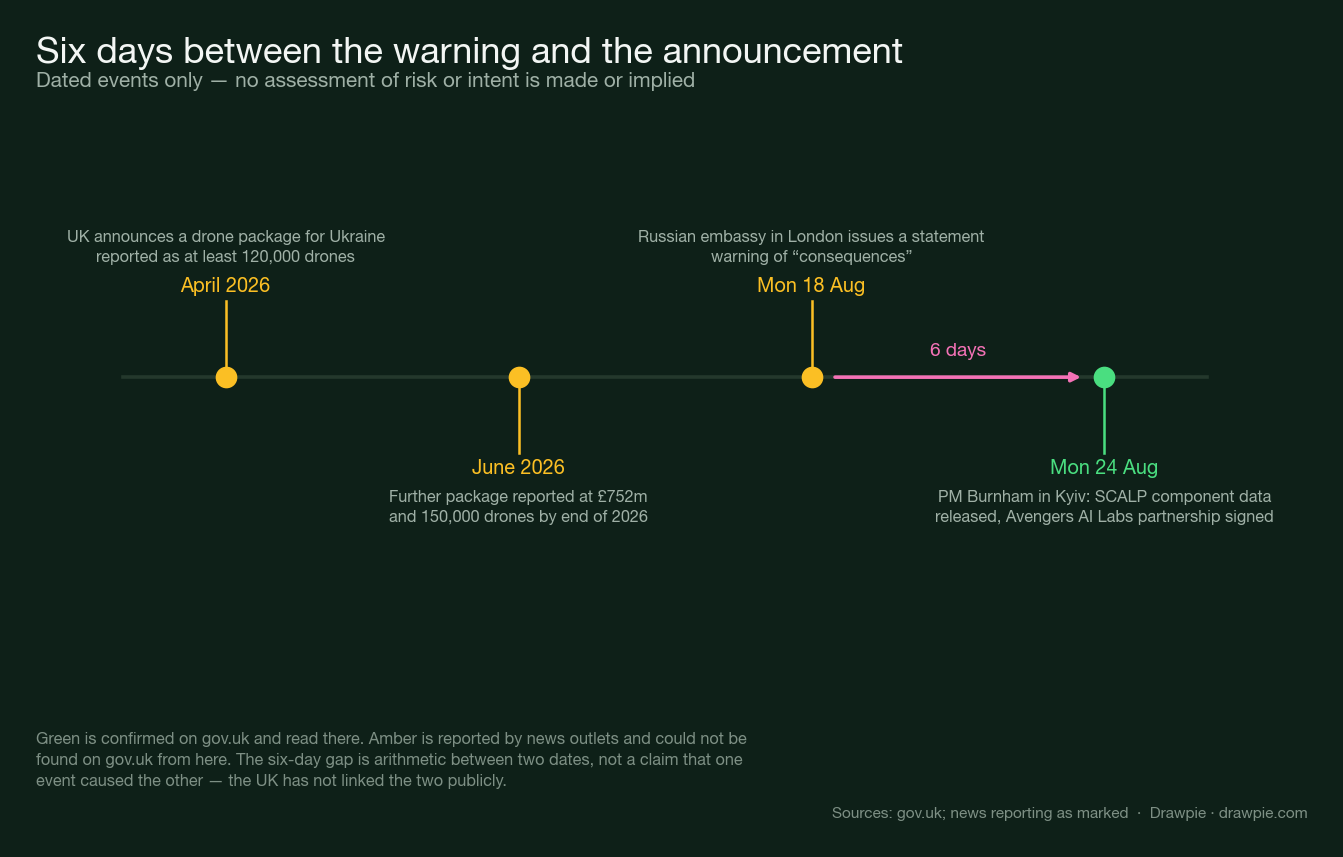
Two of those points need a caveat, and it is the same caveat both times.
How much has Britain actually sent?
Less certainly than most coverage implies — not because the figures are doubted, but because we could not verify them at source.
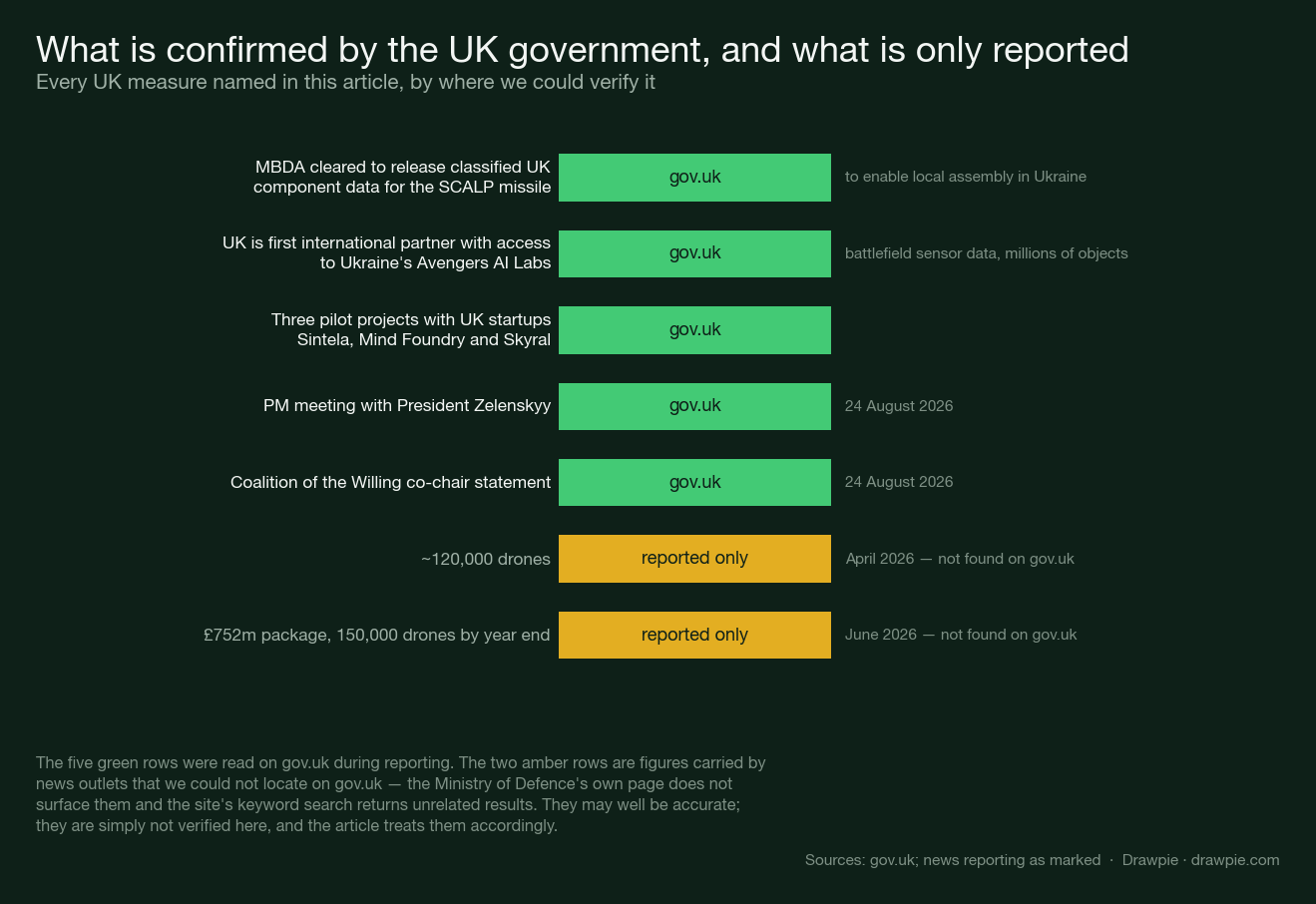
| Measure | Where we verified it |
|---|---|
| MBDA cleared to release SCALP component data | gov.uk |
| Access to Ukraine’s Avengers AI Labs | gov.uk |
| Pilots with Sintela, Mind Foundry, Skyral | gov.uk |
| Meeting with President Zelenskyy | gov.uk |
| Coalition of the Willing statement | gov.uk |
| ~120,000 drones, April 2026 | reported only |
| £752m and 150,000 drones by year end, June 2026 | reported only |
The two drone figures are the ones everyone quotes and the two we could not find on gov.uk. The Ministry of Defence’s own page does not surface them and the site’s search returns unrelated results. They are probably right. They are not confirmed here, and a page about what was actually said should be equally careful about what was actually sent.
How did the UK respond?
It did not, in the sense of issuing a reply. No UK government release we could find addresses the Russian statement directly.
What the Prime Minister said in Kyiv on 24 August was a statement of position rather than a rebuttal:
“Russia should be in no doubt of our resolve. We will not back down until there is a just and lasting peace.”
Reporting also quotes Andy Burnham saying Britain would continue supporting Ukraine “100 percent”.
A note on one line you may have seen. Widely circulated coverage attributes the phrase “outrageous threats” to the Prime Minister, along with a missile range of about 150 miles. Neither appears on the gov.uk release, and neither is used here. That is not a claim that he never said it — only that we could not source it where it should be.
What did the UK announce six days later?
Two things, both on 24 August 2026, both confirmed on gov.uk.
Missile components. The government agreed that MBDA can release classified information on UK components for the long-range SCALP cruise missile — with the stated purpose of establishing local assembly lines in Ukraine. That is a step beyond supplying weapons: it is enabling their production.
Battlefield data. The UK became the first international partner with access to Ukraine’s Avengers AI Labs — a database built from, in the release’s own words, “thousands of daylight cameras and infrared sensors across the battlefield in Ukraine”, capturing “millions of objects, such as tanks, artillery, air defence systems, infantry, and aerial targets, including Shahed drones and reconnaissance UAVs”.
Three pilot projects were launched with British startups Sintela, Mind Foundry and Skyral.
Defence Secretary Wes Streeting framed it in the release as: “Ukraine is pushing the frontier of defence innovation as they bravely resist Putin’s illegal invasion.”
The release does not mention Russian threats to the UK at all. It was published six days after the embassy statement and does not acknowledge it.
What this page does not tell you
Being explicit about the gaps, because on this subject the gaps are where the harm usually happens:
Whether there is any increased risk to anyone in the UK. Nothing in the sourcing supports an answer, and this page does not offer one. A statement warning of unspecified consequences is a diplomatic act; converting it into a personal risk assessment would require information we do not have and expertise this page does not claim.
Whether the 24 August announcements were a response. They came six days later. The UK has not linked them publicly. Both things are true and neither implies the other.
What “consequences” means. The statement does not say, and neither will we.
What Russia will do. No forecast appears anywhere on this page.
Sources
| Source | Used for |
|---|---|
| gov.uk — Prime Minister Andy Burnham visits Kyiv, 24 August 2026 | The visit date, the “Russia should be in no doubt of our resolve” quote, and the MBDA/SCALP clearance |
| gov.uk — UK and Ukraine AI partnership and Avengers AI Labs, 24 August 2026 | The Avengers AI Labs access and its description, the three UK startups, and the Defence Secretary’s quote |
| gov.uk — PM meeting with President Zelenskyy, 24 August 2026 | The meeting, as one of the dated 24 August items |
| gov.uk — Co-chair’s statement of the Coalition of the Willing, 24 August 2026 | The statement, as one of the dated 24 August items |
| Al Jazeera — Why is Russia threatening UK with ‘consequences’ over Ukraine drones, 18 August 2026 | The four quoted sentences from the Russian embassy statement, its date, what it was responding to, the “100 percent” line, and the two reported drone packages |
How we verified this
🔴 This page makes no assessment of risk to anyone in the UK, and no prediction about what Russia will or will not do. It sets out who said what, when, in response to what, and what the UK announced afterwards. A diplomatic statement is not a forecast and should not be rendered as one — which is also why neither chart on this page carries a threat level, a risk scale or an escalation ladder.
✅ The UK measures of 24 August 2026 were read on gov.uk, not taken from reporting: the Prime Minister’s Kyiv visit release, the UK–Ukraine AI partnership release, the meeting readout with President Zelenskyy and the Coalition of the Willing co-chair statement. The MBDA/SCALP clearance and the Avengers AI Labs access are quoted from those pages.
⚠️ The Russian statement is quoted from news reporting, not from a primary Russian source. We did not read it on the Russian embassy’s own channel. It is carried consistently by multiple outlets — Al Jazeera, Bloomberg, Time and others — reporting the same wording and the same date, which is why it is used, but it is second-hand and labelled as such throughout.
⚠️ Two figures in this article could not be verified on gov.uk and are marked in both charts. The reported April 2026 package of at least 120,000 drones and the reported June 2026 package of £752m and 150,000 drones by year end are carried by news outlets; the Ministry of Defence’s own gov.uk page does not surface them and the site’s keyword search returns unrelated results. They may well be accurate. They are not verified here, and the second chart exists specifically so a reader can see which claims sit on which footing.
🔴 The six-day gap is arithmetic between two dates, not a causal claim. The UK has not publicly linked its 24 August announcements to the 18 August statement, and this page does not either. Both facts are dated; the sequence is what it is.
⚠️ Russian characterisations are quoted, not adopted. The statement’s descriptions of Ukraine and of British conduct are that government’s language and appear in quotation marks with attribution. Quoting them is not endorsing them, and no claim inside them is treated as established fact.
A correction made during reporting. An early draft carried a widely circulated line that the Prime Minister called the statement “outrageous threats”, and a missile range figure of about 150 miles. Neither appears on the gov.uk release. Both were removed.