Why Bitcoin Fell Below $60,000 — and Why No Formula Predicts It

Bitcoin fell below $60,000 on June 24, 2026, closing near $59,000 — roughly half its October 2025 record high, and its weakest level since late 2024. The immediate story is a rotation of money out of crypto and into stocks, particularly the AI and chip names investors see as offering better near-term returns. But the full picture involves several forces at once. And because people often go looking for a “mathematical model” to explain or predict moves like this, it’s worth being honest up front: there isn’t a reliable one. Here’s what’s actually driving the decline, and why precise formulas and price targets are false comfort. (This is news and context, not investment advice — see the note at the end.)
How far has Bitcoin fallen?
After peaking near $126,272 in October 2025, Bitcoin has lost roughly half its value.
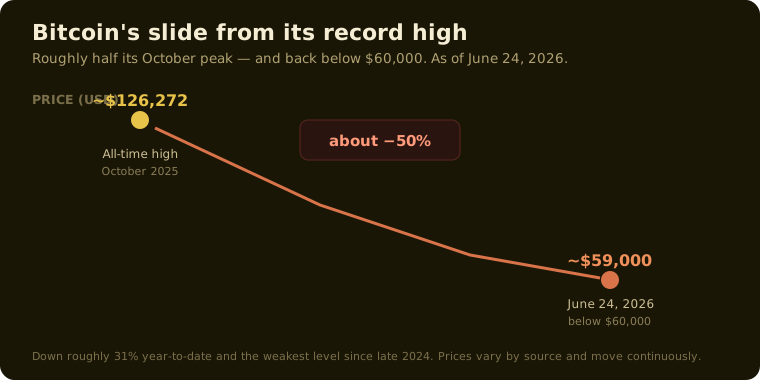
It dropped below the $60,000 mark on June 24 — the second time it has done so this month — and is down about 31% year-to-date. Prices vary slightly by exchange and by the hour, but the broad picture is clear: a deep, sustained slide from the record set just eight months earlier. By most reasonable definitions, a fall of that magnitude puts Bitcoin in a bear market.
Why is Bitcoin falling?
There’s no single cause. Instead, several forces have lined up in the same direction.
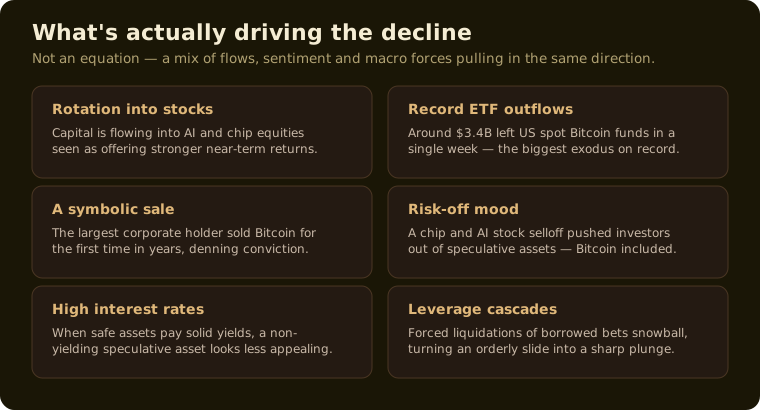
The headline driver is a rotation into stocks: institutional money has been flowing toward AI and semiconductor equities that are seen as offering stronger near-term gains than crypto. On top of that, US spot Bitcoin ETFs have suffered record outflows — around $3.4 billion in a single week, the largest on record — removing a key source of steady buying. Confidence took a further knock when the largest corporate holder of Bitcoin sold a portion of its stake for the first time in years, a symbolic blow to the “never sell” conviction that had defined the most committed holders. A broader risk-off mood, triggered by a sharp selloff in chip and AI stocks, pushed investors out of speculative assets generally. High interest rates make a non-yielding asset less attractive when safe alternatives pay well. And because much crypto trading uses borrowed money, falling prices forced waves of leveraged positions to close, amplifying the drop.
Is Bitcoin still “digital gold”?
This decline has undercut one of Bitcoin’s most popular narratives. Rather than holding its value during market stress like a safe haven, Bitcoin has been falling in step with speculative technology stocks — behaving like a risk asset, not a hedge. Notably, it dropped alongside gold and oil as the so-called “debasement trade” (betting on hard assets amid worries about government debt and currencies) unwound. For anyone who held Bitcoin expecting it to act as insurance when other markets wobble, recent evidence points the other way.
Is there a mathematical model that explains Bitcoin’s drop?
This is the question many people ask, hoping for a formula that makes the chaos legible — so here’s a straight answer: no validated mathematical model reliably explains or predicts Bitcoin’s price. That isn’t a gap waiting to be filled; it reflects what actually moves the asset. Bitcoin’s price is driven by investor sentiment, fund flows, leverage, and external shocks — things that resist being reduced to a tidy equation. The market is also reflexive: it reacts to its own movements, so a drop triggers liquidations that cause further drops, a feedback loop no static formula captures.
You’ll see a great deal of confident-looking math around Bitcoin anyway — specific “support levels,” Fibonacci targets, moving-average crossovers, on-chain price floors, and prediction-market odds. It’s worth understanding these for what they are: descriptive heuristics and educated guesses, not predictive laws. They frequently contradict one another, and many recent ones simply turned out wrong. Treating any of them as a precise forecast mistakes a story for a model. The honest framing is that we can explain the forces pushing Bitcoin around far better than we can predict its next price — and anyone selling you an exact target or formula is offering false precision.
What could happen next?
Following from that, the honest answer is that nobody knows. Bitcoin’s direction depends on the same qualitative forces now weighing on it: whether fund outflows reverse, whether the AI-stock rally cools and money rotates back, and whether interest rates start to fall. Analysts and prediction markets disagree widely about where it goes from here, which is itself a useful signal about how uncertain the situation is. What’s reasonably safe to say is that Bitcoin remains highly volatile and is, for now, trading as a risk asset tied to the broader market mood rather than moving to its own beat.
The bottom line
Bitcoin fell below $60,000 because money rotated into stocks, ETF investors pulled out in record amounts, a major holder sold, and a risk-off mood took hold — all amplified by leverage. It’s a textbook reminder that Bitcoin behaves like a speculative risk asset, not a safe haven. And while it’s tempting to want a formula that predicts the next move, the reality is that the forces driving it can be explained but not reliably modeled. Understanding those forces is far more valuable than chasing a price target.
For more market context, see our explainers on the great rotation into AI hardware and why the gold price fell .
This article is news and general context, not investment advice, and does not recommend buying or selling any asset. Prices are as of June 24, 2026 and change continuously; cryptocurrency is highly volatile and you can lose money. Past performance does not predict future results.