What Caused the Venezuela Earthquake? The Science Behind the 2026 Disaster

On June 24, 2026, Venezuela was struck by the most powerful earthquake in its recorded history — a magnitude 7.5 mainshock that hit just 40 seconds after a magnitude 7.2 foreshock, near the northern city of San Felipe. It has killed at least 164 people and injured close to a thousand, with the toll expected to rise as rescue efforts continue. The underlying cause was geological: a sudden slip along the boundary where the Caribbean tectonic plate grinds past the South American plate. Here’s the science behind why it happened, explained clearly.
What caused the Venezuela earthquake?
The earthquake was caused by movement along the boundary between two of Earth’s tectonic plates. Northern Venezuela lies where the Caribbean plate meets the South American plate, and the two are slowly grinding past each other rather than colliding head-on.
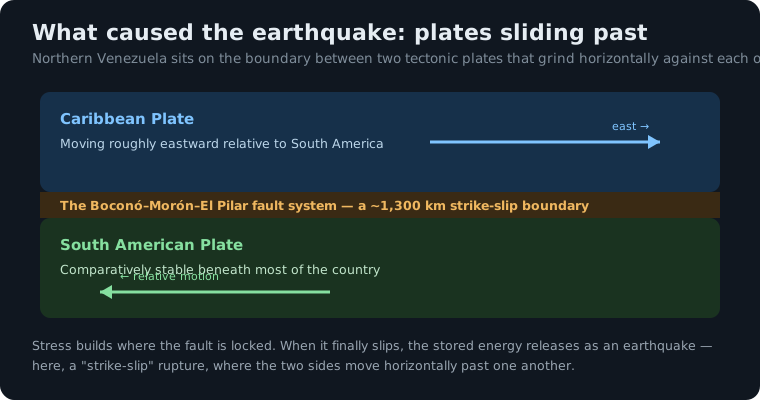
The Caribbean plate is moving roughly eastward relative to South America. Where the two plates meet, they don’t slide smoothly; friction locks sections of the fault in place while tectonic stress keeps building behind them. Eventually that stress overcomes the friction, the rock ruptures, and the stored energy is released in seconds as an earthquake. This particular rupture was a “strike-slip” earthquake, meaning the two sides of the fault moved horizontally past one another — the same type of motion seen on faults like California’s San Andreas.
Where is the fault that caused it?
The rupture occurred along the Boconó–Morón–El Pilar fault system, the major fault zone that defines this plate boundary.
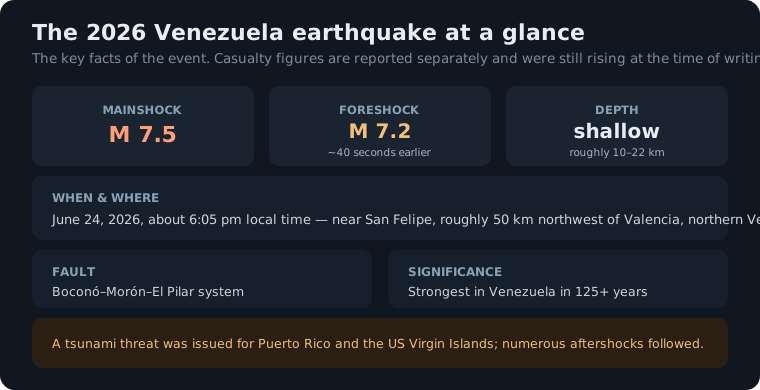
This is a roughly 1,300-kilometer-long series of strike-slip faults that runs across northern Venezuela, from the Andes in the west, along the north-central and northeastern coast, and out toward Trinidad. The western part of the country, where this earthquake struck, sits within a complex triangle formed by three fault systems: the Boconó fault to the south, the Oca–Ancón fault to the north, and the Bucaramanga–Santa Marta fault to the west. The mainshock was relatively shallow, at a depth of around 10 to 22 kilometers. That shallowness matters, because earthquakes closer to the surface tend to shake the ground above them more violently than deeper ones of the same magnitude.
Why was this earthquake so powerful and destructive?
Several factors combined to make this event so severe. First, the sheer magnitude: at 7.5, it was the strongest earthquake to hit Venezuela in more than 125 years, releasing an enormous amount of energy. Second, its shallow depth concentrated that energy near the surface, intensifying the shaking in populated areas. Third, the close foreshock-mainshock sequence — a strong 7.2 quake immediately followed by the larger 7.5 — struck buildings in rapid succession, leaving little respite. The shaking was strong enough that a tsunami threat was issued for Puerto Rico and the US Virgin Islands, and numerous aftershocks followed in the hours afterward. Building vulnerability also plays a role in any major quake: structures not engineered to withstand strong shaking are far more likely to fail.
Has Venezuela had earthquakes like this before?
Yes — the region is seismically active, though an earthquake this large is rare. The faults that caused this disaster have ruptured before, with the Boconó fault responsible for significant historical earthquakes including events in 1610 and 1894. On average, the area around Venezuela experiences dozens of magnitude-4-or-greater earthquakes every year, a reflection of the constant tectonic stress along this plate boundary. What made June 24 exceptional was the magnitude: while smaller tremors are common, a 7.5 is the most powerful the country has recorded since around 1900, which is part of why the damage has been so extensive.
What is the current situation?
As of June 25, 2026, the situation remains serious and is still developing. Authorities have reported at least 164 deaths and close to a thousand injuries nationwide, and officials have cautioned that these numbers are expected to rise as search-and-rescue teams reach more areas. The coastal state of La Guaira, which appears to have suffered some of the worst damage, has been declared a disaster zone, and buildings collapsed in Caracas and several other states. The country’s main international airport near Caracas was damaged, disrupting flights, and international search-and-rescue assistance has begun arriving to support local efforts. Because this is an unfolding emergency, the figures and details here reflect what was confirmed at the time of writing and will continue to change.
The bottom line
The 2026 Venezuela earthquake was caused by strike-slip faulting along the Boconó–Morón–El Pilar fault system, where the Caribbean plate slides eastward past the South American plate. A shallow, magnitude 7.5 rupture — the strongest in the country in over a century — produced violent shaking that has caused widespread destruction and significant loss of life. While the geological forces behind it are well understood, the human impact is still being measured, and the priority on the ground remains rescue and relief.
This article explains the geological causes of the earthquake. It reflects information confirmed as of June 25, 2026; casualty figures and other details were still changing as the situation developed. For emergency information, official sources and local authorities should be consulted.