JD Vance vs Marco Rubio 2028 Polls: GOP Primary & General Election Matchups

- JD Vance leads Marco Rubio in nearly every published 2028 Republican primary poll, and the three main averages all had him around 18 points ahead in mid-August. That average is the least interesting number here, because the polls it averages disagree violently.
- Five national polls were fielded in July 2026. Vance’s lead in them ran from 1 point to 38. Same month, same question, same party — the answer depended almost entirely on which firm you read.
- Rubio is genuinely rising: every firm that polled early and late in 2026 recorded it. They disagree on how far, from +5 points to +18, with Emerson the outlier at the top.
- In Emerson’s August poll, Rubio outperformed Vance against all four Democrats both men were tested against. Zogby’s July poll found the reverse. Neither man has filed with the FEC to run.
If you read one poll about the 2028 Republican primary, you will come away certain. If you read five, you will come away confused — and the confusion is the accurate response.
In July 2026, five national firms asked Republicans the same question. One found JD Vance ahead of Marco Rubio by a single point. Another found him ahead by 38. Nothing happened in between to explain it, because there was no in between: the fieldwork overlapped.
Here is what the polling actually supports, what it does not, and where the two men stand against the Democrats.
Who is leading the 2028 Republican primary polls?
Vance, in almost every poll taken this year. The three main polling averages were within 1.6 points of each other on 14 August, and all three had him roughly 18 points clear.
| Average | Vance | Rubio |
|---|---|---|
| Real Clear Polling | 39.8% | 21.6% |
| 270toWin | 39.6% | 20.8% |
| Race to the WH | 39.3% | 20.8% |
That agreement is misleading. Averages are stable because averaging is stabilising, not because the underlying polls agree — and here they do not.
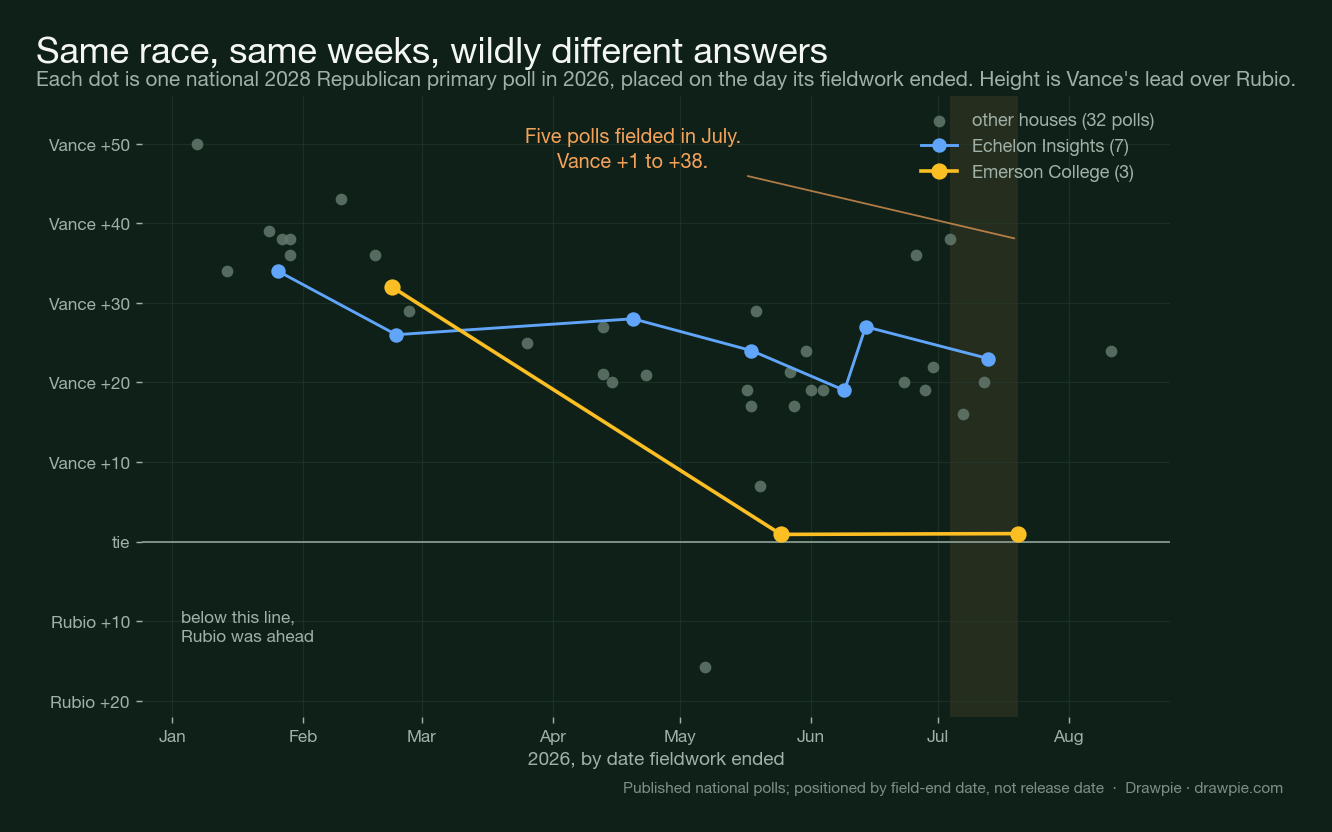
Every dot is one poll. The grey cloud is wide all year, and it does not narrow as the year goes on. Emerson, in gold, has spent since May reporting a race that is effectively tied. Echelon, in blue, has spent the same period reporting a Vance lead of twenty-odd points. Both kept polling. Neither moved towards the other.
Why do the Vance vs Rubio polls disagree so much?
Because the number depends more on which firm is asking than on when they asked. Across 2026, published national polls have put Rubio’s support anywhere from 4% to 45%. That is not a race changing; that is a measurement problem.
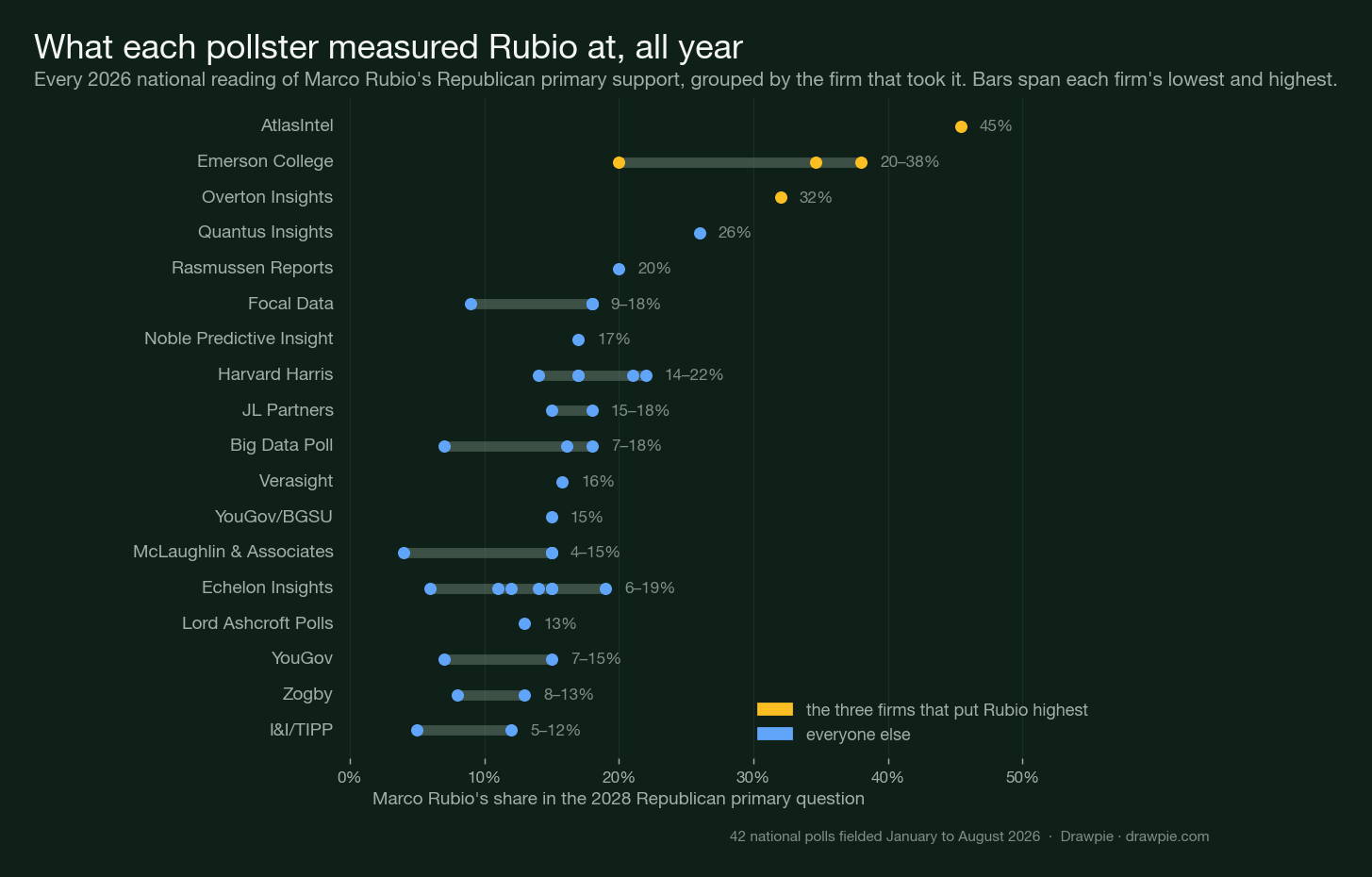
Three firms account for nearly all of the top end. AtlasIntel put Rubio at 45% in early May. Emerson has him in the mid-thirties since May. Overton had him at 32%. The other fifteen firms cluster between roughly 12% and 22%, and several of them are polling every month.
The tempting explanation is questionnaire design — that the high-Rubio firms offer shorter candidate lists, concentrating support on the two names everyone knows. That does not survive contact with the toplines. Overton’s own document lists thirteen candidates and still returned Rubio at 32%.
So the honest answer is that the spread is a house effect whose mechanism is not visible in what the firms publish. It is real, it is large, and it is not explained by the calendar.
Is Marco Rubio actually gaining on JD Vance?
Yes — and this is the one thing every firm agrees on. Comparing each firm only against itself removes the house effect entirely, and when you do that, all seven firms that polled both early and late in 2026 recorded Rubio rising. Below, each firm’s first and latest 2026 reading of Rubio’s support, and the movement between them.
| Firm | First | Latest | Change |
|---|---|---|---|
| Emerson College | 20% | 38% | +18 |
| Big Data Poll | 7% | 18% | +11 |
| McLaughlin & Associates | 4% | 15% | +11 |
| Echelon Insights | 6% | 15% | +9 |
| YouGov | 7% | 15% | +8 |
| I&I/TIPP | 5% | 12% | +7 |
| Harvard Harris | 17% | 22% | +5 |
Rubio began the year as a single-digit asterisk in most polling and is now a solid second everywhere. That is a real change and it is unanimous.
What is not unanimous is the size. Six firms put the move between 5 and 11 points. Emerson puts it at 18. Emerson is also the firm whose numbers drove most of the coverage arguing the race had become a tie — including our own reporting in July , which was built on Emerson’s May wave. The direction was right. The magnitude was one house’s.
What happens in a straight Vance vs Rubio matchup?
Only two firms have asked, and they disagree by 34 points. Overton Insights put the question to Republicans in mid-May and got Rubio 42, Vance 36, with 22% undecided. The Daily Mail’s poll, fielded on almost exactly the same days, had Vance 58 and Rubio 30.
| Poll | Vance | Rubio |
|---|---|---|
| Overton Insights, 16–20 May | 36% | 42% |
| Daily Mail / J.L. Partners, 15–19 May | 58% | 30% |
Overton’s is the one that can be checked. Its published topline gives the exact wording — “If the 2028 Republican presidential primary came down to JD Vance and Marco Rubio, who would you vote for?” — and confirms it was asked of Republicans only, so the gap is not explained by one firm polling Democrats about a Republican primary. The Daily Mail’s figures are not published on J.L. Partners’ own site and are reported here as carried rather than as verified.
The 22% undecided in Overton’s version is worth noticing on its own. When a fifth of the party has no view on a two-man contest between the vice president and the secretary of state, the contest has not started.
Who does better against the Democrats in 2028 general election polls?
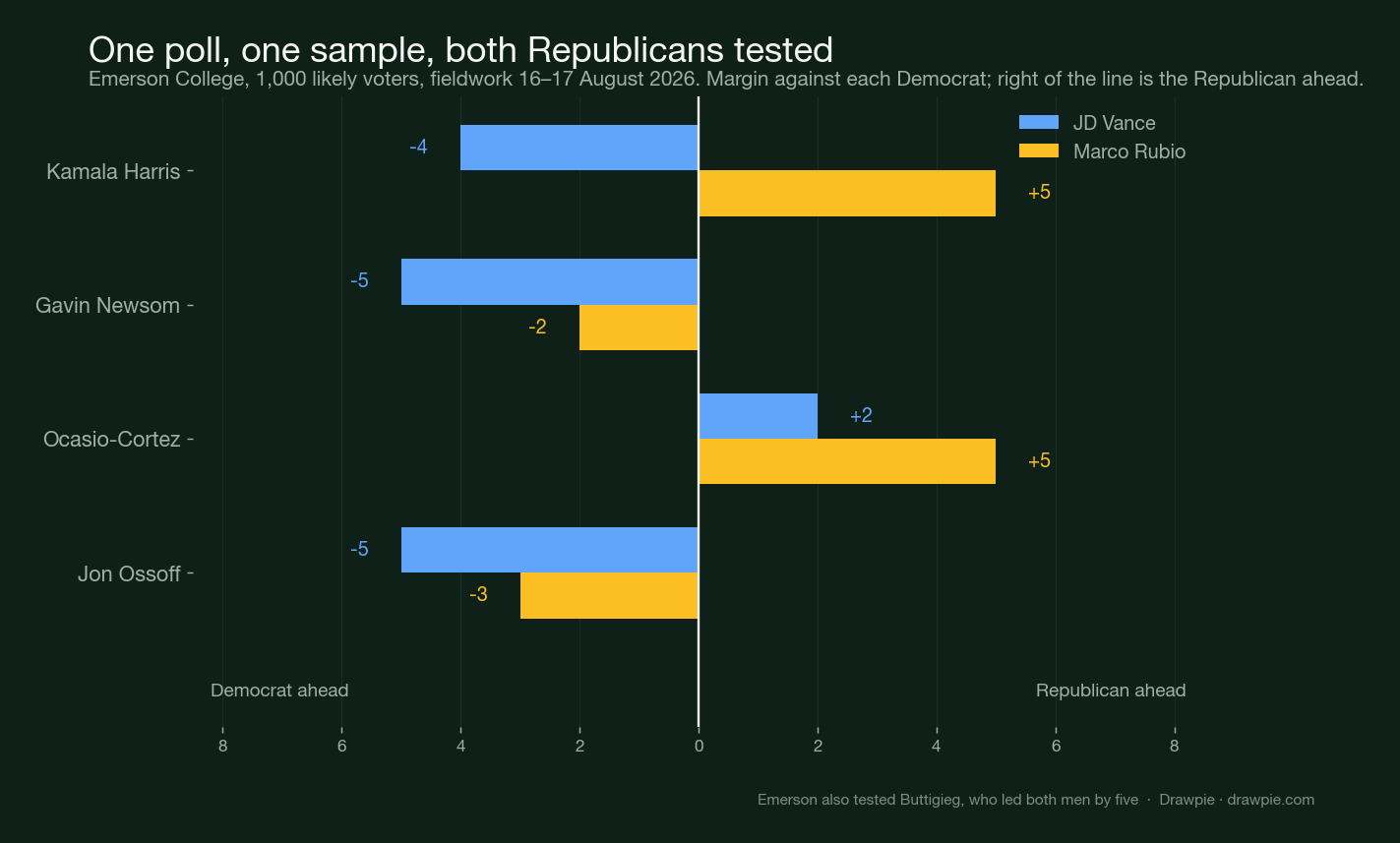
Rubio, in the only poll that tested both men against the same opponents with the same sample. Emerson fielded on 16 and 17 August among 1,000 likely voters and ran both Republicans against the same Democratic names. Its own release is headed “Rubio Outperforms Vance on 2028 Ballot Tests”.
| Emerson, 16–17 August | Vance | Rubio |
|---|---|---|
| vs Kamala Harris | −4 | +5 |
| vs Gavin Newsom | −5 | −2 |
| vs Alexandria Ocasio-Cortez | +2 | +5 |
| vs Jon Ossoff | −5 | −3 |
Rubio ran ahead of Vance against all four. In Emerson’s words, Harris “leads Vance by four points, but trails Rubio by five points”. Emerson also tested Pete Buttigieg, who led both men by the same five points.
One caveat that is easy to miss: this poll did not ask a Republican primary question at all. Emerson’s most recent primary reading is still the July one, where Vance led 39–38. The August headline is about November 2028, not about the nomination.
Do other pollsters agree that Rubio is the stronger general-election candidate?
No. Zogby ran the same exercise six weeks earlier and got the opposite result.
| Zogby, 1–4 July | Vance | Rubio |
|---|---|---|
| vs Kamala Harris | −5 | −5 |
| vs Gavin Newsom | +7 | +4 |
| vs Alexandria Ocasio-Cortez | +7 | +1 |
Morning Consult, back in November 2025, also had Vance marginally ahead of Rubio against both Harris and Newsom. So the general-election picture has the same problem as the primary one: the answer moves with the house.
What survives across all of them is narrower and duller. Both Republicans are competitive against every Democrat tested, most margins sit inside or near the margin of error, and no matchup has produced a lead larger than seven points in either direction.
Are JD Vance and Marco Rubio actually running in 2028?
Neither has filed to run. The Federal Election Commission’s candidate database has no presidential filing for JD Vance in any year, and nothing for Marco Rubio since his 2016 committee, which is long inactive.
The Republicans who have declared for 2028 are not household names. One is a television writer who wrote a Simpsons episode; the other is a former NBA player, and his FEC record shows Senate filings rather than a presidential one. There are 111 Republican presidential filers on record for 2028, almost all of them carrying a status flag that means no meaningful activity — filing costs a form, not a campaign.
Vance and Rubio sit in the category that has no legal existence at all: people who have expressed interest. Rubio has said he would support Vance if Vance runs. Vance said in May 2026 that he is not running.
What are these polls actually measuring?
Recognition, mostly, and a hypothetical. Asking Republicans to choose between names on a list three years out measures who they have heard of and who they currently feel warmly towards. It does not measure a decision anyone has made, because there is nothing yet to decide.
That is not an argument for ignoring the numbers. Rubio’s rise from 4% to the high teens is visible in every firm’s own series, which is exactly the kind of movement early polling can detect. So is the fact that no third candidate has broken double digits anywhere.
It is an argument against the way these numbers are usually reported. A single poll showing a one-point race and a single poll showing a 38-point race were taken in the same month, and both were written up as news. The useful reading is the one that holds across firms: Vance is clearly ahead, Rubio is clearly rising, and anyone quoting a precise gap is quoting their pollster.
Sources
| Source | Used for |
|---|---|
| Emerson College Polling — August 2026 national poll | The 16–17 August fieldwork, n=1,000 likely voters, ±3 credibility interval, all four general-election matchups for both men, the release headline, and the quoted line on Harris |
| Emerson College Polling — July 2026 national poll | Vance 39, Rubio 38 on the Republican ballot test, fielded 19–20 July, n=1,100 likely voters, ±2.9 |
| Overton Insights — May 2026 poll release | Vance 39, Rubio 32 in the multi-candidate primary, and the 42–36 head-to-head |
| Overton Insights — May 2026 key toplines (PDF) | The exact head-to-head wording, that it was asked of Republicans only, the 22% undecided, the thirteen-name candidate list, and N=1,377 with ±2.6 for 16–20 May |
| FEC candidate database | That neither man has a 2028 presidential filing, Rubio’s dormant 2016 committee, the 111 Republican 2028 filers and their status flags, and the declared candidates’ filing records |
| Wikipedia — nationwide 2028 Republican primary polling | Discovery of the 42 published national polls, their fieldwork dates and sample sizes, and the three polling averages |
| Wikipedia — 2028 United States presidential election | Discovery of the general-election matchup polling, the Zogby and Morning Consult figures, and the candidate-status categories |
How we verified this
🔴 The most important thing on this page is that nobody being polled about is a candidate. The FEC’s candidate database, checked on 23 August 2026, has no presidential filing of any year for JD Vance and nothing for Marco Rubio beyond his 2016 committee. Every number here is a hypothetical put to voters about a field that does not exist yet.
✅ Three readings were taken from the pollster’s own release rather than from an aggregator, because the article’s argument rests on them. Emerson’s July poll (Vance 39, Rubio 38) and its August general-election matchups were read on Emerson’s own site, along with their fieldwork dates, sample sizes and credibility intervals. Overton’s head-to-head was read in its published topline PDF. The build script that produces the chart data asserts all three and refuses to run if the parsed figures drift from them.
✅ Everything is ordered by the date fieldwork ended, never by the date a poll was released. In a field this volatile the two orderings produce different stories, and release dates can trail fieldwork by several days — Emerson’s August poll was in the field on the 16th and 17th and published on the 20th.
⚠️ One figure could not be verified at its source and is labelled where it appears. The 58–30 Vance lead in the Daily Mail’s May head-to-head does not appear on J.L. Partners’ own site, which lists no May 2026 national poll. It is reported as carried, not as verified, and no argument here depends on it.
⚠️ A poll that ranks highly for this search is not a national one. The Tarrance Group’s 47–43 Vance lead over Gavin Newsom, fielded 20–24 June, sits in the statewide section as a Nevada survey. It is not used.
⚠️ A metric was built for this piece and then thrown away. The obvious explanation for the spread is that firms offering shorter candidate lists concentrate support, so a count of names offered per poll was computed. It turned out to measure how many columns the aggregation table happens to carry, not what the questionnaire listed — Overton’s topline names thirteen candidates where the table shows four. The count was removed rather than published.
No prediction-market or betting figure appears anywhere on this page, in line with this site’s standing rule. Overton’s release states that it chose which head-to-head pairings to test on a basis other than primary standing; that is noted here for completeness, and none of the figures behind it are reproduced.