VALORANT Patch 13.01 Explained: Outlaw Nerf, Yoru & Iso Buffs, Anti-Boosting Changes

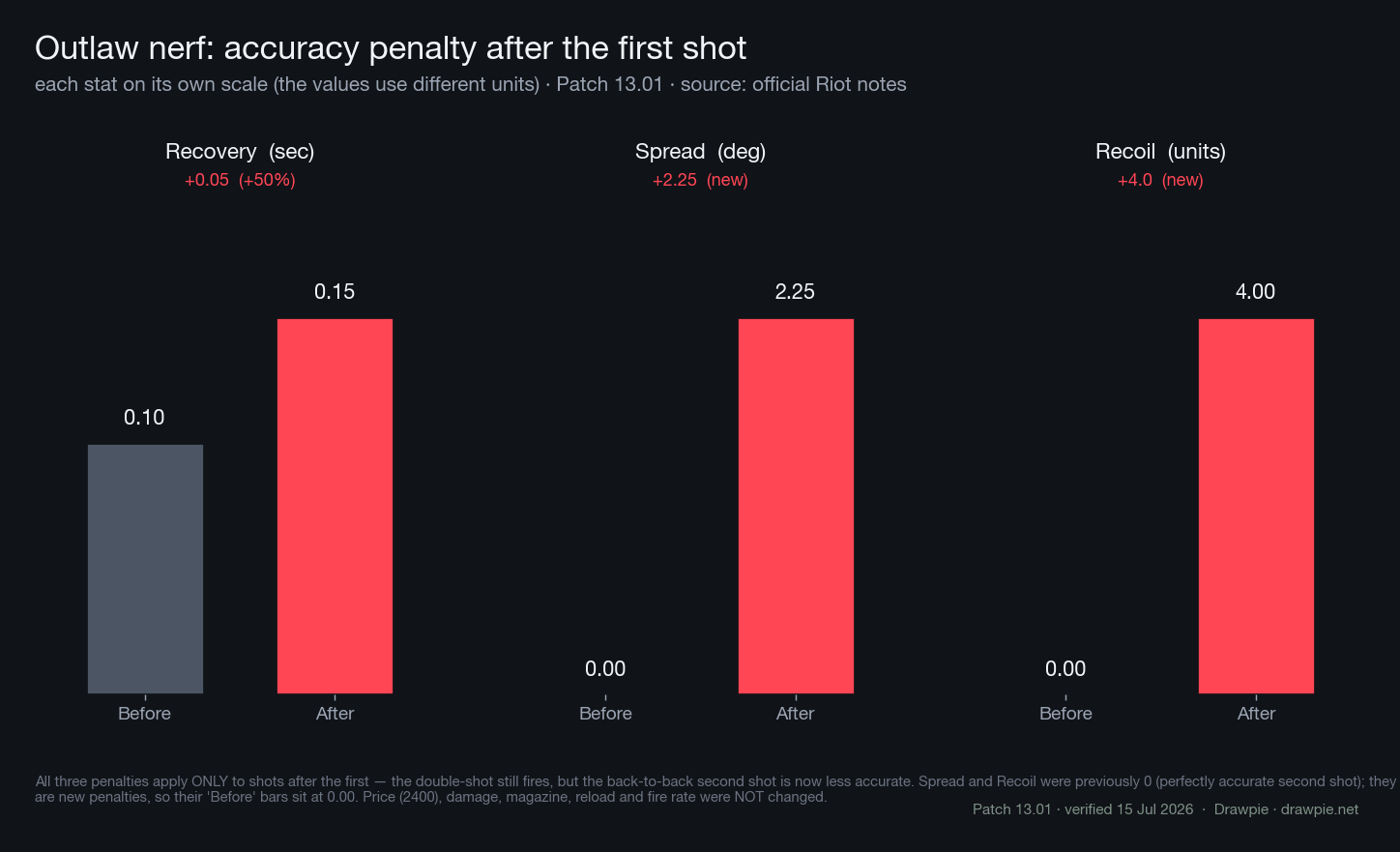
- The Outlaw was nerfed — but only after the first shot. Recovery rose from 0.1 to 0.15, Spread from 0 to 2.25, and Recoil from 0 to 4.0, so the back-to-back second shot is now less accurate. Price (2400), damage, magazine, reload and fire rate are unchanged.
- Yoru got the standout buff: Gatecrash’s Active Beacon duration went from 15 to 20 seconds (+5s, +33%), and his Fakeout clones now hold his last-equipped weapon instead of his strongest, so rifle decoys sell better.
- Iso got a quality-of-life fix — equipping a weapon right after unequipping Double Tap is now instant. Riot published no number for it.
- The headline change is systems, not balance: a new anti-boosting crackdown penalises Boosters, Boostees and Hitchhikers with suspensions, rank reversions and — for repeat abuse — permanent bans.
VALORANT Patch 13.01 is a small balance patch wrapped around one big systems change. The agent and weapon tweaks are tidy — an Outlaw nerf, a Yoru buff, an Iso quality-of-life fix — but the headline is the new anti-boosting crackdown that reaches into ranked and starts handing out suspensions and rank reversions. Here’s everything that changed, with the exact numbers.
When did Patch 13.01 drop, and what’s in it?
Patch 13.01 — the first patch of the 13.xx (2026) cycle, following Patch 13.00 — went live on 14 July 2026 (13:00 UTC). NA/LATAM/BR updated Tuesday 14 July; EU followed on Wednesday, 15 July. So if you saw “released July 15,” that’s the EU rollout, not the patch’s actual drop date.
The patch is deliberately light on content — no map changes, no new agent, no ranked-mode overhaul. What you get:
- One weapon nerf: the Outlaw.
- Two agent buffs: Yoru and Iso.
- One big Player Behavior change: the anti-boosting penalty system.
- A social-side update — Discord account linking — rolling out globally around 21 July.
The Outlaw nerf: a penalty on the second shot
The Outlaw — VALORANT’s 2,400-credit double-barrel sniper — takes a targeted nerf. Crucially, it only bites after the first shot: your opening shot is untouched, but the fast back-to-back second shot is now less accurate.
| Stat (after first shot) | Before | After | Change |
|---|---|---|---|
| Recovery | 0.1 | 0.15 | +0.05 (+50%) |
| Spread | 0 | 2.25 | new penalty |
| Recoil | 0 | 4.0 | new penalty |
Two things to read carefully off that chart:
- These are different units on different scales, which is why we plot them as three separate panels rather than one bar chart — 0.15 and 4.0 don’t belong on the same axis. Spread and Recoil were previously 0 (a perfectly accurate second shot), so those are genuinely new penalties, not tweaks.
- Nothing else about the Outlaw changed. Price stays 2,400, and damage, magazine, reserve ammo, reload time and fire rate are all untouched. The double-shot still works — you’re just punished more for spamming the follow-up instead of re-settling your aim.
The net effect: the Outlaw stays a strong long-range pick, but the “fire twice instantly and still hit” pattern is reined in.
Yoru buffs: a longer Gatecrash and smarter clones
Yoru is the clear winner of the patch. His teleport gets meaningfully more flexible.
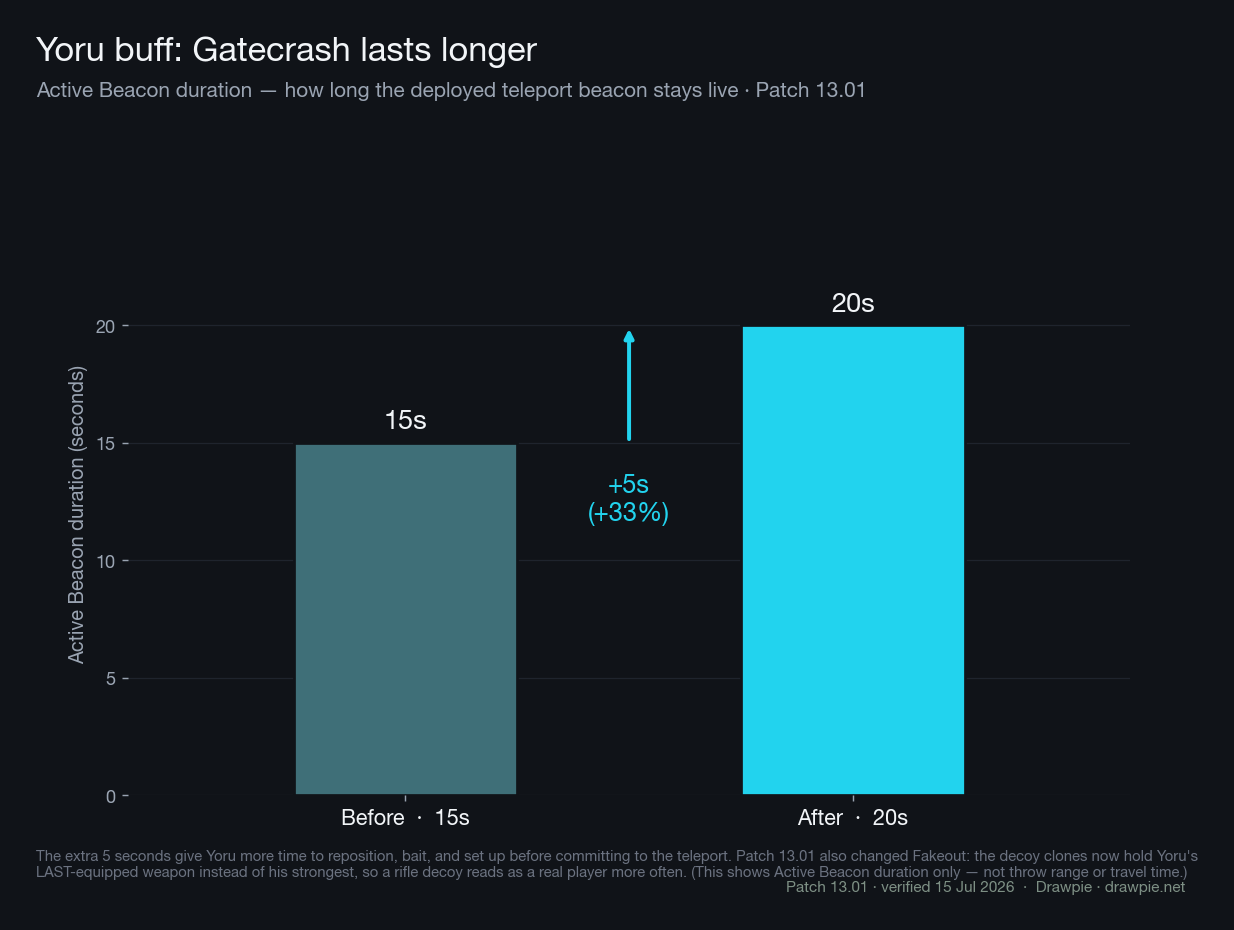
- Gatecrash (E) — Active Beacon Duration: 15s → 20s. That’s +5 seconds, a +33% increase. This is how long the deployed teleport beacon stays live before Yoru has to commit — so the buff gives him more time to reposition, bait a peek, or set up a play before he teleports. (It’s the beacon’s lifetime, not throw range or travel time.)
- Fakeout clones now hold his last-equipped weapon instead of defaulting to his strongest. A decoy holding the rifle you were just running reads as a real player far more convincingly than one that always flashes your most expensive gun.
Together these make Yoru’s information and repositioning game noticeably stronger without touching his damage.
Iso buff: an instant re-equip
Iso gets a small but welcome quality-of-life fix: equipping a weapon immediately after unequipping Double Tap is now instant, removing the previous delay. There’s no number attached here — Riot didn’t publish one, and neither do we — but if you’ve ever fumbled the swap out of Double Tap in a duel, this is the fix you wanted.
The anti-boosting crackdown — the real headline
The biggest change in 13.01 isn’t a buff or a nerf; it’s a Player Behavior systems change aimed at rank manipulation. Riot is now actively penalising boosting, and it splits offenders into three tiers:
- Boosters — players who log into someone else’s account, or intentionally lose, to inflate another player’s rank.
- Boostees — the players whose rank is being inflated.
- Hitchhikers — players who queue alongside a manipulator to farm RR off the arrangement.
The penalties escalate:
- Account suspensions.
- Rank reversions — your RR and MMR are returned to pre-boost values, and ranked rewards can be reverted too.
- Hitchhikers face rank reversion for RR gained by queuing with a manipulator.
- Permanent bans for repeat or severe abuse.
There’s also a new in-match feedback signal: you’ll be told when someone in your game has been penalised, so the enforcement is visible rather than silent. Riot says the detection is built on systems proven in League of Legends. And to be clear — legitimate solo play on your own account is fine, including climbing fast because you’re genuinely better than your current rank. The system is targeting shared accounts and coordinated manipulation, not skill.
Patch 13.01 winners and losers
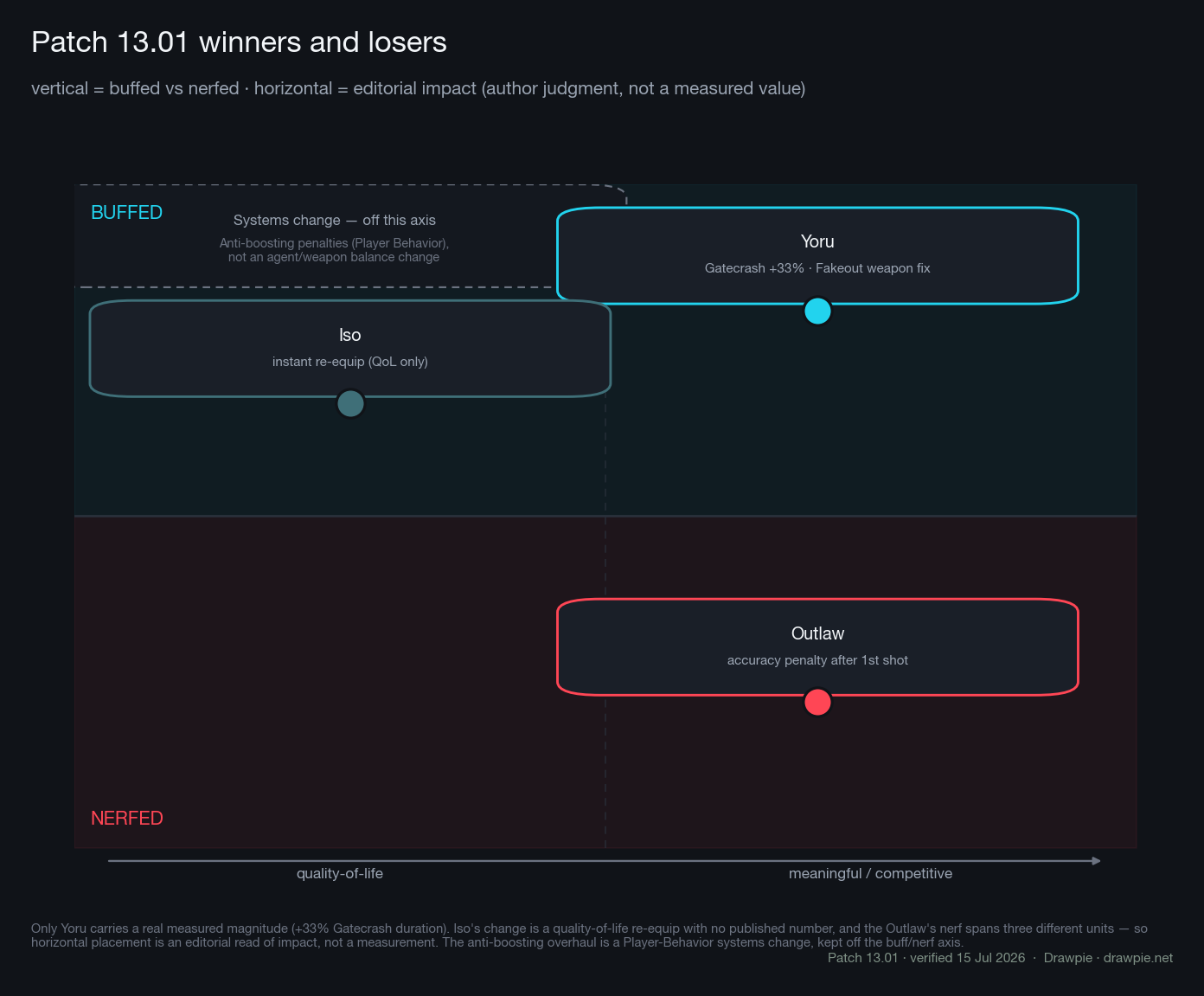
One honest caveat on that quadrant: only Yoru carries a real, measured magnitude (the +33% Gatecrash duration). Iso’s change has no published number, and the Outlaw’s nerf spans three different units — so the horizontal placement is an editorial read of impact, not a measurement. The anti-boosting overhaul sits in its own box because it’s a systems change, not an agent or weapon tweak.
Frequently asked questions
What did the Outlaw nerf actually change?
Only accuracy on shots after the first: Recovery 0.1 → 0.15, Spread 0 → 2.25, and Recoil 0 → 4.0. The opening shot is unchanged, and price, damage, magazine, reload and fire rate all stayed the same. The double-shot still works; the follow-up shot is just less accurate.
How big is the Yoru Gatecrash buff?
The Active Beacon duration went from 15 to 20 seconds — +5s, or +33%. That’s the deployed teleport beacon’s lifetime, giving Yoru more time to act before committing to the teleport. His Fakeout clones also now hold his last-equipped weapon.
What is the anti-boosting change in Patch 13.01?
A new penalty system for rank manipulation. It targets Boosters, Boostees, and Hitchhikers with account suspensions, rank/RR and MMR reversions to pre-boost values, reverted ranked rewards, and permanent bans for repeat or severe abuse. You’ll also get in-match feedback when someone in your game is penalised. Playing solo on your own account is unaffected.
Did Iso get a numeric buff?
No — his change is a quality-of-life one: re-equipping a weapon right after unequipping Double Tap is now instant. Riot didn’t publish a number for it.
When did Patch 13.01 release?
14 July 2026 for NA/LATAM/BR, with EU on 15 July. It’s the first patch of the 13.xx (2026) cycle, after Patch 13.00.
The bottom line
Patch 13.01 is a light-touch balance patch — the Outlaw’s spam-happy second shot gets reined in, Yoru’s teleport and decoys get stronger, and Iso gets a clean quality-of-life fix — sitting on top of a much bigger deal: a real anti-boosting enforcement system that can suspend accounts and roll back ranks. If you climb solo on your own account, nothing to worry about; if you’ve been buying or selling RR, this is the patch that starts to bite.
Full official notes live on Riot’s site: the VALORANT Patch 13.01 notes and the Playing Fair anti-boosting announcement .