USS Abraham Lincoln Deployment: Could It Impact the 2026 Midterms?

- The question is not whether it could reach politics — it already has. On 12 August 2026 Senator Richard Blumenthal, a member of the Senate Armed Services Committee, wrote to the Defense Secretary and the acting Navy Secretary demanding the dates of every extension to the Lincoln’s deployment, who authorised them, and what operational requirement justified each one.
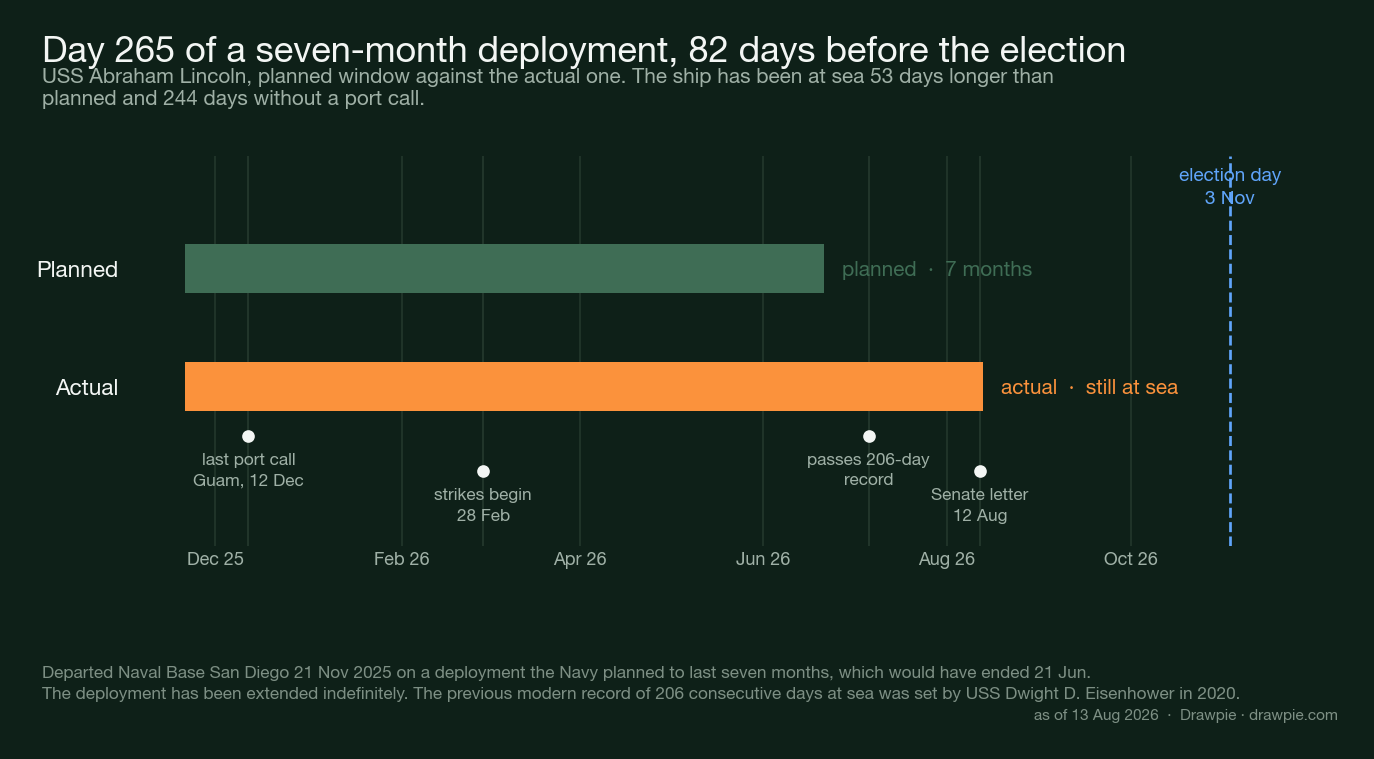
- The numbers are the story. The carrier left San Diego on 21 November 2025 on a deployment planned to last seven months. It is now on day 265, roughly 53 days past that plan, and has gone more than 200 days without a port call — past the modern record of 206 days set by USS Dwight D. Eisenhower in 2020.
- History says a war does not predict a midterm on its own. The same conflict produced opposite results four years apart: in 2002 the president’s party gained 8 House seats and 2 Senate seats; in 2006 it lost 31 and 6, and both chambers with them.
- The senator raising it is not on the ballot. Blumenthal’s seat is next contested in 2028 and neither Connecticut Senate seat is up this November, which is worth knowing before reading the letter as campaigning.
It already has — the question is only how far it travels from here. On 12 August 2026, with 82 days to go before the midterm elections, a member of the Senate Armed Services Committee wrote to the Defense Secretary demanding that the Navy account for the USS Abraham Lincoln’s deployment: every extension, who authorised it, and what operational requirement justified each one.
That is not a hypothetical political effect. That is a carrier deployment becoming a congressional oversight matter, in writing, eleven and a half weeks before an election.
What follows is the record: where the ship is, how long it has been there, exactly what is being asked, and what the historical evidence actually says about wars and midterms — which is less obliging than either party would like.
How long has the USS Abraham Lincoln been deployed?
Day 265 of a deployment planned to last seven months, and more than 200 days without a port call.
| Measure | Figure |
|---|---|
| Departed | 21 Nov 2025 |
| Planned | 7 months |
| Day count | 265 |
| Past plan by | 53 days |
| Since port call | 244 days |
The carrier left Naval Base San Diego on 21 November 2025. Seven months would have ended it on 21 June. Its last port call was a one-day visit to Naval Base Guam on 12 December 2025, and the days since then have taken it past the modern benchmark for consecutive days at sea — 206 days, set by USS Dwight D. Eisenhower in 2020. The deployment has been extended indefinitely.
Those day counts are our arithmetic from the published dates rather than figures the Navy has released.
Where is the ship now, and what is it doing?
In the Arabian Sea, supporting Operation Epic Fury. USNI News’s fleet tracker of 10 August places the Abraham Lincoln Carrier Strike Group there — Carrier Strike Group 3, with Carrier Air Wing 9 embarked, flying F/A-18E and F/A-18F Super Hornets, Marine F-35Cs and EA-18G Growlers.
The ship deployed to the Indo-Pacific and was redirected west in January, transiting the Strait of Malacca on 19 January and arriving in US Central Command’s area later that month. Operation Epic Fury began on 28 February 2026, and aircraft from Carrier Air Wing 9 were among those in the opening strikes on Iran.
One thing we are not going to tell you is when it comes home. Some coverage says the USS George Washington is heading to the Middle East to relieve it; USNI’s tracker of the same week places the George Washington in the South China Sea on its first patrol of the year. Those two things cannot both be the current position, so this article gives no relief date.
What are lawmakers actually asking?
Six things, and the first one is the politically loaded one: who signed off on each extension. Senator Richard Blumenthal of Connecticut, a Democrat on the Senate Armed Services Committee, wrote on 12 August to Defense Secretary Pete Hegseth and acting Navy Secretary Hung Cao asking for:
- the date of every extension to the Lincoln’s deployment
- who authorised each one
- the operational requirement behind each decision
- a list of significant quality-of-life problems identified aboard — mould, broken toilets or laundry facilities, inadequate water, shortages of hygiene products
- when each problem was first identified and what was done about it
- what the Navy is doing to assess fatigue, morale, mental health and crew readiness
The letter followed a Military Times report the previous day in which family members described sailors attempting to go overboard during the deployment. Separately, a US official told CNN that a sailor did go overboard last month and was recovered and medically evaluated.
Those are allegations and questions, not findings. The Navy had not published answers when this was written, and a list of things a senator wants explained is a list of things not yet explained.
Why does a letter matter to an election?
Because it converts a logistics problem into a matter of record, and records are what campaigns run on. A deployment extension is an internal decision until somebody with subpoena-adjacent standing asks, in writing, who made it. The Armed Services Committee is where that question has weight.
There is a detail worth holding against the cynical reading, though. Blumenthal is not on the ballot. His seat is next contested in 2028, and neither Connecticut Senate seat is up this November. Whatever else is going on, the senator asking is not asking in the middle of his own campaign — and the state’s competitive federal race this year is a House seat in Hartford , not his.
Has a war ever actually moved a US midterm?
Yes, in both directions — which is the part that should make anyone cautious about predicting this one. The same conflict produced opposite midterm results four years apart.
| Midterm | House | Senate |
|---|---|---|
| 2002 | +8 | +2 |
| 2006 | −31 | −6 |
Those figures are the change for the president’s party. In 2002, in the rally that followed the September 11 attacks and with the Iraq question live, the president’s party gained eight House seats and two Senate seats — reversing the usual midterm pattern, in which the White House party loses ground. In 2006, with the same war four years older, it lost 31 House seats and six in the Senate, and both chambers with them.
The academic literature calls the first effect “rally round the flag”, and its consistent finding is that the effect is short-run. What separates 2002 from 2006 is not whether there was a war but how long it had been going and how it was seen to be going.
That is precisely why the Lincoln story is the shape it is. It is not a story about a strike or a victory. It is a story about duration — a seven-month plan in its ninth month, a crew that has not seen land since December, and a senator asking who kept extending it. Historically, that is the register in which military news has moved American elections, and it is the opposite register from a rally.
What is scheduled between now and 3 November?
Nothing about this deployment is on a published calendar, and that is the honest answer. The election is fixed: Tuesday 3 November 2026, 82 days after this was written. Everything else here is not.
The Navy has no announced end date for the deployment. The senator’s letter has no published deadline for a reply that we could confirm. There is no scheduled hearing on it. If the story develops, it will be through answers arriving, conditions changing, or the ship coming home — none of which is on a timetable anyone has published.
For the races where the November arithmetic is genuinely close, the 2026 Senate control map is where the published ratings disagree with each other.
What this does not tell you
Whether any of it changes a single vote. We have not modelled it and we are not going to. The 2002 and 2006 numbers are what happened, not a forecast, and the honest reading of them is that they point in opposite directions depending on a variable — how a war is going, and for how long — that nobody can settle 82 days out.
It also does not tell you whether the conditions described aboard the Lincoln are as reported. Those accounts come from family members and from a senator’s questions; the Navy’s response is the missing document, and when it arrives it may confirm, qualify or contradict them.
And it takes no position on the war itself. Operation Epic Fury appears in this article for one reason — it is why the deployment was extended. Nothing here evaluates the conduct or the justification of any party to it, and no casualty figures are compiled. For what collective-defence commitments actually oblige states to do when they are tested, we looked at the record of the pacts themselves .
How we verified this
The ship’s location and mission are from USNI News’s fleet tracker, the standard public reference. Its edition of 10 August 2026 places the Abraham Lincoln Carrier Strike Group in the Arabian Sea in support of Operation Epic Fury, and lists Carrier Strike Group 3 with Carrier Air Wing 9 embarked.
The deployment dates come from the senator’s own letter as reported by Military Times. The 21 November 2025 departure from Naval Base San Diego, the seven-month plan, the ninth month now under way and the 200-plus days without a port call are all attributed there to Blumenthal’s letter of 12 August 2026, addressed to Defense Secretary Pete Hegseth and acting Navy Secretary Hung Cao. The letter itself is published on the senator’s Senate website; that file refused an automated request from this connection, so the article works from the reporting of it rather than claiming to quote the PDF.
The day counts are ours, computed from those dates. Day 265 and the 53-day overrun are arithmetic from 21 November 2025 and a seven-month plan ending 21 June 2026; the days-without-a-port-call figure is measured from the 12 December 2025 Guam visit reported as the last one. They are stated as calculations, not as figures anyone published.
We do not assert that the George Washington is replacing the Lincoln. Some coverage says it is heading to the Middle East to relieve it. USNI’s tracker of 10 August places the George Washington in the South China Sea on its first patrol of 2026. Those do not agree, so this article reports no relief date.
The accounts of conditions on board are attributed, and the second-hand ones are labelled as such. That a sailor went overboard last month and was recovered is attributed to a US official speaking to CNN. The accounts of multiple attempts, and of shortages, plumbing, water, mail and mental-health strain, come from family members speaking to Military Times and from the questions the senator asks — questions are not findings. The Navy’s answers had not been published when this was written.
This article does not evaluate the war or compile casualties. The conflict appears here only as the reason the deployment was extended. Nothing here judges the conduct or the justification of any party to it, and no casualty figures are collected.
It also does not forecast the election. The 2002 and 2006 results are what happened, not a model. There is no projection here of what any race will do in November, and no betting or prediction-market price appears anywhere in it.