US Open Tennis 2026: Schedule, Draw, Predictions & How to Watch
The US Open main draw begins on Sunday 30 August 2026; once play is set, the no-draw, no-order-of-play state this page describes is over.
Everything else on the page is unaffected; the figures below still say when they were read.

- The tournament opens on Sunday 23 August and the first round does not start until Sunday 30 August. The seven days in between are Fan Week — qualifying, exhibitions and the mixed doubles. The tournament’s own site gets this wrong on at least one page, where an explainer puts the main draw’s start on 23 August.
- There is no draw yet. The singles draws are reported to be revealed on Thursday 27 August, and usopen.org has not published that date itself. Until then no player has a seed number, and any 2026 seed list you have seen is either a projection or a misread of last year’s table.
- Neither Carlos Alcaraz nor Jannik Sinner had confirmed he is playing as of 20 August. Alcaraz completed the career Grand Slam in January and has not played a match since April because of a right wrist injury; Sinner has not played since winning Wimbledon and is rehabilitating a right knee.
- There is no order of play for any day. The tournament’s Schedule of Play page still reads “Stay tuned for the 2026 Schedule of Play”, so nobody can yet tell you who is on Arthur Ashe on any given afternoon.
- Americans have reached four of the last six US Open singles finals and won one of them — Coco Gauff in 2023. Jessica Pegula was the highest-ranked American on the entry list at world No. 3.
The 2026 US Open is the fourth and final Grand Slam of the tennis year, and this year it arrives with an unusually large hole in the middle of it: as of 20 August, the two men who have won seven of the last eight majors between them have not said whether they are playing.
That is the honest starting point. Below is what the tournament has actually published, what is only reported, and what nobody knows yet — kept in those three categories rather than blended together.
When does the 2026 US Open actually start?
It depends what you mean by “start”, and this is the single most common mistake in coverage of this tournament. The US Open runs from Sunday 23 August to Sunday 13 September 2026 — 22 days. But the main draw does not begin until Sunday 30 August. The seven days before that are Fan Week: qualifying rounds, exhibitions, the mixed doubles championship, and free admission to the grounds.
So if you turn up on 24 August expecting first-round Grand Slam tennis, you will be watching qualifying. Both statements — “the US Open starts on 23 August” and “the US Open starts on 30 August” — are true, about different things.
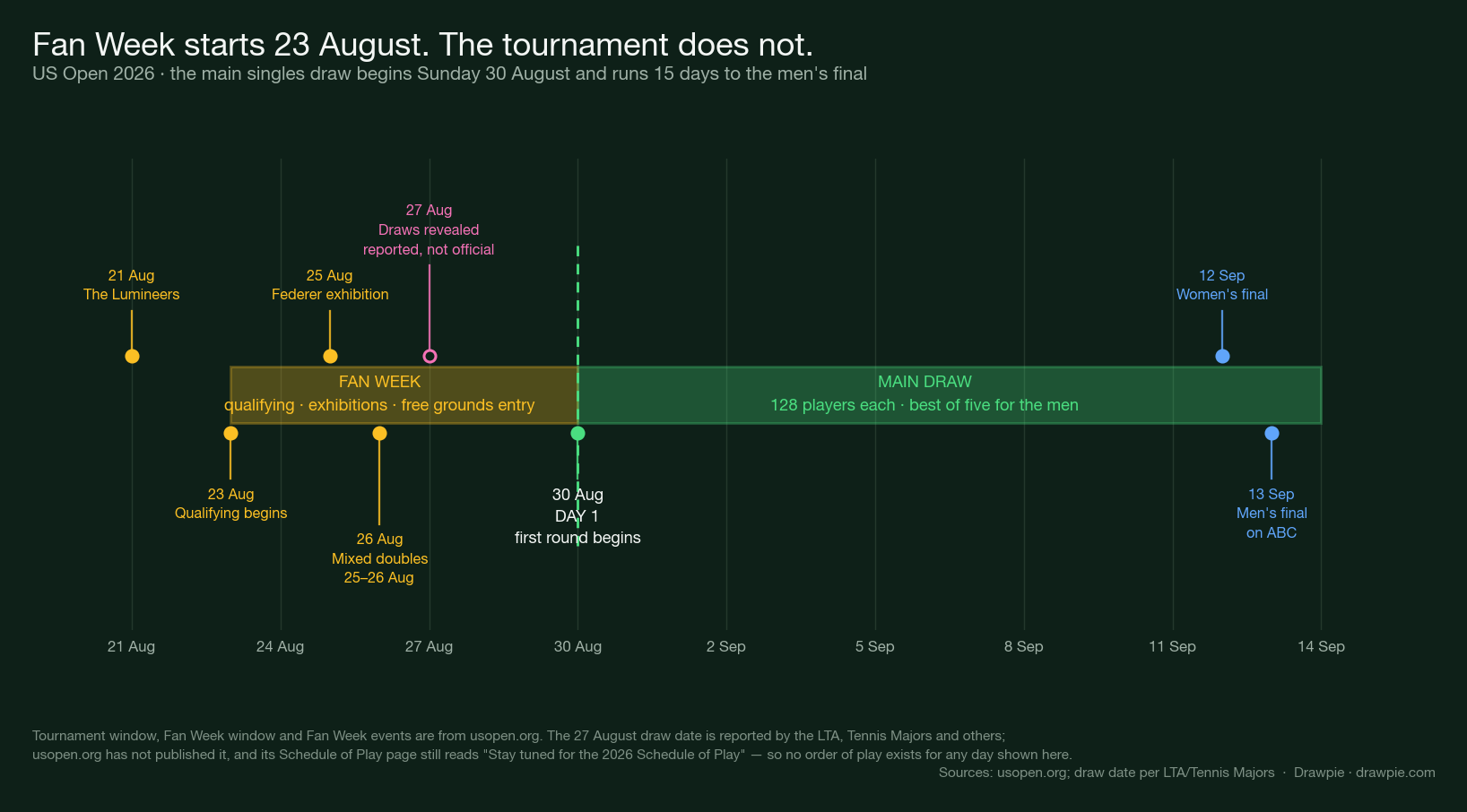
The main draw is 15 days. The women’s final is Saturday 12 September and the men’s final is Sunday 13 September.
Fan Week itself has a real programme this year. The Lumineers play Louis Armstrong Stadium on 21 August. Roger Federer plays an exhibition on Arthur Ashe on 25 August — no start time is given here because the tournament’s own pages give two different ones. The Mixed Doubles Championship runs 25 and 26 August with 16 duos, and Stars of the Open is on 27 August.
When is the 2026 US Open draw released?
The singles draws are reported to be revealed on Thursday 27 August, three days before play starts. That date is carried by the LTA, Tennis Majors, Flashscore and others, but it is not on usopen.org, so treat it as reported rather than confirmed.
The practical consequence matters more than the date: until the draw is made, no player has a seed number. If you have seen a 2026 US Open seed list, it is either somebody’s projection or — as we found while researching this piece — a misreading of the 2025 table. Seedings follow the rankings published the week before the tournament, and those rankings are still moving.
Is there a schedule of play for each day?
No, and this is worth stating flatly because so many pages imply otherwise. The tournament’s Schedule of Play page currently reads: “Stay tuned for the 2026 Schedule of Play.” There is no order of play for any day of this tournament yet.
Order of play is normally published the evening before each day. Since the draw itself is not out, nobody can tell you which players are on Arthur Ashe on 31 August, and any page that appears to is guessing.
Will Carlos Alcaraz play the 2026 US Open?
Unknown as of 20 August. Alcaraz is the defending champion and is on the entry list, but he has not played a match since April because of a right wrist injury, and he had not confirmed his participation with the draw a week away. A decision was reported to be days away. This is the story of the tournament so far.
2026 has already given him the best moment of his career: in January he beat Novak Djokovic in the Australian Open final to complete the career Grand Slam — the ninth player to do it and the youngest man ever, at 22 years, 8 months and 27 days. It was his seventh major.
Then it stopped. The wrist cost him the French Open and Wimbledon, he withdrew from Cincinnati, and he arrives on the entry list without having competed for four months. He has been training in Murcia, and a reporter who watched a session described the wrist as close to fully healed — but that is an eyewitness account, not a medical clearance.
He would be attempting to win a third US Open title — he won in 2022 and 2025 — off no match play at all, in best-of-five sets.
Will Jannik Sinner play the US Open?
Also unconfirmed. Sinner won Wimbledon and has not played since. He withdrew from Cincinnati on 9 August with a right knee problem, saying his knee had been bothering him and he was not ready to compete, and has been rehabilitating in Turin. He has already withdrawn from the US Open mixed doubles.
Early reporting framed the Cincinnati withdrawal as precautionary rather than a threat to his Grand Slam. He remains the world No. 1 and would be the top seed if he plays. But “expected to play” is not “confirmed”, and at the time of writing he has not confirmed.
Nine players had withdrawn from the 2026 US Open as of 20 August.
Who else is in the 2026 US Open field?
A strong one, whatever happens at the top. When the tournament published its entry list on 21 July, it counted 17 former Grand Slam champions in the two singles draws — eleven women and six men — and ten former US Open champions.
- Aryna Sabalenka was the women’s world No. 1 on that list and is chasing a third consecutive US Open title, which no woman has done since Serena Williams in 2012–14.
- Novak Djokovic returns with 24 majors, four of them in New York, and reached the Australian Open final in January at 38.
- Alexander Zverev won the French Open this year — his first major, after three losing finals, and the first by a German man at Roland-Garros since 1937.
- Elena Rybakina is the reigning Australian Open champion.
- The other two 2026 women’s majors went to first-time champions: Mirra Andreeva at Roland-Garros, at 19 years and 1 month the youngest champion there since Monica Seles in 1992, and Linda Nosková at Wimbledon. Andreeva’s opponent in that final, Maja Chwalińska, was only the second qualifier in the Open Era to reach a major final, after Emma Raducanu at the 2021 US Open.
The United States leads the field with 28 direct entries, more than any other country. Wild cards went to Venus Williams and Sloane Stephens on the women’s side, with Gaël Monfils heading the men’s list. The entry cutoffs were No. 102 for women and No. 101 for men.
On the current ATP list, read on 20 August, Ben Shelton is No. 6, Taylor Fritz No. 9 and Learner Tien No. 12 — Tien having reached the Australian Open quarter-finals in January, the youngest man to do so since Nick Kyrgios in 2015.
Who is going to win the 2026 US Open?
The truthful answer on 20 August is that the men’s tournament cannot be sensibly previewed yet. Sinner and Alcaraz have won seven of the last eight majors between them — Sinner four, Alcaraz three, with only Alexander Zverev’s Roland-Garros title this June interrupting them — and neither has confirmed he is playing.
What can be said without guessing:
If both play, it is their tournament to lose. Alcaraz beat Sinner in last year’s final here. If neither plays, the men’s draw opens up more dramatically than at any major in years, and Zverev, Djokovic and Shelton are the names with the strongest recent evidence behind them.
The women’s draw has a clearer favourite and a harder question. Sabalenka has won the last two US Opens and is the most proven hard-court player among the women in it. But she did not win any of the three majors played in 2026 — they went to Rybakina, Andreeva and Nosková — so the season’s form and the tournament’s history point in different directions.
We do not publish betting odds or implied probabilities for this or any other event, so that is as far as this goes. When the draw lands on 27 August the picture will change more than any prediction made before it.
Can an American win the US Open in 2026?
On recent evidence, yes — and more plausibly in the women’s draw. Americans have reached four of the last six US Open singles finals and won one of them.
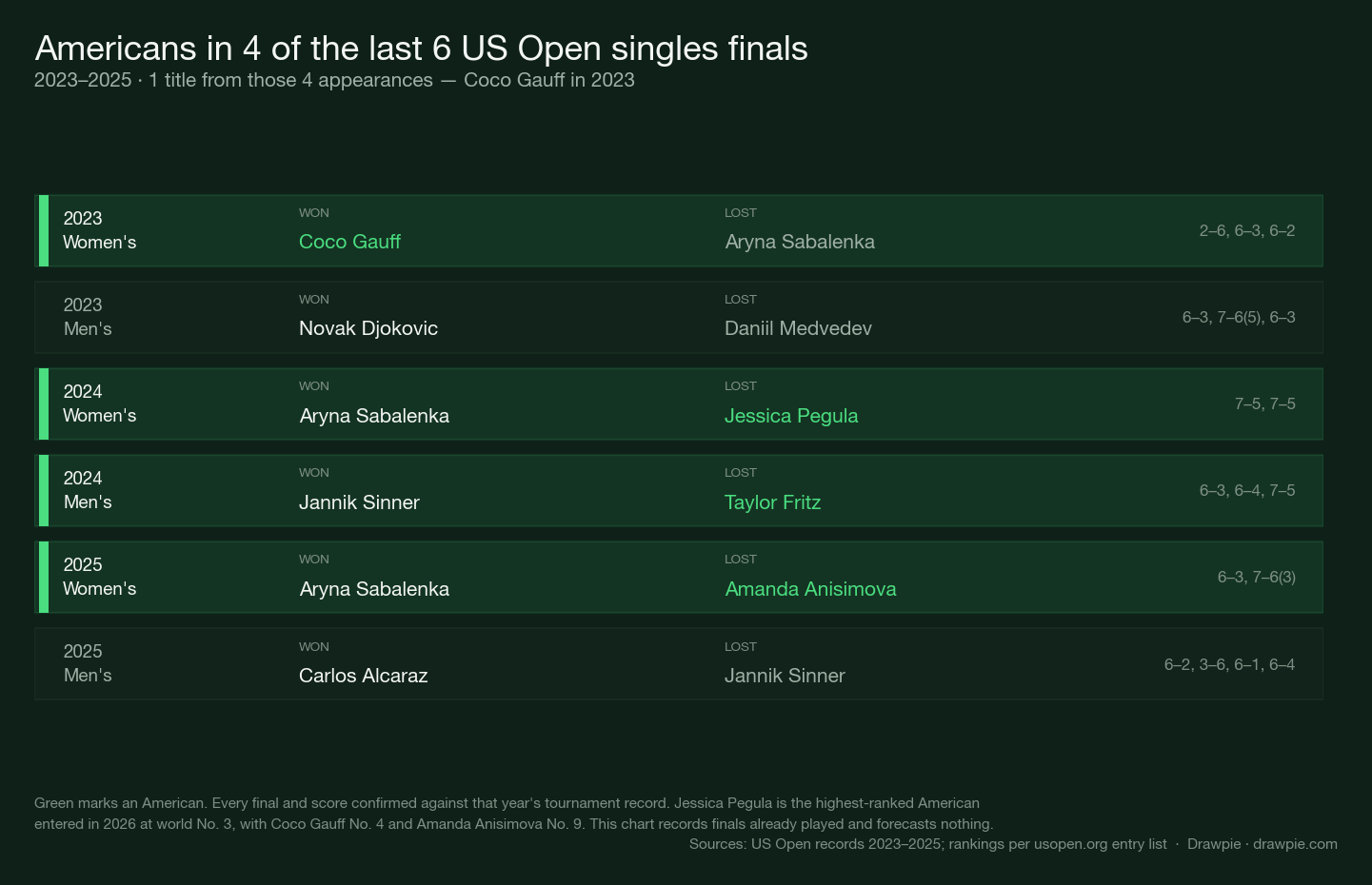
Coco Gauff’s 2023 title is the one that converted. The other three ended in defeat, and all three defeats were to Sabalenka or Sinner.
On the 21 July entry list, Jessica Pegula was the highest-ranked American at world No. 3, with Gauff at No. 4 and Amanda Anisimova at No. 9 — three American women inside the top ten, all three of whom have reached a US Open final. Shelton and Fritz carry the men’s hopes.
How can you watch the 2026 US Open in the US?
ESPN has it, for the 18th consecutive year and the 12th as the exclusive domestic broadcast partner. The headline numbers, from the tournament’s own broadcast page:
| Coverage | Detail |
|---|---|
| Television | 170+ hours across ESPN, ESPN2 and ABC |
| Spanish-language | 110+ hours on ESPN Deportes |
| Streaming | 1,000+ hours “digital grounds pass” on the ESPN App |
| Men’s final | On ABC, for the third year |
| Day 1 (Sun 30 Aug) | On ABC, ESPN and ESPN2 — the second year Day 1 is covered |
| Fan Week | Qualifying and mixed doubles on ESPN2 and the ESPN App |
Tennis Channel is on site as well, with preview programming and selected Fan Week and qualifying coverage outside ESPN’s window.
The practical point for a casual viewer: the men’s final is on broadcast ABC, not cable, so you do not need a sports package to watch it. Everything else runs through ESPN’s channels and app.
What does the 2026 US Open pay?
The tournament has committed $108 million in total player compensation for 2026. That figure covers singles, doubles, mixed doubles, qualifying and per-diem support rather than the singles prize money alone, and the tournament has not published the per-round breakdown behind it.
What this article cannot tell you
Four things, all of which will be knowable soon and none of which are knowable now:
- Who is in whose half. The draw is reported for 27 August.
- Who is seeded where. Seeds follow the draw. Nothing published before 27 August is a seed list.
- Who plays when. There is no order of play for any day.
- Whether Alcaraz and Sinner play at all. Both were unconfirmed on 20 August.
For ticket prices, free-admission days and how sessions are sold, see our separate 2026 US Open tickets guide — the pricing picture there has its own complications, starting with the fact that the tournament does not publish prices on its own site.
Sources
| Source | Used for |
|---|---|
| usopen.org — tournament, Fan Week, schedule of play and broadcast pages, read in a rendered browser | Tournament window, Fan Week dates and events, finals days, the “Stay tuned for the 2026 Schedule of Play” wording, and every ESPN coverage figure |
| usopen.org entry-list article, 21 July 2026 | 17 former major champions, 10 former US Open champions, 28 US direct entries, entry cutoffs, wild cards, Sabalenka’s three-peat bid, and the women’s rankings quoted |
| LTA US Open seedings page | Confirmation that 2026 seedings are “still to be confirmed”, and the source of the 2025 table that a search summary misread |
| Tennis Abstract ATP report | Current ATP rankings for Shelton, Fritz, Tien, Zverev and Draper, read 20 August 2026 |
| ATP Tour — Sinner Cincinnati withdrawal | Sinner’s knee, his own wording, and the 9 August date |
| Olympics.com — Alcaraz withdraws from Cincinnati | Alcaraz’s wrist, his absence since April and the Cincinnati withdrawal |
| Tennis365 — 2026 US Open withdrawal list | The nine withdrawals, and that Alcaraz and Sinner were both still in doubt |
| Tennis Tonic — draw date | The reported 27 August draw date |
| Grand Slam tournament records, 2023–2026 | Every final, finalist and score in the American finals chart; the seven-of-eight majors count for Sinner and Alcaraz; Alcaraz’s career Grand Slam at the 2026 Australian Open; and the 2026 women’s major champions |
How we verified this
Everything sourced to usopen.org here was read in a rendered browser, because the site cannot be read any other way. It is a JavaScript application that returns a roughly 4KB shell to a command-line request. A control fetch of an invented path returned that same 4KB shell with HTTP 200, identical to a real page — so for this host, a successful-looking response proves nothing and every claim below was taken from the rendered page instead.
🔴 A web search returned a confident, specific and completely false 2026 seed list, and none of it is printed here. The summary stated that Taylor Fritz is seeded first, Ben Shelton third and Jack Draper second. Fetching the underlying LTA page showed what it actually says: “The seedings for the 2026 US Open are still to be confirmed.” The page does carry a full 32-seed table — for 2025 — and that is what was misread. Draper is currently ranked No. 143. No seed number for any player appears in this article, because the draw has not been made.
The 27 August draw date is reported, not official. It is carried by the LTA, Tennis Majors, Flashscore and Tennis Tonic. It does not appear on usopen.org, whose Schedule of Play page reads “Stay tuned for the 2026 Schedule of Play”. The chart marks it with a hollow ring for that reason.
⚠️ The Alcaraz and Sinner situation is the most perishable thing on this page and is timestamped everywhere it appears. Both were on the entry list and neither had confirmed as of 20 August 2026. Alcaraz’s decision was reported to be days away. If you are reading this after the draw, that question has been answered and this section has not.
Two sets of rankings appear here and they are labelled separately, because they disagree. The women’s numbers are the tournament’s own, as published with the entry list on 21 July 2026 and based on the rankings of 20 July. The men’s numbers are the current ATP list as mirrored by Tennis Abstract, read on 20 August. On the earlier list the tournament described Alexander Zverev as a world No. 2; on the current one Alcaraz is No. 2 and Zverev No. 3. Rankings move weekly, so no ranking is printed here without the date it was read. Tennis Abstract passed a control test — a real report returned 200 and an invented one returned 404.
No start time is given for the Federer exhibition, because the tournament contradicts itself. One official article gives 7:30 p.m. and two others give 7:00 p.m. The event is listed by date only.
This article publishes no betting odds and no implied probabilities, for this or any other event. That is a site-wide rule. The predictions section is built from results that have already happened and from who is and is not fit, and it says plainly where that runs out.
Ticket prices are deliberately absent. They are covered, with their own caveats about who actually publishes them, in our 2026 US Open tickets article .