Ukraine and Russia Military Deaths 2022–2026: What the Numbers Actually Show

- Matched measure for measure, Russia has lost roughly 2.4 to 3.3 times as many soldiers as Ukraine: 233,199 against 96,821 on the two name-by-name counts, and about 352,000 against 125,000–150,000 on the modelled estimates. Comparing Russia’s highest figure with Ukraine’s official one gives a ratio of nine, but that is mostly a difference of method.
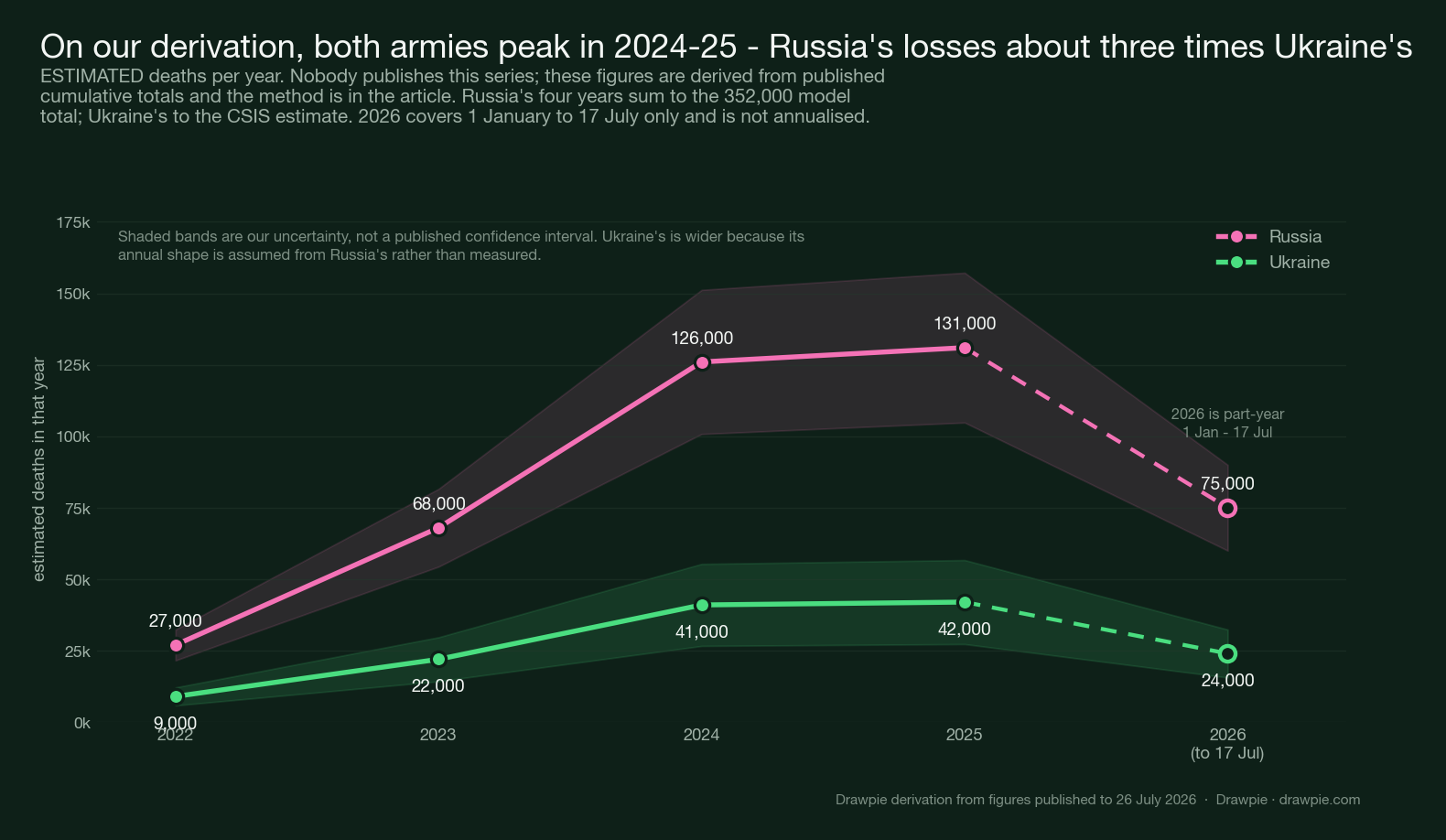
- There is no published year-by-year death toll for either army. We have reconstructed one — roughly 27,000 Russian deaths in 2022 rising to 131,000 in 2025, against 9,000 to 42,000 Ukrainian — by rescaling the only annual splits ever published to the current totals. The arithmetic is shown in full, and those figures are ours rather than anyone’s official series.
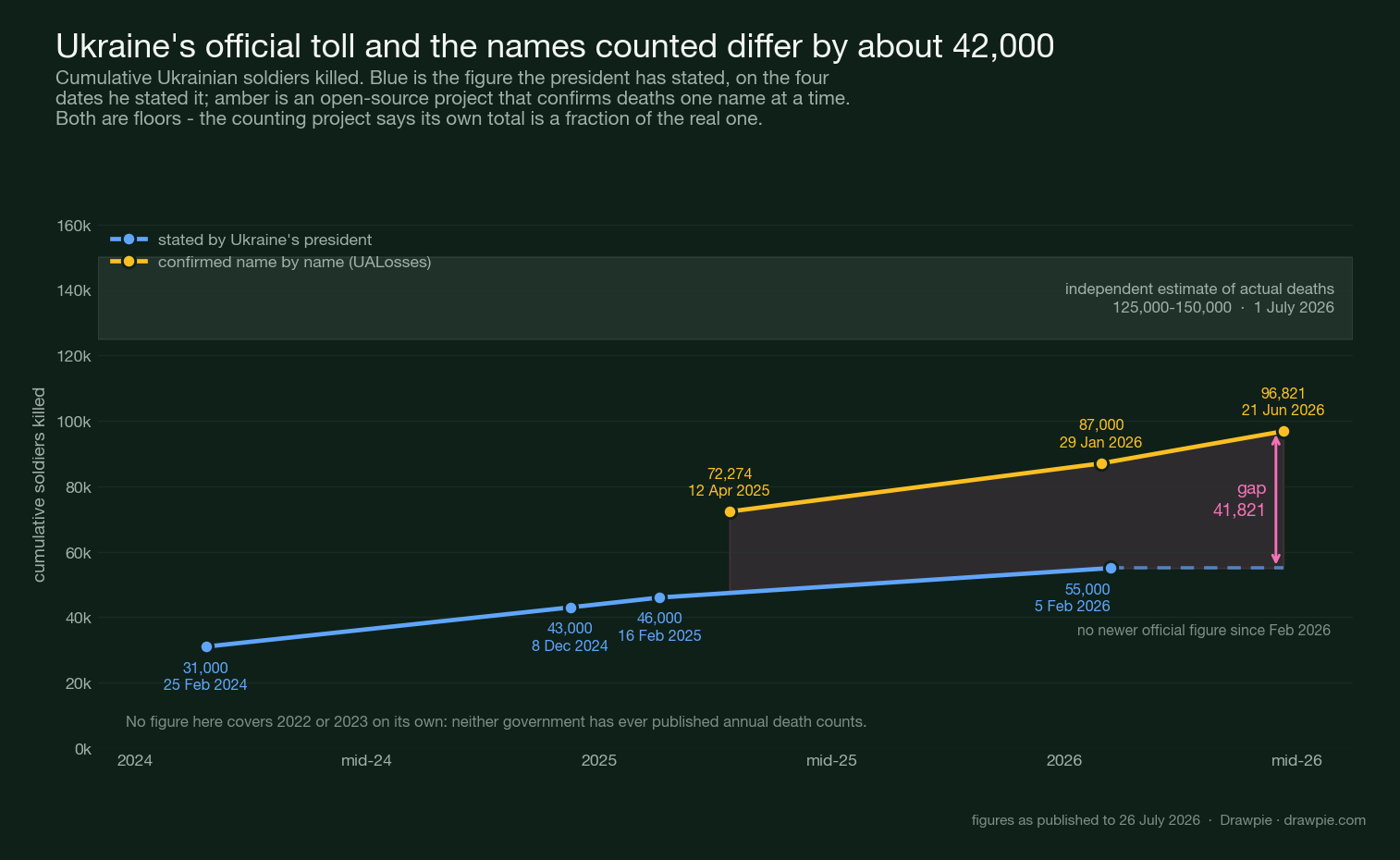
- The two sides do not even publish the same kinds of number. Moscow has released nothing since 2022, so Russia’s figures come entirely from independent projects and foreign intelligence; Ukraine gives an official figure about once a year, and the gap between it and the names independently confirmed has widened to about 42,000.
- The most misread number in this war is the daily one. Ukraine’s General Staff reports roughly 1,000 Russian troops a day — that figure is killed and wounded together, not deaths, and it is a belligerent’s own claim.
Russia has lost roughly two and a half to three times as many soldiers as Ukraine — and how many that is depends entirely on which kind of number you are reading. Russian military deaths run from 233,199 confirmed one name at a time to nearly 500,000 in a British intelligence assessment. Ukraine’s own official figure is 55,000, while a name-by-name project has documented 96,821.
Those are not competing estimates of the same thing with some noise around them. They are different measurements, and most of the distance between them is methodology rather than disagreement. Comparing them therefore takes some care, which is where this starts.
How do Russian and Ukrainian military deaths compare?
Matched measure for measure, Russia has lost roughly 2.4 to 3.3 times as many soldiers as Ukraine.
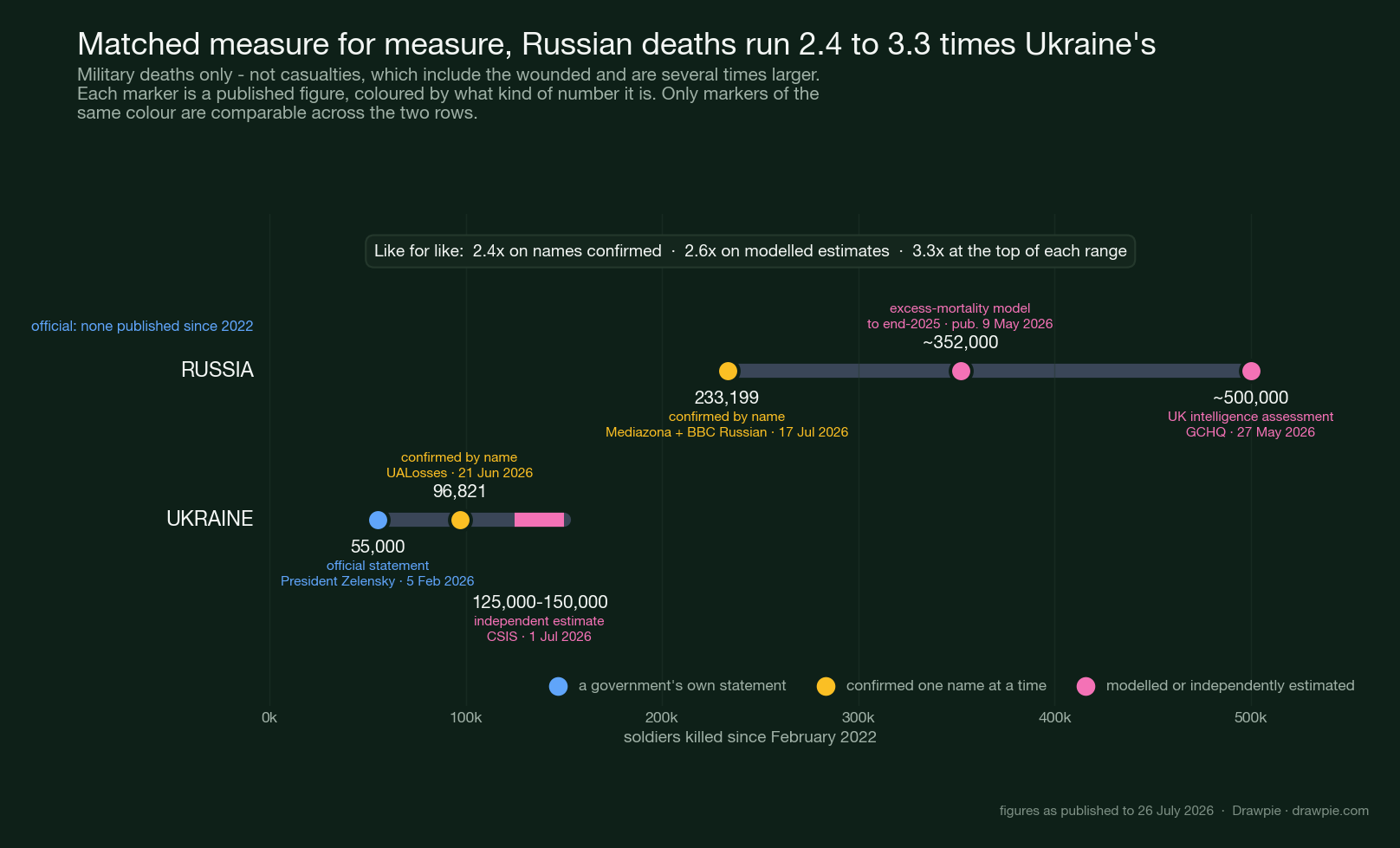
The matching is the whole trick, and it is easy to get wrong. Russia’s highest published figure is about 500,000; Ukraine’s official one is 55,000. Divide those and you get a ratio of nine — but that number compares a British intelligence assessment with a press statement, and most of it is method rather than war.
Line up the same kinds of number instead and the picture is stable:
| Compared like with like | Russia | Ukraine | Ratio |
|---|---|---|---|
| Confirmed individually by name | 233,199 | 96,821 | 2.4× |
| Modelled or independently estimated | ~352,000 | 125,000–150,000 | 2.6× |
| Highest figure published for each | ~500,000 | 150,000 | 3.3× |
Two asymmetries survive that exercise and are worth naming rather than smoothing over.
Russia has no official figure at all. Moscow has published essentially nothing since 2022, so the blue marker that exists on Ukraine’s row has no counterpart on Russia’s. That absence is not a gap in our data — it is a decision by one of the two governments.
Ukraine has no equivalent of the GCHQ assessment. Western intelligence agencies talk publicly about Russian losses far more than about Ukrainian ones, so the top of Ukraine’s range comes from a think tank rather than a government. The 3.3× figure is therefore the least like-for-like of the three, and the 2.4× comparison of the two name-by-name counts is the most solid.
Why is there no year-by-year death toll?
Because neither government publishes one, and the independent projects publish running totals instead.
This is worth stating plainly, because annual charts of this war do circulate. They are constructed, not reported.
What exists is: a continuously updated list of confirmed names on each side; occasional statements from Kyiv giving a cumulative figure; and periodic modelled estimates. Moscow has published essentially nothing since the first months of the invasion.
Annual figures for Russia did exist at one point — roughly 20,000 for 2022, 50,000 for 2023 and 93,000 for 2024, from the excess-mortality model. But that model has since revised its own total to about 352,000 through the end of 2025. The old yearly splits belong to an earlier version of the estimate and no longer add up to the current one, so combining them with today’s totals produces a series that never existed. Ukraine has never published annual figures at all.
The chart below therefore shows what is actually published: cumulative figures, on the dates they were given.
What would a year-by-year curve look like?
Roughly like this — but the numbers below are ours, not anybody’s published series. Since the shape of the war is the thing most people actually want, here is a reconstruction, with the arithmetic in the open so you can check it or disagree with it.
| Estimated deaths in that year | Russia | Ukraine |
|---|---|---|
| 2022 | ~27,000 | ~9,000 |
| 2023 | ~68,000 | ~22,000 |
| 2024 | ~126,000 | ~41,000 |
| 2025 | ~131,000 | ~42,000 |
| 2026, 1 Jan – 17 Jul | ~75,000 | ~24,000 |
| Total | ~427,000 | ~138,000 |
How it was built, in four steps:
- Russia’s shape comes from the only annual splits ever published — about 20,000 for 2022, 50,000 for 2023 and 93,000 for 2024. We use their proportions only, because their level belongs to a superseded version of the model.
- Russia’s level comes from the current version: 352,000 to the end of 2025. Rescaling the three published years by 1.35 — roughly the factor by which the model grew when it began counting late-registered and court-confirmed deaths — leaves 2025 as the residual. The four years then sum to exactly 352,000.
- Ukraine’s total is the CSIS estimate of 125,000–150,000 through mid-2026. Its annual shape is assumed to follow Russia’s, scaled down by the overall ratio of 3.1.
- 2026 is a part-year, 1 January to 17 July, carried at the 2025 monthly rate. It is not annualised and should not be read as a full-year figure.
The weakest link is step 3, and it is worth being blunt about it. Ukraine’s annual shape is assumed rather than measured, so it inherits Russia’s profile — which almost certainly flatters the early period. In 2022 Ukraine was defending Mariupol and Severodonetsk and losing men at a rate much closer to Russia’s than the 3.1 ratio implies; from 2023 the ratio widened as Russia switched to assault tactics. The curve above spreads that difference evenly instead of showing it, which is why Ukraine’s band is drawn wider.
Everything after this point is published figures again.
How many Russian soldiers have been killed?
Between 233,199 and roughly 500,000, depending on the method.
| Figure | What it is | Source | As of |
|---|---|---|---|
| 233,199 | Deaths confirmed individually by name | Mediazona and the BBC Russian Service | 17 July 2026 |
| ~352,000 | Modelled from excess male mortality and the Probate Registry | Mediazona and Meduza | End of December 2025 |
| ~500,000 | Government intelligence assessment | GCHQ, in a speech by its director | 27 May 2026 |
| 1,300,000–1,450,000 | Casualties — killed and wounded | NATO | 17 June 2026 |
The named list is the most conservative and the most verifiable: every entry is a person identified from a public source. Its composition tells you how Russia has fought — more than 84,300 of the confirmed dead signed contracts after the invasion began, 25,800 were recruited from prisons, and 19,200 were mobilised. Officers number 7,406.
It is also, by its own account, incomplete. The project excludes fighters from the Donetsk and Luhansk formations entirely, and says its most recent months are always under-recorded because obituaries surface slowly. Nor is Russia’s own army the whole of its side of the line: the North Korean troops deployed to fight for Russia carry loss estimates of their own, and those diverge by source in exactly the way the figures here do.
How many Ukrainian soldiers have been killed?
The official figure is 55,000. Independent counting has passed 96,000, and the gap between them is growing.
| Figure | What it is | Source | As of |
|---|---|---|---|
| 55,000 | Official statement | President Zelensky, to French television | 5 February 2026 |
| 96,821 | Deaths confirmed individually by name | UALosses | 21 June 2026 |
| 125,000–150,000 | Independent estimate of actual deaths | CSIS | 1 July 2026 |
| 525,000–625,000 | Casualties — killed and wounded | CSIS | 1 July 2026 |
Ukraine’s official number has been updated roughly once a year: 31,000 in February 2024, 43,000 that December, more than 46,000 in February 2025, and 55,000 in February 2026. Each step is around 9,000 to 12,000.
The name-by-name count has risen faster over the same stretch — 72,274 in April 2025, about 87,000 in January 2026, 96,821 in June 2026 — so the gap has grown from roughly 26,000 to nearly 42,000. And the counting project is emphatic that it is not measuring the total, noting that its data is thin for large cities, Transcarpathia and most of the east and south, and that what it lists “is likely only a fraction of the real toll”.
That is why the independent estimate sits above both lines rather than between them.
Why do the estimates differ by so much?
Three reasons, and only one of them is uncertainty.
They measure different things. A named list counts deaths that someone has publicly recorded. A statistical model estimates deaths that occurred whether or not anyone recorded them. An intelligence assessment draws on material neither of the others can see. A larger number is not necessarily a more alarmist number — it is often a different question being answered.
Deaths and casualties get mixed together. This is the single most common error in circulation. NATO’s 1.3–1.45 million Russian figure and CSIS’s 525,000–625,000 Ukrainian figure are casualties: killed and wounded combined. They are routinely quoted as death tolls, which inflates them by a factor of three or more. The daily figures have the same problem — when Ukraine’s General Staff reports around 1,000 Russian troops in a day, that is killed and wounded, and it is a claim made by one side about the other.
Both governments have reasons not to publish. Russia has released almost no figures since 2022. Ukraine releases one occasionally. Neither silence is neutral, and independent projects exist precisely because of it.
The same problem runs through most reporting on this war, which is why it is usually better to measure it by decisions than by claims — the approach we took in looking at how Ukraine’s long-range drone campaign changed Russian refining .
Which figure should you use?
Say what kind of number it is, or the number means nothing.
- For what is verifiable: the named counts — 233,199 Russian and 96,821 Ukrainian. Both are floors and both will rise as more names are confirmed, including for deaths years in the past.
- For best available estimates of the real toll: around 352,000 Russian on the modelling, up to about 500,000 on the British assessment, and 125,000–150,000 Ukrainian.
- For anything involving the word “casualties”: check whether the wounded are included before comparing it with anything else.
None of these is final. The fighting has not stopped, the confirmations lag by months, and the sources that produce the estimates have each revised them upward more than once.
How we verified this
What each figure is, and where it comes from. Every number in this article is a published figure with a date and a named source. They are not interchangeable, and the article keeps them apart deliberately:
- Named, individually confirmed — Mediazona with the BBC Russian Service for Russia; UALosses for Ukraine. Each death is tied to a person identified from obituaries, local-authority announcements, media reports, relatives’ posts and monuments. These are hard floors, not totals. Both projects say so explicitly.
- Modelled estimates — Mediazona with Meduza, using excess male mortality against Russia’s Probate Registry. Published 9 May 2026, covering to the end of December 2025.
- Government and institutional assessments — GCHQ (27 May 2026) for Russian deaths; CSIS (1 July 2026) for Ukrainian deaths and casualties; NATO (17 June 2026) for Russian casualties.
- Official statements — the four dated occasions on which Ukraine’s president has given a figure.
Killed is not the same as casualties. Casualty figures include the wounded and are several times larger than death figures. Where a source gives casualties, this article labels it as such and does not convert it into deaths.
What we did not use. Ukraine’s General Staff publishes daily Russian loss figures; those are a belligerent’s claims and combine killed with wounded, so they appear here only as an example of a misread number. We also found a much higher Russian range attributed to Mediazona in a third-party compilation that we could not reconcile with Mediazona’s own published figures, so it is not in this article.
One section is our own arithmetic, not reporting. The year-by-year curve does not exist in any published source. It is derived from published cumulative totals by the four steps set out beside it, and it is labelled as an estimate on the chart, in the table and in the text. Its weakest assumption — that Ukraine’s annual shape followed Russia’s — is stated there rather than buried here.
Known limits. Mediazona excludes fighters from the Donetsk and Luhansk formations, and says its recent months are incomplete and will rise. UALosses says data is scarce for large cities, Transcarpathia and most of the east and south, so its total “is likely only a fraction of the real toll”. Figures current to 26 July 2026; the war is ongoing and none of these numbers is final.