How Ukraine's Long-Range Drones Are Reshaping the War With Russia
Update log (1)
- — Published 24 July 2026. Refinery outages, export bans and processing rates all move week to week.

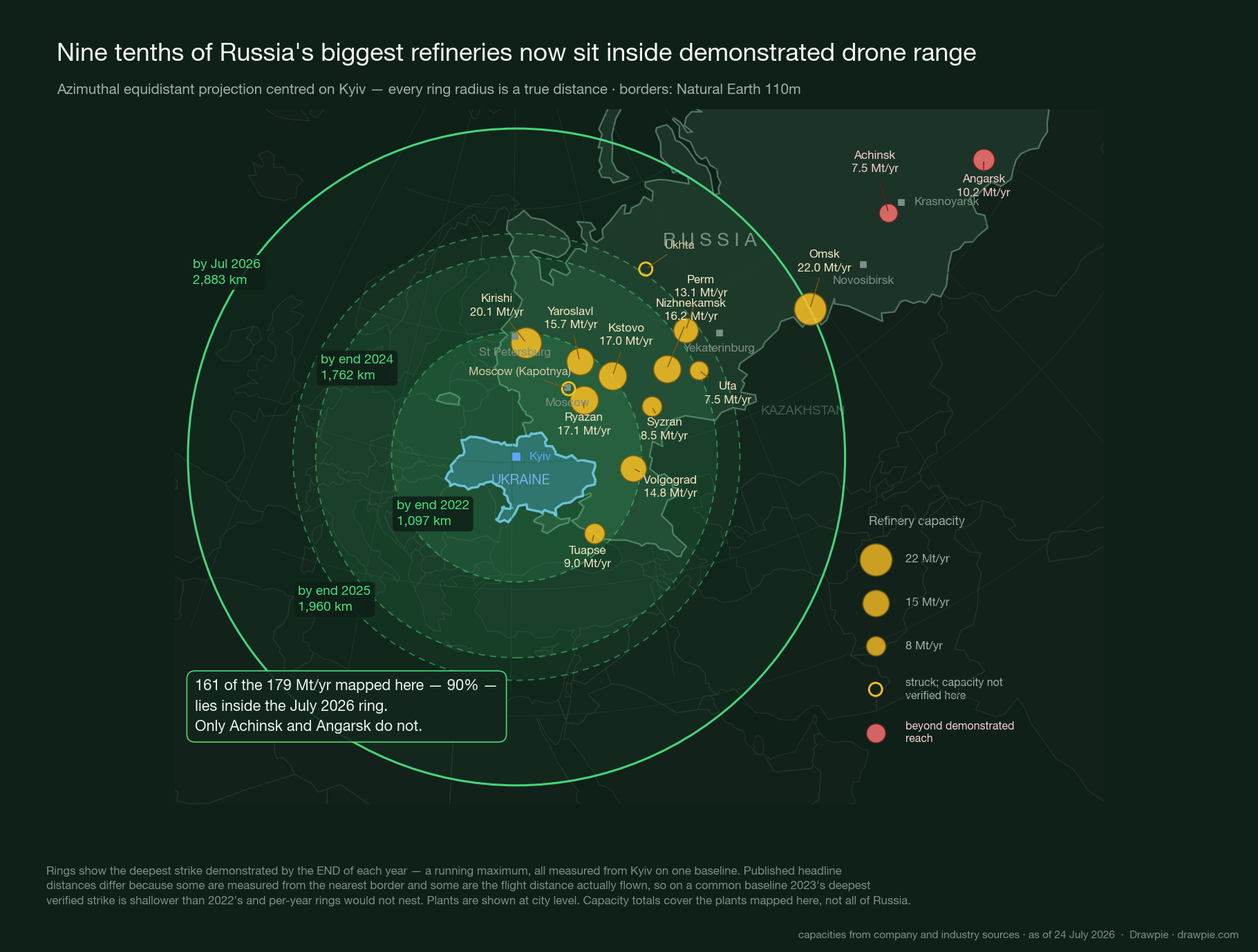
- On 6 July 2026 Ukraine hit the Omsk refinery in Siberia, roughly 2,500 km beyond the border. On our own mapping, about 90% of Russia’s largest refining capacity now sits inside demonstrated drone range.
- The most reliable evidence is not either side’s damage claims. It is Moscow’s behaviour: a petrol export ban, then a diesel export ban on 8 July, fuel imports, ration coupons at some stations and record wholesale prices.
- Independent analysts put Russian refinery runs at 3.91 million barrels a day in July 2026 — the lowest since March 2005, and more than 1.4 million below a year earlier.
- It is not a knockout. Only about one in ten long-range drones is reported to reach its target, unrefined crude exports have risen to replace lost product exports, and the collapse in Russian oil and gas revenue is driven mainly by prices, not by drones.
On 6 July 2026, Ukrainian drones struck the Omsk refinery in western Siberia — Russia’s largest, processing more than 22 million tonnes of crude a year, and roughly 2,500 km beyond the Ukrainian border. Reporting on the strike noted the drone probably covered more than 3,000 km in the air, because it did not fly in a straight line.
Omsk was described as the last of Russia’s eleven biggest petrol-producing refineries still untouched.
Three years earlier, reaching a Russian airbase 700 km inside the border was a headline. The interesting question now is not how far Ukraine can reach. It is what the reach has actually accomplished — and that is a harder question than most coverage admits, because both governments have every reason to lie about it.
All figures checked on 24 July 2026.
What is now inside range
| Reach demonstrated by | Distance from Kyiv | Deepest verified strike |
|---|---|---|
| End of 2022 | 1,097 km | Engels-2 airbase |
| End of 2024 | 1,762 km | Salavat refinery |
| End of 2025 | 1,960 km | Orsk-area radar station |
| July 2026 | 2,883 km | Omsk refinery |
A note on how we built that, because it matters. Published strike distances are not measured the same way. Some are straight-line from the nearest border, some are the flight distance actually flown, some are from the launch point. Measured consistently from one point, the deepest verified strike of 2023 is shallower than 2022’s — the apparent smooth yearly progression is partly an artefact of mixed baselines. So the rings show cumulative demonstrated reach, all computed from Kyiv, rather than a year-by-year record we would have had to invent.
On that mapping, 161 of the 179 million tonnes a year of refining capacity we plotted — about 90% — sits inside the July 2026 ring. Only Achinsk and Angarsk, both deep in Siberia, fall outside it.
What the strikes have actually done
Here the sourcing has to be separated carefully, because three very different kinds of claim get quoted interchangeably.
| Source | Claim | What it is |
|---|---|---|
| Ukraine’s General Staff | 42.7% of Russian refining capacity disabled | A belligerent’s claim |
| Independent analysts | 20–40% of capacity affected | Third-party estimate |
| IEA | Crude processing cut by ~500,000 barrels a day | Third-party measurement |
| Energy Aspects | Refinery runs at 3.91 million b/d in July 2026 | Third-party measurement |
The Ukrainian figure sits above the independent range. That does not make it false, but it is the number a party to the war is putting forward, and it should not be quoted as though it were an audit.
The independent measurements are the ones worth holding on to. Energy Aspects puts Russian refinery runs in July 2026 at 3.91 million barrels a day — the lowest since March 2005, and more than 1.4 million below July 2025.
There is a second, quieter finding in that figure. The IEA had projected Russian processing at just under 5 million barrels a day through June 2026, recovering toward 5.4 million after that. The actual July number came in well below the level the recovery was supposed to start from. The damage has outlasted the forecast.
The evidence that is hardest to spin
Damage claims are contested. Policy is not. And Moscow’s own decisions over the past few months describe the situation more honestly than any statement from either capital:
- A ban on petrol exports, running to the end of July.
- A ban on diesel exports from 8 July 2026 — for one of the world’s largest diesel exporters.
- Fuel imports. Russia began buying in fuel to cover domestic supply.
- Ration coupons at petrol stations during the worst of the shortages.
- Record wholesale petrol prices on the domestic exchange.
- Damper subsidies holding pump prices roughly 30 roubles a litre below market, at a cost running to billions of roubles a month.
An oil superpower that bans fuel exports and starts importing fuel is not making a claim. It is making a disclosure. No press release accompanies it, and it cannot be dismissed as enemy propaganda, because Russia is the one doing it. If you want a single measure of whether the campaign is working, that list is a better one than any percentage.
What it has not done
This is where most coverage of the campaign overreaches, in both directions.
Most drones do not arrive. Ukraine’s largest strike-drone manufacturer produces on the order of 100 FP-1s a day, and only about one in ten is reported to reach its target. The campaign works by volume, not precision — a fact that sits awkwardly alongside descriptions of surgical deep strikes.
Lost refining does not mean lost revenue. Crude that cannot be processed at home gets exported instead. Russian seaborne crude exports rebounded to around 3.8 million barrels a day in late April — roughly 500,000 above the 2023–25 average. The campaign is displacing Russian earnings from refined products into crude, not simply deleting them.
Russia adapts on paper as well as in the field. One measure allowed lower-grade Euro-3 petrol to be sold as Euro-5, which released volumes into the domestic market that would otherwise have left the country as petrochemical feedstock. It is not a repair, but it buys time.
And the headline economic number is not the drones’ doing. Russian oil and gas budget revenue fell 38.3% year on year in January–April 2026, to 2.298 trillion roubles. That is a striking figure and it is regularly attached to the drone campaign. It should not be: reporting attributes the fall mainly to oil prices in preceding periods. The drones are a real cost, but they are not the reason that particular number collapsed. Conflating the two is the single most common error in coverage of this story — and it is the same trap as reading a shipping chokepoint as the whole oil market, which we went through in detail in our look at the Strait of Hormuz .
Refineries also come back. Throughput has fallen below 4 million barrels a day after a wave of strikes and then recovered past 4.5 million before the next one. The Ryazan refinery has been attacked around fifteen times and is still in the story. What has genuinely changed is repair time: complex units need imported parts, and sanctions make those slow.
The war in the other direction
Any account of this that only runs one way is incomplete.
| Ukraine | Russia | |
|---|---|---|
| Long-range strike drones | ~200 a day claimed by its largest maker (March 2026) | ~110,000 planned for 2026 — about 60,000 strike, 50,000 decoy |
| Daily launch rate | Not published | Averaged ~135 Shahed/Geran a day in March 2026 |
| Direction of effort | Refining, energy and military-industrial sites | Ukrainian cities, energy grid and infrastructure |
Russia’s programme is larger in units. Ukraine’s is aimed at a narrower and more economically concentrated target set. They are not the same campaign with the roles reversed, and comparing raw drone counts obscures that. The drone comparison also sits inside a wider supply picture: North Korean ballistic missiles and artillery shells are documented in Russia’s arsenal , and the missiles have been used against Ukrainian cities.
So what is actually being reshaped?
Not the front line. Nothing about refinery throughput in Omsk moves a trench in Donetsk this month.
What has changed is cost structure and attention. Russia is now paying — in export earnings foregone, in subsidies to hold down pump prices, in imported fuel, in air defence that has to cover an area the size of a continent rather than a border. A drone reported at around $50,000 that forces a response costing many multiples of that, repeatedly, is a different kind of pressure from territorial advance. It does not win a war. It changes what the war costs to keep running.
The honest summary is narrower than either side would like. Ukraine has demonstrated it can reach nearly all of Russia’s refining base and has driven processing to a two-decade low. It has not broken the Russian oil sector, it has not collapsed Russian revenue, and most of its drones never arrive. Both of those things are true at once, and the reporting that picks one is the reporting to distrust.
Frequently asked questions
How far can Ukrainian drones reach into Russia?
The deepest verified strike is the Omsk refinery on 6 July 2026, about 2,500 km beyond the border and 2,883 km from Kyiv. Ukraine’s military intelligence has claimed a capability of up to 3,500 km, but that is a stated capability rather than a demonstrated strike.
How much of Russia’s refining capacity has been hit?
Independent analysts estimate roughly 20–40% affected. Ukraine’s General Staff has claimed 42.7%. The most concrete third-party measurement is that refinery runs fell to 3.91 million barrels a day in July 2026, the lowest since March 2005.
Is Russia running out of fuel?
It has had serious shortages. Russia banned petrol exports, banned diesel exports from 8 July 2026, began importing fuel, saw ration coupons appear at some stations and record wholesale prices. That is severe strain rather than collapse, and it has eased and returned in waves as refineries are repaired and struck again.
Have Ukraine’s strikes cut Russia’s oil revenue?
Less than the headline numbers suggest. Oil and gas budget revenue fell 38.3% year on year in January–April 2026, but that is attributed mainly to oil prices. Crude exports have partly replaced lost refined-product exports, so the campaign displaces earnings more than it erases them.
Do most long-range drones hit their targets?
No. Only around one in ten is reported to reach its target. The campaign is built on cheap volume rather than accuracy.
Which Russian refineries are still out of range?
On our mapping, Achinsk and Angarsk — both deep in Siberia — fall outside the reach demonstrated as of July 2026. Every other major refinery we plotted is inside it.