Where to Buy Solar Eclipse Glasses in the US and UK, and When the Next Eclipse Is
Update log (7)
- — Corrected what the American Astronomical Society's list actually is. The AAS has discontinued the list of wholesalers, distributors, retailers and resellers it kept for the 2017, 2023 and 2024 eclipses — "vetting all these suppliers became an overwhelming burden" — and now publishes only its manufacturer list, about 25 companies for eclipse glasses and handheld viewers. The article's 'more than a hundred sellers' line and its Amazon/Etsy/eBay attribution have gone. Added the one thing that has appeared since: the AAS now says its list is no longer the only vetted one and points European buyers to Eclipse Seguro, run by the Volunteer Astronomy Observers of Spain, which checks EN ISO 12312-2 paperwork ahead of the 2027 and 2028 eclipses. Also corrected the Absolute Eclipse traceability example — the company publishes its certificates and test reports on its own compliance page, it does not run a separate site where you look up a pair — and noted that ukeclipse.com, the list the RAS points to, has not been updated past 12 August 2026. Every eclipse date, type and figure in the article was re-checked against NASA's decade tables and stands unchanged.
- — The 12 August eclipse has been and gone, and the next one is a long way off in both countries. The UK's next is a partial on 2 August 2027; the US does not see that one at all and waits until the partial phase of the 26 January 2028 annular eclipse, visible from the eastern states. Neither country sees totality again until 23 August 2044 in Montana and North Dakota, and 23 September 2090 in Britain. The next total eclipse anywhere in the world is that 2 August 2027 one: greatest eclipse falls at 10:07:50 UTC in the Egyptian desert near Luxor, with a 258 km wide shadow and 6 minutes 23 seconds of totality at its longest — the longest on easily accessible land this century. This article now covers buying certified glasses in both countries at any time, rather than before one date.
- — Added a map of the whole of the UK and Ireland — 32 places, each with the share of the Sun covered and the UK time of maximum, including seven Irish cities the article had no figures for at all. The map is computed from the Besselian elements NASA publishes for this eclipse, and it reproduces five of the Royal Astronomical Society's six city figures exactly and London's contact times to the minute. The sixth is Newcastle: the RAS gives 92%, which is that city's magnitude rather than its obscuration, so the article now carries 90% and explains why. The correction changes no advice — the filter stays on everywhere, for every minute.
- — Third round. The biggest change is about the ISO marking: the standard's own labelling clause does not require its number to be printed, but it does require the manufacturer's name and address, so the article now treats a missing maker as the serious signal and the missing ISO string as a reason for suspicion. The film chart no longer has an ambiguous cell - a safety matrix should default to the restrictive reading. Also removed the last places calling the six RAS cities the UK range, and the last line calling the sellers a practical route.
- — Second round of corrections. Retail has largely run out: the cheapest UK listing went out of stock, the EU seller's single pair sold out and the third seller has no naked-eye viewers left, so the article no longer presents ordering as the practical route. The timing chart's 'glasses on from here' is gone, because the Sun is no safer before first contact. Fixed the coverage chart's superlative, the film chart's title, the 91-95% range, and the certification-document count. Added the point that these are legally protective equipment.
- — Corrections after a full re-check. The timing chart said the glasses could come off when the eclipse ends at 20:06; at that point the Sun is whole again and still up, so the label now says to keep the filter on and turn away before removing it. Tightened the indoor test to the AAS's actual wording, restored the RAS's 'official CE-marked' condition on reusing old glasses, and stopped implying that no solar film is made for naked-eye use. Dropped the 'deepest since 1999' framing: the BAA recorded 98% from Shetland in 2015. Corrected the AAS's role — it vets manufacturers, not shops — and stopped quoting fast-moving retail prices and deadlines.
- — Royal Museums Greenwich — the one retailer UKHSA names — has removed eclipse glasses from its online shop, and its notice is quoted here. Added what ISO 12312-2 actually requires, with the transmittance limits, and a chart of them. Named the three retailers on the list the RAS points to, with prices and the disclosure that one of them co-created that site. Added why telescope film is not glasses material. Replaced the improvised viewing suggestions with the Royal Observatory's own live stream, which it lists first among its safe ways to watch. Added four AAS-listed manufacturers that publish their own certification documents, and Baader's own recommended storage time for its viewers.

- The next eclipse each country can see is years apart. The UK gets a partial on 2 August 2027; the US does not see that one at all and waits until 26 January 2028, when the eastern states catch the partial phase of an annular eclipse. Neither sees totality at home again until 2044 in the US and 2090 in the UK.
- The next total eclipse anywhere in the world is 2 August 2027 over Egypt. Greatest eclipse is at 10:07:50 UTC at 25°30′N 33°12′E, near Luxor, with a shadow 258 km wide and up to 6 minutes 23 seconds of totality — reportedly the longest on easily accessible land this century, with nothing longer until 2114. The path runs from Spain and Gibraltar through Morocco, Algeria, Tunisia, Libya and Egypt to Saudi Arabia, Yemen and Somalia.
- In the US there is a list, and it is the whole answer. The American Astronomical Society vets manufacturers, confirming who made a viewer and that an accredited laboratory tested it to ISO 12312-2. Buy from a manufacturer on that list, or from a dealer that manufacturer publicly names. There is no UK equivalent.
- The printed ‘ISO 12312-2’ marking is not the check. Anyone can print it, and good counterfeits print a real manufacturer’s name too. What the standard actually requires on the filter is the maker’s name and address — so a missing maker is the serious signal.
- Glasses do not expire after three years, and that rule is not in the standard. The standard asks a manufacturer to state an obsolescence period; the AAS says modern viewers last up to ten years stored well. Condition and certification are the tests, not age.
The next solar eclipse you can see from home is 2 August 2027 if you are in the UK, and 26 January 2028 if you are in the US. Neither is total from either country, and neither is soon — which makes this a good moment to sort out eye protection properly rather than in the panic of an eclipse week, when the certified sellers run out and the marketplace listings do not.
This guide covers both countries: when the next eclipses actually are, where to buy glasses that have been tested by somebody other than the person selling them, and how to tell a real pair from a printed claim.
When is the next solar eclipse?
2 August 2027 for the UK, 26 January 2028 for the US, and no totality at home in either country this side of 2044.
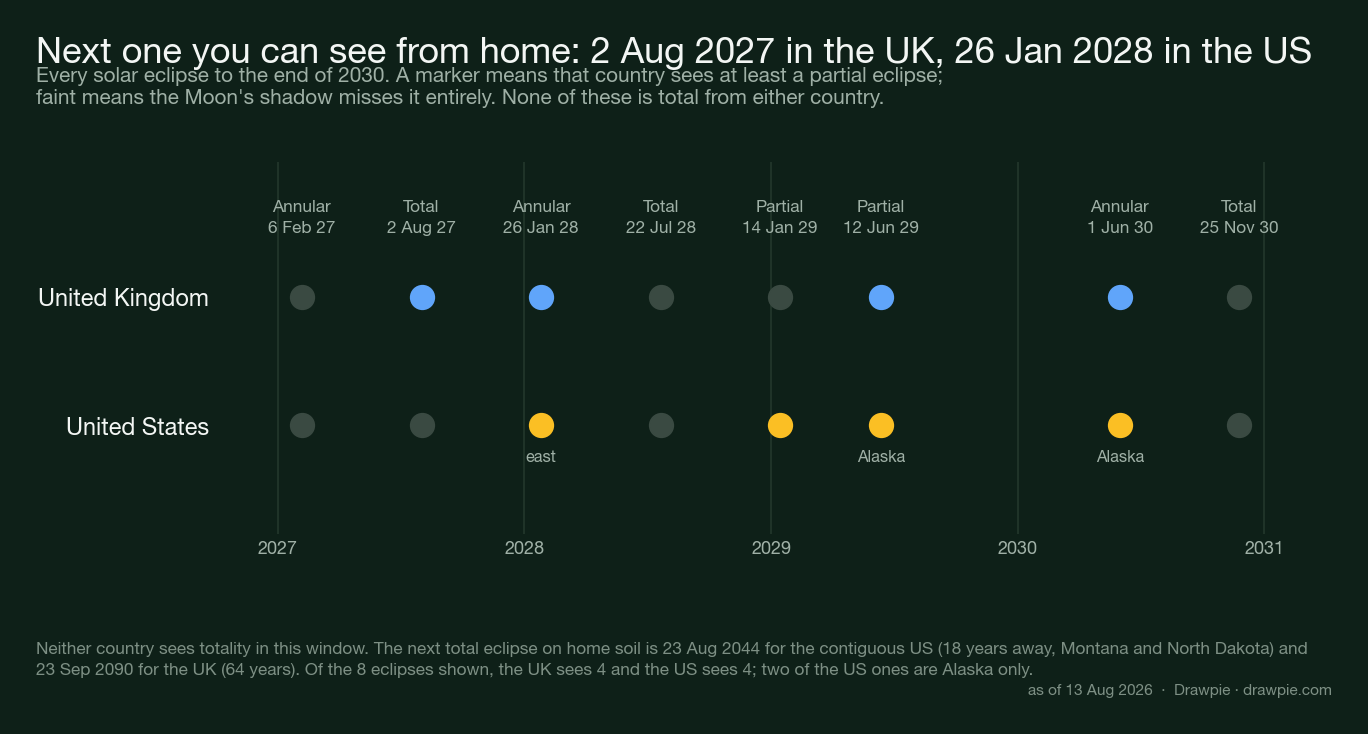
| Date | Type | Seen from |
|---|---|---|
| 6 Feb 2027 | Annular | Neither |
| 2 Aug 2027 | Total | UK only |
| 26 Jan 2028 | Annular | Both |
| 22 Jul 2028 | Total | Neither |
| 14 Jan 2029 | Partial | US only |
| 12 Jun 2029 | Partial | Both |
| 1 Jun 2030 | Annular | Both |
Two of those deserve a note.
2 August 2027 is the big one, but not from home. The Moon’s shadow crosses Morocco, southern Spain, Algeria, Libya, Egypt, Saudi Arabia, Yemen and Somalia, and totality lasts six minutes and 23 seconds — exceptionally long, and the reason eclipse chasers have had that date circled for years. From the UK it is a modest partial in the morning. From the US it is nothing at all.
26 January 2028 is an annular eclipse — the Moon is too far from Earth to cover the Sun completely, leaving a ring of Sun around it. The ring is visible from Ecuador, Peru, Brazil, Suriname, Spain and Portugal; the eastern United States and western Europe get a partial. An annular eclipse never becomes safe to look at with the naked eye, because the Sun is never fully covered, which makes filters more important for one of these than for a total eclipse, not less.
For anything after 2030: the next total eclipse visible from the contiguous US is 23 August 2044, with totality across Montana and North Dakota. Alaska gets one sooner, on 30 March 2033. The UK’s next total eclipse is 23 September 2090; the closest thing before that is 3 September 2081, when about 99% of the Sun is covered.
Where is the next total solar eclipse in the world, and at what time?
Egypt, at 10:07:50 UTC on 2 August 2027 — and it is the longest totality this century on land you can reasonably get to. That is the same eclipse the UK sees a slice of, and it is the one worth booking a flight for.
NASA puts greatest eclipse at 25°30′N 33°12′E, in the Egyptian desert not far from Luxor, with the Moon’s shadow 258 km (160 miles) wide and totality running 6 minutes 23 seconds at its longest. Both figures are worth reading carefully: the 6m23s maximum falls at a point in the desert southeast of Luxor, and Luxor itself gets about 6m20s. The city that everyone will name is a few seconds short of the number everyone will quote.
The shadow crosses Spain and Gibraltar, then Morocco, Algeria, Tunisia, Libya, Egypt, Saudi Arabia, Yemen and Somalia, west to east, over the course of a morning.
| Place | Totality lasts |
|---|---|
| Cádiz, Spain | 2m 55s |
| Tangier, Morocco | 4m 51s |
| Luxor, Egypt | 6m 20s |
| Jeddah, Saudi Arabia | 5m 59s |
On timing, work back from greatest eclipse at 10:07:50 UTC. Because the shadow travels eastward, the European and Moroccan end happens first — totality reaches Tangier at roughly 09:44 local time and Cádiz at roughly 10:47 local, which are 08:44 and 08:47 UTC — and Egypt sees it in the early afternoon, just after 1pm local time, since Egypt runs three hours ahead of UTC in August.
The reason this one has been circled for years is the length. It is described as the longest total eclipse on easily accessible land this century, with nothing longer until 3 June 2114. Everything in this article about filters applies to it in full: the only moment glasses come off is inside that 258 km strip, for those few minutes, and nowhere else on Earth that day.
Do I really need glasses for a partial eclipse?
Yes, for every second of it, and this is the part people get wrong. During a total eclipse there is a brief window when the Sun is completely covered and it is safe to look — but that window only exists inside the narrow path of totality. Everywhere else, and for every partial and annular eclipse, some part of the Sun’s disc is visible the whole time, and a partially covered Sun is exactly as damaging as an uncovered one.
The trap is that it does not feel that way. The sky dims, the glare drops, and the eye stops flinching — so the reflex that normally stops you staring at the Sun is the thing that goes away first. Solar retinopathy is painless as it happens and can take hours to show up.
The filter stays on the entire time.
Where can I buy eclipse glasses in the US?
From a manufacturer on the American Astronomical Society’s list, or from a dealer that manufacturer publicly names. This is the single most useful thing in this article and it is free to check.
The AAS runs the vetting programme the trade relies on. For every seller on its list it has confirmed three things: who actually manufactured the viewer, that the manufacturer’s viewers have been tested to ISO 12312-2 by a properly accredited laboratory, and that they meet the standard’s transmittance limits across the parts of the spectrum that can injure an eye. A manufacturer wanting on the list has to supply a test report from a laboratory accredited by a signatory of the International Laboratory Accreditation Cooperation’s mutual-recognition arrangement.
Its own caution is worth repeating: the AAS used to list wholesalers, distributors, retailers and resellers as well as manufacturers, and has stopped — “vetting all these suppliers became an overwhelming burden, and the AAS cannot support it any longer”. What is left is the list of manufacturers, about 25 of them for eclipse glasses and handheld viewers, and its advice is to buy from one of those makers or an authorised dealer they publicly name rather than from anyone “simply ‘cashing in’” on an eclipse. The list is not a ranking of quality. It is a list of the ones somebody checked.
Long-established US manufacturers on it include American Paper Optics in Tennessee, Thousand Oaks Optical in Arizona, Rainbow Symphony in California and DayStar Filters in Missouri. The practical rule is simply: identify the manufacturer first, then buy from them or from a dealer they name.
Where can I buy eclipse glasses in the UK?
There is no UK equivalent of the AAS list, so the American one is still the best tool you have — with one new European addition. The AAS itself now says its list “is no longer the sole list of vetted suppliers of safe solar viewers” and points European buyers to Eclipse Seguro, run by the Volunteer Astronomy Observers of Spain (OVAE), which checks EN ISO 12312-2:2015 certification documents for sellers ahead of the 2 August 2027 and 26 January 2028 eclipses. The AAS is careful to say it does not supervise that vetting, and it is a Spanish list rather than a UK one, but it is a second set of eyes where there used to be none. The UK Health Security Agency and the Royal Astronomical Society both give safety advice, but neither runs a vetting programme, and the RAS points readers to a third-party list with a handful of sellers on it — ukeclipse.com, which as of September 2026 still counts down to the 12 August 2026 eclipse and shows placeholder text where its featured retailers should be.
Three routes, in order of reliability:
- A manufacturer’s own shop. Several AAS-vetted makers ship internationally, and one — Sollunae — is listed by the AAS specifically for UK sales. Buying from the maker removes every intermediary who could substitute stock.
- A specialist astronomy retailer. Telescope shops carry solar viewers, know what the certification means and will tell you the manufacturer without you having to ask twice.
- Museum and observatory shops. The physical version of the same rule: an institution you can identify, with a supplier it can name.
What to avoid is the same in both countries: a general marketplace listing with no identifiable manufacturer, however many reassuring characters are printed on the frame.
How do I know a pair is genuine?
Not by the writing on the glasses. This is where a lot of well-meaning advice goes wrong.
The RAS and Greenwich both tell you to check for ISO 12312-2 — UKHSA gives the full designation as ISO 12312-2:2015(E) — printed on the frame. As a screen that is sensible, and if it is not there we would not use them.
But be clear about what it is. The standard’s own labelling clause does not ask for its number to be printed. What section 5 requires on the filter or its packaging is the name and address of the manufacturer, instructions for use, warnings that looking at the Sun without a proper filter can cause permanent injury, a warning to discard damaged filters, storage advice, and an obsolescence period where appropriate. A missing ISO string is a reason for suspicion; a missing manufacturer is a reason to stop.
The AAS makes the point that the marking cannot be the test: anyone can print those characters, and the worst counterfeits go further and print a real American manufacturer’s name on the frame. A printed claim proves that someone owned a printer.
So the test is the chain, not the label:
| Check | What good looks like |
|---|---|
| Where you bought it | Manufacturer direct, or a dealer they publicly name |
| The marking | ISO 12312-2 present — a sensible screen, but not what the standard actually requires |
| The lens | No scratches, pinholes, tears or wrinkled coating |
| The maker | A name and address on the filter or the packet, which the standard does require, and a batch you can trace |
| What you can see through it | Essentially nothing indoors. Very bright lights may show, very faintly |
That last row is the practical one, and the AAS gives it precisely: put them on indoors and look around, and “you shouldn’t be able to see anything through them, except perhaps very bright lights, which should appear very faint”. The disqualifying test is furniture: “if you can see anything else, such as household furnishings or pictures on the wall, your viewers aren’t dark enough for solar observing”.
Eclipse glasses are treated as protective equipment rather than as a novelty — Baader’s certification page cites the EU’s personal protective equipment regulation alongside the eye-safety standard, and the RAS’s advice on reusing an old pair turns on whether it is CE-marked. A pair with no maker’s name and no way to trace a batch is failing a test that has nothing to do with how dark it looks.
One genuine mark of a serious manufacturer is being able to check a specific batch. Absolute Eclipse, for instance, publishes its whole compliance file — the EU type-examination certificate from MTIC Intercert (notified body 0068), the test reports, the declaration of conformity and the instructions leaflet — as downloadable PDFs on its own site. That is what traceability looks like in practice, and it is exactly what a marketplace listing cannot give you.
What does ISO 12312-2 actually require?
That a filter be dark — and, less obviously, that it not be too dark.
Almost every article about eclipse glasses names the standard and stops there. It is worth a minute on what the number actually means, because it explains why sunglasses are not a near-miss but a different category of object.
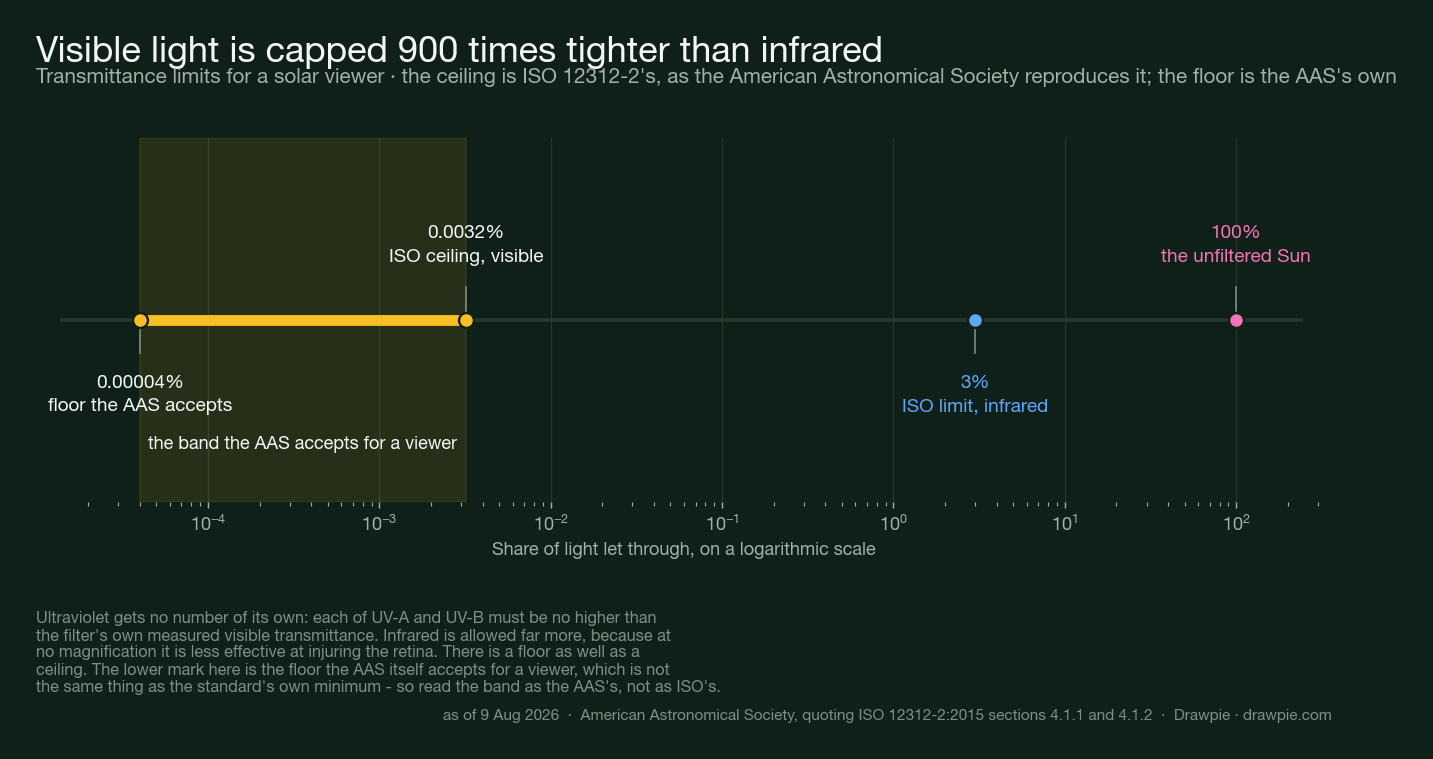
| What it limits | The limit |
|---|---|
| Visible light | no more than 0.0032% gets through |
| Ultraviolet A and B | each no higher than the filter’s own visible transmittance |
| Infrared | no more than 3% |
| Uniformity | even across the filter to within 10% |
Four things follow, and each answers a question people actually ask.
It sets a floor, not just a ceiling. A filter can fail the standard for being too dark. That sounds perverse until you remember that a viewer you cannot see the Sun through tempts you to take it off.
Infrared is allowed about 900 times more than visible light. Not an oversight: the AAS explains that at no magnification, infrared “is less effective at causing a retinal injury than UV or visible light”. It also disposes of a common claim that the standard only covers visible light. It does not.
Ultraviolet gets no number of its own. The limits are relative to the filter’s own visible transmittance, which is why a “UV400” rating on a pair of sunglasses tells you nothing about solar viewing.
It applies only to 1x viewing. The standard covers “nonmagnifying (‘unit power,’ or 1x), nonfocusing products”, handheld or worn as spectacles. This is the cleanest explanation of why a telescope filter is a different product under different rules — and why holding eclipse glasses behind an eyepiece is not covered by anything.
One more clause is worth quoting, because it kills a myth: on labelling, the standard requires a manufacturer to state an “obsolescence deadline or period of obsolescence, as appropriate”. It sets no fixed lifetime. The widely repeated claim that eclipse glasses expire after three years is not in the standard — the AAS’s own note is that modern viewers last up to ten years if stored and maintained well.
A caveat on all of the above. ISO 12312-2:2015 is a paywalled document and we have not read it. Every clause here is the American Astronomical Society reproducing it in quotation marks on its own eye-safety pages. In the UK the standard exists as BS EN ISO 12312-2:2015. A second edition is drafted but is still at approval stage, so the 2015 text is the one in force.
Which kind of filter do I actually need?
For looking at an eclipse: glasses, a handheld viewer, or sheet film from a maker the AAS lists for naked-eye viewing. Not telescope film.
The standard recognises two mountings — handheld, or spectacles worn over your own glasses — and requires that a mounted filter “shall be held securely so that it cannot be dislodged by normal handling or by gusts of wind”.
The trap is assuming that any solar film will do. Some film is made for naked-eye use — the AAS’s list of vetted makers has a whole category for “Eclipse Glasses, Handheld Solar Viewers & Solar Filter Sheets/Rolls”, and several of those companies sell sheets intended for direct viewing of the Sun. The bar is that the maker is on that list and says the material is for direct viewing; a manufacturer’s claim on its own is not the same as a vetted product. Film made for telescopes is a different thing again, and Baader says so about its own.
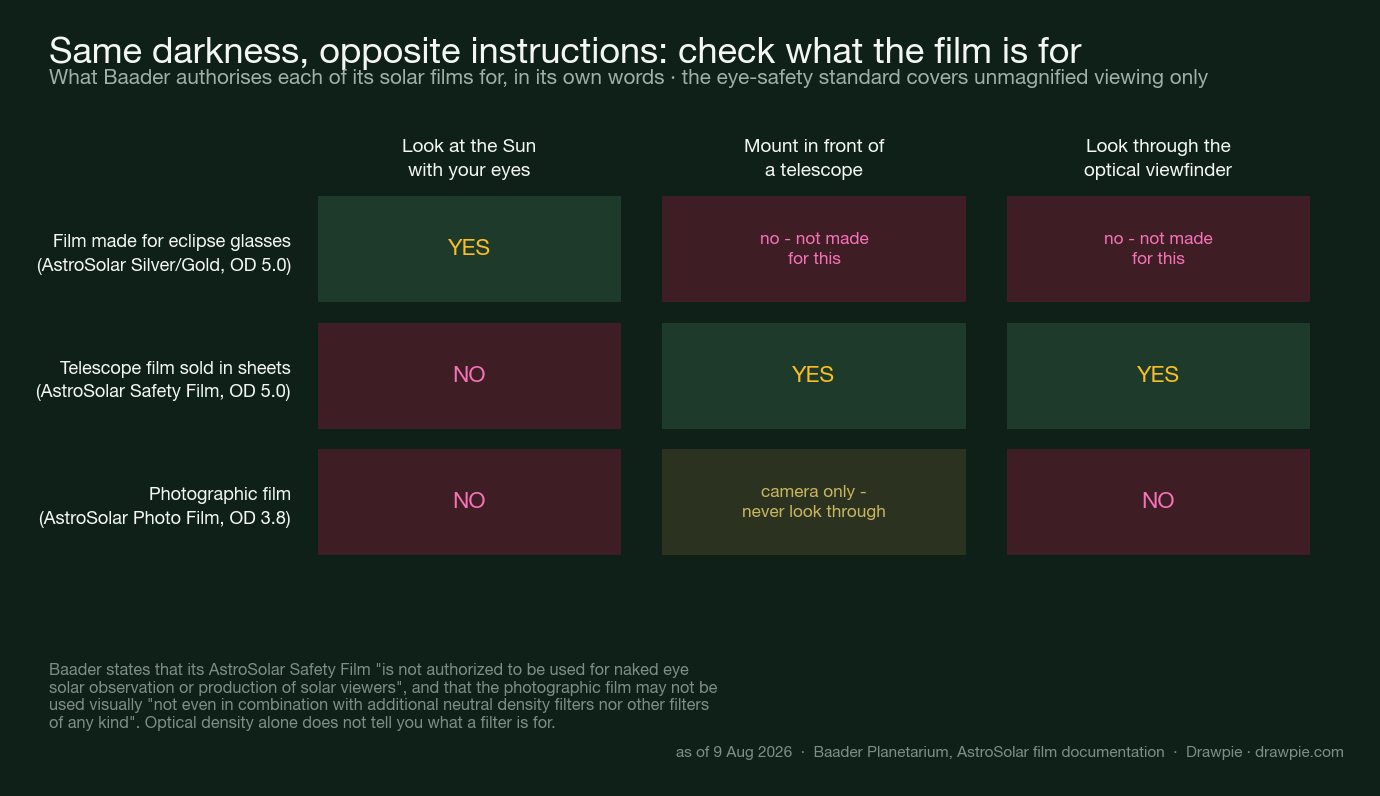
Baader’s AstroSolar Safety Film “is not authorized to be used for naked eye solar observation or production of solar viewers” — it is made to be mounted in front of a telescope, camera lens or binoculars. A different Baader film, the Silver/Gold, is the one “specially developed for visual solar observation at zero magnification for use with solar viewers”. The photographic film, at a lower optical density, “may not be used for visual solar observation — not even in combination with additional neutral density filters nor other filters of any kind”.
The reason is the one from the section above: the eye-safety standard covers unmagnified viewing, and, as Baader puts it, “does not apply to front aperture filters, covering long-range optics”. Optical density on its own does not tell you what a filter is for — the rule is what the manufacturer authorises it for, not what it is made of or how dark it is.
If you do own a telescope or binoculars, the RAS accepts solar film for them — “as long as the material fully covers the top end, with no chance of the filter being dislodged and no chinks in the holder”. Front end only, every time.
What about the glasses I kept from last time?
The two UK authorities differ here, and the difference is worth knowing.
- The Royal Astronomical Society sets two conditions, and the first is easy to miss. Its wording is that “if you have any official CE-marked eclipse glasses from previous events these may also be safe to use, but only if they have been stored safely and the surfaces haven’t been damaged in any way”. So it is not “any undamaged old pair” — it is a certified pair that is also undamaged. It tells you what to look for: “no tiny holes in the coatings, or wrinkles where the coating may have worn away”.
- The Royal Observatory Greenwich recommends simply buying fresh pairs.
A manufacturer puts a number on it. Baader, whose film is inside a lot of the glasses sold in Europe, tells owners: “Recommended storage time: up to 10 years after first use, or even longer after inspection.” That is the maker’s own figure, and it lines up with the RAS rather than with the folk rule that eclipse glasses expire after three years.
Both positions are defensible. If you have a pair, hold them up to a bright indoor light and look at the filter itself, not through it at the Sun: any pinhole, scratch, crease or separation of the film and they go in the bin. If you are not confident making that judgement, take Greenwich’s advice.
With years rather than days before the next eclipse in either country, there is a third option the previous version of this page could not offer: buy now, store them properly, and check them again nearer the time. The scramble that empties the certified sellers happens in the fortnight before an eclipse, not two years out.
What if I cannot get any glasses at all?
Then you watch a broadcast, which is free and involves no eye protection at all, because you are looking at a screen.
Major observatories stream eclipses live and list their own streams among the safe ways to watch — the Royal Observatory Greenwich did exactly that for the 2026 eclipse, putting its free feed first among four safe options. NASA does the same for eclipses crossing the Americas. Closer to any given date, check the observatory nearest the path.
Two other routes cost nothing and need no delivery:
- You may not need one each. The AAS is explicit: “Not everyone in a family or other group of observers needs their own eclipse glasses or handheld solar viewer.” Partial phases “progress quite slowly; there’s no point in watching continuously”, so “there’s plenty of time to share a small number of solar viewers among a large group.”
- Go to an event. Astronomical societies, observatories and museums run public viewing events for every significant eclipse, and many hand out or lend glasses. Check with the organiser before travelling on that basis — listings are written by organisers and often hedge with “while stocks last”.
For what a deep partial eclipse actually looked like from these islands, our coverage of the 12 August 2026 eclipse has the numbers.
How we verified this
The eclipse dates and types come from NASA’s five-millennium catalogue, not from news coverage. Every date, type and region in the timeline is taken from NASA’s decade tables for 2021-2030, 2031-2040 and 2041-2050, which state the visibility regions in NASA’s own wording. The next total eclipse dates for each country — 23 August 2044 for the contiguous US, with totality in Montana and North Dakota, and 23 September 2090 for the UK — come from the same catalogue and from timeanddate’s per-country eclipse listings.
The 2 August 2027 figures separate the hard numbers from the city-level ones. The time of greatest eclipse (10:07:50 UTC), its coordinates, the 258 km path width and the 6m23s maximum duration are the catalogue figures, and NASA’s own eclipse page for that date gives the greatest duration as 06m23.2s. The per-city totality lengths and the local times for Tangier and Cádiz come from eclipse-planning coverage rather than from the catalogue, so they are given as approximate. We checked them for consistency: Tangier at about 09:44 local (UTC+1) and Cádiz at about 10:47 local (UTC+2) are 08:44 and 08:47 UTC, which sits correctly west of the Egyptian maximum an hour and a half later.
The “longest this century” claim is attributed, not asserted. It is how the eclipse is described in reference coverage, together with 3 June 2114 as the next longer one. We have not independently ranked every totality of the century. Note also that the widely quoted 6m23s falls at a point southeast of Luxor rather than in the city, which gets about 6m20s.
One row on the chart reflects a disagreement between two sources, and we went with the finer-grained one. For 12 June 2029 NASA’s regional summary reads “Arctic, Scandinavia, Alaska, north Asia, north Canada” and does not name the UK; timeanddate, which computes visibility per location, lists it among eclipses visible from the United Kingdom. We mark it visible from the UK because a coarse regional label cannot rule out a small partial in the far north, and we note the difference here rather than hiding it.
This is an eye-safety article, so the sourcing is deliberately narrow. What is safe comes from the American Astronomical Society, which runs the vetting programme the trade relies on, the UK Health Security Agency, the Royal Astronomical Society and the Royal Observatory Greenwich. Two manufacturers’ own safety documentation is used where the point is about their products — Baader on which of its films may be used with the naked eye, and NASA on front-mounting filters. Nothing about safety comes from a retailer’s marketing.
We no longer quote prices or stock, and that is deliberate. The earlier version of this page tracked UK retail in the days before 12 August 2026, and every one of those figures was out of date within about 48 hours. A guide meant to be read years before the next eclipse cannot carry live retail, so it carries the routes instead: the vetting list, the manufacturer-direct rule and the physical-shop rule.
We do not print do-it-yourself viewing instructions, and that is a departure from official advice. Both UKHSA and the RAS suggest improvised indirect methods, and done correctly they are safe. We have left them out anyway: they stay safe only if they are followed exactly, an article has no way of checking that they were, and there is a route with no failure mode at all — watching a broadcast. Where we differ from an authority we say so rather than quietly dropping it.
The standard itself is behind a paywall and we did not read it. ISO 12312-2:2015 costs money and iso.org blocks automated access. Every clause quoted here is the American Astronomical Society reproducing it, and the article says so in the section itself rather than implying we have the document. The identity of the standard — 2015 edition, still current, adopted in the UK as BS EN ISO 12312-2:2015, with a second edition drafted but not yet in force — comes from the ISO committee catalogue and BSI.
One near-miss worth keeping. Sollunae is listed by the American Astronomical Society as “Sollunae (U.K. sales only)”, and it is easy to assume the address is sollunae.co.uk. That domain does not resolve at all; the shop is at sollunae.com. Publishing the plausible address would have sent readers nowhere.