UK State Pension NI Years: How Many You Need, How to Check & What a Gap Costs

- You need 35 qualifying years for the full new State Pension if your record started after April 2016 — and more than 35 if you were ever contracted out.
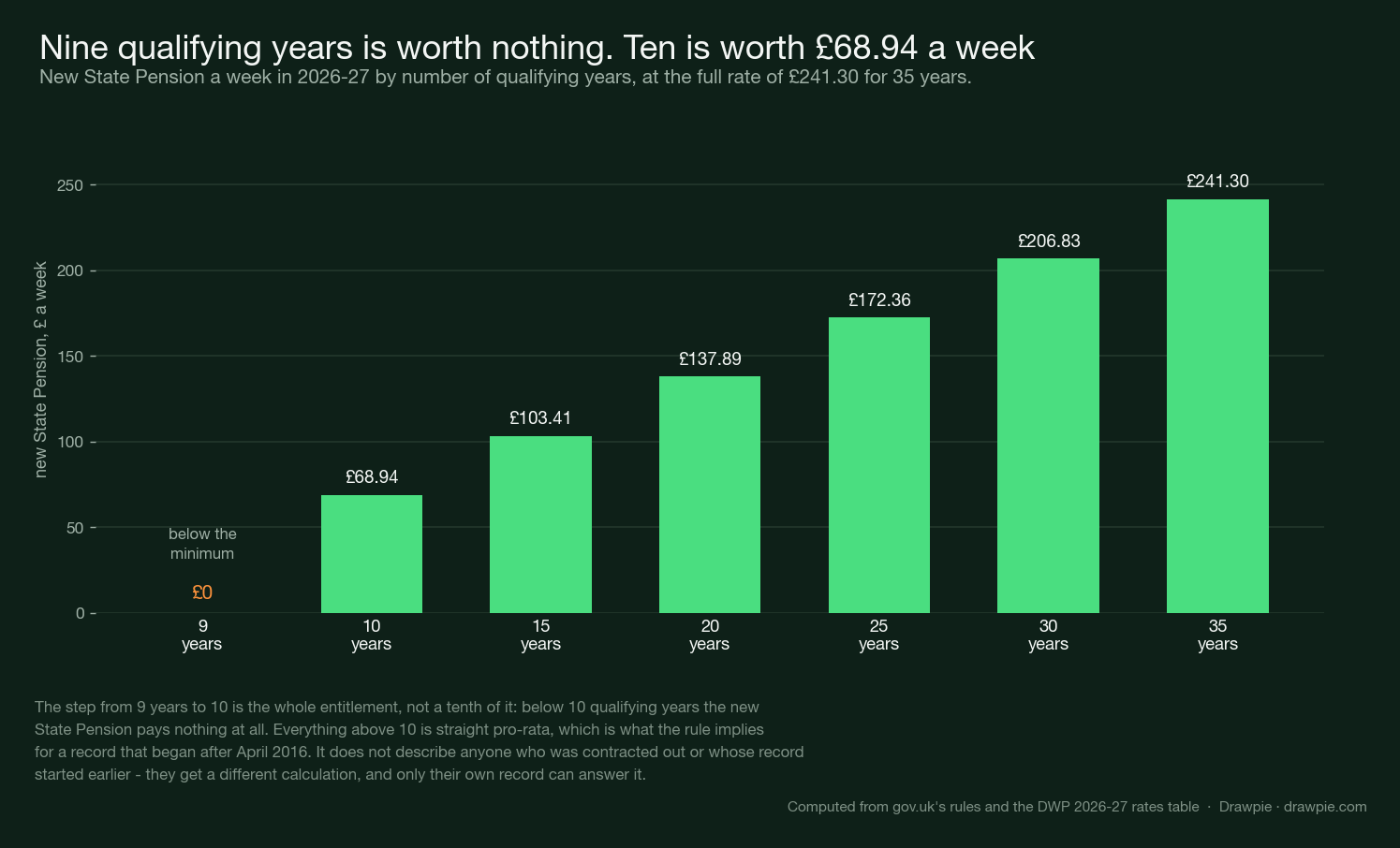
- You need 10 qualifying years to get anything at all. At 9 years the answer is nothing, not a smaller amount.
- The full rate is £241.30 a week in 2026-27, so on straight pro-rata each qualifying year is worth about £6.89 a week — roughly £358 a year, for life.
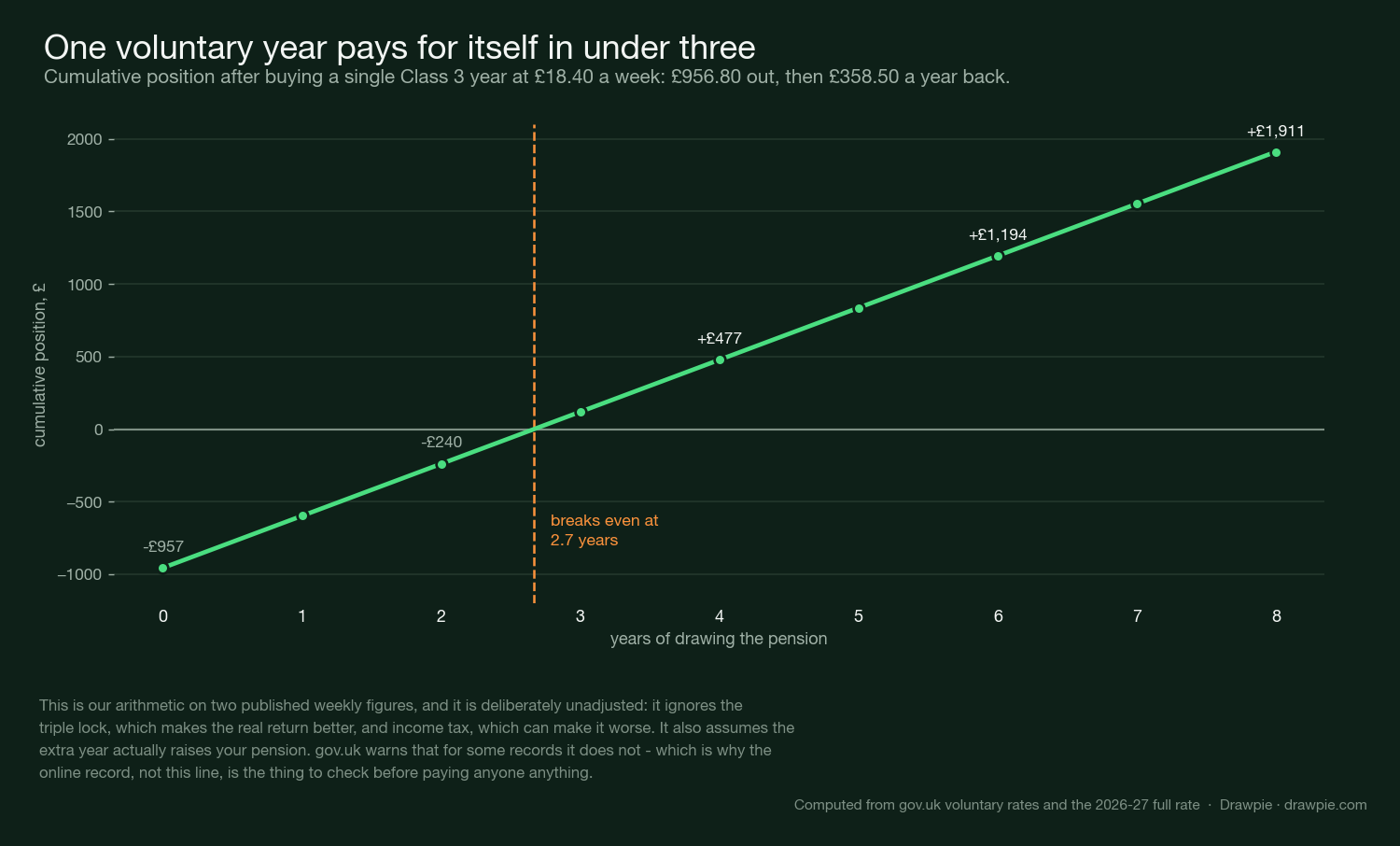
- A full year of voluntary Class 3 contributions costs £18.40 a week, about £957 for the year. On those figures it pays for itself in under three years of retirement.
- You can only buy back the past 6 tax years. The extended window has closed.
- Registering for Child Benefit gives you National Insurance credits even if you never take the money — the classic missed year for households that opted out over the high income charge.
- Grandparents who look after a child under 12, carers without Carer’s Allowance and people who did jury service all qualify for credits — but have to claim them.
- Before paying anything, check your own record online. It tells you whether paying would actually raise your pension, and what it would cost.
The full new State Pension is £241.30 a week. Getting all of it takes 35 qualifying years of National Insurance. Getting any of it takes 10.
That second number is the one worth knowing first, because it is a cliff rather than a slope — and because most of the ways to fill a gap in your record are free, and several of them have to be asked for.
35 years, and 10 to get anything
The rules, from gov.uk:
- 35 qualifying years gets you the full rate — if your National Insurance record started after April 2016.
- More than 35 if you were contracted out before 2016. While you were contracted out, less went into your State Pension and more into a workplace or private pension.
- 10 qualifying years is the floor for getting a new State Pension at all.
A qualifying year is one in which you were working and paying National Insurance, or getting National Insurance credits, or paying voluntary contributions. All three count the same.
The 9-year problem is not a small pension. It is no pension. That is the single most consequential line on this page, and it is why anyone near the bottom of the range should check their record rather than assume something is better than nothing.
Above 10 years it is straight proportion — full rate × years ÷ 35 — for a record that began after April 2016. If yours started earlier or you were ever contracted out, that line does not describe you and only your own record will.
How to see your own record
Check your National Insurance record on gov.uk. You will need to sign in and probably prove your identity with photo ID.
It shows six things, and the fourth is the one to read first:
- What you have paid, up to the start of the current tax year — 6 April 2026.
- Any National Insurance credits you have received.
- Whether gaps mean some years do not count as qualifying years.
- Whether you will benefit from paying voluntary contributions to fill them.
- How your forecast changes if you do.
- Whether you can pay online, and how much it would cost.
Point four is the whole ball game. For some records, paying to fill a gap raises nothing — you may already be on course for the full rate, or the year may fall somewhere it does not help. The service tells you before you spend anything. No article, this one included, can.
You can also request a printed statement online, by post from abroad, or by phone — but not for the current or previous tax year. And if you paid National Insurance in the Isle of Man, it will not appear on your record at all if you reach State Pension age after 5 April 2016; that has to be chased separately.
Why gaps happen
Almost never because someone decided not to pay. The common causes are ordinary:
- Working abroad, or a period living overseas.
- Self-employment with low profits, where contributions were not due.
- Employment below the threshold — part-time work, or several small jobs none of which individually reached it.
- A career break to raise children or care for someone, where the credits that should have covered it were never claimed.
- Opting out of Child Benefit over the High Income Child Benefit Charge without registering — which loses the credits along with the money, when registering alone would have kept them.
That last one is the most expensive mistake in this article and the easiest to fix going forward.
What filling one costs
Voluntary rates for 2026-27:
| Class | Weekly | A full year |
|---|---|---|
| Class 3 (the usual one) | £18.40 | £956.80 |
| Class 2 (some self-employed) | £3.65 | £189.80 |
What a year buys. On the full rate of £241.30 for 35 years, one qualifying year is worth £6.89 a week — about £358.50 a year, for the rest of your life.
So the arithmetic is £956.80 out, £358.50 a year back — a break-even at about 2.7 years of drawing the pension.
Three things that arithmetic does not include, and they pull in both directions:
- It ignores the triple lock, which raises the pension every year and makes the real return better than this.
- It ignores income tax, which can make it worse.
- It assumes the year actually raises your pension. gov.uk warns that for some records it does not. Check first.
Which rate you pay depends on the year. You usually pay the current rate. Paying Class 2 for the previous tax year, or Class 3 for the previous two, gets you the original rate for those years. Anything earlier is charged at the 2026-27 rate.
Who can pay at all is narrower than people expect: employed and earning under £129 a week without being eligible for credits; self-employed with gross income of £1,000 or less, or profits under £7,105; unemployed while claiming nothing and getting no credits. Past State Pension age you can still pay Class 3, and Class 2 if eligible.
The credits you have to ask for

This is where free qualifying years go missing, and the split is clean.
Arrive automatically — Universal Credit, Carer’s Allowance (or Carer Support Payment in Scotland), Jobseeker’s Allowance, Employment and Support Allowance, Maternity Allowance, a Jobcentre Plus training course, and registering for Child Benefit for a child under 12 even if you do not receive it.
You have to claim — and nobody writes to tell you:
- Grandparents and other family members looking after a child under 12. These are Specified Adult Childcare credits, and the child’s parent has to agree to transfer them.
- Carers doing 20+ hours a week who are not on Carer’s Allowance.
- Jury service, if you are not self-employed. Write to HMRC.
- Statutory sick, maternity, adoption, shared parental, neonatal or bereavement pay where you did not earn enough for a qualifying year. Also a letter to HMRC.
- Unemployed and looking for work but not on Jobseeker’s Allowance — contact your local Jobcentre.
- Foster carers, and kinship carers in Scotland.
- Transferring credits from a partner who received the Child Benefit.
The grandparent one is the most under-used credit in the system. A grandparent under State Pension age who looks after a grandchild so a parent can work is entitled to a qualifying year for it — and it is transferred from the parent, who is often already covered by their own employment and losing nothing.
The 6-year window
You can only pay voluntary contributions for the past 6 tax years. The deadline is 5 April each year.
The extended window that once let people reach back further has closed. What is left is the standing rule, and gov.uk’s own worked example of it: you have until 5 April 2032 to fill gaps in the 2025-26 tax year.
Apply the same six years to the oldest year still open and the 2020-21 tax year runs out on 5 April 2027. That date is our arithmetic on their rule rather than something gov.uk prints — but if you have a gap around 2020-21, this is the tax year to look at it in.
Two practical notes. Contributions paid now are usually charged at the current rate, so an older gap is not cheaper for being older. And if you are close to State Pension age, the Future Pension Centre will check whether a payment would benefit you; past pension age, that is the Pension Service.
The bottom line
35 years for the full rate, 10 to get anything, £241.30 a week at the top.
Check your record before you do anything else — it tells you whether you have a gap, whether filling it would help, and what it would cost. Then look at the free credits before the paid ones: a grandparent minding a toddler, a spell on a jury and a Child Benefit registration are all qualifying years that cost nothing, and all three are missed constantly.
Rules and rates from gov.uk’s new State Pension, National Insurance record, voluntary contributions and credits pages, with the full weekly rate confirmed against the DWP’s dated 2026-27 rates table. Cost, value and payback figures are our arithmetic on those published rates.