UK Pension Changes 2026–27: How Much You'll Get, When You Can Retire & New Tax Rules

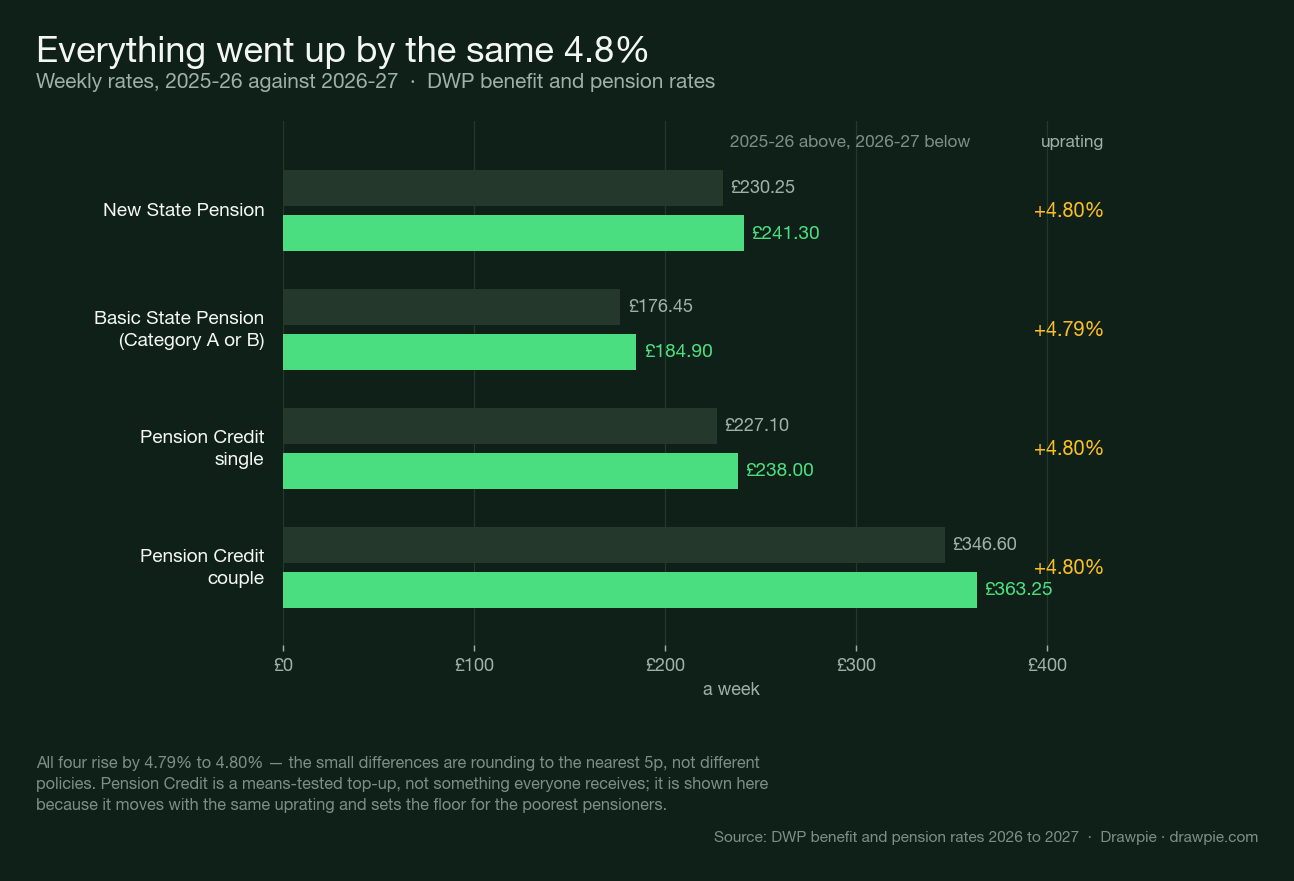
- The full new State Pension is £241.30 a week in 2026-27, up from £230.25 — a rise of 4.80%. The basic State Pension is £184.90, up from £176.45.
- That works out at £12,547.60 a year against a Personal Allowance of £12,570. The gap is £22.40 a year, or about 43p a week — 0.18% of the allowance.
- The tax rules did not change. The Personal Allowance is the same £12,570 it has been, and the bands are unmoved. What changed is that the State Pension moved towards a threshold that did not move back.
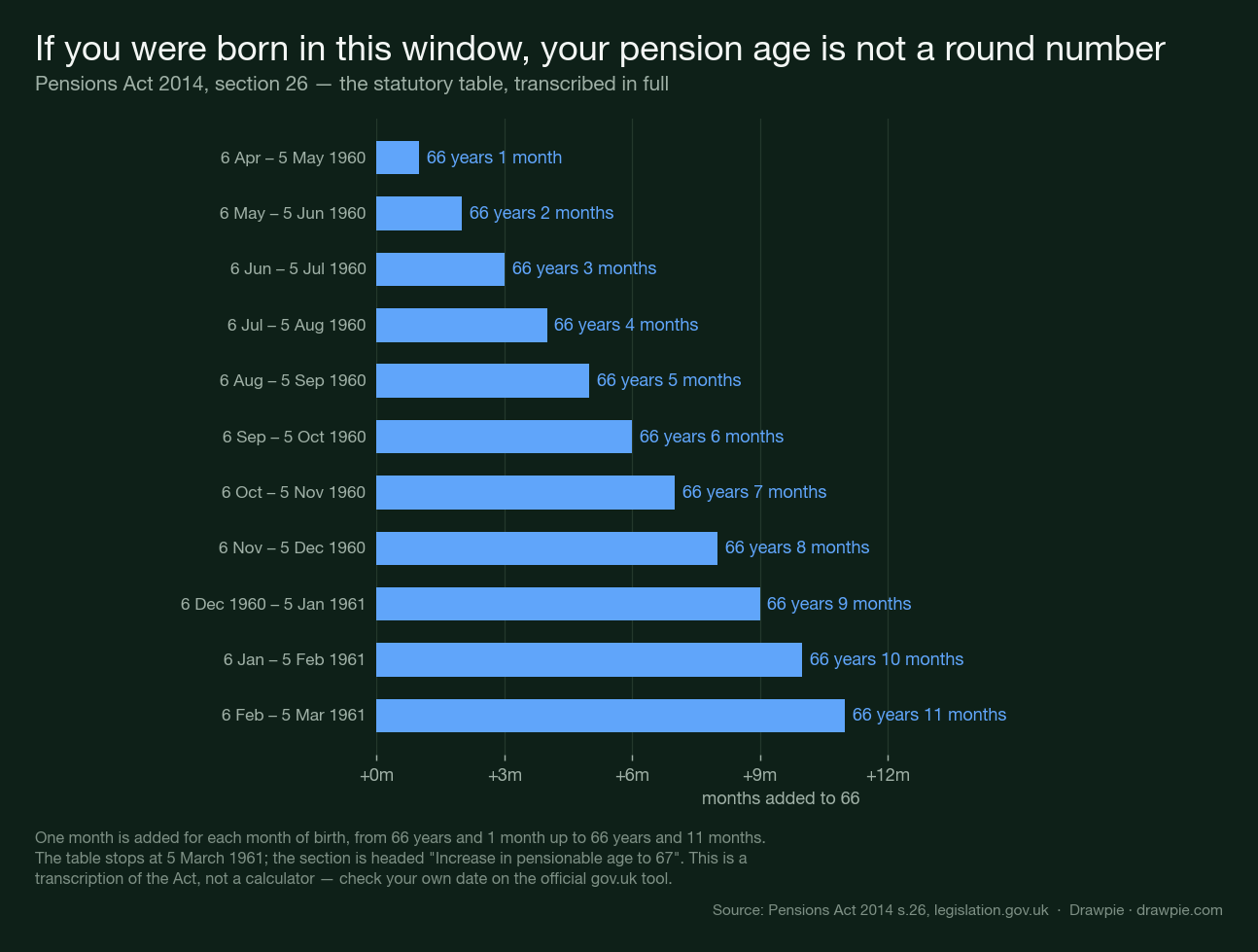
- If you were born between 6 April 1960 and 5 March 1961, your State Pension age is not 66 or 67 but 66 plus a number of months — set month by month in the Pensions Act 2014. The Act’s own worked example has someone born 31 July 1960 reaching pension age on 30 November 2026.
- The private-pension allowances gov.uk publishes are: £60,000 annual allowance, £268,275 lump sum allowance and £1,073,100 lump sum and death benefit allowance.
The full new State Pension is £241.30 a week in 2026-27. Over a year that is £12,547.60 — and the amount you can receive before income tax starts is £12,570.
The gap is £22.40 a year. About 43p a week. That is the whole of the tax-free headroom left on a full State Pension, and it is the single most useful number on this page.
Here is what the rates are, what the retirement age actually is, and where tax starts.
How much is the State Pension in 2026-27?
£241.30 a week if you get the full new State Pension, and £184.90 if you are on the old basic State Pension.
| Payment | 2025-26 | 2026-27 |
|---|---|---|
| New State Pension, full rate | £230.25 | £241.30 |
| Basic State Pension, Category A or B | £176.45 | £184.90 |
| Pension Credit, single | £227.10 | £238.00 |
| Pension Credit, couple | £346.60 | £363.25 |
Which one you are on depends on when you reached State Pension age, not on which you would prefer. The new State Pension applies to people reaching pension age from 6 April 2016; the basic State Pension is the older system.
The full rate is not automatic. gov.uk states that you need 35 qualifying years of National Insurance for the full new State Pension if your record began after April 2016 — and that more than 35 may be needed if you were contracted out at any point. Ten qualifying years is the floor for getting anything at all. We have gone through how many NI years you need, how to check your record and what a gap costs to fill separately.
Pension Credit is different in kind. It is a means-tested top-up, not something everyone receives. It is in the table because it moves with the same uprating and it sets the floor for the poorest pensioners.
How much has it gone up?
4.8%, and the same 4.8% across all four figures.
| Payment | Rise | In pounds a week |
|---|---|---|
| New State Pension | +4.80% | +£11.05 |
| Basic State Pension | +4.79% | +£8.45 |
| Pension Credit, single | +4.80% | +£10.90 |
| Pension Credit, couple | +4.80% | +£16.65 |
The 4.79% on the basic pension is not a different policy. It is the same uprating landing on a smaller number and being rounded to the nearest 5p. All four are the same decision.
Will you pay tax on your State Pension?
Not on the State Pension alone — but there is almost nothing left over.
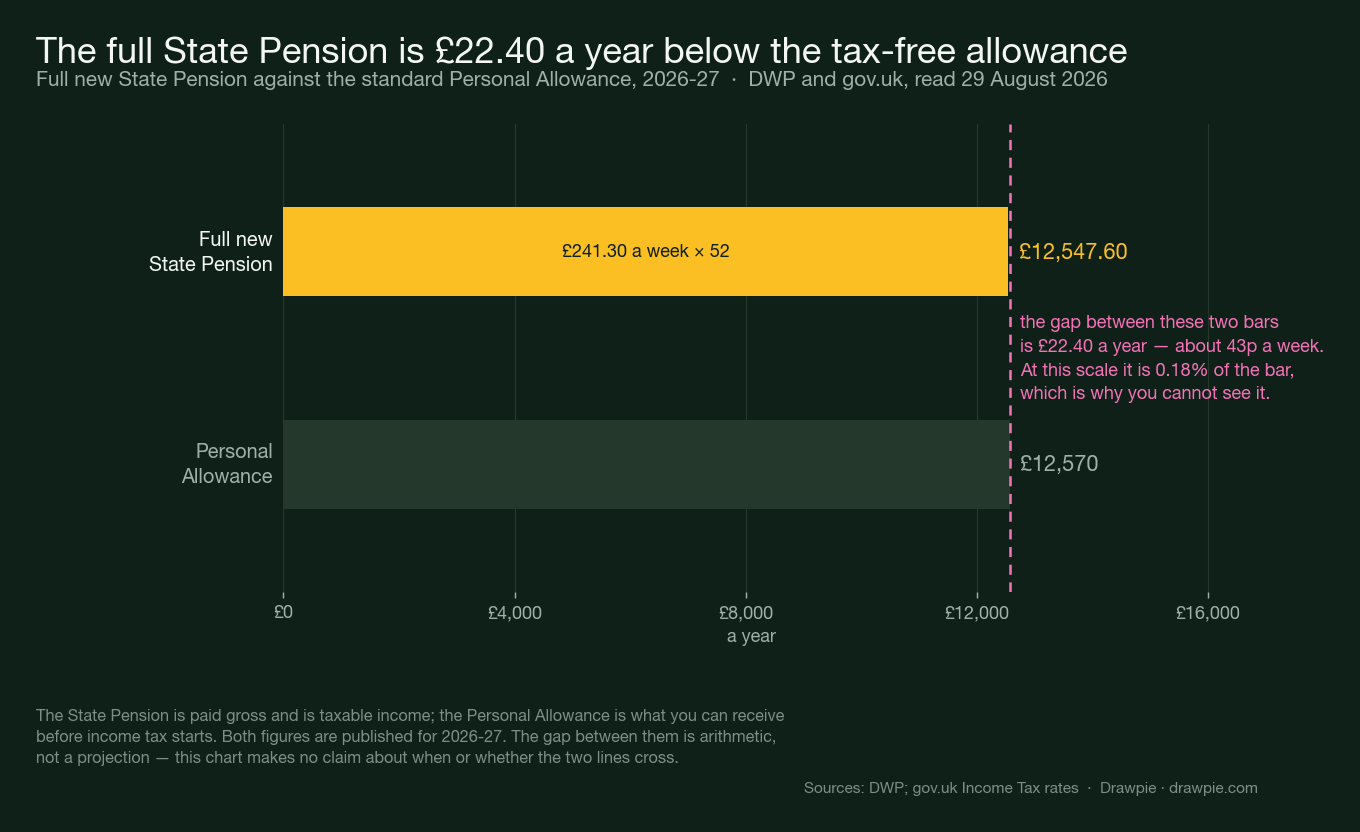
The arithmetic is short enough to do in public:
| £241.30 × 52 | £12,547.60 |
| Personal Allowance 2026-27 | £12,570 |
| Headroom | £22.40 a year |
The State Pension is taxable income. It is paid without tax deducted, which is why people assume it is tax-free, but it counts towards your Personal Allowance like any other income.
What that means in practice. If the full new State Pension is genuinely all you have, you pay no income tax — with £22.40 to spare. If you have anything else at all — a small private pension, part-time earnings, savings interest above your allowances — the tax starts on that other income almost immediately, because the State Pension has used up nearly all of the allowance first.
The bands for 2026-27, unchanged:
| Band | Taxable income | Rate |
|---|---|---|
| Personal Allowance | up to £12,570 | 0% |
| Basic rate | £12,571 to £50,270 | 20% |
| Higher rate | £50,271 to £125,140 | 40% |
| Additional rate | over £125,140 | 45% |
A note on the framing, because it matters. No income tax rule changed for 2026-27 in anything we checked. The allowance is the same £12,570; the bands sit where they sat. What changed is the pension, which rose 4.8% towards a line that did not move. That is a squeeze produced by arithmetic rather than by legislation, and it is worth being precise about which one you are looking at.
When can you retire?
Not at a round number, if you were born between April 1960 and March 1961.
Most coverage says the State Pension age “is rising from 66 to 67”. What the Pensions Act 2014 actually does is add one month for each month of birth across an eleven-month window.
| Born | State Pension age |
|---|---|
| 6 Apr – 5 May 1960 | 66 years 1 month |
| 6 May – 5 Jun 1960 | 66 years 2 months |
| 6 Jun – 5 Jul 1960 | 66 years 3 months |
| 6 Jul – 5 Aug 1960 | 66 years 4 months |
| 6 Aug – 5 Sep 1960 | 66 years 5 months |
| 6 Sep – 5 Oct 1960 | 66 years 6 months |
| 6 Oct – 5 Nov 1960 | 66 years 7 months |
| 6 Nov – 5 Dec 1960 | 66 years 8 months |
| 6 Dec 1960 – 5 Jan 1961 | 66 years 9 months |
| 6 Jan – 5 Feb 1961 | 66 years 10 months |
| 6 Feb – 5 Mar 1961 | 66 years 11 months |
The Act gives its own worked examples, which are useful because they are dates rather than durations:
- Born 31 July 1960 → reaches 66 years and 4 months on 30 November 2026
- Born 31 December 1960 → reaches 66 years and 9 months on 30 September 2027
- Born 31 January 1961 → reaches 66 years and 10 months on 30 November 2027
Two of those three fall inside 2026-27. This is not a future change being trailed; it is happening to people during the tax year this page covers.
The table stops at 5 March 1961, and the section is headed “Increase in pensionable age to 67.”
🔴 Do not take your own date from this table. It is a transcription of one section of one Act, and individual circumstances vary. Use the official Check your State Pension age tool, which is the government’s own calculator and is the only thing that should settle it.
What are the private pension allowances?
These are the figures gov.uk publishes, and they are worth knowing because they are the numbers people most often misremember. One caveat first: unlike the State Pension rates, gov.uk does not put a tax year on them, and we had no dated table to check them against — so read them as current rather than as confirmed for 2026-27.
| Allowance | Amount |
|---|---|
| Annual allowance | £60,000 |
| Lump sum allowance | £268,275 |
| Lump sum and death benefit allowance | £1,073,100 |
The lump sum allowance is the tax-free cash cap. gov.uk’s wording: you can usually take up to 25% of any pension as a tax-free lump sum, and “the most you can take is £268,275.” The 25% and the cash cap operate together — whichever bites first.
The £1,073,100 figure applies in specific circumstances, including serious ill health and death benefits paid to beneficiaries. Anything above your allowances is taxed as income, deducted by the provider before you receive it.
If you hold a protected allowance, from any of the older regimes, your figures are higher than these and none of this applies cleanly. That is a case for the provider or an adviser, not a table.
What this page cannot tell you
Your own pension. The amount above is the full new State Pension. What you get depends on your National Insurance record, and the only reliable answer is your own State Pension forecast .
Your own pension age. Use the calculator, not the table.
Whether the State Pension will cross the Personal Allowance. That would need two forecasts — a future uprating and a future allowance — and this page makes neither. What it reports is that the current gap is £22.40.
Anything about Scotland’s income tax rates, which differ from the rest of the UK on non-savings income and are not covered here.
The pension tax topics we did not source, including inheritance tax treatment, the normal minimum pension age, and contracting-out adjustments. Their absence here is a limit on our checking, not a statement that nothing is happening in them.
Sources
| Source | Used for |
|---|---|
| DWP — Benefit and pension rates 2026 to 2027 | Every weekly rate for both years, and therefore every uprating percentage |
| gov.uk — Income Tax rates and Personal Allowances | The £12,570 Personal Allowance and all four bands for 6 April 2026 to 5 April 2027 |
| Pensions Act 2014, section 26 | The full statutory pension age table and the three dated worked examples |
| gov.uk — The new State Pension: what you’ll get | The 35 qualifying years rule and the contracted-out caveat |
| gov.uk — Tax on your private pension: lump sum allowance | The £268,275 and £1,073,100 allowances and the 25% wording |
| gov.uk — Check your State Pension age · Check your State Pension forecast | The official tools this page defers to for anything personal |
How we verified this
🔴 This is information, not advice. It sets out published rates, published thresholds and what the statute says. It does not tell you what your own State Pension will be, when you personally can retire, or what to do about any of it. For your own pension age, use the official gov.uk calculator; for your own forecast, use the State Pension forecast service. Both are linked below.
✅ Every figure is from a primary source, read on 29 August 2026. Rates are from the DWP’s “Benefit and pension rates 2026 to 2027”, updated 16 February 2026, which prints the 2025-26 and 2026-27 columns side by side — so the comparison is the department’s own, not two documents stitched together. The Personal Allowance and income tax bands are from gov.uk’s Income Tax rates page for 6 April 2026 to 5 April 2027. The pension age table is from the Pensions Act 2014 on legislation.gov.uk.
🔴 The pension age table was transcribed row by row, not interpolated. It would have been quick to read the first row (66 years and 1 month) and the last (66 years and 11 months) and fill in the middle by pattern. All eleven rows were pulled from the Act instead. The pattern turns out to be regular — one month added per month of birth — but a statutory table is exactly the sort of thing that has irregular rows, and assuming otherwise is how errors get published.
⚠️ “New tax rules” is the brief’s framing, and this page does not adopt it. No income tax rule changed for 2026-27 in the sources checked: the Personal Allowance is £12,570 and the bands sit where they sat. The change worth writing about is the other side of the same sum — the State Pension rising 4.8% towards a threshold that stayed still. The page says that rather than implying legislation that we could not find.
⚠️ The £22.40 headroom uses 52 weeks, which is a convention rather than a law of nature. The State Pension is paid every four weeks, and a tax year does not contain exactly 52 payment weeks every year. £241.30 × 52 is how the annual figure is conventionally quoted and how it is quoted here, but your own taxable amount for a given year can differ slightly.
⚠️ A figure without a year attached is not a 2026-27 figure until something says so. gov.uk’s own new State Pension page gives £241.30 with no tax year on it. That is why the DWP rates document is the source used here: it shows £241.30 in the 2026-27 column against £230.25 for 2025-26, so the year is stated rather than assumed.
⚠️ The three private-pension allowances carry no year label on gov.uk either, and unlike the State Pension we had no dated table to check them against. The £60,000 annual allowance, £268,275 lump sum allowance and £1,073,100 lump sum and death benefit allowance are reported as the figures gov.uk publishes today. The body says so in as many words, and deliberately does not call them “the 2026-27 allowances” — that is a claim we cannot support with what we read.
What is not covered. This page does not deal with inheritance tax treatment of pensions, the normal minimum pension age, contracting-out adjustments, protected allowances, or the Scottish rate of income tax — each of which changes the picture for some people and none of which we sourced here.