UK Partial Lunar Eclipse 2026: Date, Time, 93% Coverage & Where to See It
This page is written for the morning of Friday 28 August 2026. The date comes from NASA’s eclipse catalogue, not from an estimate. Once the eclipse has happened, the timings and the viewing advice stop being useful and the page should either be retired or rewritten around what was actually seen.
Everything else on the page is unaffected; the figures below still say when they were read.

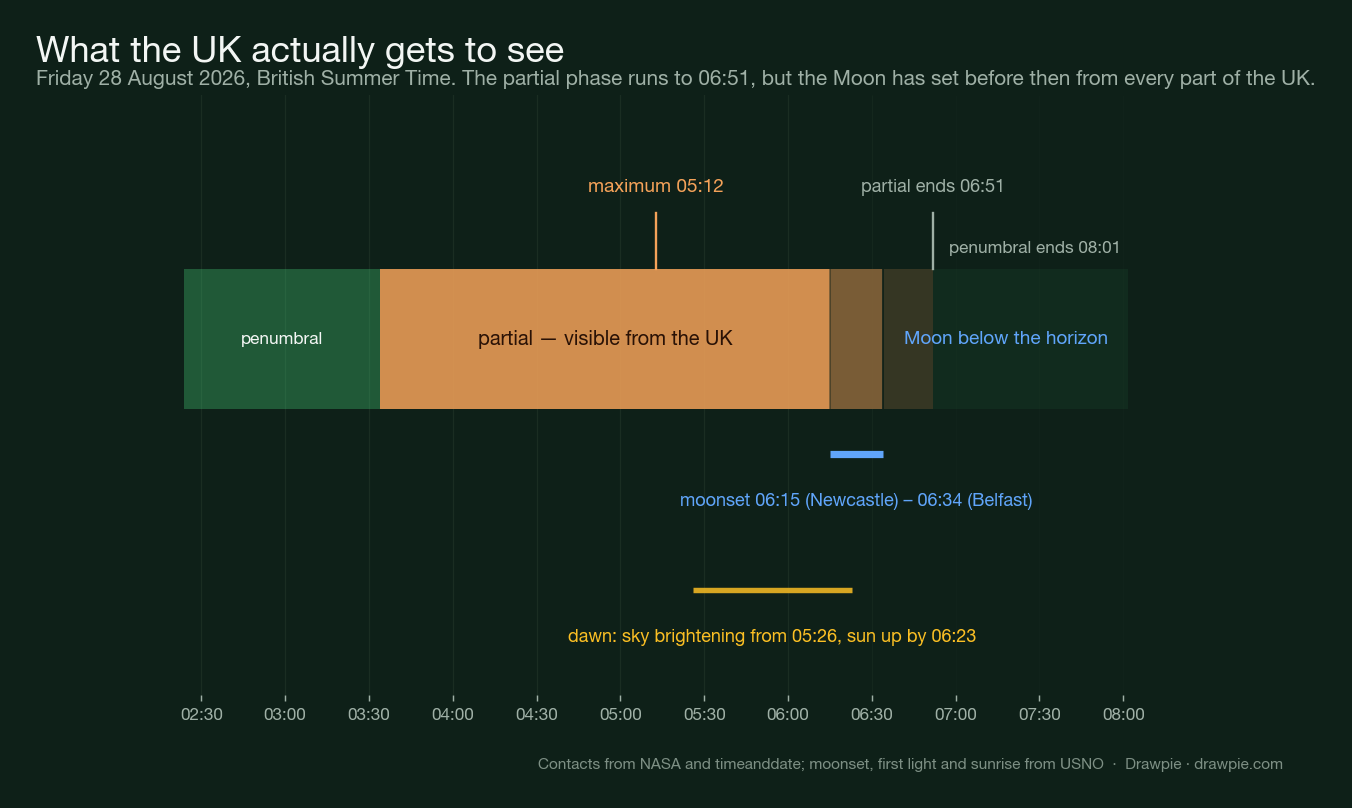
- The partial lunar eclipse falls in the early hours of Friday 28 August 2026. The partial phase starts at 3.33am BST, maximum is at 5.12am, and the times are the same everywhere in the UK. What changes with location is how high the Moon sits and when it sets.
- At maximum the Moon is only 7–10° above the horizon, bearing roughly west-southwest. You need a genuinely clear low horizon in that direction; a hedge or a terrace will hide it.
- The eclipse is billed at 93%, and that is the fraction of the Moon’s diameter in Earth’s umbra. The fraction of its visible face is higher, at 96.2%. Both numbers are correct and they are measuring different things.
- The Moon sets before the partial phase ends. Moonset runs from 6.15am in Newcastle to 6.34am in Belfast; the eclipse does not finish until 6.51am, so nobody in the UK sees the end of it.
The UK gets one lunar eclipse in 2026, and it is a good one. In the early hours of Friday 28 August, the Moon slides almost entirely into the Earth’s shadow — deep enough that only a thin bright rim survives.
The catch is the hour and the height. Maximum comes at 5.12am BST, by which point the Moon is low in the west-southwest and sinking towards a brightening sky. Get the direction wrong, or pick a spot with anything on the western horizon, and you will miss it entirely.
When is the 2026 partial lunar eclipse in the UK?
It runs from 2.23am to 6.51am BST on Friday 28 August, with maximum at 5.12am. Those times are the same in Penzance and in Lerwick — a lunar eclipse is the Earth’s shadow falling on the Moon, so everyone on the night side sees it happen at the same instant.
| Stage | Time (BST) | What happens |
|---|---|---|
| Penumbral eclipse begins | 2.23am | The Moon enters the outer shadow. Very subtle |
| Partial eclipse begins | 3.33am | A dark bite appears at the edge |
| Maximum eclipse | 5.12am | 93% of the Moon’s width in deep shadow |
| Moonset | 6.15am to 6.34am | The Moon disappears, still eclipsed |
| Partial eclipse ends | 6.51am | Below the horizon across the UK |
The two hours in the middle are the ones that matter. Before 3.33am the Moon only dims slightly, which is hard to notice unless you are watching for it, and the whole event does not formally finish until 8.01am — long after the Moon has gone.
What does “93% coverage” actually mean?
It is the share of the Moon’s width, not its face. At maximum, 93% of the Moon’s diameter is inside the umbra — the dark central part of the Earth’s shadow. Measured by area instead, the shaded portion is larger still, at 96.2%.
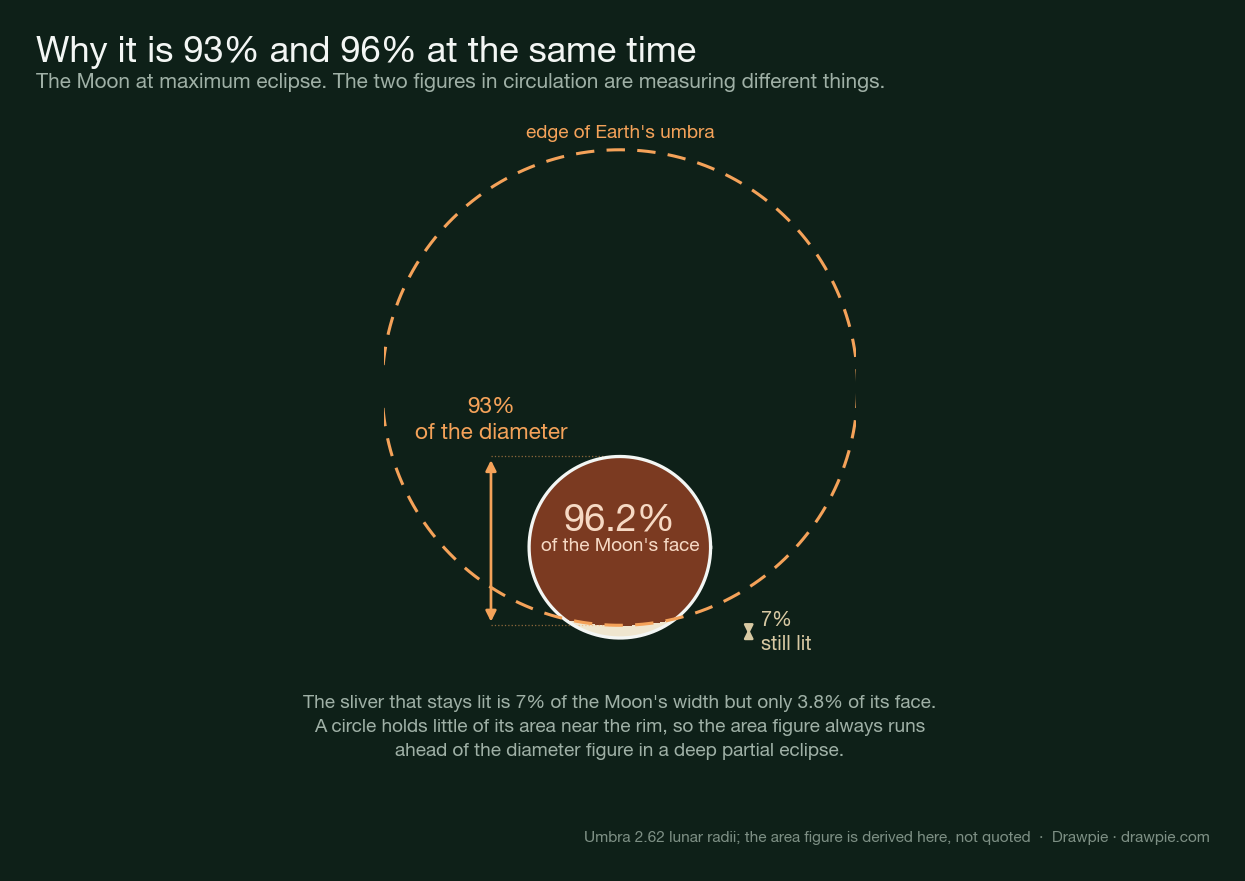
Both figures describe the same picture; they just measure it differently. A circle carries very little of its area out at the rim, so once a shadow has swallowed 93% of the width, it has already taken 96% of the visible face. The sliver left in sunlight is 7% of the Moon’s width and only 3.8% of its face.
Neither number means totality. Nowhere on Earth sees a total lunar eclipse on this date — the Moon’s northern edge stays just outside the umbra all the way through.
Where in the UK can you see it?
Everywhere, at the same times. The Royal Observatory Greenwich puts it plainly: unlike a solar eclipse, the whole of the British Isles sees the same percentage of the Moon in shadow. What differs from place to place is how high the Moon sits at maximum, and how long you have before it sets.
| City | Max height | Moon sets |
|---|---|---|
| Cardiff | 9.6° | 6.29am |
| Belfast | 9.4° | 6.34am |
| Birmingham | 8.5° | 6.22am |
| Manchester | 8.2° | 6.21am |
| London | 8.0° | 6.16am |
| Glasgow | 8.0° | 6.25am |
| Edinburgh | 7.4° | 6.20am |
| Newcastle | 7.1° | 6.15am |
The spread is small. Belfast, the most westerly of the eight, holds the Moon almost twenty minutes longer than Newcastle, and Cardiff sits it two and a half degrees higher than Newcastle at maximum. Nowhere in the UK is meaningfully better than anywhere else — your horizon matters far more than your postcode.
Why does the Moon set before the eclipse ends?
Because the eclipse is happening as the Moon is already on its way down. It is full, so it sets at about the same time the Sun rises, and maximum eclipse falls barely an hour before that.
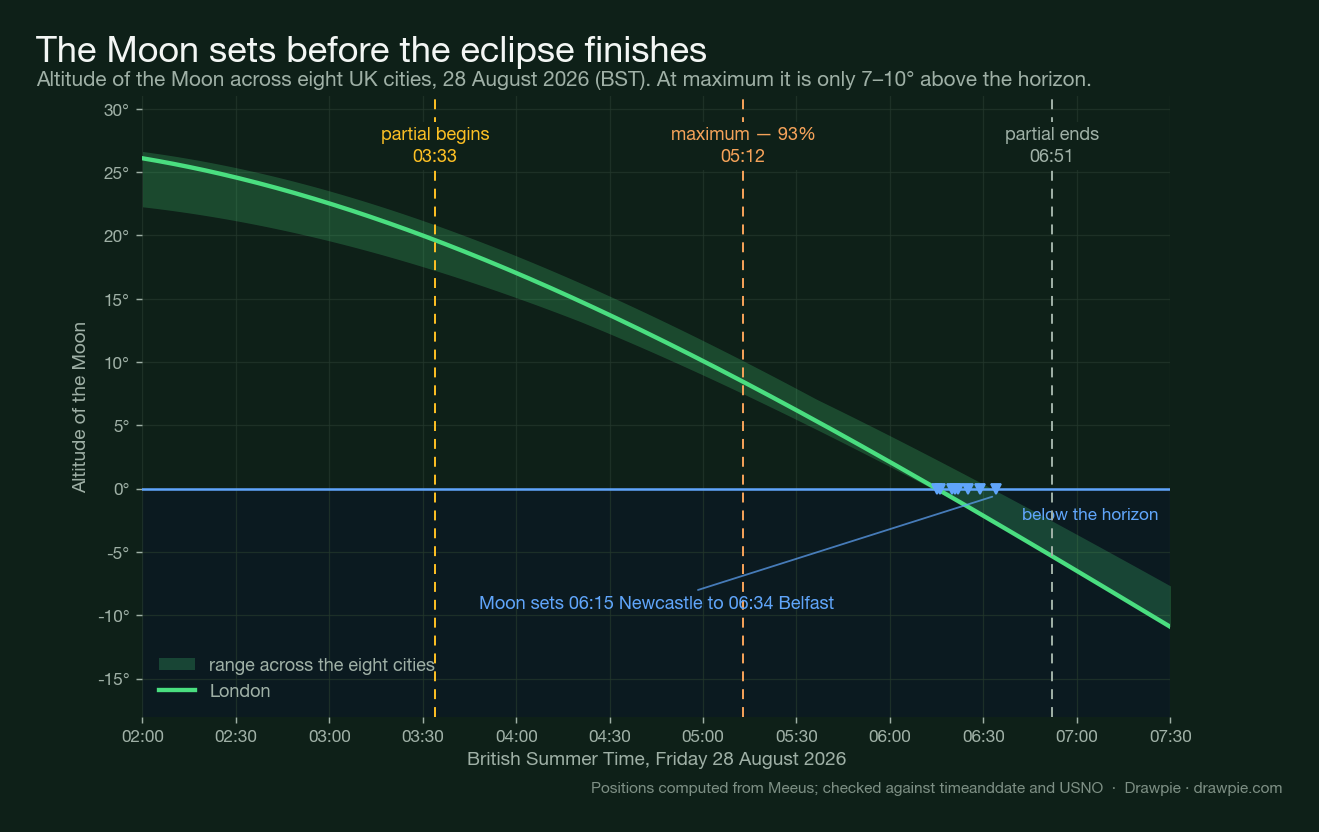
At 3.33am, when the first bite appears, the Moon is around 17–21° up — a comfortable height, roughly two fists at arm’s length above a flat horizon. By maximum it has dropped to 7–10°, which is one fist. Then it goes.
The last stages happen below the horizon everywhere in the country. The partial phase does not end until 6.51am, and the latest UK moonset is Belfast’s at 6.34am. Whatever you see, you will not see the Moon come back out of the shadow.
Dawn works against you at the same time. First light arrives between 5.26am and 5.45am depending on where you are, so maximum at 5.12am lands in the last properly dark stretch of the night — narrowly, and only just.
Which way should you look?
West-southwest, and low. At maximum the Moon sits on a bearing between 237° and 242° from the eight cities above, and by moonset it has swung round to roughly 253°–255°. In practice that means the Moon tracks right and downwards through the eclipse.
The Royal Observatory’s advice is to find a high vantage point with a clear view towards the south-western horizon. At 8° above the horizon, a line of houses two streets away is enough to block the Moon completely, and so is a low ridge or a stand of trees. A hilltop, a coastal path facing west, or an upstairs window on the right side of the building will all do better than a garden.
Do you need eclipse glasses for a lunar eclipse?
No. The Royal Observatory Greenwich states it directly: no special glasses are required, and watching it is as safe as looking at the full Moon. That is the fundamental difference between a lunar and a solar eclipse — here you are looking at reflected moonlight, not at the Sun.
Binoculars are worth having, though, purely because the Moon will be low and small in a big sky. Nothing is required beyond your eyes and a clear view.
Will the Moon turn red?
The shadowed part may look reddish or coppery, which is where the popular term “blood moon” comes from. Sunlight bends through the Earth’s atmosphere and is scattered on the way, and the light that reaches the Moon is what is left after that — the same physics that reddens a sunset.
This one comes with a caveat that a total eclipse does not have. Because 7% of the Moon’s width stays in direct sunlight, there is a brilliantly lit rim right next to the shadowed part for the whole eclipse. That bright edge is far brighter than the coppery region beside it, so the colour tends to read best in photographs and through binoculars rather than to the naked eye.
What is the weather forecast for the eclipse?
Unsettled, on the Met Office’s current outlook — but five days out that is a tendency, not a forecast. Its long-range text for 27 August to 5 September, issued at 3am on 23 August, reads: “A relatively unsettled start to this period, as showers or longer spells of rain are possible across many parts of the UK. Some heavy bursts and thunderstorms are likely at times.”
That is not encouraging, and it is also not specific enough to write off any particular hour in any particular place. Check a local forecast the evening before. Given the Moon will be at 8°, low cloud on the western horizon will matter more to you than the sky overhead.
When is the next lunar eclipse visible from the UK?
Not for another eighteen months. The next one visible from London is a penumbral eclipse on 20–21 February 2027, which is the faint kind where the Moon merely dims. For another partial you wait until 12 January 2028.
That is what makes this one worth setting an alarm for. There was a second lunar eclipse in 2026 — a total one on 3 March — but NASA’s visibility list for it covers eastern Asia, Australia, the Pacific and the Americas, and not Europe. From the UK, 28 August is the only lunar eclipse of the year.
It also comes just over a fortnight after the 12 August total solar eclipse , and that pairing is not a coincidence: solar and lunar eclipses come in pairs about two weeks apart, at opposite ends of the same alignment.
Sources
| Source | Used for |
|---|---|
| NASA — Catalog of Lunar Eclipses: 2001 to 2100 | Greatest eclipse at 04:14:04 TD, ΔT of 75 seconds, Saros 138, gamma 0.4964, umbral magnitude 0.9299, penumbral magnitude 1.9645, and the 198.1-minute partial phase used to derive the contact times |
| NASA — Lunar Eclipses: 2021 to 2030 | The definition of umbral magnitude as the fraction of the Moon’s diameter in the umbra, and the visibility regions for both 2026 lunar eclipses |
| Royal Observatory Greenwich — 28 August 2026 partial lunar eclipse | The BST stage times, that the whole of the British Isles sees the same percentage, the south-western horizon advice, that no eclipse glasses are needed, that nowhere sees totality, and the ‘blood moon’ explanation |
| timeanddate — 28 August 2026 partial lunar eclipse | Contact times to the second, magnitude 0.930 and obscuration 96.2% with the definitions of each |
| timeanddate — the eclipse from London | Per-city altitude and bearing at each stage, for London and the seven other cities on the equivalent pages |
| US Naval Observatory — rise, set and twilight API | Moonset, first light and sunrise for all eight cities, and the exact time of full Moon |
| Met Office — UK forecast | The long-range outlook for 27 August to 5 September, quoted as issued at 03:00 UTC on 23 August 2026 |
How we verified this
Every time on this page was derived twice, from independent sources, before it was printed. NASA’s five-millennium catalogue gives greatest eclipse at 04:14:04 Terrestrial Dynamical Time with ΔT of 75 seconds and a partial phase lasting 198.1 minutes. Working the contact times out from those figures reproduces timeanddate’s published times to within eight seconds, and both agree with the Royal Observatory Greenwich’s own page to the minute. The BST times quoted are the ones all three sources share.
✅ The per-city altitudes and moonset times were recomputed rather than copied. There is no astronomy library on the machine this was written on, so the Moon’s position was implemented directly from Meeus and then held to a standard: it had to reproduce all forty of timeanddate’s published altitude and azimuth values for the eight cities, and it had to land on USNO’s moonset times. It clears the second test by 1.2 minutes at worst. The chart script refuses to draw anything if either check fails.
🔴 The 93% and 96.2% figures are not in conflict, and the difference is not cosmetic. NASA defines umbral magnitude as “the fraction of the Moon’s diameter immersed in Earth’s umbral shadow” — that is the 0.930. The share of the Moon’s visible face is a separate quantity, and timeanddate publishes it as 96.2%. Rather than take that on trust, the geometry was solved here: an umbra of 2.62 lunar radii with centres 1.76 lunar radii apart gives a magnitude of exactly 0.930 and an overlapping area of 96.20%. Note that the Royal Observatory’s page describes the 93% as “roughly 93% of its visible surface”, which is the diameter figure attached to the area’s wording.
🔴 A “deepest of the decade” line was drafted for this page and then cut, because it does not survive NASA’s own table. Six total lunar eclipses between 2021 and 2030 list Europe in their visibility, the deepest being 26 June 2029 at umbral magnitude 1.844, and the partial of 19 November 2021 was deeper than this one at 0.974. What the table does support is the narrower claim made here: the other 2026 lunar eclipse, the total on 3 March, lists eastern Asia, Australia, the Pacific and the Americas and not Europe, so 28 August is the UK’s only one this year.
⚠️ Two of the seven sources could not be read the same way as the others, and both are flagged. timeanddate serves a bot challenge to a plain fetch, so its pages were read in a browser instead; its own default view also localises to the reader’s IP, so every per-city figure here was taken from an explicitly city-addressed URL rather than from whatever the site offered. The USNO endpoint returns JSON with no page title, so it was checked by its content rather than by a title comparison. The other five links each return a distinct title, and invented control paths on the same hosts each return a clean 404.
⚠️ The weather line is an outlook, not a forecast for the morning itself. It is the Met Office’s own long-range text for 27 August to 5 September, read at 03:00 UTC on 23 August — five days out. No cloud-cover prediction for the eclipse hours appears here, because at this range nobody has one worth printing.
Nothing on this page tells you what you personally will see, because that depends on your horizon and the cloud. The altitudes are for eight city centres at sea level; a hill helps and a building does not.