UK Mortgage Rates Hit a One-Month High: What It Means for Buyers and Remortgagers
Update log (1)
- — Published three days after the rates quoted. Mortgage pricing changes daily and the Bank of England decides on 30 July.

- Average two-year fixes reached about 5.57% on 22 July, up roughly 0.10 points in a week; five-year fixes reached about 5.60%. Over 100 deals were pulled in the same week and several lenders repriced twice.
- The Bank of England has not moved. Base rate is 3.75% and is widely expected to stay there on 30 July. Fixed rates track swap rates, which rose as oil climbed through July and Gulf risk pushed the forward curve up — though the Bank says much of that curve move is risk premium rather than a forecast of rises.
- A one-month high is not a high — but only for the two-year. It sits about 0.11 points below its end-May level of roughly 5.68%. The five-year, at 5.60% against about 5.63%, is effectively back where it was.
- On a £200,000 mortgage the week’s rise costs about £12 a month. Lapsing onto the average 7.13% standard variable rate instead of a 4.60% fix costs roughly £307 a month. The second number is the one worth acting on.
Average UK fixed mortgage rates reached a one-month high in the week to 22 July 2026. The two-year average rose to about 5.57% from 5.47%; the five-year to about 5.60% from 5.49%. More than a hundred deals were withdrawn in a week, and several lenders repriced twice.
The Bank of England did not do any of this. Base rate is 3.75%, it has not moved, and it is widely expected to stay there when the Monetary Policy Committee decides on 30 July.
What repriced your mortgage was the cost of funding a fix.
All figures below are date-anchored, because mortgage pricing changes daily. This is general information, not financial advice.
What actually moved
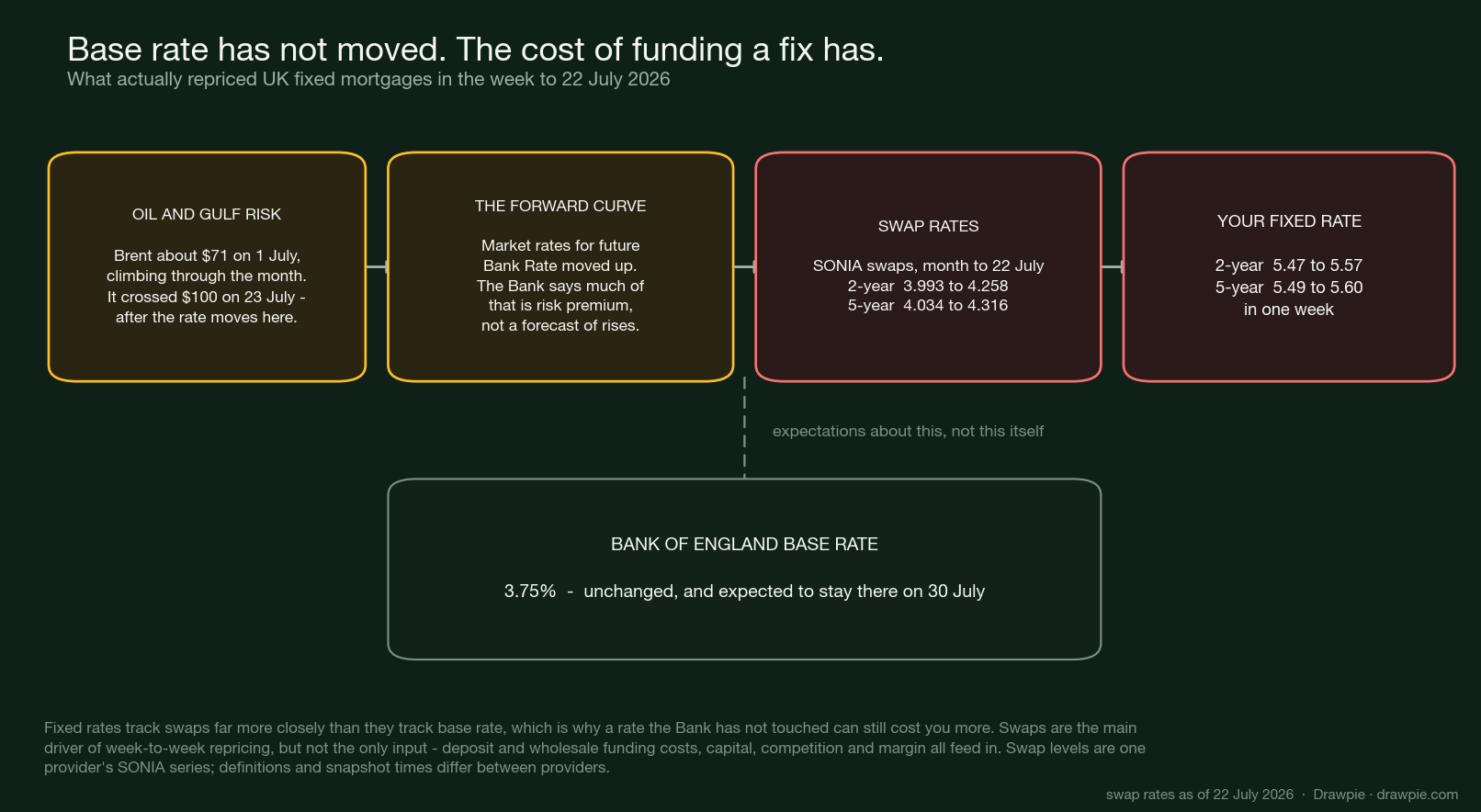
| Link in the chain | The move |
|---|---|
| Oil and Gulf risk | Brent about $71 on 1 July, climbing through the month |
| The forward curve | Market rates for future Bank Rate moved up |
| 2-year swap rate | 3.993% → 4.258% over a month |
| 5-year swap rate | 4.034% → 4.316% |
| 2-year fixed average | 5.47% → 5.57% in a week |
| 5-year fixed average | 5.49% → 5.60% |
| Bank of England base rate | 3.75% — unchanged |
This is the bit most coverage skips, and it is the bit that actually helps you. Fixed-rate mortgages track the base rate far less closely than they track swap rates — what it costs a lender to hedge its funding for the length of your fix.
So as Gulf escalation pushed oil up through July, market rates for future Bank Rate rose, swaps followed, and lenders repriced within days.
⚠️ Two caveats on that chain, because it is easy to overstate. An upward-sloping forward curve is not the market forecasting rate rises — the Bank itself has said a large part of the recent move is risk premium, and survey medians still point to Bank Rate roughly where it is. And swaps are the main driver of week-to-week repricing but not the only input: deposit and wholesale funding costs, capital, competition and margin all feed into the rate you are actually offered.
One thing not to get backwards. Brent crossed $100 on 23 July — after the 22 July rate data above. Oil climbing through the month is part of this story; the $100 headline cannot be the trigger for numbers measured the day before it happened.
The practical consequence is uncomfortable: a hold on 30 July will not automatically bring fixed rates back down. The move already happened in expectations. If you are waiting for a base rate decision before fixing, you are watching the wrong number — a point that generalises well beyond mortgages, and one we went through in detail when the same chokepoint was being written off as a diminishing threat .
A one-month high is not a high
Headlines are technically accurate and quietly misleading here.
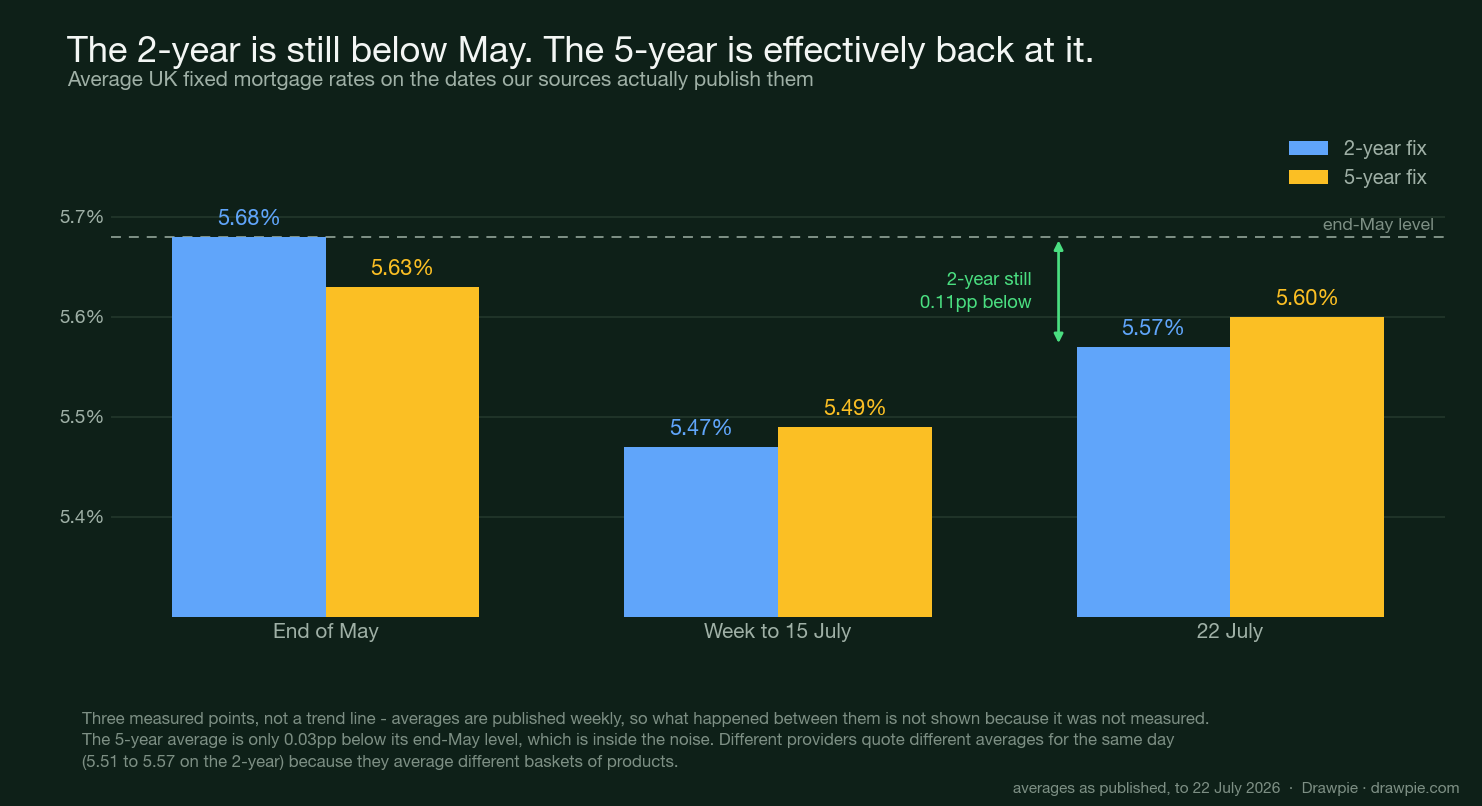
| 2-year fix | 5-year fix | |
|---|---|---|
| End of May 2026 | ~5.68% | ~5.63% |
| Week to 15 July | 5.47% | 5.49% |
| 22 July | 5.57% | 5.60% |
The two-year is higher than a month ago and still about 0.11 points below its end-May level. The five-year is a different story: at 5.60% against roughly 5.63%, it has essentially given back the whole decline. A one-month high is a real move, but only the two-year is meaningfully below where it stood in May.
⚠️ One number you will see quoted three different ways. The two-year average appears as 5.51%, 5.55% and 5.57% depending on who is publishing, because each provider averages a different basket of products. None is wrong. If two sources disagree by a few hundredths, that is why.
The number that actually matters to you
Here is what the week’s move costs, and what it sits next to.
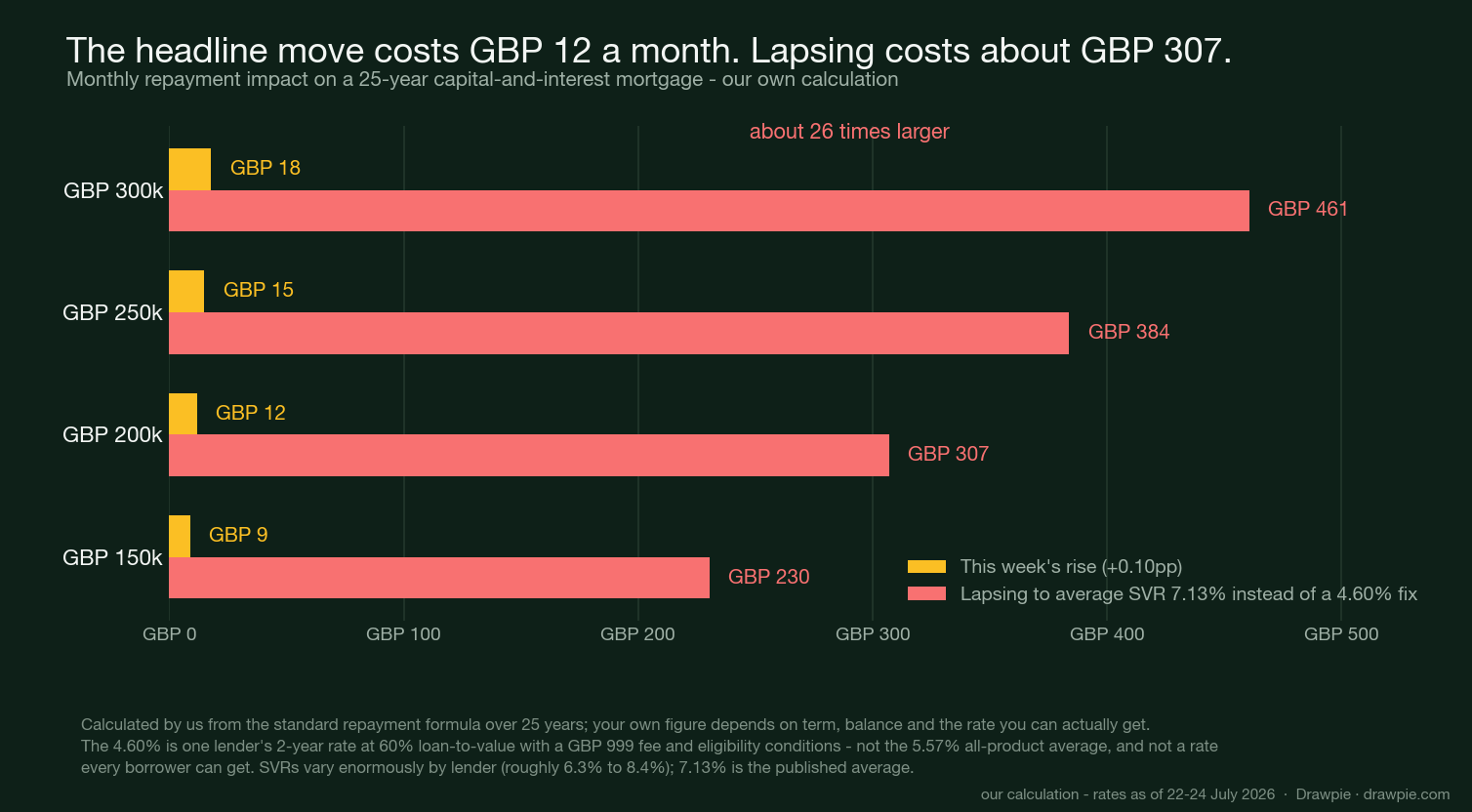
| Balance | This week’s rise (+0.10pp) | Lapsing to SVR instead of fixing |
|---|---|---|
| £150,000 | +£9/month | +£230/month |
| £200,000 | +£12/month | +£307/month |
| £250,000 | +£15/month | +£384/month |
| £300,000 | +£18/month | +£461/month |
Our own calculation, 25-year capital-and-interest, comparing 5.47% with 5.57%, and the 7.13% average standard variable rate with a 4.60% two-year fix. That 4.60% carries a £999 fee and eligibility conditions, and SVRs vary enormously by lender — roughly 6.3% to 8.4% — so 7.13% is an average, not your rate.
On a £200,000 mortgage, the news story costs you about £12 a month. Lapsing instead of switching costs roughly £307. The thing being reported is around twenty-six times smaller than the thing that quietly happens to people who let a fix expire.
That is not a reason to ignore the rise. It is a reason to keep it in proportion: the risk in this market is inertia, not timing.
The 4.60% and the 5.57% are not the same number
This trips up almost everyone, so it is worth being blunt about.
- 5.57% is the average across all products, including high loan-to-value deals that carry the highest rates.
- 4.28% to 4.60% is the sort of rate available on low loan-to-value deals — typically 60% LTV, usually with an arrangement fee.
If you have significant equity, the average is not your rate and never was. If you are buying with a small deposit, the average is optimistic. Quoting one at someone in the other position is how people end up either complacent or unnecessarily alarmed.
And a fee-bearing deal at a lower rate is not automatically cheaper — on a smaller balance, a £999 fee can outweigh the saving. Compare the total cost over the fixed period, not the headline rate.
Who this actually affects, and when
Around 1.8 million UK fixed-rate deals expire during 2026. Industry forecasts put external remortgaging at about £77bn for the year and product transfers — switching to a new deal with your existing lender — at about £261bn. Those are projections, not results.
The lenders that repriced in the days to 24 July give a sense of the pace:
| Lender | Move |
|---|---|
| Nationwide | 2-year at 60% LTV 4.37% → 4.60%; 75% LTV 4.46% → 4.68% |
| Virgin Money | Product transfers up to +0.23% |
| Accord | Residential up to 90% LTV +0.2% |
| TSB | 2-year +0.2%; 60% LTV purchases now from 4.59% |
| HSBC | Increases effective 27 July |
Two things follow from that table. Repricing is happening within days, not weeks — so a rate you were quoted last week may not exist. And it is hitting product transfers as well as new business, which means staying with your current lender is not a way to sit the move out.
What to do about it
Not advice — a checklist of the decisions this market actually puts in front of you.
- Find out exactly when your fix ends. Everything else depends on that date, and a surprising number of people are out by months.
- Start looking around six months ahead. Most lenders let you reserve a rate that far out. If rates fall before completion, you can usually switch to the better deal; if they rise, you are covered. That is the closest thing to a free option in this market.
- Never let a fix lapse onto the standard variable rate. The published average is about 7.13%, and individual lenders run from roughly 6.3% to 8.4%. It is the most expensive outcome commonly available, and it happens by default rather than by decision.
- Compare a product transfer against a full remortgage. Staying put is faster and usually needs less paperwork; moving lender may be cheaper. Both were repriced this week, so the gap between them may have changed.
- Compare total cost, not rate. Fee plus interest over the fixed term, on your actual balance.
- Do not try to time 30 July. The Bank is expected to hold, and even a cut would not automatically drag fixes down, because fixes already moved on expectations.
Frequently asked questions
What are UK mortgage rates right now?
As of 22 July 2026 the average two-year fix was about 5.57% and the average five-year about 5.60%, both up roughly 0.10 points in a week. Different providers publish slightly different averages — 5.51% to 5.57% on the two-year — because they average different product baskets. The best low-loan-to-value deals are considerably lower, in the 4.28%–4.60% range.
Why are mortgage rates rising if the Bank of England has not raised rates?
Because fixed rates track swap rates far more closely than the base rate. Swaps move with market rates for future Bank Rate. Oil climbing through July on Gulf escalation pushed those market rates up, swaps followed, and lenders repriced. Note that an upward forward curve is not the same as a forecast of rises — the Bank has said much of the recent move is risk premium.
Will mortgage rates fall after the 30 July decision?
Not automatically. The Bank is widely expected to hold at 3.75%, and a hold is already priced in. Fixed rates respond to changes in expectations, not to the announcement itself.
How much does the recent rise actually cost?
On a £200,000 25-year repayment mortgage, about £12 a month. For comparison, allowing a fix to lapse onto the 7.13% average standard variable rate instead of taking a 4.60% fix costs roughly £307 a month on the same balance — and that 4.60% carries a fee and eligibility conditions.
Should I fix for two years or five?
The averages are now almost identical — 5.57% against 5.60% — so the pricing barely distinguishes them, which is unusual. That makes it a question about your circumstances rather than about value: five years buys certainty, two years keeps you flexible if expectations reverse. Nobody can tell you which is right for you, and anyone who says they can is guessing about the same rate path the market is arguing over.
How early can I lock in a new rate?
Most lenders allow you to reserve a rate around six months before your current deal ends, and generally let you switch to a cheaper one if rates fall before completion. Terms vary by lender.