UK Minimum Wage 2026: Rates by Age, Annual Salary, Apprentices & Your Pay Rights

- From 1 April 2026: £12.71 at 21 and over, £10.85 at 18 to 20, and £8.00 for under-18s and for apprentices.
- The 18–20 rate rose 8.5% this year against 4.1% for the adult rate — more than twice as fast, and that is deliberate.
- The Low Pay Commission’s advice letter says Government policy is to remove the 18–20 rate entirely and lower the adult age threshold to 18 within this parliament.
- Being 20 rather than 21 is legally worth £1.86 an hour less. On a 37.5-hour week that is £3,627 a year, for the same job.
- The apprentice rate has a cliff in it: a 21-year-old apprentice gets £8.00 in year one and £12.71 the day year one ends.
- Under-18s and apprentices have shared the same rate since April 2022. There is no lower band — entitlement starts at school leaving age.
- A contract agreeing to less than the minimum wage is not legally binding. You are still owed the correct rate.
- If an employer charges you for accommodation above £11.10 a day, the excess comes off the pay that counts towards your minimum wage.
From 1 April 2026 the minimum wage is £12.71 an hour if you are 21 or over, £10.85 if you are 18 to 20, and £8.00 if you are under 18 or an apprentice.
Those four numbers are the easy part. The parts worth knowing are that one of those bands is being deliberately abolished, that the apprentice rate contains a cliff edge, and that a contract agreeing to less than any of this is worthless.
The rates from April 2026
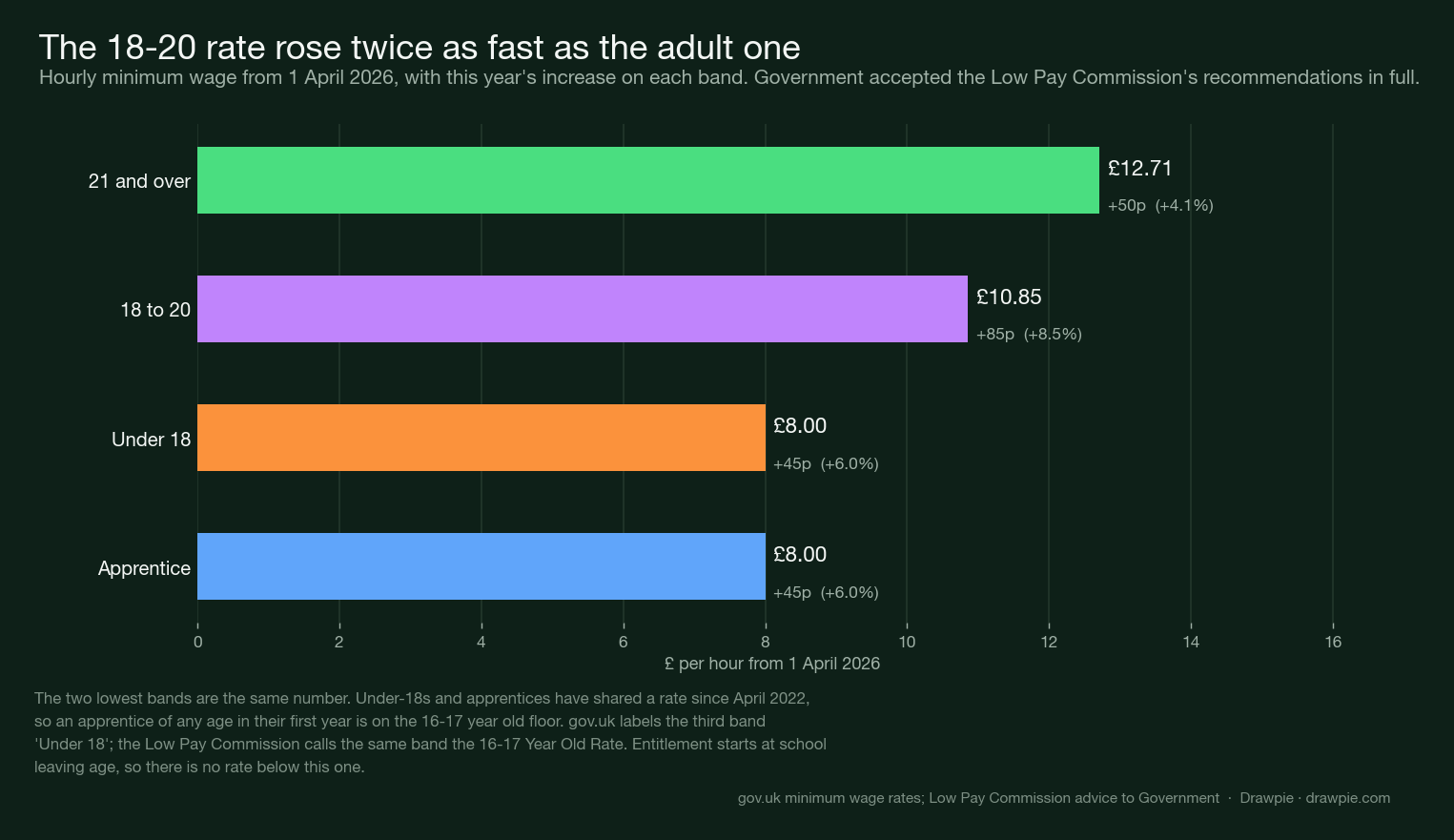
| Band | From 1 April 2026 | Rise |
|---|---|---|
| 21 and over (National Living Wage) | £12.71 | +50p, 4.1% |
| 18 to 20 | £10.85 | +85p, 8.5% |
| Under 18 | £8.00 | +45p, 6.0% |
| Apprentice | £8.00 | +45p, 6.0% |
The rates change on 1 April every year. The Government accepted the Low Pay Commission’s recommendations in full.
Two things in that table catch people out.
The bottom two rows are the same number. Under-18s and apprentices have shared a rate since April 2022. And there is nothing below it — entitlement begins at school leaving age, so a 15-year-old with a Saturday job has no minimum wage at all.
“National Living Wage” is not the “real Living Wage”. The £12.71 is the legal floor for 21 and over. The Living Wage Foundation’s voluntary rate — the one employers advertise being accredited for — is £13.45 across the UK and £14.80 in London, and it is not enforceable. Two similar names, one of which you can take to a tribunal and one of which you cannot.
Why the 18–20 rate rose twice as fast
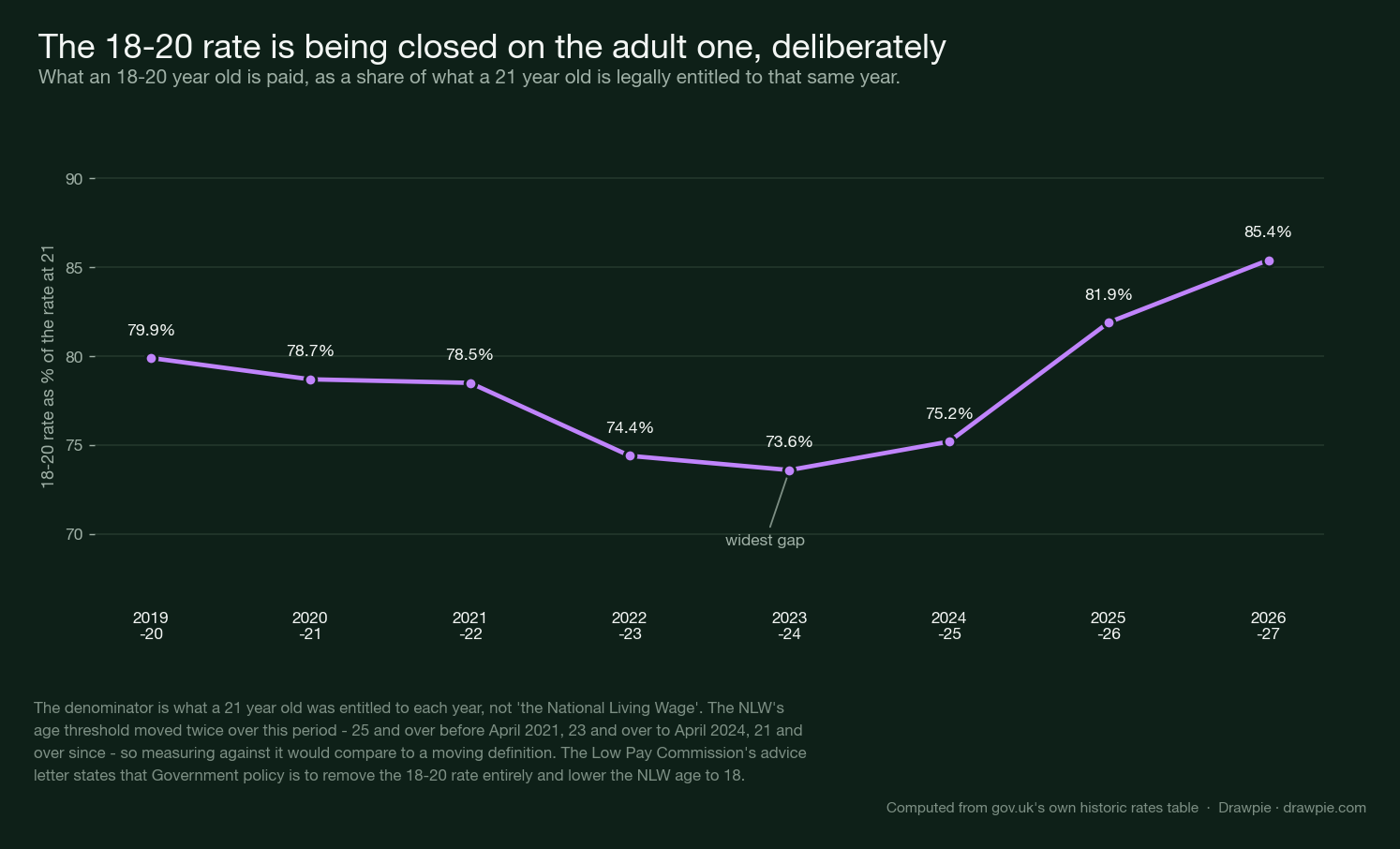
Because the Government intends to get rid of it.
That is not an inference. The Low Pay Commission’s advice letter states plainly that Government policy is to remove the 18–20 rate entirely, and describes the Government’s ambition to lower the National Living Wage age threshold to 18 within this parliament.
The chart above measures the 18–20 rate against what a 21-year-old was legally entitled to that same year. That denominator is used on purpose: the National Living Wage’s own age threshold moved twice over this period, so measuring against “the NLW” would be measuring against a moving definition.
The gap got wider first. It bottomed out at 73.6% in 2023–24. Since then it has closed hard: 75.2%, then 81.9%, now 85.4%.
And the Commission says the biggest increases are still ahead. It considered moving 20-year-olds onto the adult rate in April 2026 — which would have meant a rise of more than 25% for them — judged that too risky given the state of the youth labour market, and chose to backload the increases needed to reach alignment.
What that means for a 20-year-old today. The gap is £1.86 an hour. On a 37.5-hour week that is £3,627 a year for doing the same job as someone a year older, entirely lawfully. That figure is our arithmetic on an assumed working week, not a published number — but the £1.86 is not.
What that is a year
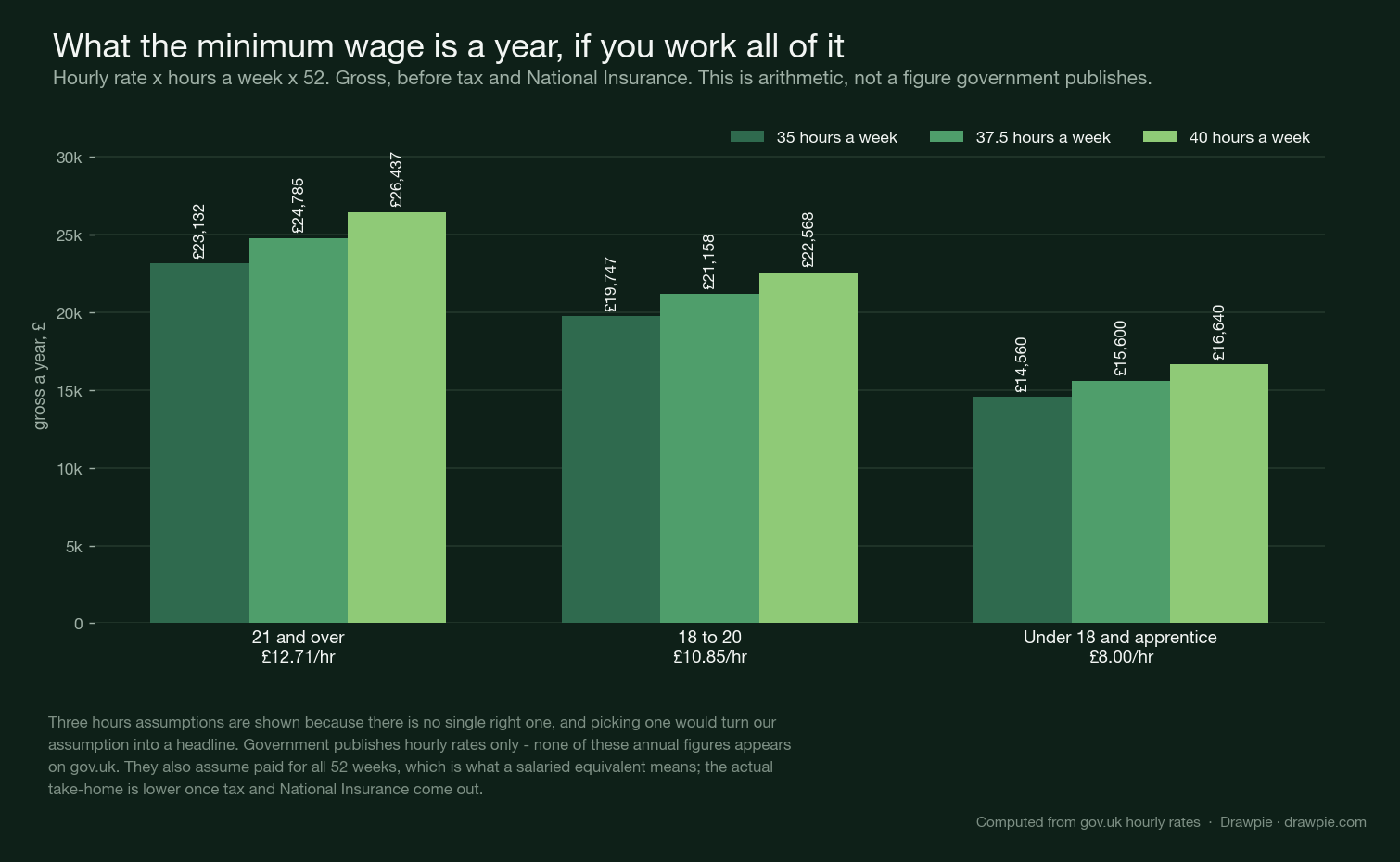
Government does not publish an annual minimum wage figure. It publishes hourly rates. Everything below is hourly × hours × 52, and the hours are an assumption:
| Band | 35 hrs/week | 37.5 hrs/week | 40 hrs/week |
|---|---|---|---|
| 21 and over — £12.71 | £23,132 | £24,785 | £26,437 |
| 18 to 20 — £10.85 | £19,747 | £21,158 | £22,568 |
| Under 18 / apprentice — £8.00 | £14,560 | £15,600 | £16,640 |
These are gross. Income tax and National Insurance come out of them. They also assume you are paid for all 52 weeks, which is what a salaried equivalent means — statutory holiday is paid, so that holds for most employees, but it does not hold for genuinely irregular or zero-hours work where you are paid only for hours worked.
Three columns rather than one is the point. Pick 40 hours and the adult rate looks like £26,437. Pick 35 and it looks like £23,132. The difference between those two headlines is £3,305 and it is entirely an assumption about your contract, not about your pay rate.
The apprentice rate has a cliff in it
A 21-year-old apprentice in the first year of their apprenticeship is entitled to £8.00 an hour. The same 21-year-old, the day after that first year ends, is entitled to £12.71.
Both of those are gov.uk’s own worked examples, printed one after the other on the same page. The step is £4.71 an hour — around £9,185 a year on a 37.5-hour week.
The rule that produces it:
- You get the apprentice rate if you are under 19, or 19 or over and in the first year of your apprenticeship.
- You get the normal rate for your age if you are 19 or over and have completed the first year.
So the anniversary matters more than the birthday. A 22-year-old still in year one is on £8.00. A 19-year-old who finished year one is on £10.85. If you are an apprentice approaching the end of your first year, that date is the single most valuable thing in your contract — and it is worth checking that your employer has actually moved you.
The Low Pay Commission has said it sees merit in reforming this, including replacing the flat apprentice floor with a discount against the age rates. That is a stated view, not a decision, and nothing has changed yet.
Who does and doesn’t get it
You must be a “worker” and at least school leaving age. You do not need to be full-time, permanent, or British.
Entitled, per gov.uk, includes: part-time workers, casual labourers hired for a single day, agency workers, people paid per item made, apprentices, trainees and workers on probation, disabled workers, agricultural workers, foreign workers, seafarers and offshore workers, and au pairs treated as one of the family.
Not entitled includes: the genuinely self-employed, company directors, volunteers, members of the armed forces, family members living in the employer’s home, anyone below school leaving age, students on a work placement of up to a year, people shadowing at work, people on a Jobcentre Plus Work trial of up to six weeks, share fishermen, prisoners, and people living and working in a religious community.
A contract to pay less than the minimum wage is not legally binding. Signing one does not remove your entitlement — you are still owed the correct rate. This is the single most useful sentence on the gov.uk guide and the one most likely to matter.
The “self-employed” line is where most disputes actually live. Being labelled self-employed by an employer does not make you self-employed; what counts is how the work really operates.
What counts as work, and what gets deducted
Two mechanisms quietly reduce what you are effectively paid, and both are legal when done correctly.
Time that counts towards the minimum wage includes travelling in connection with work — explicitly including travel from one assignment to the next — and training, including travelling to it.
Time that does not count includes commuting between home and work, and time on industrial action.
gov.uk’s own example is a care worker with two morning appointments and no break: the travel between them must be paid. If that worker goes home in between, the travel to and from home does not count. If you move between jobs during a shift and are paid only for the time inside them, that is the rule to check.
Accommodation is the other one. An employer can provide accommodation and count some of its value towards your wage, up to an offset of £11.10 a day, or £77.70 a week, from April 2026. Charge above that and the excess comes off the pay that counts towards your minimum wage. Charge at or below it and it makes no difference. Provide it free and the offset is added to your pay for the calculation.
If you’re being underpaid
The route, in order, from gov.uk:
- Raise it with your employer. Most underpayment is a payroll error rather than a decision.
- Ask in writing to see your payment records. You have the right to inspect them, to take someone with you, and to make copies.
- Call the Acas helpline — it is confidential and free.
- Complain to HMRC about the employer or the agency. You can do this on behalf of someone else, which matters if the person affected does not want to be identified.
- Or go straight to an employment tribunal yourself.
What happens then. If HMRC finds the employer has not paid, it issues a notice for the arrears plus a fine. If the employer still refuses, they can be taken to court on the worker’s behalf. HMRC enforces the minimum wage on behalf of the Fair Work Agency.
And if you are dismissed over it, that is a separate claim: you can also complain to the tribunal for unfair dismissal.
The bottom line
£12.71 at 21 and over, £10.85 at 18 to 20, £8.00 for under-18s and apprentices, from 1 April 2026.
If you are 18 to 20, your band is on a stated path to disappear into the adult rate, and the Commission has said the larger increases are still to come. If you are an apprentice, find out the exact date your first year ends. And if you are being paid less than the table above, the contract you signed does not matter.
All rates from gov.uk’s National Minimum Wage and National Living Wage rates page and guide, cross-read against the Low Pay Commission’s published advice to Government. Annual figures are our arithmetic on stated hours assumptions, not published figures.