When Does the UK Heatwave End? It Already Has for Most of England

- The heatwave has broken for most of the country. The amber heat-health alerts that covered all nine English regions expired on 14 and 15 August, and by the afternoon of 15 August six regions were on no alert at all, with only London, the South East and South West still on yellow.
- It peaked at 38.1C at Kew Gardens on 13 August, the UK’s fifth hottest day on record. Pershore in Worcestershire hit 38.0C and 40 locations across central and southern England passed 36C.
- The Met Office expects a gradual return to average over a few days rather than a sudden drop. Its chief forecaster put Friday at 34C in the south east, with the weekend still hovering above 30C in the south before conditions settle back.
- The heat ending is not the drought ending. The Met Office’s deputy chief forecaster said the next meaningful rain for the driest parts of England could be towards the end of the following week, and that the rain arriving first would fall mostly over Scotland and Northern Ireland.
The UK heatwave is over for most of England. The amber heat-health alerts that covered all nine English regions through the peak expired on 14 and 15 August 2026, and by the afternoon of the 15th six of those nine regions were on no alert at all.
It ended the way UK heatwaves usually do — not with a thunderstorm sweeping it away in an afternoon, but with a cold front sliding southeast over a couple of days and the numbers drifting back to normal. What has not ended is the drought underneath it.
When does the UK heatwave end?
It has effectively already ended, over 14 and 15 August, with a gradual return to average temperatures rather than a sharp break. The Met Office’s chief forecaster, Neil Armstrong, set out the shape of it on 13 August: Friday would be “a less hot day” topping out at 34C in the south east, and “into the weekend temperatures could still hover over 30C in the south, with a gradual return to average over the next few days.”
The mechanism was a cold front introducing fresher air from the west, with conditions feeling much less humid by Saturday. That matters more than the headline temperature for anyone who struggled to sleep during the spell: the Met Office had warned of a widespread tropical night in the east at the peak, meaning overnight lows that never fell below 20C.
So there is no single moment to point at. The useful markers are the official ones, and both have now lapsed.
Are the heat alerts still in force?
Mostly not. Six of England’s nine regions are clear, and the three that remain — London, the South East and the South West — have been stepped down from amber to yellow. The levels below were read from the UKHSA dashboard at 16:59 on 15 August.
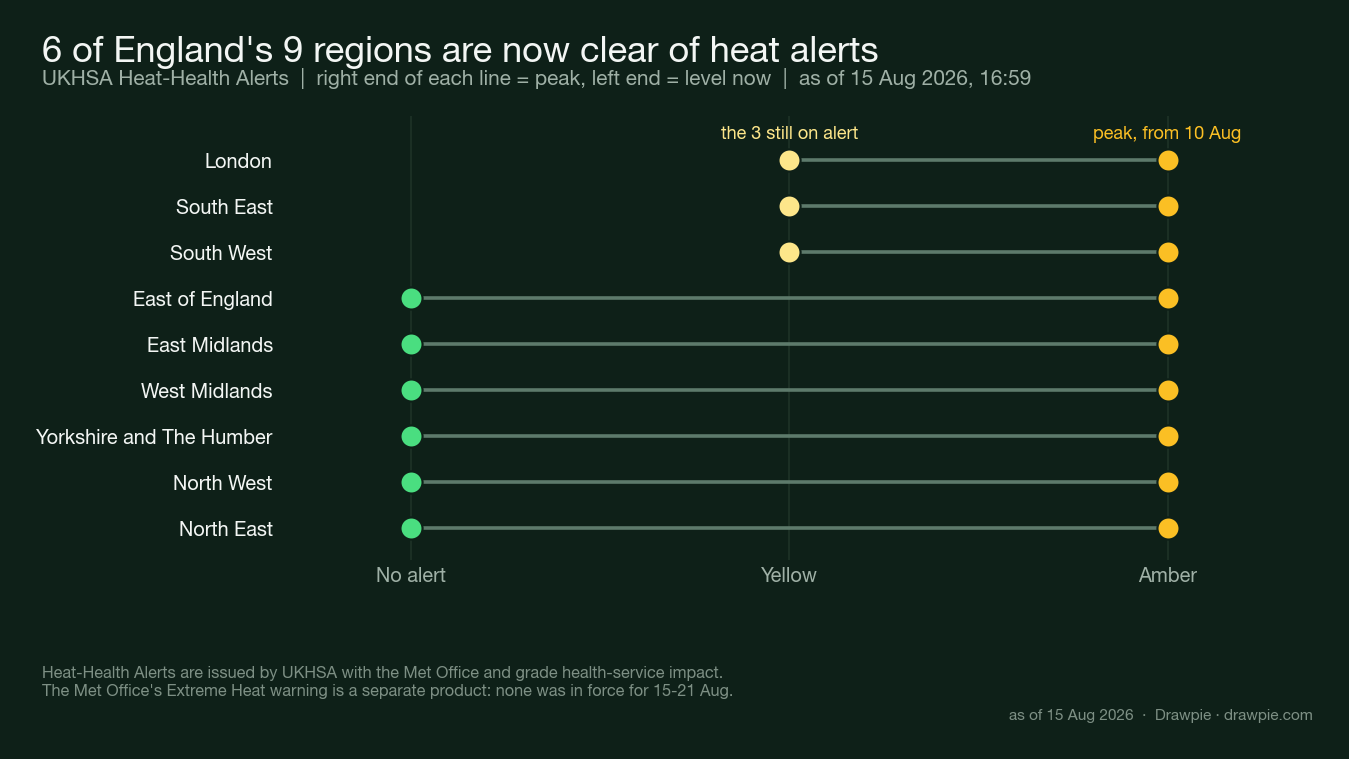
| Region | Peak | Now |
|---|---|---|
| London | Amber | Yellow |
| South East | Amber | Yellow |
| South West | Amber | Yellow |
| East of England | Amber | No alert |
| East Midlands | Amber | No alert |
| West Midlands | Amber | No alert |
| Yorkshire and The Humber | Amber | No alert |
| North West | Amber | No alert |
| North East | Amber | No alert |
There is a distinction here that most coverage flattens, and it is worth holding onto because the two things can disappear at different times. Heat-Health Alerts are issued by the UK Health Security Agency with the Met Office, and they grade the expected impact on health and social care — amber means significant impact across the whole service, yellow means impact mainly on the vulnerable. The Extreme Heat warning is a different product from the Met Office alone, on the same scale as its warnings for wind or snow.
On 15 August the Met Office had no weather warnings of any kind in force for the following seven days, through to 21 August. So the warning has gone and most of the health alerts have gone, but a yellow alert still sits over the southern third of England.
How hot did it actually get?
The spell peaked at 38.1C at Kew Gardens in London on 13 August, provisionally the fifth hottest day ever recorded in the UK. Pershore in Worcestershire reached 38.0C the same day, and 40 locations across central and southern England recorded 36C or higher.
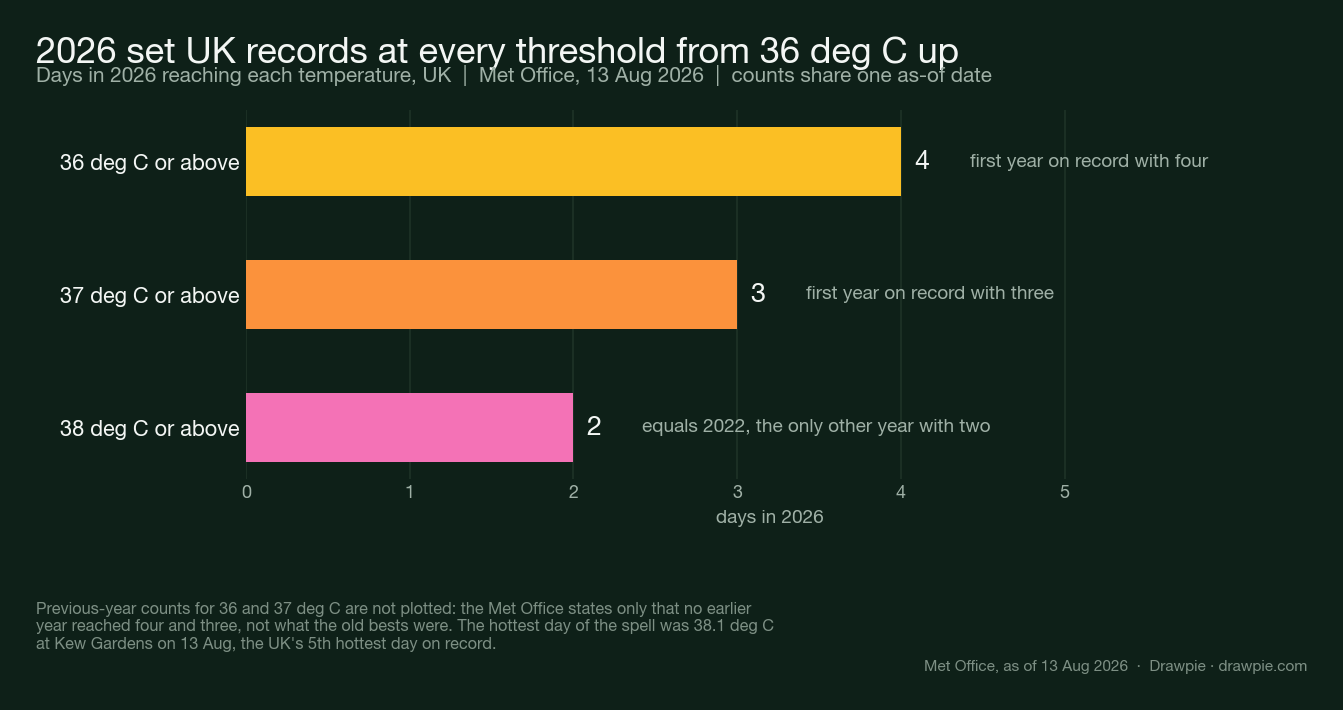
| Threshold | Days in 2026 | Standing |
|---|---|---|
| 36C or above | 4 | First year on record with four |
| 37C or above | 3 | First year on record with three |
| 38C or above | 2 | Equals 2022, the only other year with two |
Those three counts all come from the same Met Office statement on 13 August, so they can be read together. A fourth record is worth adding separately: back on 10 July, the Met Office reported that 2026 had already logged a record eight days above 34C, beating a mark previously shared by 1976 and 2020 — and that it had become the first year in the UK record to reach 35C in May, June and July alike.
To put 38C in perspective, before this year the UK had only ever recorded it on four dates in a series going back to the mid-19th century: 10 August 2003, 25 July 2019, and 18 and 19 July 2022.
Does the rain arrive with the cooler air?
Not in the places that need it most, and not immediately. This is the part of the story that the phrase “heatwave ends” tends to bury.
The Met Office’s deputy chief forecaster, Steven Keates, was blunt about the mismatch on 13 August. There was a chance of thunderstorms developing in central and southeastern England later on the Friday into Saturday, but he described those as “very uncertain”. A front crossing the UK on the Monday and Tuesday would bring some rain to northern areas — but, in his words, “amounts of rain in the south will be small at most and the majority will fall over Northern Ireland and Scotland.”
For the driest ground in England and Wales, he put the next meaningful rain at towards the end of the following week, when an area of low pressure was expected to influence the weather from the southwest, adding that the detail would become clearer over the following days.
That is the gap that matters. The temperature stress lifts within a couple of days; the water deficit does not.
Is the drought over now the heat has gone?
No. A heatwave ending changes the temperature, not the ground. By mid-August all of Wales and around half of England were in official drought status, with hosepipe restrictions affecting millions of households, and fire services had attended hundreds of wildfire incidents over the first twelve days of the month.
Those restrictions are set by individual water companies and by region rather than nationally, and they are lifted on the state of reservoirs and rivers, not on the forecast. Several weeks of the sort of rain the Met Office was describing — mostly falling on Scotland and Northern Ireland first — would not shift them quickly. If you want to know whether a ban applies to you, your water company’s own page is the only authority; we have a separate guide to the 2026 hosepipe bans and which areas they cover . For the settled spell that followed and the thunderstorms that broke it, see the 27C peak and what came after .
The wildfire risk behaves the same way. Dry vegetation stays dry after the air cools, which is why restrictions on disposable barbecues stayed in place into the middle of August even as temperatures fell.
Could another heatwave come before the end of summer?
Possible, but nothing is forecast. The Met Office’s longer-range outlook published on 21 July framed the rest of the season as likely to be above average overall with “further heatwaves are possible but not guaranteed” — language that is deliberately non-committal at that range, and which was written before this spell happened.
What can be said with more confidence is that 2026 has already been an outlier. This was the country’s sixth heatwave of the year, and it followed events in May, June and July that each set their own records. A summer that has already produced records at four separate temperature thresholds is not one where another warm spell would be surprising.
For anything firmer than that, the Met Office’s own forecast is updated daily and is the only source worth using — long-range heat predictions circulating more than a week or two ahead are not forecasts in any meaningful sense.
What this heatwave leaves behind
A record book with 2026 written across several lines, and a landscape that still needs rain. The health alerts have gone or been downgraded, the warnings have expired, and temperatures are heading back to something like normal for late August.
The honest summary for anyone searching for the end date is that there is not one — there is a Friday that was less hot than Thursday, a weekend still above 30C in the south, and an alert map that emptied from the north down. The drought behind it will outlast all of that by weeks.
How we verified this
The alert picture is read from the two issuing bodies separately, because they are two different instruments. Heat-Health Alerts are issued by UKHSA with the Met Office and grade the impact on health services. The Met Office’s Extreme Heat warning is a separate product on a separate scale. Reporting that merges them into one “heat warning” is the most common error on this topic. The region-by-region alert levels here come from the UKHSA data dashboard, which timestamped itself 16:59 on 15 August 2026; the warning position comes from the Met Office’s own warnings page, which showed none in force for 15 to 21 August.
The forecast quotes are from the Met Office’s own newsroom, dated 17:15 on 13 August 2026, and are attributed to the named forecasters who gave them. No forecast here is ours.
One near-miss worth recording. A Met Office article headlined “Heatwave to give way to fresher, more changeable conditions” matches this story so exactly that search results were summarising it as the forecast for this weekend. It is dated 28 May 2026 and describes the May heatwave — its giveaway is a reference to peaks of 28C, a figure that has nothing to do with a spell that reached 38.1C. Nothing from it is used here.
The record counts share a single as-of date. The four days at 36C or above, three at 37C and two at 38C all come from one Met Office release of 13 August. The separate record of eight days above 34C is quoted in the text with its own date of 10 July, because it is five weeks older and will have moved; it is deliberately kept off the chart so that no reader reads the two vintages as one set.
Prior-year counts are not given for 36C and 37C because the Met Office states only that no earlier year reached four and three. It does not publish what the previous bests were, so there is nothing to compare against without inventing it.
Drought and hosepipe figures are as reported in mid-August and move week to week. They are given as context for why the rain question matters, not as a current list of which companies have restrictions in force; check your own water company for that.