Armed Drones in 2026: What Actually Changed in Global Strike

- On 17 June 2026 the US Air Force awarded production contracts for both of its Collaborative Combat Aircraft — General Atomics’ FQ-42A and Anduril’s FQ-44A — four months ahead of schedule. It wants 150 or more this decade and has spoken of around 1,000 eventually.
- Three things followed within six weeks: the first CCA live-fire test at Edwards on 15 July, an Australian MQ-28 flying counter-air missions alongside crewed fighters at Valiant Shield on 21 June, and the first production airframe rolling out of Anduril’s Ohio factory on 28 July.
- Turkey is further along in public than the United States on four of five milestones, including the only confirmed export. Its Kizilelma shot down a target with a radar-guided missile in November 2025.
- Europe went the other way. The Franco-German-Spanish FCAS programme was terminated on 8 June 2026, and its remote-carrier drone went with it.
In the space of six weeks this summer, the United States contracted, fired and built the first of a new class of combat aircraft that nobody sits in. On 17 June the Air Force ordered both of its Collaborative Combat Aircraft into production. On 15 July one of them fired a missile for the first time. On 28 July the first production airframe rolled out of a factory in Ohio.
That is not a forecast about the future of air power. It is a procurement record. Here is what happened, who else is doing it, and which parts of the “drones are reshaping strike” claim the evidence actually supports.
What actually changed in 2026?
The United States stopped experimenting and started buying. On 17 June 2026 the Air Force awarded engineering, manufacturing development and production contracts to General Atomics for the FQ-42A and Anduril for the FQ-44A — both of them, rather than picking a winner.
Two details matter more than the announcement itself.
It came four months early. Col. Timothy Helfrich said the selection turned on each vendor’s ability to meet the schedule, the cost criteria and the performance needed to deliver “150-plus aircraft by the end of the decade”. Defence programmes are not usually early.
The Air Force bought two suppliers, not one. Both airframes go into production, while the autonomy software is being competed separately — Anduril, Shield AI and RTX’s Collins Aerospace are still in that race, with a narrowing expected toward a single vendor by mid-2027. Splitting the airframe from the brain is the structural choice in this programme, and it is the one most likely to be copied.
The contract value is classified. What the Air Force has published is a ceiling: under $30 million per aircraft, about a third of an F-35.
What can these aircraft actually do yet?
As of now: fly, integrate with crewed fighters, and release a weapon. Not deploy.
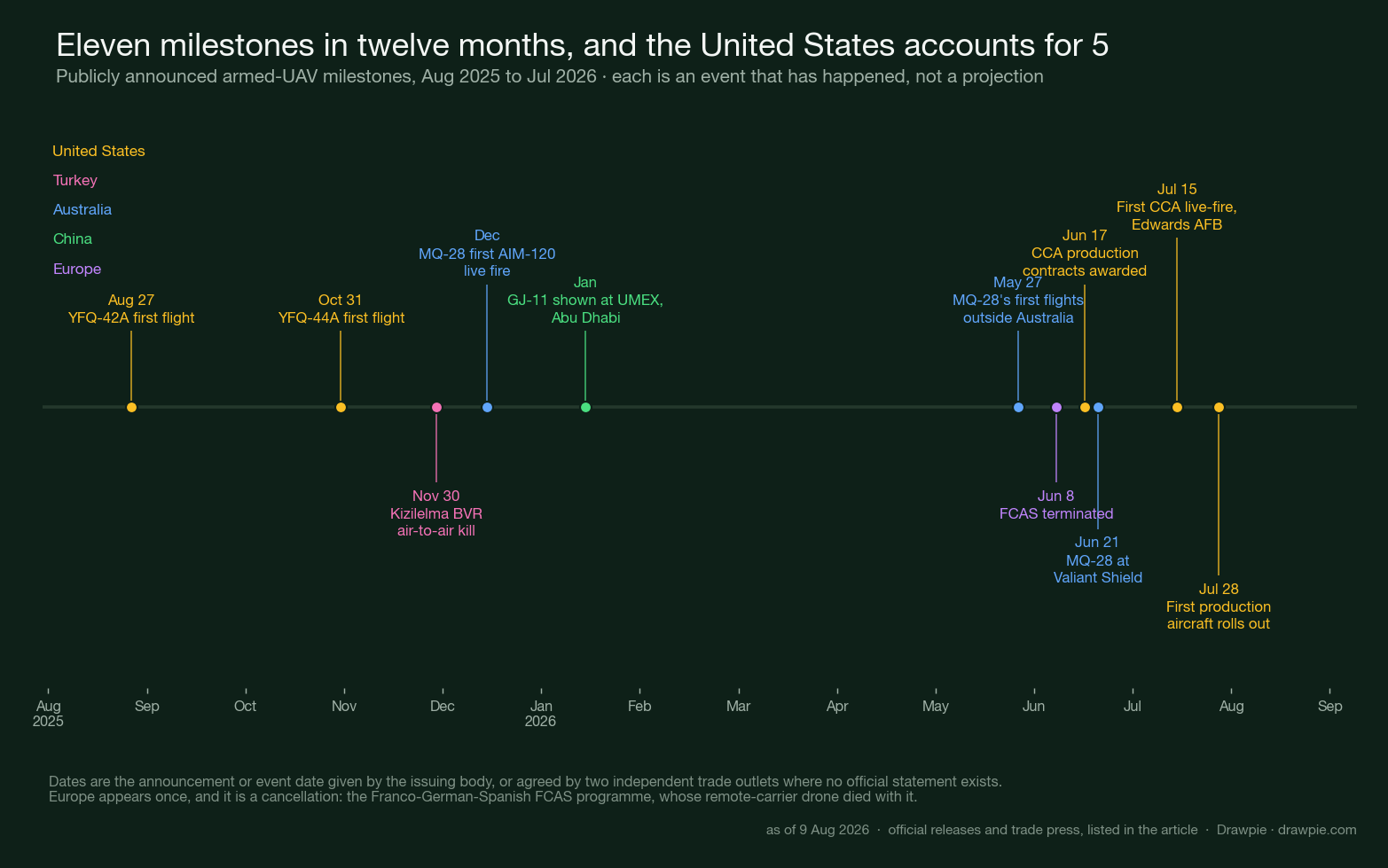
The three American milestones came in quick succession:
| Date | What happened |
|---|---|
| 27 Aug 2025 | YFQ-42A first flight |
| 31 Oct 2025 | YFQ-44A first flight |
| 17 Jun 2026 | Production contracts, both vendors |
| 15 Jul 2026 | First CCA live-fire, Edwards AFB |
| 28 Jul 2026 | First production airframe rolls out |
The live-fire test is the substantive one. At Edwards Air Force Base on 15 July, an Anduril aircraft carried out what was described as an end-to-end, beyond-line-of-sight strike against a simulated target using an inert AIM-120. Gen. Dale White said it demonstrated “program maturity, allowing us to validate our digital integration models with actual data”.
The rollout matters for a different reason: rate. The first airframe came off the line at Anduril’s Arsenal-1 plant in Pickaway County, Ohio, on 28 July. The facility is built for 150 aircraft a year. Air Force Chief of Staff Gen. Ken Wilsbach framed the point bluntly: “Air superiority in today’s increasingly contested environments requires the rapid fielding of affordable mass.”
Meanwhile Australia’s MQ-28 Ghost Bat did the thing none of the American aircraft has done yet — it went to an exercise. At Valiant Shield 2026 on Rota in the Northern Marianas, Pacific Air Forces says the MQ-28, a production-representative test aircraft, flew “in concert with crewed fighter platforms” on “defensive and offensive counter air missions”.
Who else is flying armed drones like this?
Turkey is ahead of the United States on the public record, and it is not close.
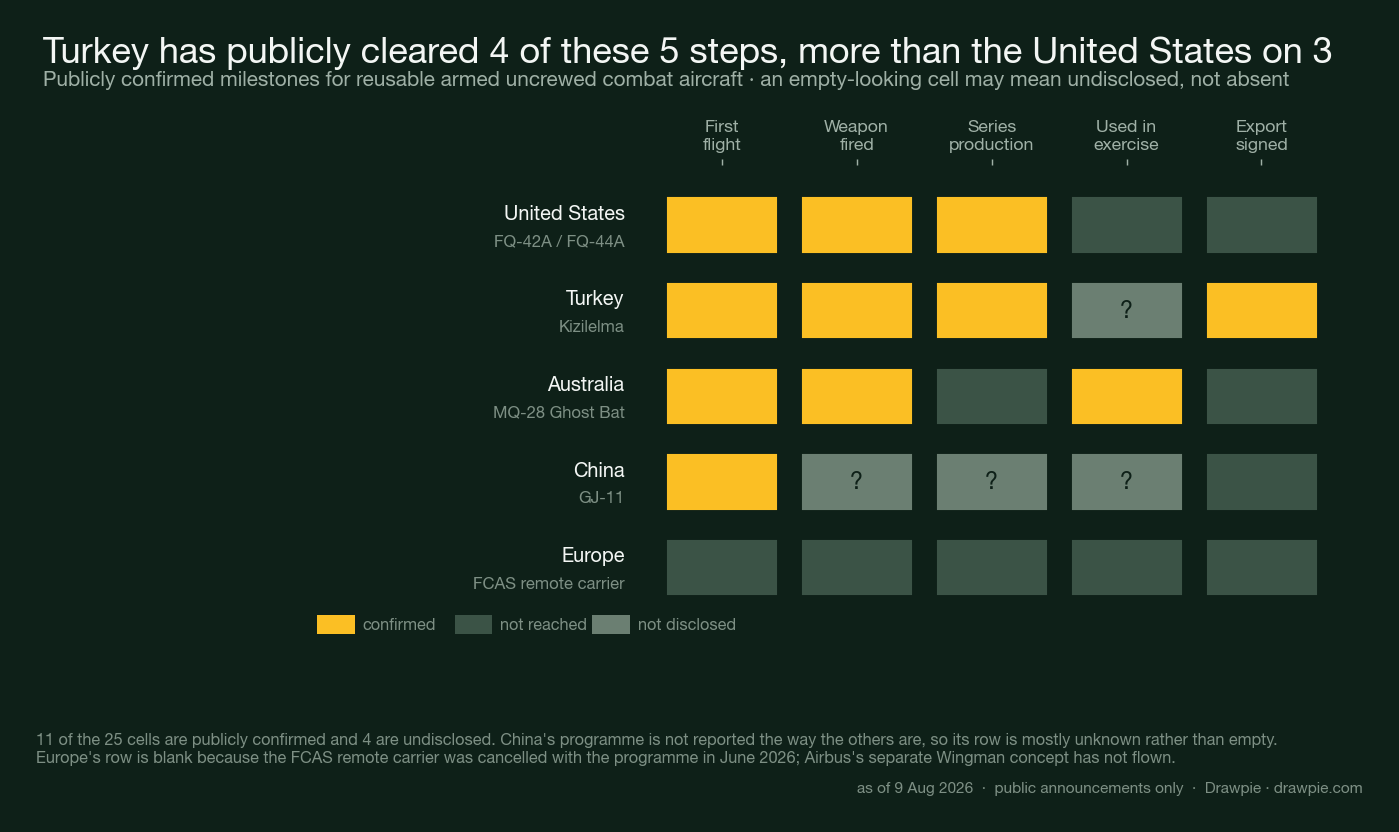
| Country | Publicly confirmed so far |
|---|---|
| Turkey | first flight, weapon fired, series production, export |
| United States | first flight, weapon fired, series production |
| Australia | first flight, weapon fired, used in an exercise |
| China | first flight only; the rest undisclosed |
| Europe | none; the programme was cancelled |
Turkey’s Kizilelma shot down an aerial target with a radar-guided missile on 30 November 2025, using a Gökdoğan beyond-visual-range missile developed by TÜBİTAK SAGE and an Aselsan MURAD radar, in a test over Sinop. The missile’s developer describes it as a first. Serial production began in 2025 and Indonesia has signed as an export customer.
One widely repeated claim about Kizilelma is worth correcting: it is often described as operating from the assault ship TCG Anadolu. It can take off from the ship. It cannot currently land on it — the vessel has no arresting gear, and none was planned.
China’s GJ-11 is the hardest to assess, which is itself informative. Footage released in November 2025 showed one flying in formation with a J-20 and a J-16D. In January 2026 a scale model appeared at UMEX in Abu Dhabi, with the UAE reported to be evaluating options. Beyond that, the milestones the other three countries announce — weapons releases, production rates, exercise participation — are simply not published.
Why did Europe’s version collapse?
Because two companies could not agree who was in charge. On 8 June 2026, France and Germany terminated the Future Combat Air System. German defence minister Boris Pistorius put it plainly the next day, at the opening of the ILA Berlin air show: after nine years, he said, the joint German, French and Spanish fighter project “has been terminated”.
The proximate cause was an unresolvable dispute between Dassault Aviation and Airbus Defence and Space over leadership and workshare. The relevant consequence for this article is narrower: FCAS was where Europe’s collaborative combat drone lived. Airbus’s remote-carrier work was part of that programme, and it went with it. The separate Airbus Wingman concept — roughly 12 metres of wingspan, aimed at the 2030s — has not flown.
Nine days separated Europe cancelling its programme and the United States putting two aircraft into production.
What do they cost, and why does that matter?
Because the entire argument for these aircraft is arithmetic, not capability.
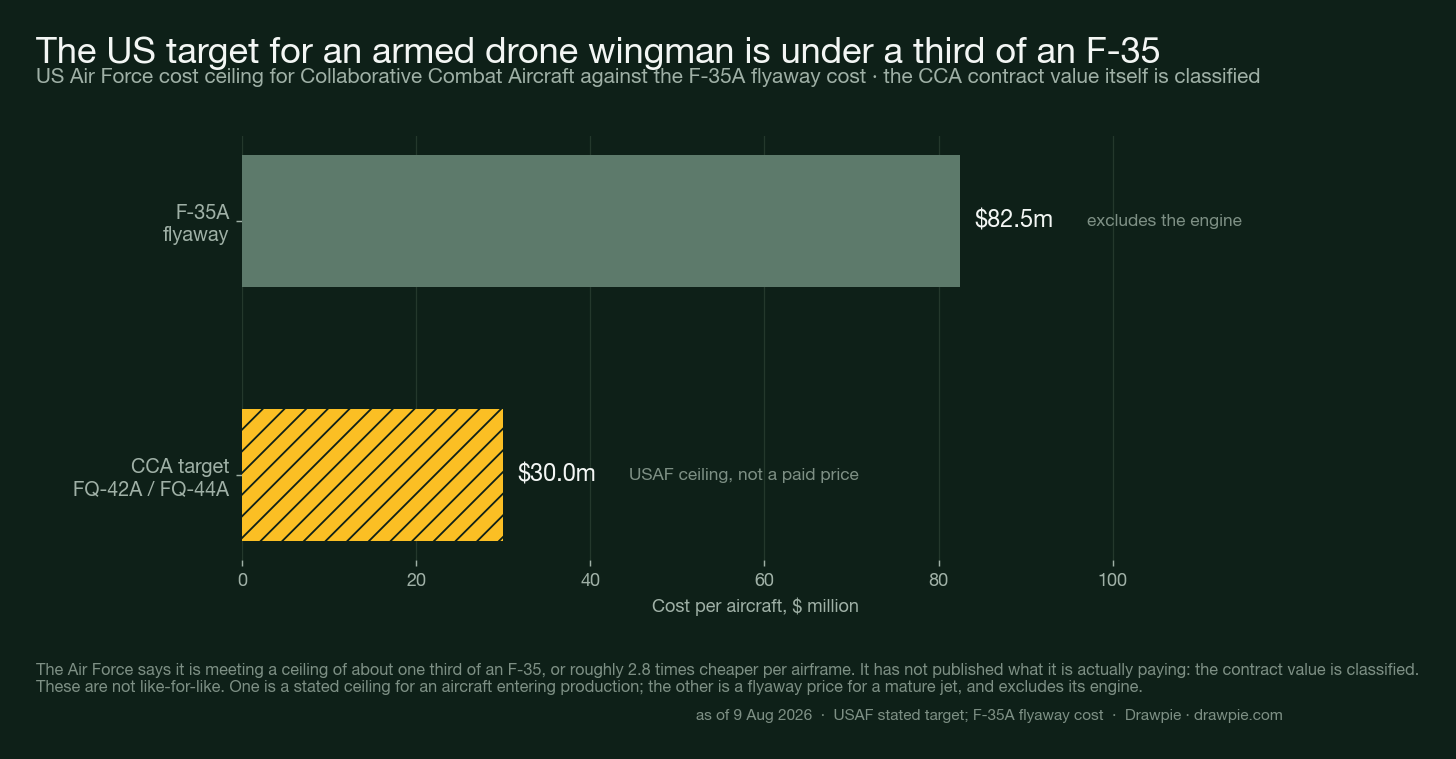
| Cost per aircraft | Basis | |
|---|---|---|
| F-35A | $82.5m | flyaway, excludes engine |
| CCA target | under $30m | USAF ceiling, not a paid price |
Those two numbers are not the same kind of thing, and the difference matters. One is what the Pentagon pays for a mature aircraft. The other is a ceiling the Air Force has set itself for an aircraft just entering production, with the actual contract value classified.
Even so, the logic is clear enough. At roughly a third of the price you can field roughly three times as many airframes for the same money — and the Ohio plant is sized for 150 a year. Wilsbach’s phrase for it is “affordable mass”. The requested budget for FY27 is about $1.4 billion in development and close to $1 billion in procurement.
For what a crewed sixth-generation fighter costs by comparison, see our GCAP and F-35 breakdown .
Does a machine decide to fire?
On the American programmes, the published answer is no, and both services have said so unprompted.
Pacific Air Forces, describing the MQ-28 at Valiant Shield, commits the Department of the Air Force to ethical development of these systems and to ensuring that “a human remains in the loop for all critical decisions”. The same release defines CCAs as semi-autonomous aircraft operating under human oversight.
The Edwards live-fire coverage made the same point about the weapon itself: the decision to release remains with a human operator with command and control of the aircraft.
Two honest caveats. These are statements of policy, not descriptions of a technical incapacity — policy can change, and it is not verifiable from outside. And they describe the American programmes only. Neither China nor Russia publishes anything comparable, and the Turkish programme’s autonomy boundaries are not documented in the same way.
What is actually being reshaped — and what is not?
Reshaped: the unit economics of air power, and the industrial base that supplies it.
- A production line sized for 150 aircraft a year is a different proposition from a fighter line measured in dozens.
- The Air Force bought two airframe vendors and competed the software separately. Anduril, a company founded in 2017, now has a combat aircraft in production alongside General Atomics.
- Turkey has an export customer for a jet-powered armed drone. That is a proliferation channel that did not exist for this class of aircraft five years ago.
Not yet reshaped: anything that has actually happened in combat.
- No CCA has deployed. The US aircraft have flown, fired an inert missile at a simulated target, and been built. The MQ-28 has been to an exercise. That is the whole record.
- No armed drone of this class has been used in a shooting war. The strike campaigns that have reshaped fighting in the last four years used something else — cheap one-way attack drones and cruise munitions, not reusable jet-powered wingmen. Our piece on Ukraine’s long-range drone campaign covers what that has and has not achieved.
- The hardest problem is not the airframe. It is the autonomy software, and the Air Force has not chosen a supplier yet. That decision is expected around mid-2027.
The honest summary for 2026 is narrower than the headline claim and more interesting than it. Global strike has not been reshaped by these aircraft, because they have not been used. What changed in 2026 is that one country stopped debating them and started buying them at a rate, another cancelled its programme outright, and a third turned out to be further ahead in public than either.
Sources
Checked on 9 August 2026.
| Source | What it supports here |
|---|---|
| Pacific Air Forces — MQ-28 Ghost Bat to join allied forces in Valiant Shield 2026 | The MQ-28’s role, the Rota location and 21 June date, the counter-air missions, the human-in-the-loop policy and the definition of a CCA |
| Air & Space Forces Magazine — Air Force selects General Atomics and Anduril for CCA production | The 17 June award, both designations, the classified contract value, the under-$30m ceiling, the four-months-early quote and the autonomy software field |
| Breaking Defense — Air Force picks General Atomics, Anduril to build first CCA drone wingmen | Independent confirmation of the award, the FY27 budget requests and the Helfrich quote |
| Military Times — Air Force completes first-ever CCA live-fire test | The 15 July Edwards test, the inert AIM-120, the beyond-line-of-sight description and the human-release statement |
| Military Times — First Anduril YFQ-44A rolls off production line | The 28 July rollout, the Ohio plant, the 150-a-year capacity and the Wilsbach quote |
| TÜBİTAK SAGE — a historic moment: Gökdoğan shot from Kizilelma | The missile firing, from the organisation that built the missile |
| The Aviationist — Kizilelma downs target drone with Gökdoğan | The 30 November 2025 date, the Sinop location and the MURAD radar |
| FlightGlobal — FCAS industrial spat causes termination of Europe’s New Generation Fighter project | The FCAS termination and the Dassault-Airbus dispute behind it |
| Breaking Defense — Franco-German-Spanish FCAS fighter program dead | Independent confirmation of the cancellation and the Pistorius statement |
| Army Recognition — China shows GJ-11 at UMEX 2026 | The GJ-11 model at UMEX in January 2026 and the reported UAE interest |
The hero image is a crewed F-22, not a drone. It is here because these aircraft are designed to fly alongside crewed stealth fighters, which is the point of the programme.
How we verified this
This article does not forecast anything. The brief was that armed drones “will reshape global strike”. What follows is what has already been contracted, flown, fired and cancelled, with dates. Whether that amounts to a reshaping is left to the reader, and the closing section says plainly which parts of the claim the evidence does not support.
Priority was given to the issuing body. The MQ-28’s role at Valiant Shield 2026 is from Pacific Air Forces’ own release of 24 June 2026, including the quoted policy that “a human remains in the loop for all critical decisions”. The Gökdoğan missile firing is from TÜBİTAK SAGE, which developed the missile. Where no official statement was available — the CCA contract award, the live-fire test, the production rollout — figures are used only where two independent trade outlets agree, and those outlets are named in Sources.
The CCA contract value is classified and is not given here. The only cost figure in this article is the Air Force’s own stated ceiling of under $30 million per aircraft. That is a target, not a price paid, and the chart labels it that way. The F-35A comparison uses the same $82.5 million flyaway figure as our GCAP article , and carries the same caveat: it excludes the engine.
Designations are in flux and we have not tidied that up. June reporting said the Air Force dropped the “Y” prefix on both aircraft to mark the move from prototype to production, giving FQ-42A and FQ-44A. Trade coverage in July still used YFQ-44A for the same airframe. We use the production designations for the programme and quote the July designation where the source did, rather than silently harmonising them.
Quantities are reported inconsistently at source and we have not averaged them. The June coverage says the Air Force will field “at least 150” CCAs by the end of the decade; July coverage describes Increment 1 as seeking 100 to 150. Both figures appear below, attributed.
China’s row in the status chart is mostly unknown, not empty. The GJ-11 is not documented the way the American, Australian and Turkish programmes are. Cells are marked undisclosed rather than filled by inference from imagery or airshow models.