UAE Nafis Program Updates 2026: Salary Support, Eligibility & September Changes

- From September 2026 salary support is tiered by qualification: AED 6,000 for a bachelor’s degree, AED 5,000 for a diploma, AED 4,000 for secondary school, and AED 4,000 or AED 3,000 below that. It replaces a single ceiling of up to AED 7,000 that applied regardless of qualification.
- Eligibility now has a floor as well as a ceiling. Your monthly salary must be at least AED 6,000 and no more than AED 20,000.
- Existing recipients are not cut immediately. Support falls by AED 500 every six months from September until it reaches the new amount, described as a transition of up to three years.
- Two new schemes pay up to AED 3,000 a month — one for wives of Emirati men, one for children of Emirati mothers — and both require a bachelor’s degree.
- Employers lose a subsidy. Nafis stops reimbursing the 2.5% pension contribution for employees earning under AED 20,000, and the child allowance of AED 600 a month per child is no longer capped by the number of children.
The biggest change to Nafis since it launched takes effect in September 2026: salary support stops being a single ceiling and starts depending on your qualification.
The programme has also been extended to 2040, two new schemes have been created for Emirati families, and employers lose a pension subsidy they have had since the start.
What is changing in the Nafis programme in September 2026?
Five things, approved by the UAE Cabinet in April 2026 and announced by the Emirati Talent Competitiveness Council.
| Change | Effect |
|---|---|
| Salary support is tiered | Amount now depends on qualification, replacing a flat ceiling |
| A salary floor is added | You must earn at least AED 6,000 a month to qualify |
| A ceiling is confirmed | Support stops above AED 20,000 a month |
| Two new family schemes | Up to AED 3,000 a month each |
| Employers take on the pension | Nafis stops reimbursing the 2.5% contribution |
New applicants move onto the new system from September. Existing recipients change gradually.
How much Nafis salary support will you get?
Between AED 3,000 and AED 6,000 a month, depending on your qualification. Every tier sits below the old ceiling of AED 7,000, so the reform lowers the maximum for everyone while redistributing who gets what.
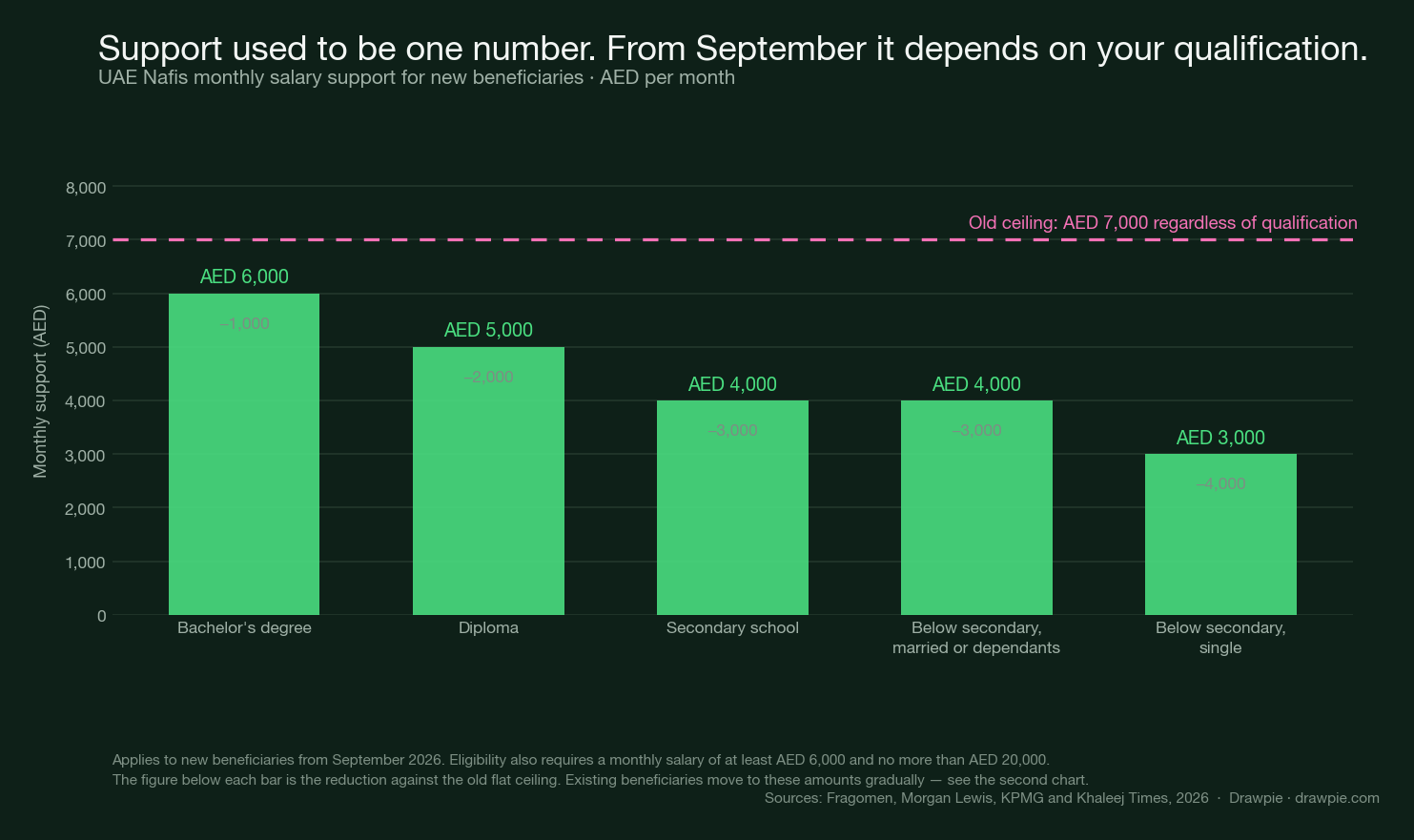
| Qualification | Monthly support | Against the old ceiling |
|---|---|---|
| Bachelor’s degree | AED 6,000 | −1,000 |
| Diploma | AED 5,000 | −2,000 |
| Secondary school | AED 4,000 | −3,000 |
| Below secondary, married or with dependants | AED 4,000 | −3,000 |
| Below secondary, single | AED 3,000 | −4,000 |
The old system paid up to AED 7,000 regardless of qualification. Every new tier is below that, so the reform reduces the maximum for everyone while changing who gets what.
Who is eligible for Nafis support now?
Emiratis in private-sector jobs paying between AED 6,000 and AED 20,000 a month.
The AED 6,000 floor is new and it is the same figure as the minimum wage that applies to new and renewed Emirati work permits from 1 January 2026. Morgan Lewis notes that staff without an upcoming permit renewal were expected to reach AED 6,000 by 30 June 2026, a date that has now passed.
The AED 20,000 ceiling means support stops entirely above that salary.
There is also a separate arrangement for free zone employees whose salary is corrected up to AED 6,000: they keep full support for six months, then 70 per cent for six months, then 30 per cent for three months — fifteen months in total.
What happens if you already receive Nafis support?
Your payment does not drop to the new rate in September — it steps down gradually, by AED 500 every six months, until it reaches whatever the new system says you should get. Nobody currently on Nafis loses the difference in one go.
Officials describe that transition as taking up to three years.
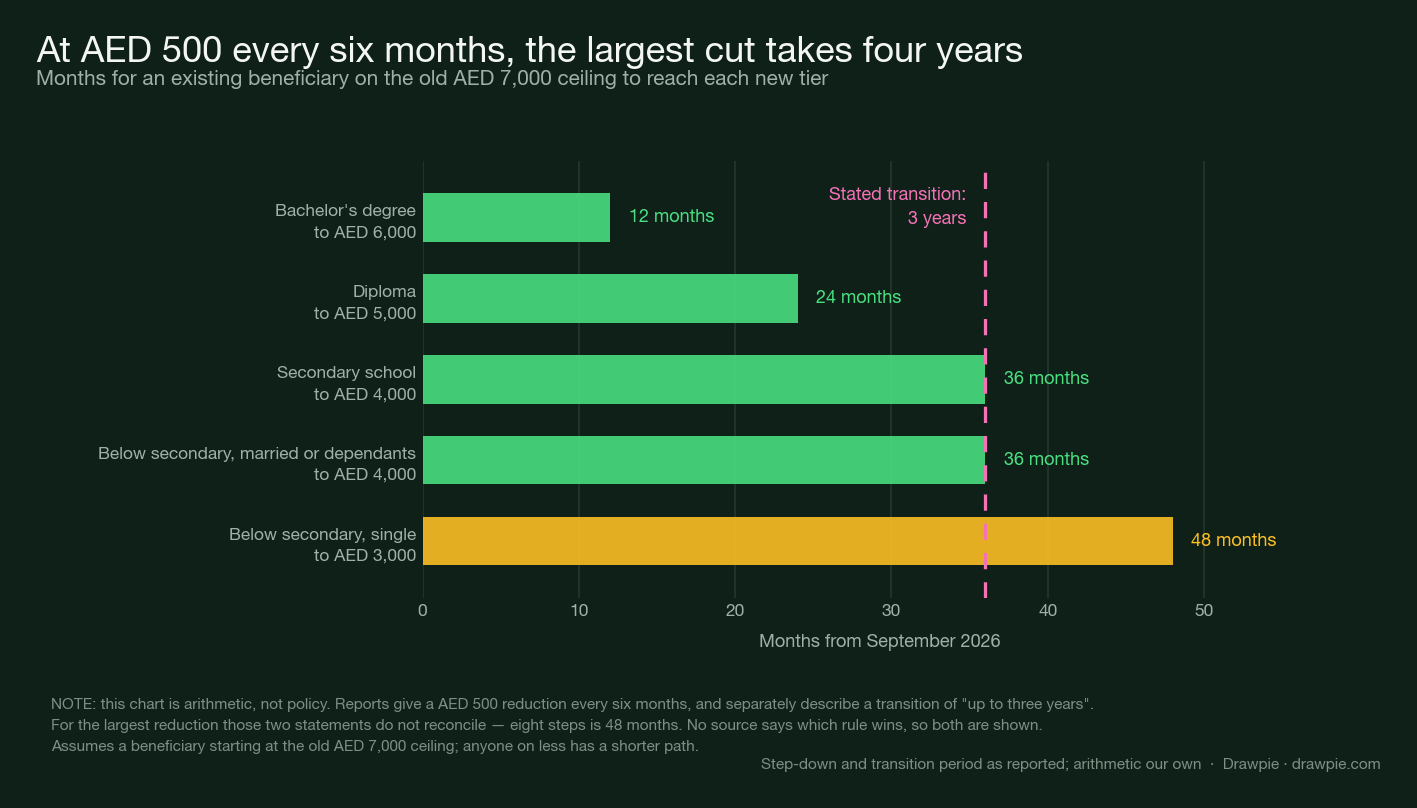
That arithmetic does not quite fit the stated three years. Someone on the old AED 7,000 ceiling who now falls in the AED 3,000 tier needs eight steps, or 48 months — a year longer than the transition officials have described. None of the available sources says which rule wins, so treat both statements as reported and check your own case.
Anyone who was already receiving less than AED 7,000 has a shorter path, and anyone whose current payment already matches their new tier should see no change at all.
What are the two new Nafis schemes for Emirati families?
Both pay up to AED 3,000 a month and both require a bachelor’s degree — one for wives of Emirati men, one for children of Emirati mothers. They differ in the salary band that applies and in whether there are family conditions attached.
| Wives of Emirati men | Children of Emirati mothers | |
|---|---|---|
| Maximum | AED 3,000/month | AED 3,000/month |
| Salary band | AED 6,000 – 15,000 | AED 6,000 – 20,000 |
| Qualification | Bachelor’s degree | Bachelor’s degree |
| Other conditions | Emirati husband who is employed, retired or medically unable to work; and either two children or five years of marriage | — |
Fragomen notes that the marriage and children conditions can be waived after two years for holders of medical degrees and PhDs.
Separately, the child allowance is now AED 600 a month per child, and the previous limit on the number of children — reported by Morgan Lewis as four — has been removed.
What changes for employers?
They pick up a cost Nafis used to carry. The programme will no longer reimburse the 2.5 per cent pension contribution for eligible Emirati employees earning under AED 20,000. Employers now pay their statutory share in full.
For a company with several Emirati staff on Nafis, that is a recurring line item appearing on the payroll from September that was not there before. It sits alongside the AED 6,000 minimum wage for Emirati work permits, so the combined effect on the cost of employing an Emirati at the lower end is larger than either change on its own.
What is not confirmed
Three things, and they matter if you are trying to work out your own position.
The Cabinet Resolution number. None of the professional alerts gives one. KPMG says only that the Cabinet approved the overhaul in April 2026.
Whether the three-year transition or the AED 500 step-down takes priority where the two conflict, as they do for the largest reductions.
The child allowance salary band. Morgan Lewis puts it at AED 6,000 to AED 50,000, much wider than the AED 20,000 ceiling that applies to salary support. That may be correct and deliberate, but it rests on one source.
Given that Nafis’s own website could not be reached while this was written, the sensible step before making any decision is to confirm your entitlement with Nafis directly rather than from any summary, including this one.
Sources
| Source | Used for |
|---|---|
| Fragomen — Changes to Nafis Program Forthcoming, 9 June 2026 | The education-based tier structure, the pension change, and the conditions for both new family schemes including the medical and PhD waivers |
| Morgan Lewis — UAE Nafis Update: What’s Changing, 18 June 2026 | The AED 600 child allowance and the removal of the four-child cap, the AED 6,000 minimum-wage alignment and the 30 June 2026 date, and the free zone support period |
| KPMG GMS Flash Alert 2026-118, 29 April 2026 | Cabinet approval in April 2026, the tier amounts and the AED 6,000 threshold |
| Khaleej Times — Nafis salary rules change in September, 19 August 2026 | The AED 20,000 band, the AED 500 step-down and its endpoint, the free zone taper percentages, the ETCC attribution and the extension to 2040 |
How we verified this
🔴 Nothing on this page is first-party, because the official sources could not be reached. Both nafis.gov.ae and mohre.gov.ae refused every connection from this session — bare requests, a browser User-Agent and HTTP/1.1 all returned no response at all, and so did a control request to an invented path on the same hosts. The official text of the reform was therefore never read here. Everything below is attributed to professional advisers and UAE press, and anyone acting on it should confirm their own position with Nafis directly.
The sources are law-firm and Big Four alerts rather than news aggregation, which is deliberate. Fragomen (9 June 2026), Morgan Lewis (18 June 2026) and KPMG (29 April 2026) publish client alerts that read the underlying instrument, and Khaleej Times (19 August 2026) is the most recent detailed account. The four agree on the tier amounts, the AED 6,000 floor, the AED 20,000 ceiling, the AED 500 step-down and the September start.
⚠️ One figure is disputed between sources and this page picks the majority rather than averaging. KPMG reports the child allowance as “up to AED 3,000 per child”; Khaleej Times and Morgan Lewis both report AED 600. AED 3,000 is the amount attached to a different scheme — the one for children of Emirati mothers — so this reads as a conflation. AED 600 is used, and the conflict is recorded here rather than hidden.
⚠️ One salary band rests on a single source and is flagged in the text. Morgan Lewis puts the child allowance band at AED 6,000 to AED 50,000, which is far wider than the AED 20,000 ceiling the other three describe for salary support. Those may genuinely be different bands for different schemes, but with one source it is reported as a single-source claim rather than as settled.
🔴 The step-down arithmetic in the second chart is ours, and the chart says so. Sources give a AED 500 reduction every six months and separately describe a transition of “up to three years”. For the largest reduction those do not reconcile: AED 7,000 down to AED 3,000 is eight steps, or 48 months. No source states which rule prevails, so the chart plots the arithmetic and marks the three-year line rather than resolving the conflict.
No Cabinet Resolution number is quoted because none of the sources gives one. KPMG says only that “in April 2026, the UAE Cabinet approved an overhaul of the Nafis programme”. The announcement is attributed to the Emirati Talent Competitiveness Council.
This is a summary of reported policy, not advice. Individual entitlements depend on circumstances no article can assess.