Trump Demands Lower Interest Rates: What It Would Mean for Your Mortgage, Credit Cards and Savings
The FOMC decides on 16 September and every rate on this page can move that week. The mechanism sections do not perish; the levels do. Re-read on 17 September, refresh the published rates, and either update or retire the political framing depending on what happened.
Everything else on the page is unaffected; the figures below still say when they were read.

- The federal funds target range is 3.50–3.75% and has not moved since 11 December 2025. The Fed held it at all five 2026 meetings so far.
- At the July meeting three members dissented — in favour of a rise, not a cut. The chair, Kevin Warsh, was appointed under Trump.
- A cut passes to credit cards fastest, because most card APRs are the bank prime rate plus a margin and prime tracks the policy rate almost mechanically. Cards currently average 20.94%.
- It does not pass to mortgages the same way. The 30-year, at 6.71%, follows long-dated Treasury yields, which are driven by inflation expectations rather than by this month’s policy rate.
- If a cut is read as tolerating higher inflation, long yields can rise — taking mortgage rates up while the policy rate goes down.
- Savers are on the other side of the trade. The national average savings rate is 0.38% and banks cut deposit rates faster than they raise them.
- The next decision is 16 September. This page carries no forecast of it and no probability of any outcome.
A lower policy rate would cut your credit card bill quickly, cut what your savings earn even faster, and might not touch your mortgage rate at all.
That is the part missing from a fight that got louder on 4 September, when the president called again for sharply lower interest rates. Here is where the rate actually is, and what moving it would and would not reach.
What he actually said, and what the rate actually is
The demand, as reported on 4 September by Bloomberg, CNBC, Yahoo Finance and The Washington Times: rates should be at 1% or half a percent, they should not be at “4 percent”, and each percentage point of interest is claimed to cost the United States $650 billion. It came with a threat to cut off trade with certain economies where the US runs a deficit if the Fed does not act.
The catalyst was the August jobs report. Payrolls came in at 162,000 against expectations near 53,000 — a strong number, and conventionally the sort that argues against cutting rather than for it.
Where the rate actually is:
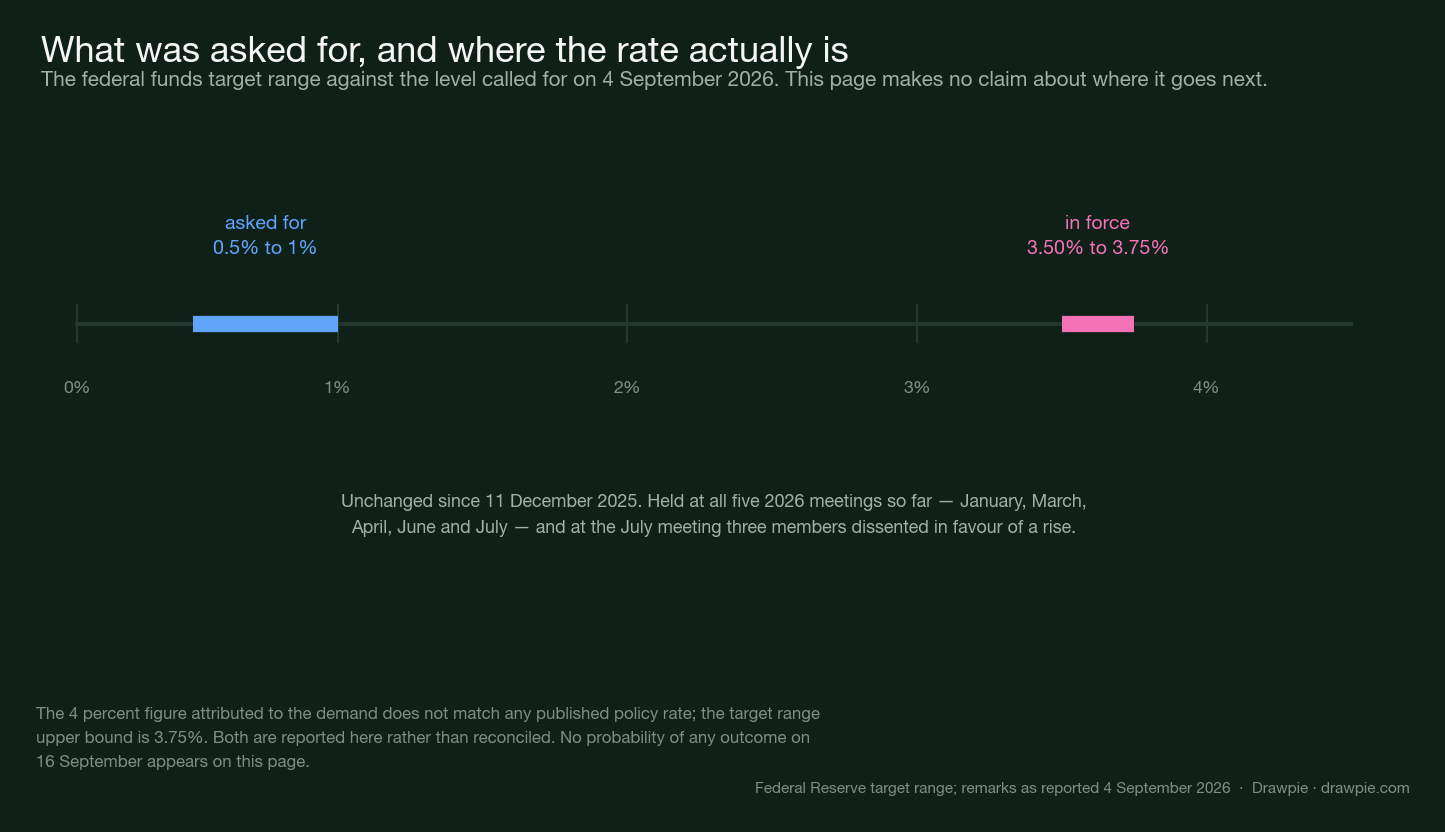
| Federal funds target range | 3.50–3.75% |
| Unchanged since | 11 December 2025 |
| 2026 meetings so far | Five — January, March, April, June, July — all held |
| July 2026 dissents | Three, in favour of a rise |
| Fed chair | Kevin Warsh, appointed under Trump |
| Next decision | 16 September 2026 |
Two things are worth separating out of that table.
The gap being asked for is enormous. Moving from 3.50–3.75% to 0.5% is not a trim. It is roughly three percentage points, delivered against an economy that just produced a jobs number three times the expected size.
The pressure is not aimed at an opponent. The chair is the president’s own appointee, and the most recent meeting produced three dissents pointing the other way. We covered that July meeting and the inflation curve behind it in full at the time.
One figure does not add up, and this page is not going to quietly fix it. The objection reported is to being “at 4 percent”. The target range tops out at 3.75%. It is not clear which rate the 4% refers to, so both numbers are printed here as they stand.
The Fed does not set your mortgage rate
This is the single most useful thing to understand about the whole argument, and it is the opposite of what the framing implies.
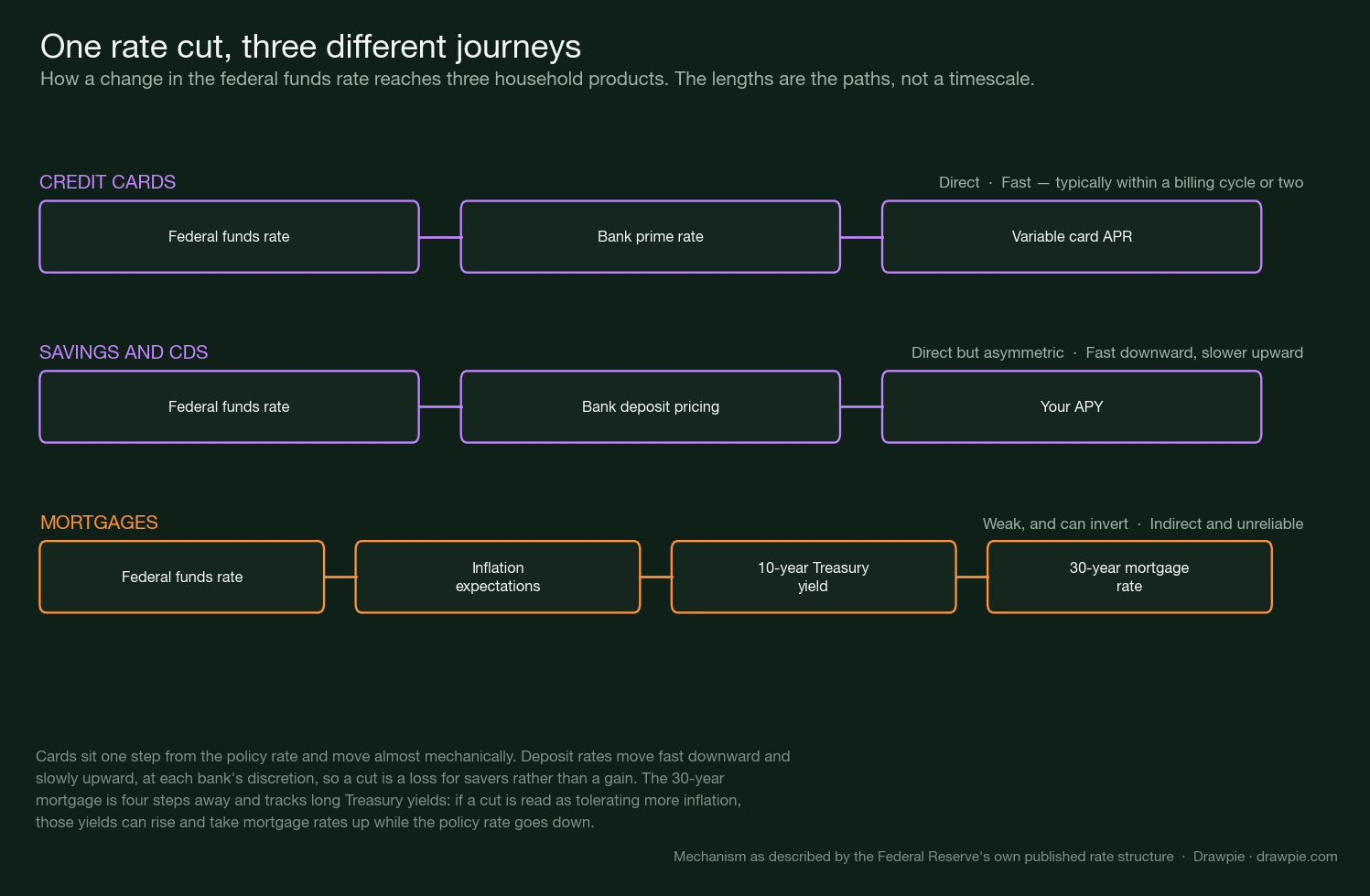
The 30-year fixed mortgage does not follow the overnight policy rate. It follows long-dated Treasury yields, and those are set by what investors expect inflation to do over decades — not by where the Fed puts its target range this month.
That distance shows up in the numbers. The 30-year fixed averaged 6.71% in the week of 3 September, with the 15-year at 6.04%. The policy rate has sat still since December 2025. Mortgage rates have not, because they are answering a different question.
And the link can run backwards. If a cut is read by bond markets as a central bank willing to tolerate more inflation — particularly one seen as cutting under political pressure rather than on the data — long yields can rise. The policy rate goes down and the mortgage rate goes up. That is not a hypothetical mechanism; it is the ordinary behaviour of a yield curve when the far end loses confidence in the near end.
So a household waiting for a rate cut to make a house affordable is waiting on the wrong lever. What moves the 30-year is the inflation outlook.
Credit cards are the one that moves fastest
Here the link is real, direct, and quick.
Most variable card APRs are written as the bank prime rate plus a fixed margin, and prime moves with the federal funds rate almost mechanically. When the policy rate falls, prime falls, and card rates follow within a billing cycle or two.
That matters because of where card rates currently sit:
| Rate | |
|---|---|
| Credit card, accounts assessed interest | 22.15% |
| Credit card, all accounts | 20.94% |
| New car loan, 60 months | 7.14% |
| New car loan, 72 months | 6.97% |
Federal Reserve G.19, June 2026 data.
Note which line is which. The 20.94% figure averages in accounts that carry no balance. For households actually paying interest, the average is 22.15%.
On a $6,000 revolving balance, a full percentage point off an APR is roughly $60 a year. That is real, and it is also the honest scale of it: the transmission is fast and certain, but a point of policy rate is a point, not a transformation.
Savers are on the other side of this
Every argument for lower rates is also an argument for paying savers less, and that half rarely gets said out loud.
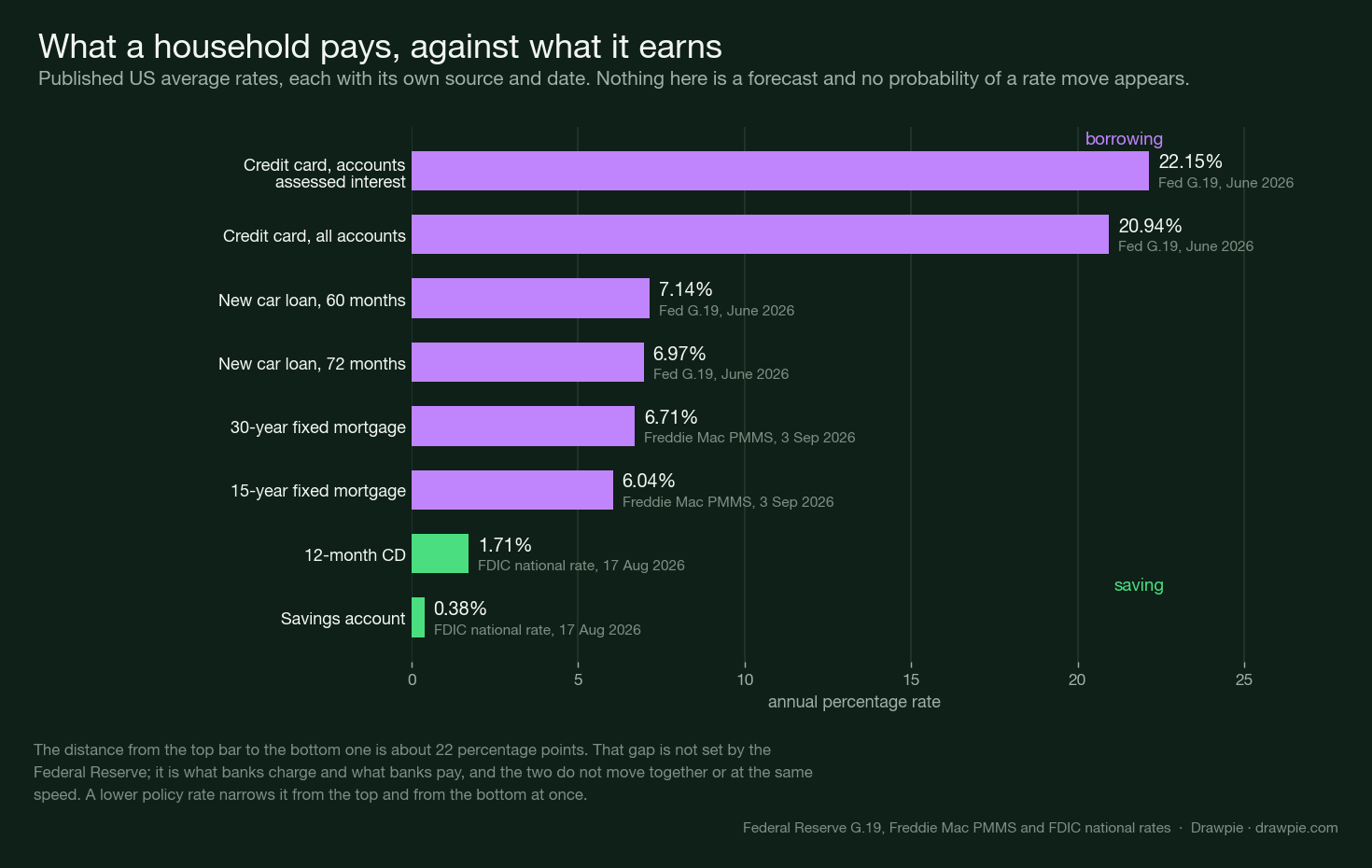
The FDIC national average savings rate is 0.38%. A 12-month CD averages 1.71%. Both are as of 17 August 2026.
Two features of deposit pricing are worth knowing:
- Banks set these rates themselves. There is no formula tying a savings account to the federal funds rate the way a card APR is tied to prime.
- They are asymmetric in practice. Deposit rates historically come down quickly when policy rates fall, and go up reluctantly when policy rates rise.
At 0.38%, the national average savings rate has very little room to fall. The CD rate has more. And anyone holding cash in a higher-yielding account than the national average is holding the thing that a cut is designed to make less attractive.
The plainest way to put it: a cut is a transfer. Borrowers with variable-rate debt gain, promptly. Savers lose, more promptly still. Mortgage holders and buyers may get nothing either way.
What happens on 16 September
The FOMC’s next decision is 16 September 2026.
This page does not tell you what will happen, and it does not carry anybody’s estimate of the odds. That is a deliberate omission rather than a gap: probabilities implied by rate futures are published everywhere, they are routinely written up as though they were decisions, and this site does not print them in any category.
What is on the record instead:
- the range has not moved since 11 December 2025, coming up on nine months
- five 2026 meetings have left it alone
- the most recent meeting produced three dissents, all pointing up
- the chair has been described as striking a hawkish tone
Those are facts about what has already happened. What they imply about 16 September is a matter for the people who have to vote on it.
The bottom line
Rates are at 3.50–3.75%. The demand is for 0.5% to 1%. And the household effects of getting there would not be what most people picture.
Your credit card would respond within a couple of statements. Your savings account would respond faster and in the direction you would not want. Your mortgage rate is four steps removed and following a different signal entirely — and under a cut delivered against a strong economy, could move the wrong way.
The lever exists. It is just not connected to the thing most people are hoping it will move.
Rates from the Federal Reserve, Freddie Mac and the FDIC, each dated in the tables above. The 4 September remarks are as reported by four independent publishers. No forecast, no probabilities, and not financial advice.