2026 Total Solar Eclipse: Path, Times & Best Places to Watch
Update log (1)
- — Three days out. Added a section on watching totality online, with each broadcaster's own published start time — NASA+ and NASA SolarSTEAM at 1:15 p.m. ET, Slooh at 12:30, timeanddate at 12:00. Replaced the US coverage bar chart with a map, because the story is geographic. NASA's city table was re-fetched and is unchanged, including the Portland, Maine end time we flag below.

- Wednesday 12 August 2026. Totality crosses the Arctic, eastern Greenland, western Iceland, northern Spain and a single border village in northeastern Portugal. Greatest eclipse is 17:47 UTC over open ocean 45 km west of Iceland, where totality runs 2 min 18 s.
- No part of the United States sees totality. The whole country gets a partial eclipse at best — Fairbanks 37%, Anchorage 28%, Bangor 24%, Boston 16%, New York 9%, Washington 4%. That means eclipse glasses the entire time, with no safe moment to look unfiltered.
- Iceland or Spain is a real trade-off, not a preference. Iceland gets up to 2 min 13 s with the Sun 25° up but is reliably cloudy; Spain gets up to 1 min 49 s with the Sun at 8–12°, low enough that a hill or a coastal cloud bank ruins it, but August skies there are far more likely to be clear.
- NASA’s own US city table lists Portland, Maine’s partial ending at 2:27 p.m. EDT. An independent ephemeris computation reproduces the other nine US cities in that table to within a minute and puts Portland at 2:47 p.m. Plan for the later time.
- You can still see totality live and free. NASA+ carries it from 1:15 p.m. ET with views from a WB-57 aircraft flying under the shadow; totality itself is at 1:47 p.m. ET, six minutes before the US Northeast reaches its own partial maximum.
A total solar eclipse crosses Greenland, Iceland and northern Spain on Wednesday 12 August 2026 — the first in Iceland since 1954, the first in Spain since 1905, and the first in continental Europe for twenty years.
If you are reading this from the United States, start with the disappointing part: no US city sees totality. The whole country gets a partial eclipse at best, and the best is Fairbanks at 37% of the Sun covered. That is not a small version of totality. It is a different event, and one you must watch through filters from beginning to end.
The good news is that you can watch the real thing as it happens. Totality is at 1:47 p.m. Eastern, and several broadcasters will be carrying it live and free — including NASA, whose coverage this year includes a WB-57 research aircraft flying under the Moon’s shadow. Your own partial maximum follows six minutes later, at about 1:53 p.m. Both times are below.
Can you see the 2026 eclipse from the United States?
Only as a partial eclipse, and only from the northern half of the country — NASA puts the range as Alaska to North Carolina, plus most of Canada.
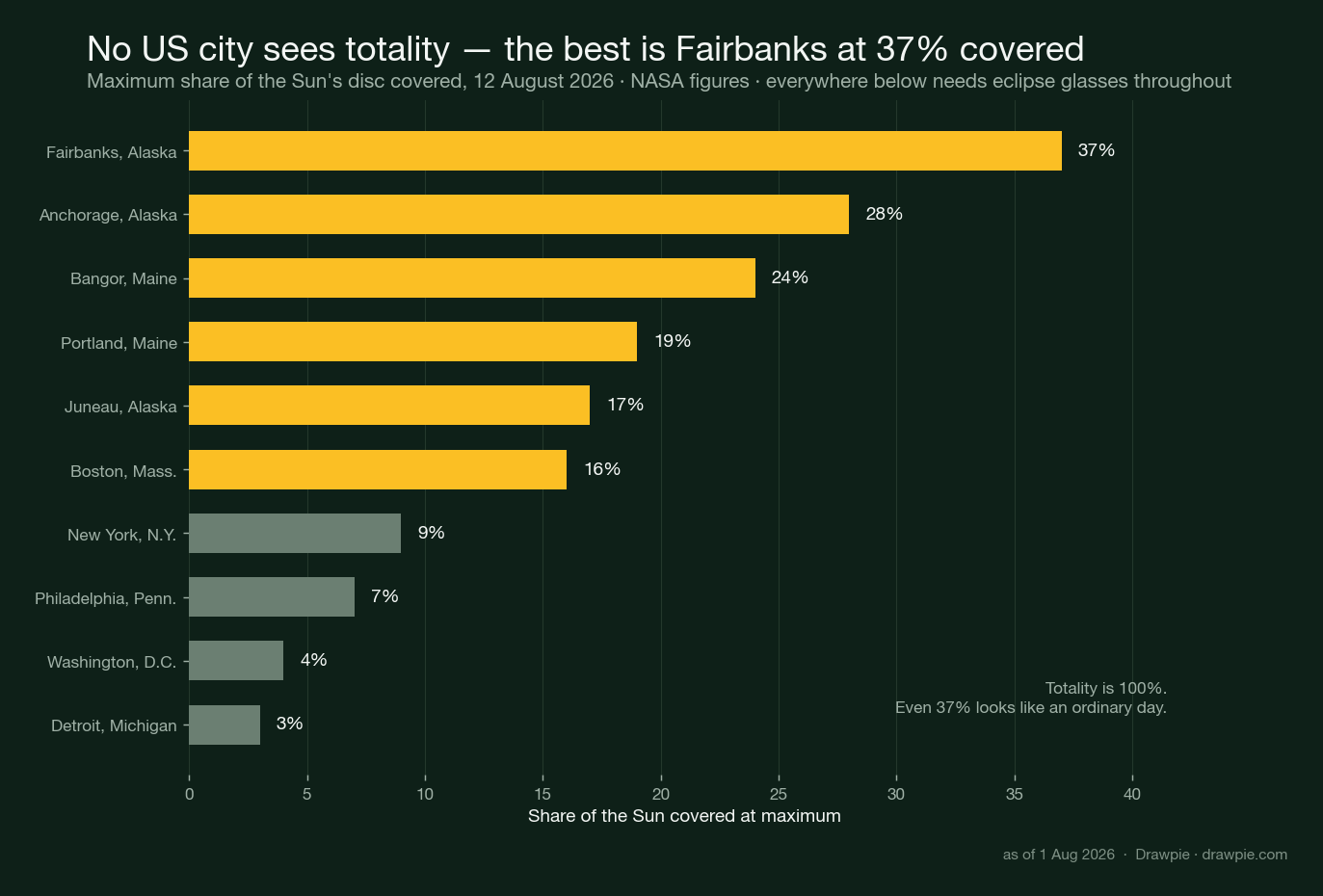
| City | Window | Max | Cover |
|---|---|---|---|
| Fairbanks | 7:37–9:18 | 8:27 | 37% |
| Anchorage | 7:36–9:09 | 8:21 | 28% |
| Bangor | 12:54–2:49 | 1:53 | 24% |
| Portland ME | 12:57–2:27* | 1:53 | 19% |
| Juneau | 7:41–9:08 | 8:24 | 17% |
| Boston | 1:01–2:46 | 1:55 | 16% |
| New York | 1:07–2:38 | 1:54 | 9% |
| Philadelphia | 1:11–2:35 | 1:53 | 7% |
| Washington | 1:17–2:27 | 1:53 | 4% |
| Detroit | 1:03–2:08 | 1:36 | 3% |
All times local. Fairbanks, Anchorage and Juneau are a.m. (AKDT); every other city is p.m. (EDT). * Portland ME — see the note below.
⚠️ About that Portland, Maine row. NASA’s table gives the partial ending at 2:27 p.m. We think that is a slip, and we checked before saying so. Portland has more coverage than Boston and starts earlier, so its eclipse cannot finish 19 minutes before Boston’s. Recomputing every city in the table from JPL ephemerides reproduces nine of the ten to within a minute — and puts Portland’s end at 2:47 p.m. The listed 2:27 p.m. is also identical to Washington, D.C.’s. If you are in Portland, plan for 2:47.
Everywhere in this table, the Sun is never safe to look at with the naked eye at any point. Totality is the only phase during which filters can come off, and totality does not happen anywhere in the US on this date.
Where does the path of totality actually go?
Totality touches the Arctic, eastern Greenland, western Iceland, northern Spain, two villages in northeastern Portugal and Mallorca — and almost nothing else. The track also does something unusual: it begins over Siberia and runs east to west across the Arctic, just missing the North Pole, before curving south for Greenland, Iceland and Spain.
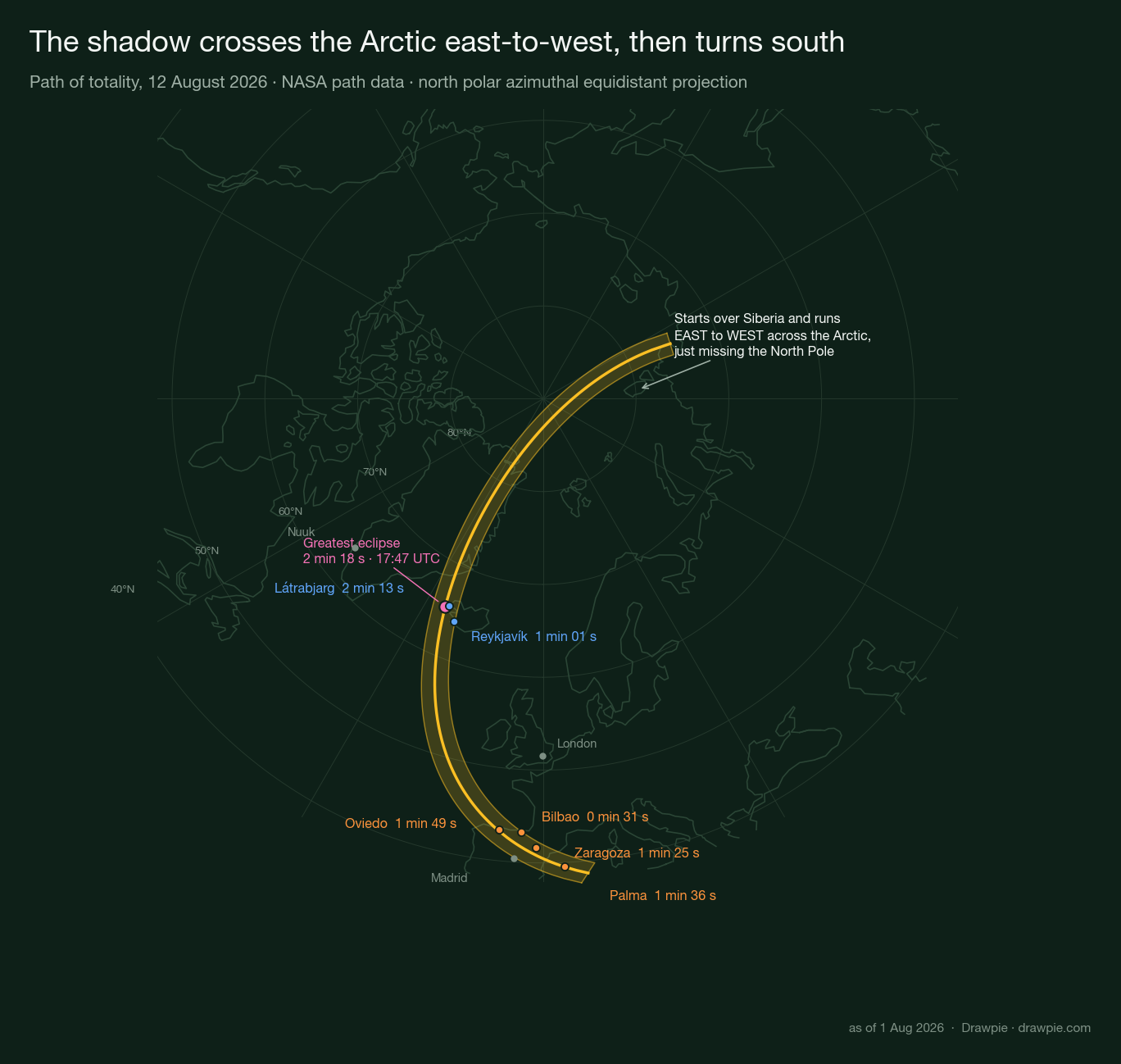
| Segment | What is there | Totality |
|---|---|---|
| Arctic Ocean / N Siberia | almost nobody | path begins at sunrise |
| Eastern Greenland | Scoresby Sound fjords; a few research and military outposts, plus expedition ships | up to ~2 min |
| Open ocean, 45 km west of Iceland | nothing — this is the point of greatest eclipse | 2 min 18 s |
| Western Iceland | Westfjords, Snæfellsnes, Reykjavík, Keflavík | 0 min 40 s – 2 min 13 s |
| Northern Spain | Galicia, Asturias, Cantabria, Castilla y León, Aragón | 0 min 31 s – 1 min 49 s |
| NE Portugal | Guadramil and Rio de Onor, border villages in Bragança | 17 s |
| Balearics | Mallorca | 1 min 36 s |
The path is 294 km (183 miles) wide at its widest. Madrid, Barcelona, Lisbon, London and Paris are all outside it — Madrid and Barcelona reach 99% and still see nothing of the corona. Ninety-nine per cent is not totality; the difference between them is the entire point of travelling.
Iceland or Spain: which is the better bet?
This is the real question, and it is a genuine trade-off rather than a matter of taste.
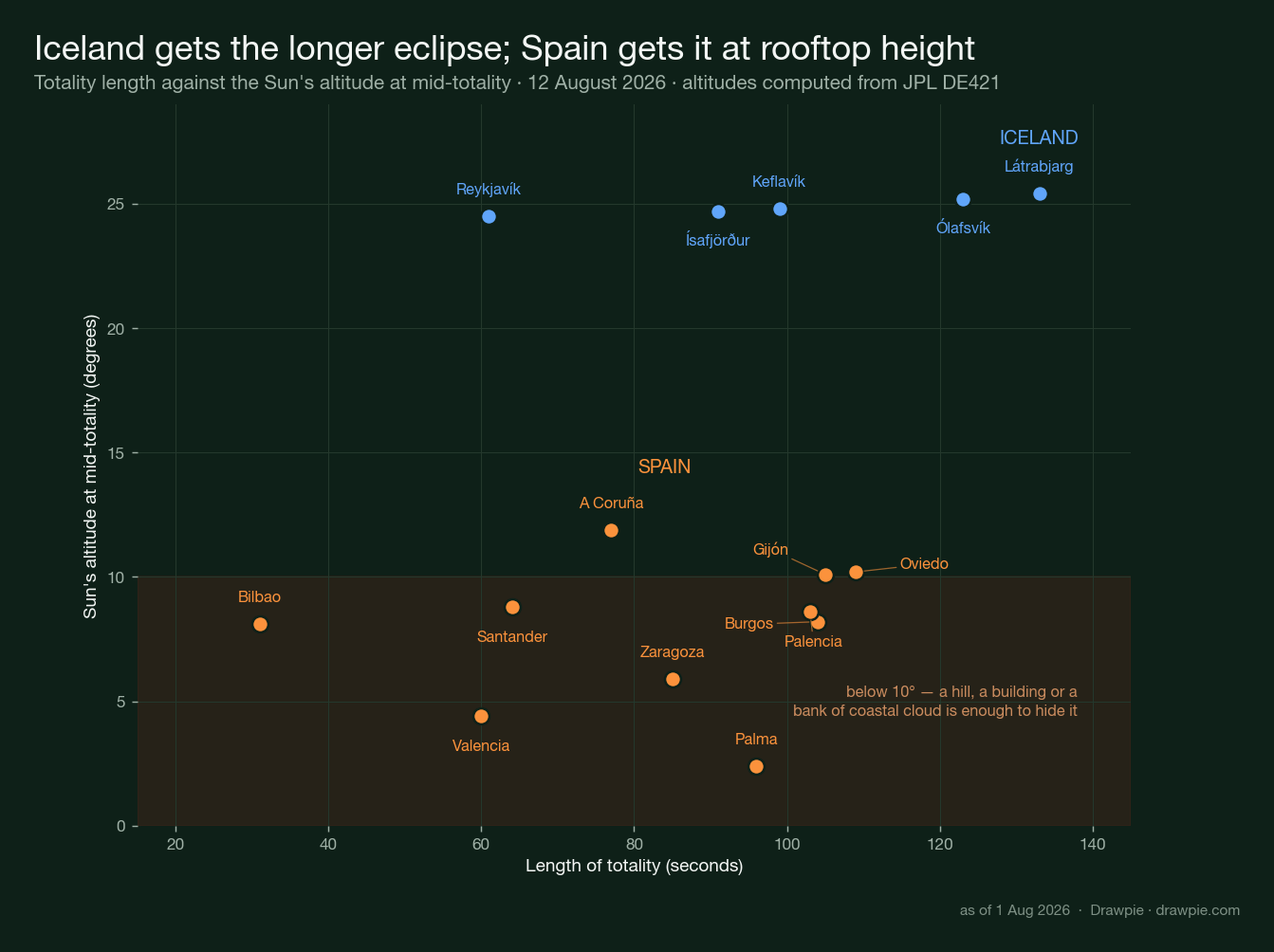
| Place | Country | Totality | Sun |
|---|---|---|---|
| Látrabjarg | Iceland | 2:13 | 25.4° |
| Ólafsvík | Iceland | 2:03 | 25.2° |
| Keflavík | Iceland | 1:39 | 24.8° |
| Ísafjörður | Iceland | 1:31 | 24.7° |
| Reykjavík | Iceland | 1:01 | 24.5° |
| Oviedo | Spain | 1:49 | 10.2° |
| Gijón | Spain | 1:45 | 10.1° |
| Burgos | Spain | 1:44 | 8.2° |
| Palencia | Spain | 1:43 | 8.6° |
| Palma | Spain | 1:36 | 2.4° |
| Zaragoza | Spain | 1:25 | 5.9° |
| A Coruña | Spain | 1:17 | 11.9° |
| Santander | Spain | 1:04 | 8.8° |
| Valencia | Spain | 1:00 | 4.4° |
| Bilbao | Spain | 0:31 | 8.1° |
Iceland has the better geometry and the worse weather. The Sun sits about 25° up — high enough that terrain and low cloud are not fatal — and the western Westfjords get the longest totality on land anywhere, 2 min 13 s at Látrabjarg. Iceland is also, reliably, a cloudy country.
Spain has the better weather and the worse geometry. August at low elevation in northern Spain offers a genuinely good chance of clear sky. But the Sun is only 8 to 12° above the horizon on the north coast, and lower still inland and east — 5.9° at Zaragoza, 4.4° at Valencia, 2.4° at Palma. At those altitudes a ridgeline, a hotel, or one bank of coastal cloud sitting on the horizon is enough to take the whole thing away.
The practical consequence: in Spain, site selection is not about the town, it is about the horizon. You need an unobstructed view low to the west-northwest. In Iceland you mostly need luck with cloud.
Two Icelandic details worth knowing. Reykjavík gets only 1 min 01 s — the capital sits near the edge of the path, and Látrabjarg gets more than twice as long. And Bilbao gets 31 seconds, for the same reason on the Spanish side. Being inside the path is not the same as being well inside it.
What time does it happen?
Greatest eclipse is at 17:47 UTC — 1:47 p.m. Eastern. Iceland sees totality two minutes later; Spain sees it forty minutes after that, at about 18:28 to 18:33 UTC, which is 8:28 to 8:33 in the evening local time.
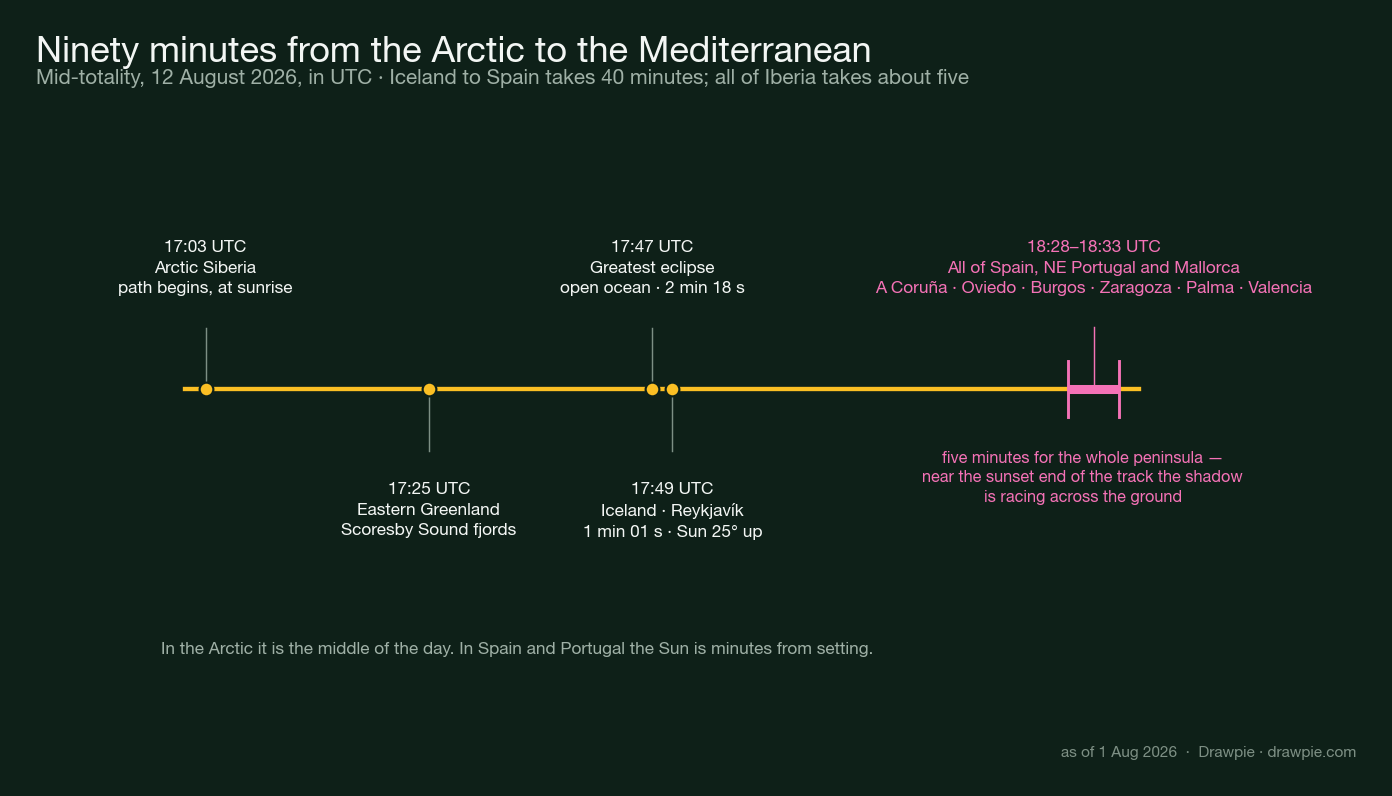
| Moment | UTC | Local | US ET |
|---|---|---|---|
| Path begins (Siberia) | 17:03 | — | 1:03 p.m. |
| Eastern Greenland | 17:25 | — | 1:25 p.m. |
| Greatest eclipse | 17:47 | — | 1:47 p.m. |
| Reykjavík | 17:48–17:49 | 5:48 p.m. GMT | 1:48 p.m. |
| A Coruña | 18:28 | 8:28 p.m. CEST | 2:28 p.m. |
| Zaragoza | 18:30 | 8:30 p.m. CEST | 2:30 p.m. |
| Palma | 18:31 | 8:31 p.m. CEST | 2:31 p.m. |
The whole track takes about ninety minutes, and the Iberian end of it takes about five. That compression is real: near the sunset end of a track the shadow is moving at its fastest across the ground.
It also means the Spanish eclipse happens minutes before sunset. In Bilbao, Vitoria, Logroño, Burgos, Zaragoza and along the Costa Daurada the Sun actually sets while the eclipse is still in its closing partial phase — the published tables give a sunset time instead of an end time for those cities.
How can you watch the 2026 eclipse online from the US?
Free, on several streams, and the timing works out unusually well for the eastern US: totality happens at 1:47 p.m. Eastern, six minutes before your own partial maximum. Watch the corona on a screen, then put the glasses on and step outside.
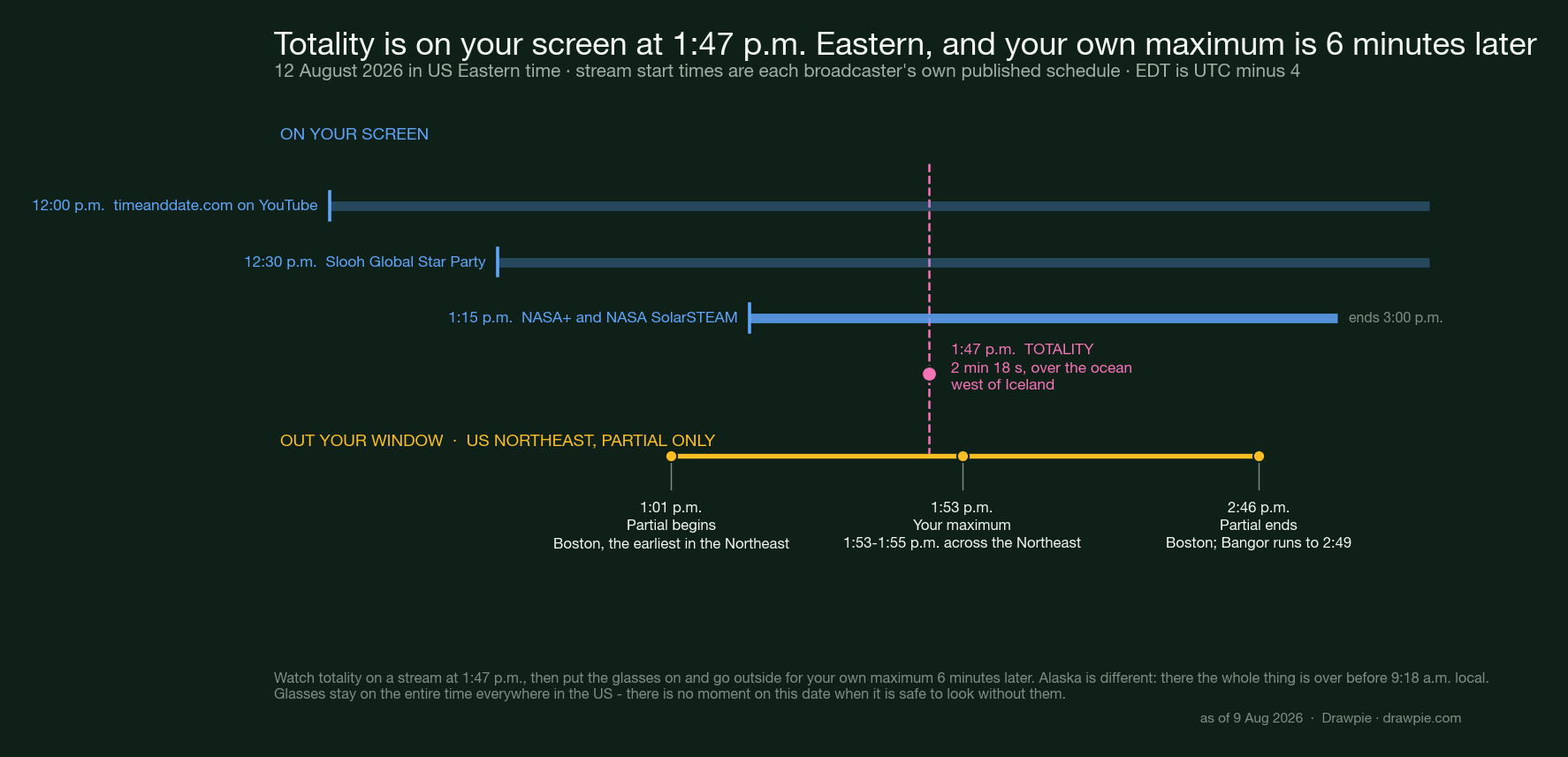
| Stream | Starts (ET) | UTC |
|---|---|---|
| timeanddate.com | 12:00 p.m. | 16:00 |
| Slooh | 12:30 p.m. | 16:30 |
| NASA+ | 1:15 p.m. | 17:15 |
| NASA SolarSTEAM | 1:15 p.m. | 17:15 |
Every start time above is the broadcaster’s own published schedule, not a figure lifted from coverage of it. ESA is also broadcasting, on ESA Web TV, and the Virtual Telescope Project is carrying live views from Spain and Italy; neither publishes a start time we could verify, so neither is in the table.
NASA’s is the one to pick if you only watch one. Its broadcast runs 1:15 to 3:00 p.m. ET and features telescope views plus footage from a WB-57 high-altitude research aircraft chasing the Moon’s shadow — a vantage point no ground site can offer, and the reason to watch a stream even if your own sky is clear. NASA SolarSTEAM, a NASA-funded project run by Southern Illinois University, broadcasts separately from León in northern Spain with dedicated white-light, hydrogen-alpha and calcium-K telescope feeds.
If you are in Alaska, none of this lines up: your partial eclipse is over by 9:18 a.m. local at the latest, hours before any of these streams begin.
How do you watch it safely?
The rule is short and it has one exception.
- Certified eclipse glasses (ISO 12312-2) for every partial phase. Sunglasses are not a substitute, and neither is a phone screen, exposed film, or a welding mask below shade 14.
- Only inside totality can the filters come off — and only for as long as totality lasts, which here is at most 2 min 18 s and in most places nearer one minute.
- In the United States there is no such moment. The eclipse is partial from coast to coast, so the glasses stay on from first contact to last.
- Cameras, binoculars and telescopes need their own filters fitted at the front. Eclipse glasses held behind an optic do not protect you.
If you have no glasses, a pinhole projector made from two pieces of card works, costs nothing, and is completely safe because you never look at the Sun at all.
UK readers get a much deeper partial than the US — 91% in London, 95% in Plymouth, the best since 1999. We have a separate guide to where to buy eclipse glasses in the UK , including how to tell a certified pair from a counterfeit and what to do if none arrive in time.
When is the next total solar eclipse?
Sooner than you would think, and then not for a long time.
| Date | Where | Max totality |
|---|---|---|
| 2 Aug 2027 | Spain, North Africa, Egypt, Arabia | 6 min 23 s |
| 23 Aug 2044 | Greenland, NW Canada, Montana / N. Dakota | ~1 min 30 s |
| 12 Aug 2045 | California to Florida | ~6 min |
The 2027 track runs from Spain across Morocco, Algeria, Libya and Egypt to Saudi Arabia, Yemen and Somalia; the maximum falls near Luxor, and it is the longest totality on easily reached land this century. The 2044 path only clips the US near sunset. 2045 is the coast-to-coast one — the sequel to 2017.
Spain is extraordinarily lucky here: it gets totality on 12 August 2026 and again on 2 August 2027, 355 days later, having waited 121 years before that. Iceland is the opposite case — this is its only total eclipse of the entire 21st century, and the next one is in 2196.
For US readers the honest summary is that seeing totality in 2026 means a trip abroad or somebody else’s camera, and the next real one at home is 19 years away, on 12 August 2045.
Sources
Checked on 1 August 2026; the NASA table and the stream schedules re-checked on 9 August 2026.
| Source | What it supports here |
|---|---|
| NASA — Total Solar Eclipse on August 12, 2026 | The US and Canadian city timing table, the countries in the path, the range of US partial visibility, and the note that an asterisked end time is a sunset time |
| NASA GSFC eclipse catalogue — path map for 2026 Aug 12 | The path polylines used to draw the map, and the greatest-eclipse and greatest-duration positions |
| Solar eclipse of August 12, 2026 — Wikipedia | Greatest eclipse at 17:47:05.8 UTC, 2 min 18 s maximum, 294 km path width, the city-by-city local-times table, the Portuguese villages in the path, and the 1905 / 1954 / 2196 comparisons |
| National Eclipse — 2026 overview | Totality lengths for Icelandic and Spanish towns, the low Sun altitude in Spain, and the qualitative weather comparison between Iceland and Spain |
| Sky & Telescope — Luxor 2027 | The 2 August 2027 eclipse over Egypt and its duration |
| NASA+ — 2026 Total Solar Eclipse broadcast | NASA’s 1:15–3:00 p.m. ET broadcast window, and the telescope and WB-57 aircraft coverage |
| NASA SolarSTEAM — 2026 total solar eclipse, Spain | The León broadcast, its 12:15 CDT start, the telescope feeds, and that it is NASA-funded through Southern Illinois University |
| Sky & Telescope — where to see the eclipse online | Which organisations are broadcasting, including ESA Web TV and the Virtual Telescope Project |
How we verified this
THE PATH GEOMETRY on the map is NASA GSFC’s published polylines for this eclipse — northern limit, southern limit and centre line — not our own shadow model. We wrote one, and its greatest-eclipse point landed about 60 km from NASA’s published position. That is invisible at hemisphere scale, and we still did not use it, because the authoritative track was available. Coastlines are Natural Earth 110m, drawn as a locator only; this is a schematic, not a survey.
THE US CITY TIMES are NASA’s, with one flagged exception. Contact times were recomputed independently from JPL DE421 ephemerides — topocentric Sun and Moon positions, contacts found where the apparent separation equals the sum of the two discs’ radii. That computation reproduces nine of NASA’s ten US cities to within one minute on every contact and to within half a percentage point on coverage. The tenth, Portland, Maine, comes out 20 minutes later than NASA’s listed end. Two things point the same way: Portland has higher coverage than Boston and starts earlier, so its eclipse cannot end 19 minutes before Boston’s; and NASA’s listed value, 2:27 p.m., is character-for-character the same as Washington, D.C.’s in the row seven lines below. We publish NASA’s number, flag it, and give ours next to it rather than silently substituting.
SUN ALTITUDES at mid-totality are ours, computed with the same ephemeris. No source we found publishes them city by city, and they decide whether a site is usable: 2.4° at Palma is not the same proposition as 25.4° at Látrabjarg, even though the totality lengths are within 40 seconds of each other.
TOTALITY DURATIONS are from the published city-by-city local-times table, not from our own model.
ONE SOURCE CONFLICT IS UNRESOLVED IN OUR FAVOUR. NASA describes the Portuguese segment as “the very northwestern tip of Portugal.” The detailed local-times table names the Portuguese places in the path as Guadramil and Rio de Onor, which are border villages in the Bragança district — the extreme northeast. We went with the named villages over the direction word, and say so here.
WEATHER PROSPECTS are summarised qualitatively from eclipse-guide sources. We did not compute cloud climatology and do not publish a percentage, because we could not verify one to the standard the rest of this article is held to.
ADDED 9 AUGUST. STREAM START TIMES are each broadcaster’s own published schedule, read from the machine-readable listing rather than from an article about it: NASA’s from the NASA+ event window (17:15–19:00 UTC), timeanddate’s and Slooh’s from the scheduled-broadcast start on their own YouTube listings (16:00 and 16:30 UTC), SolarSTEAM’s from Southern Illinois University’s own page, which states it as “12:15 CDT / 19:15 CEST”. Two of those pages render a local date one day later depending on the reader’s time zone; the times above are the UTC values, converted once. Sky & Telescope’s roundup of the broadcasts, which most coverage cites, carries no times at all.
ONE FIGURE WE CHANGED A WORD ON. We wrote “the first in mainland Europe for twenty years.” Wikipedia dates the previous continental European totality to 29 March 2006, which is twenty years; Slooh and others say 1999, which is twenty-seven. The difference is whether the 2006 track over Turkey counts as Europe. We have kept the twenty-year figure, which matches the source we cite, and changed “mainland” to “continental” to match its wording rather than implying a claim the source does not make.
NASA’S CITY TABLE WAS RE-FETCHED on 9 August and is unchanged, including the Portland, Maine end time flagged above. The coverage map redraws those same figures; it adds no contours, because equal-coverage lines would require our own shadow model, which this article deliberately does not publish.