The East Palace on Netflix: Cast, Full Recap and the Ending Explained
Update log (1)
- — Published 24 July 2026, one week after release. Review counts and viewing figures will move.

- All eight episodes landed on 17 July 2026. It is a closed story with an ending, not a series waiting on a second season.
- The premise is a misdirect. The palace blames a thirty-year-old curse laid by an executed court lady; the thing actually killing the royal heirs is closer to home.
- The ending turns the hunter into the hunted: Gu-cheon bargains for a weapon, becomes an ak-gwi himself, and spends what he has left on Saeng-gang.
- It holds 100% on Rotten Tomatoes, but from only nine reviews. The harder number is 32.9 million hours viewed in a week it was only available for three days of.
The East Palace — Donggung — arrived on Netflix on 17 July 2026 with all eight episodes at once, and spent the following week as one of the most-watched shows in the world. It is a Joseon-set dark fantasy about a palace where the royal heirs keep dying and everyone has agreed to call it a curse.
The interesting thing about it is structural: the show keeps handing you an explanation, letting you settle into it, and then opening the floor underneath.
⚠️ Full spoilers from here, including the ending.
Everything below was checked on 24 July 2026, one week after release.
The essentials
| Detail | |
|---|---|
| Released | 17 July 2026, all 8 episodes |
| Episodes | 8, roughly 46–59 minutes each |
| Director | Choi Jung-kyu |
| Writers | Kwon So-ra and Seo Jae-won |
| Genre | Dark fantasy, horror, period sageuk |
| Where to watch | Netflix, included with any subscription |
| Rotten Tomatoes | 100% — from 9 reviews |
| First week | 32.9m hours viewed; No. 2 non-English show worldwide; Top 10 in 80+ countries |
Cast and characters
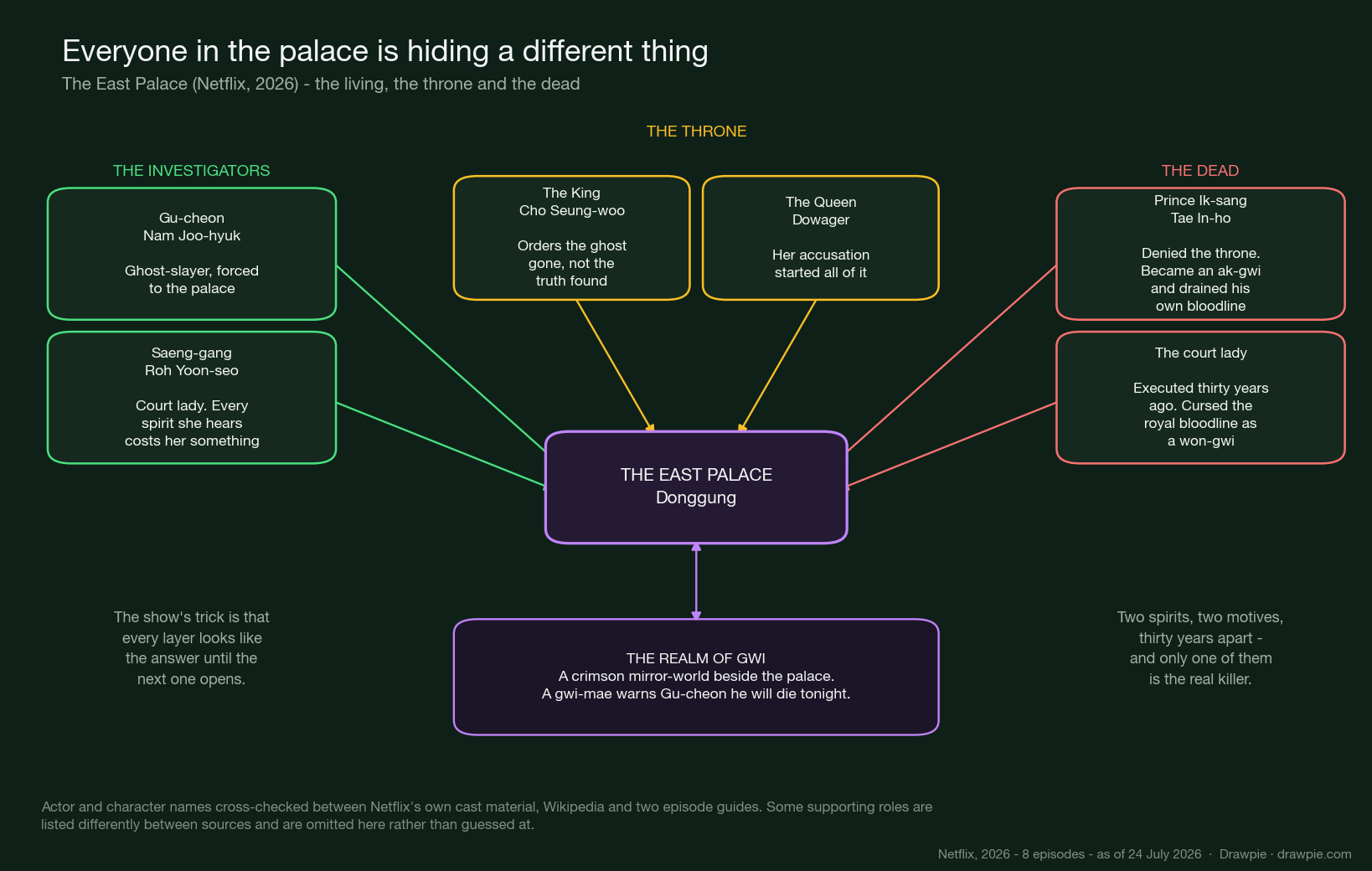
| Actor | Character | Who they are in the story | |
|---|---|---|---|
| Nam Joo-hyuk | Gu-cheon | A ghost-slayer living in isolation in the mountains, dragged to the palace against his will to find out what is killing the crown princes. He kills spirits with a blade, and the series slowly makes clear how thin the line is between what he hunts and what he is. | @skawngur |
| Roh Yoon-seo | Saeng-gang | A court lady who can hear the dead — a curse rather than a gift, because every spirit she lets speak takes something from her. She becomes Gu-cheon’s guide, then his equal, then the only person who understands him. | @rohyoonseo |
| Cho Seung-woo | The King | The most compromised figure in the palace. He wants the haunting stopped but explicitly does not want the truth found, and refuses to name the woman at the centre of it. His refusal is the plot’s engine. | — |
| Tae In-ho | Prince Ik-sang | Denied the throne in life. In death he becomes an ak-gwi, an evil spirit, and turns on his own bloodline — the answer the palace spends eight episodes not looking at. | — |
| Park Su-yeon | Queen Consort | A palace figure caught between the throne and the hauntings. | — |
| — | The Queen Dowager | Thirty years ago, as queen, she made the accusation that destroyed a court lady. Everything in the present grows out of that. | — |
The story, in four movements
Because all eight episodes dropped at once and the plot is one continuous arc rather than eight self-contained cases, it reads better as movements than as an episode list.
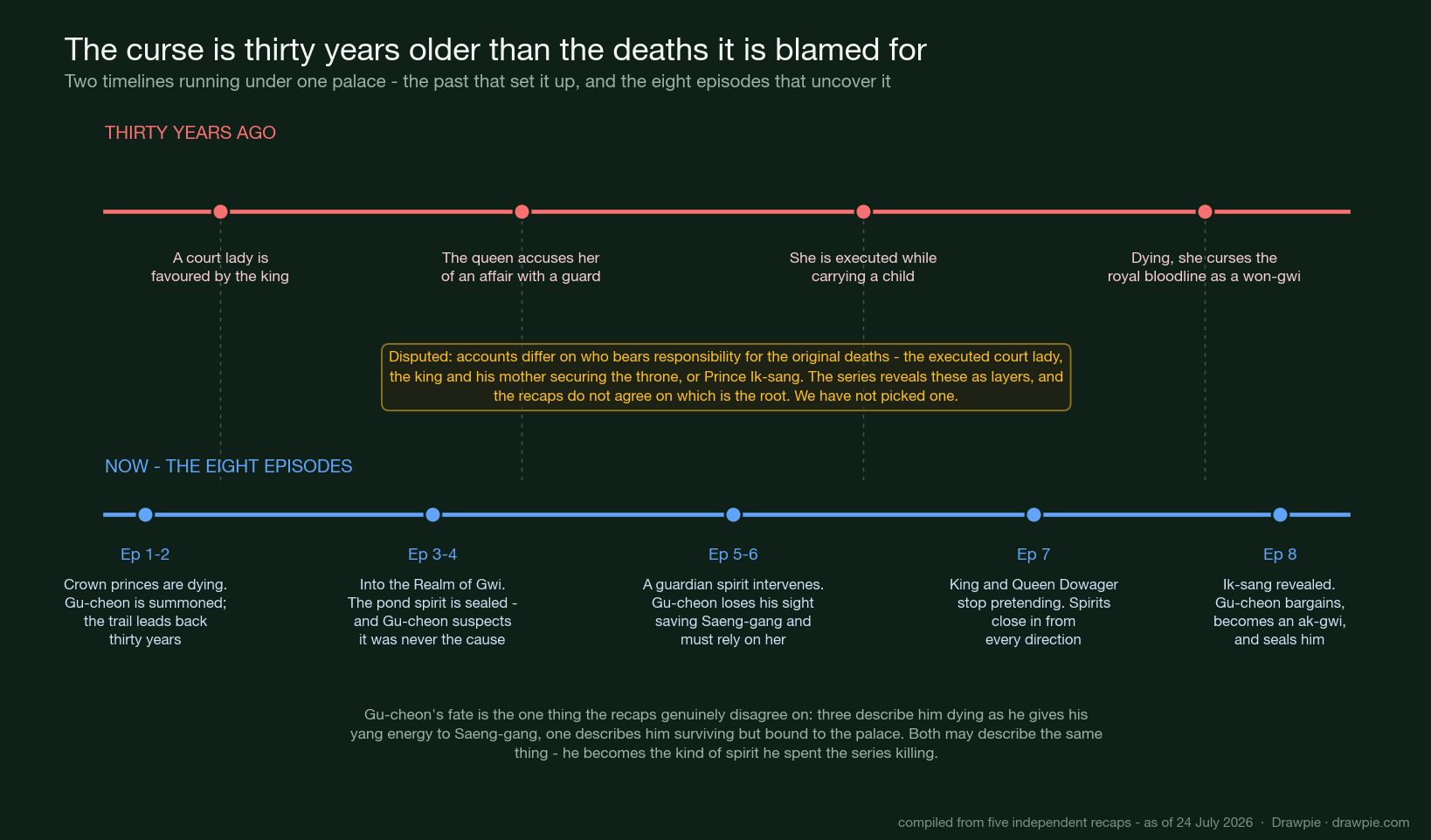
One — the summons
Royal heirs are dying in the East Palace, the crown prince’s residence. Gu-cheon, a ghost-slayer who has arranged his life around not being in places like this, is compelled to the palace. He is assigned a guide: Saeng-gang, a court lady whose ability to hear spirits makes her useful and expendable in roughly equal measure.
Their first case sets the tone. Jars in the salt storehouse break, and the spirits that come out belonged to young girls who were locked inside years earlier and died in a fire, their remains sealed into those jars. Freeing them is a small mercy that solves nothing — but one of the spirits says something that reframes the whole investigation: the king’s most favoured lady cursed the royal family before taking her own life.
The trail runs thirty years back.
Two — the wrong answer
The investigation reaches into the Realm of Gwi, a crimson mirror-world sitting alongside the palace, and eventually to a pond spirit that seems to be the source of everything. They seal it.
And Gu-cheon immediately doesn’t believe it. The sealing works, and the deaths do not stop in the way they should. Something larger is still arranging things.
This is the hinge of the series. Most supernatural dramas would spend eight episodes building to the reveal of the pond spirit. This one disposes of it at the halfway mark and treats the audience’s satisfaction as a warning sign — the same trick of letting you settle into the wrong answer that Elite Force builds its entire finale on , in a very different genre.
Three — the cost
The middle stretch is where the show earns its reputation, and it does it by taking things away.
A guardian spirit intervenes against them. In a fight to protect Saeng-gang, Gu-cheon loses his sight. The ghost-slayer who kills with a blade now cannot see, and has to work entirely through the woman whose ability he initially treated as a liability. The power balance between them inverts and never goes back.
Meanwhile the human plot surfaces. The King and the Queen Dowager stop pretending to be aligned, and the palace’s ordinary crimes — succession intrigue, poisonings, an accusation made thirty years ago by a queen who could not tolerate her husband’s favour falling on a servant — turn out to be doing at least as much killing as anything supernatural.
Four — what the curse actually was
The thing draining the royal bloodline is Prince Ik-sang.
Denied the throne in life, his resentment curdled after death into an ak-gwi, and he has been killing his own family while the court comfortably blamed a dead woman’s curse. The question underneath the whole series turns out to be his: why couldn’t I be king?
The ending explained
Gu-cheon cannot beat him as a man.
So he bargains with a primordial spirit for a weapon, and pays for it by becoming an ak-gwi himself — the exact thing he has spent his life destroying. On the way to the confrontation a gwi-mae tells him plainly that he will die that night.
He seals Ik-sang. And he pours what is left of his own yang energy into Saeng-gang, so that she can come back from the spirit realm.
Does Gu-cheon die? The recaps genuinely split here, and it is worth being straight about it. Three separate accounts describe him dying — the gwi-mae’s warning delivered, the sacrifice completed. One describes him as surviving, but bound to the palace, his freedom only apparent.
Both may be describing the same thing. He becomes an ak-gwi and spends himself on Saeng-gang; whether you call what remains “alive” is exactly the question the series has been asking for eight episodes. The show’s own line is that the boundary between spirit and human was never as fixed as the palace insisted. An ending that cannot be cleanly answered with “he lived” or “he died” looks less like ambiguity for its own sake and more like the point.
What is not ambiguous: Saeng-gang survives, and she survives because of him. The King lives, carrying what he did. And Ik-sang — the prince whose grievance was that nobody would give him the throne — ends sealed away by a man who gave up everything he was.
Is it worth watching?
The reception numbers are strong but read them carefully. 100% on Rotten Tomatoes sounds decisive; it is nine reviews. Nine positive reviews is genuinely good and it is also a sample small enough that one dissenting critic would move it ten points. Nor is it unique to this show: My Brilliant Career holds a 100% from just 13 reviews, against a 54% audience score . The more meaningful figure is 32.9 million hours viewed in the week of 13–19 July — a week the series was only available for three days of. That is an audience finding it fast, in 80-plus countries, which is harder to manufacture than a critics’ score.
Structurally, the strongest choice is the one at the halfway point. Sealing the pond spirit in episode four and revealing it as the wrong answer is a real risk: it spends the audience’s satisfaction early and asks them to keep going on distrust rather than resolution. Shows that do this either feel rigorous or feel like they are stalling. That it landed as an easy binge suggests it stayed on the right side of that line.
The blinding is the other tell. Taking the lead’s defining capability away in episode six — from a character whose entire identity is a blade and a pair of eyes — forces the last quarter to run on the relationship rather than on action. That is a writers’ room confident in what it built.
The reservation worth naming is the one common to eight-episode streaming sageuk: a curse spanning thirty years, three layers of culprit, a mirror realm and a palace conspiracy is a lot of architecture for roughly six and a half hours. The recaps disagreeing on who is ultimately responsible for the original deaths is not necessarily their failure — it may be the show moving fast enough that the layers blur.
Our read: a closed, confident eight-episode story with a genuinely unusual midpoint and an ending that refuses to be tidy. If you want a supernatural mystery that treats its own explanations with suspicion, this is the one. If you want a clean answer on the last page, it will annoy you — deliberately.
Where it was filmed
Entirely in South Korea, across Gyeonggi, North Gyeongsang and Gangwon provinces.
- The palace is the open Joseon set at Mungyeongsaejae Provincial Park in Mungyeong, North Gyeongsang — a standing replica of Joseon palace architecture used for the courtyard wides that stand in for Donggung.
- The wilderness where Gu-cheon lives in isolation was shot at Seoraksan National Park in Gangwon.
One production note that did not make it on screen: a fire at a production facility in Yeoncheon County on 21 December 2024 destroyed sets and equipment during the shoot. Nobody was hurt.
Where to watch The East Palace
Netflix, included with any subscription — there is no separate rental or purchase. All eight episodes have been available since 17 July 2026.
Checked on 24 July 2026. As a Netflix original its availability follows Netflix’s own regional rollout rather than separate licensing; it charted in the Top 10 in more than 80 countries in its first week, which is a reasonable indication of how broadly it is carried, though we have not verified every territory.
Frequently asked questions
How many episodes is The East Palace?
Eight, roughly 46 to 59 minutes each, all released together on 17 July 2026. It is a complete story.
Does Gu-cheon die at the end?
The majority of recaps say yes — he becomes an ak-gwi, seals Ik-sang, and gives the last of his yang energy to Saeng-gang after being warned he will die that night. One account describes him as surviving but bound to the palace. Given what he becomes, both may be describing the same ending.
Who is the real villain of The East Palace?
Prince Ik-sang. Denied the throne in life, he became an ak-gwi after death and drained his own royal bloodline while the palace blamed a thirty-year-old curse.
What was the curse in The East Palace?
Thirty years earlier a court lady favoured by the king was accused by the queen — the present-day Queen Dowager — of an affair with a royal guard, and executed while carrying a child. Dying, she cursed the royal bloodline as a won-gwi. The series then reveals that this is not the whole explanation for the deaths in the present.
What do won-gwi, ak-gwi and gwi-mae mean?
They are the series’ tiers of spirit. A won-gwi is bound to the human world by its own resentment; an ak-gwi is an evil spirit, which is what Ik-sang becomes and what Gu-cheon turns himself into; a gwi-mae is a higher spirit entity — one of them warns Gu-cheon of his death.
Is there a season 2 of The East Palace?
Nothing has been announced. The eight episodes tell a closed story with a resolved ending, so it reads as a limited series rather than a first season.
Where was The East Palace filmed?
In South Korea. The palace scenes used the Joseon open set at Mungyeongsaejae Provincial Park in North Gyeongsang, and Gu-cheon’s mountain wilderness was shot at Seoraksan National Park in Gangwon.