Tesla Cybercab Explained: Robotaxi Economics, Autonomous Driving & Regulation
NHTSA opened an audit of about 1,000 Cybercabs on 3–4 September 2026. An audit produces an outcome, and whichever way it goes it changes this page’s central question. Re-read in early October, or sooner if NHTSA, Tesla or a court says anything.
Everything else on the page is unaffected; the figures below still say when they were read.

- Tesla began Cybercab rides in Austin on 3 September 2026. The car has no steering wheel, no pedals and no mirrors.
- Within hours, NHTSA said it had opened an audit of about 1,000 Cybercabs, to assess how Tesla determined they comply with federal vehicle-safety standards.
- Those standards were written for human-driven cars and require manual controls. In the United States a manufacturer can put a vehicle on the road by certifying its own compliance — no prior clearance is needed.
- The exemption route exists but caps deployment at 2,500 vehicles a year. Tesla’s engineering chief said the Cybercab would not be subject to that cap, without explaining why; NHTSA has said Tesla had not applied.
- Someone has already run this maze. Amazon’s Zoox self-certified a no-controls vehicle, NHTSA investigated, Zoox withdrew the claim — and about a year later took the exemption instead, receiving one in July.
- Tesla’s existing robotaxis are Model Y SUVs, which do have manual controls and, Reuters reports, human backup drivers in some cars. The Cybercab is the first in the fleet that cannot comply.
- The economics are not public. No cost per mile, no utilisation figures, no verifiable fleet size and no published fare table. This page does not estimate them.
On 3 September 2026, in downtown Austin, Tesla started putting passengers into a car with no steering wheel, no pedals and no mirrors. Within hours, the federal regulator opened an audit of about 1,000 of them.
That sequence is the whole story. Not whether the Cybercab is a good car — nobody outside Tesla can say yet — but whether a vehicle that cannot meet the rules is allowed to carry people while everyone works out what the rules mean.
What happened
| Event | Downtown Austin, 3 September 2026 |
| What launched | Cybercabs added to Tesla’s existing robotaxi fleet |
| Tesla’s position | Rides “open to everyone”; executives described pricing plans without saying whether they had started charging |
| Regulator’s response | NHTSA opened an audit of about 1,000 Cybercabs, hours later |
| Tesla’s comment | Did not respond to Reuters’ requests for comment |
The audit’s stated purpose is to assess how Tesla determined the cars comply with federal vehicle-safety regulations. That phrasing is worth reading twice: the question is not whether they do, it is how Tesla decided they do.
Why a missing steering wheel is a legal problem
US federal motor vehicle safety standards were written for cars driven by people, and they require manual controls. The Cybercab has none.
And in the United States, nobody has to approve a car before it goes on sale. Unlike most countries, where a new model needs regulatory clearance ahead of launch, American manufacturers can deploy by self-certifying that a vehicle meets the standards. The regulator’s involvement comes afterwards.
That is the gap the Cybercab is driving through, and it is why the same product would be handled completely differently almost anywhere else.
Tesla’s existing robotaxis do not have this problem. The Model Ys already running paid, limited robotaxi services in Texas and Florida have the manual controls the standards require, and Reuters reports human backup drivers in some cars. The Cybercab is the first vehicle in the fleet that cannot comply.
The three routes onto a public road
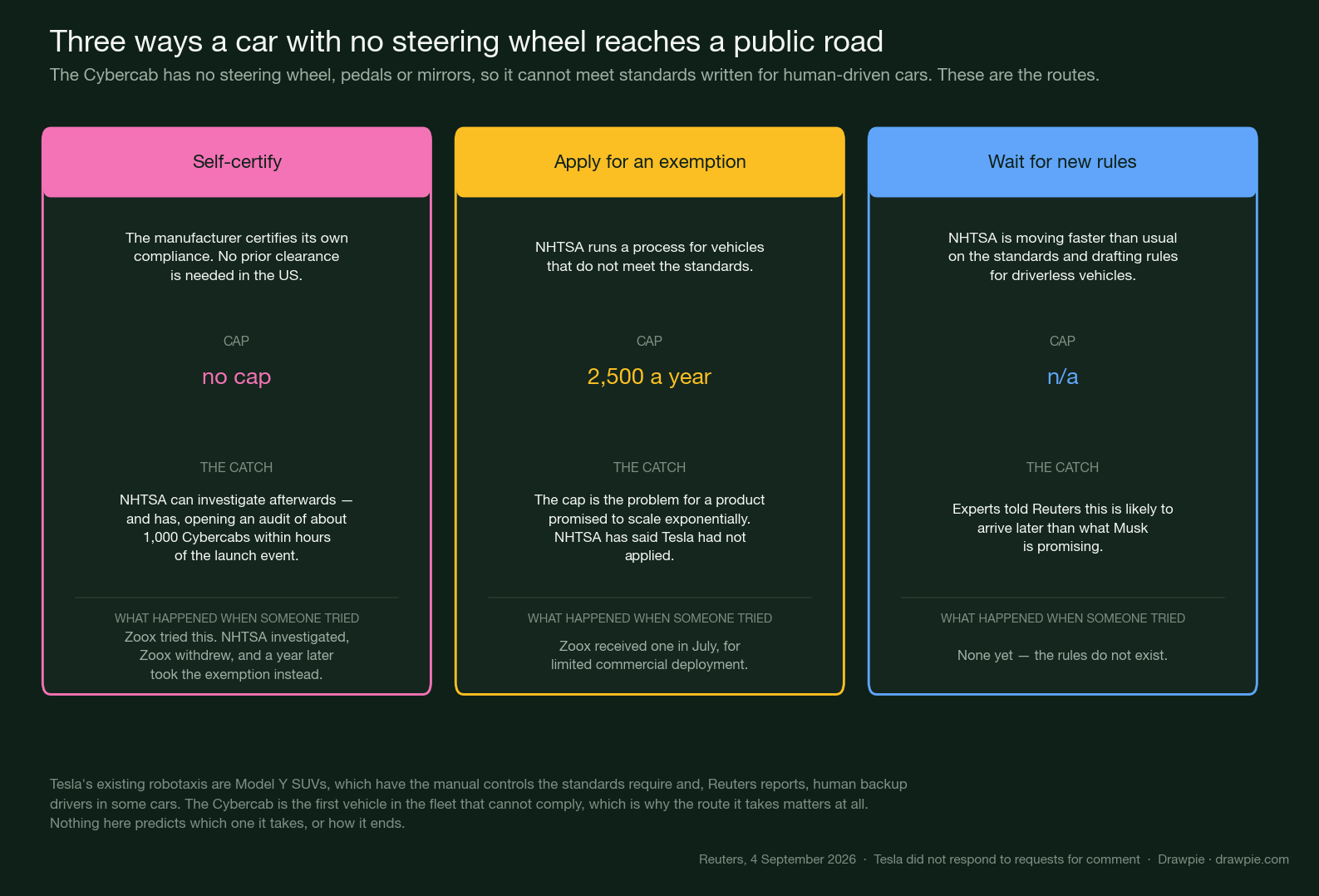
Self-certify. No cap, no prior clearance — and no protection. NHTSA can investigate afterwards, and already has.
Apply for an exemption. NHTSA runs a process for vehicles that do not meet the standards. It caps deployment at 2,500 vehicles a year, which is the problem for a product Musk says will grow exponentially. Tesla’s engineering chief Lars Moravy said on X earlier this year that the Cybercab would not be subject to that cap, without explaining why. NHTSA has previously said Tesla had not applied.
Wait for new rules. NHTSA is moving faster than usual on the standards and is separately drafting rules for driverless vehicles. Experts told Reuters those efforts are likely to arrive later than what Musk is promising.
Someone has already run this maze
This is the part that turns speculation into evidence.
Amazon’s Zoox — a vehicle with two bench seats facing each other and no driving controls — went the self-certification route. NHTSA launched an investigation. Zoox withdrew the claim. About a year later, in July, Zoox took the exemption route instead and received one for limited commercial deployment.
So the question “can a company just self-certify a car with no steering wheel?” has a recent, factual answer: one tried, and ended up in the process it had bypassed.
That does not settle what happens to Tesla. Three former senior NHTSA officials told Reuters a clash over self-certification could land in court, and one noted that NHTSA “has not always won these cases.”
Can the software actually do it?
Two accounts, and this page adjudicates neither.
Tesla says its Full Self-Driving software — a version of which runs the Cybercab — is up to 10 times safer than human drivers, and that its Austin service has operated without a fatal accident.
Against that, Reuters interviewed multiple former Tesla employees who trained the company’s self-driving software and reports that it continued to struggle with basic manoeuvres. Two named academics go further:
Bryant Walker Smith, a University of South Carolina law professor focused on autonomous-driving regulation: “No public information about Tesla’s capabilities suggests that Tesla is anywhere close to being able to safely and reliably deploy an automated driving system over the wide range of conditions that would be required for a vehicle without conventional controls.”
Michael Brooks of the Center for Auto Safety, on the legal question: “I don’t think there is a reasonable interpretation that can be made to suggest that the Cybercab can comply with the Federal Motor Vehicle Safety Standards.”
Philip Koopman, a Carnegie Mellon engineering professor, on what he expects Tesla to do: “Tesla historically has tested limits and pushed boundaries on regulations.” He suggests Tesla could adopt a creative interpretation, declare compliance and flood the market — which “could take NHTSA or state regulators years to resolve. Meanwhile, Tesla could be operating on public roads.”
The economics: what is published, and what is not
This is the section most coverage fills with arithmetic. It should not be, because the inputs are not public.
Here is everything Tesla has actually put out:
- At the 2024 unveiling, Musk said the Cybercab would sell for less than $30,000.
- Musk has said production will grow “exponentially” later this year or next.
- Manufacturing began in April 2026.
- At the launch, executives described pricing plans without saying whether they had begun charging.
Here is what is not published, and what you would need to assess whether a robotaxi ride makes money:
| Missing | Why it decides the answer |
|---|---|
| Cost per mile | The core unit of the business |
| Utilisation | Hours per day a vehicle actually carries someone |
| Fleet size | How many are running, verifiably |
| Fare table | What a rider pays |
| Cost stack | Energy, cleaning, depot, remote supervision, insurance, depreciation |
A vehicle price on its own tells you nothing. A $30,000 car that sits idle is worse business than a $60,000 car running sixteen hours a day. Robotaxi economics live almost entirely in utilisation and cost per mile, and neither figure exists in public for the Cybercab.
So this page does not model it. Anyone showing you a Cybercab cost-per-mile today has built it from assumptions, and the assumptions are doing all the work.
Is the Tesla Cybercab legal?
That is precisely what NHTSA has opened an audit to determine, and it is not settled.
Tesla appears to be relying on self-certification — the American system in which a manufacturer attests that its own vehicle meets federal standards, with no prior approval required. NHTSA is now examining how Tesla reached that conclusion for a car with no steering wheel, pedals or mirrors, when the standards were written to require manual controls.
The nearest precedent is unhelpful for Tesla: Zoox self-certified, was investigated, and withdrew. But precedent is not law, and former NHTSA officials point out the agency does not always win in court.
How many Cybercabs are there?
Not publicly known, and this page will not guess.
NHTSA’s audit covers about 1,000 vehicles, which is a figure about the scope of an audit rather than a count of cars carrying passengers. Tesla has published no fleet figure. A number for how many are authorised to operate commercially in Texas is circulating, but could not be verified from a readable source, so it does not appear here.
Does the Cybercab have a steering wheel?
No — and that is the entire regulatory issue.
It has no steering wheel, no pedals and no mirrors. It is a two-seater with butterfly doors, designed from the start on the assumption that nobody drives it. Every federal safety standard that assumes a human driver is therefore a question the vehicle has to answer differently, and the answer Tesla has given is the thing being audited.
The bottom line
A car that cannot meet the rules started carrying passengers, and the regulator responded within hours. Neither of those facts is in dispute.
What happens next has three possible routes, one of which has already been walked by somebody else and ended back at the start. Whether Tesla’s version ends differently depends on an audit that has just begun, and possibly on a court.
And the question everyone actually wants answered — whether a robotaxi ride makes money — cannot be answered from anything Tesla has published.
Reporting from Reuters’ analysis of 4 September 2026, read in full; Tesla did not respond to its requests for comment. This page contains no share-price commentary, no forecast, and no estimate of costs Tesla has not published.