Tennis Club Guide: What Membership Actually Costs and How to Choose One

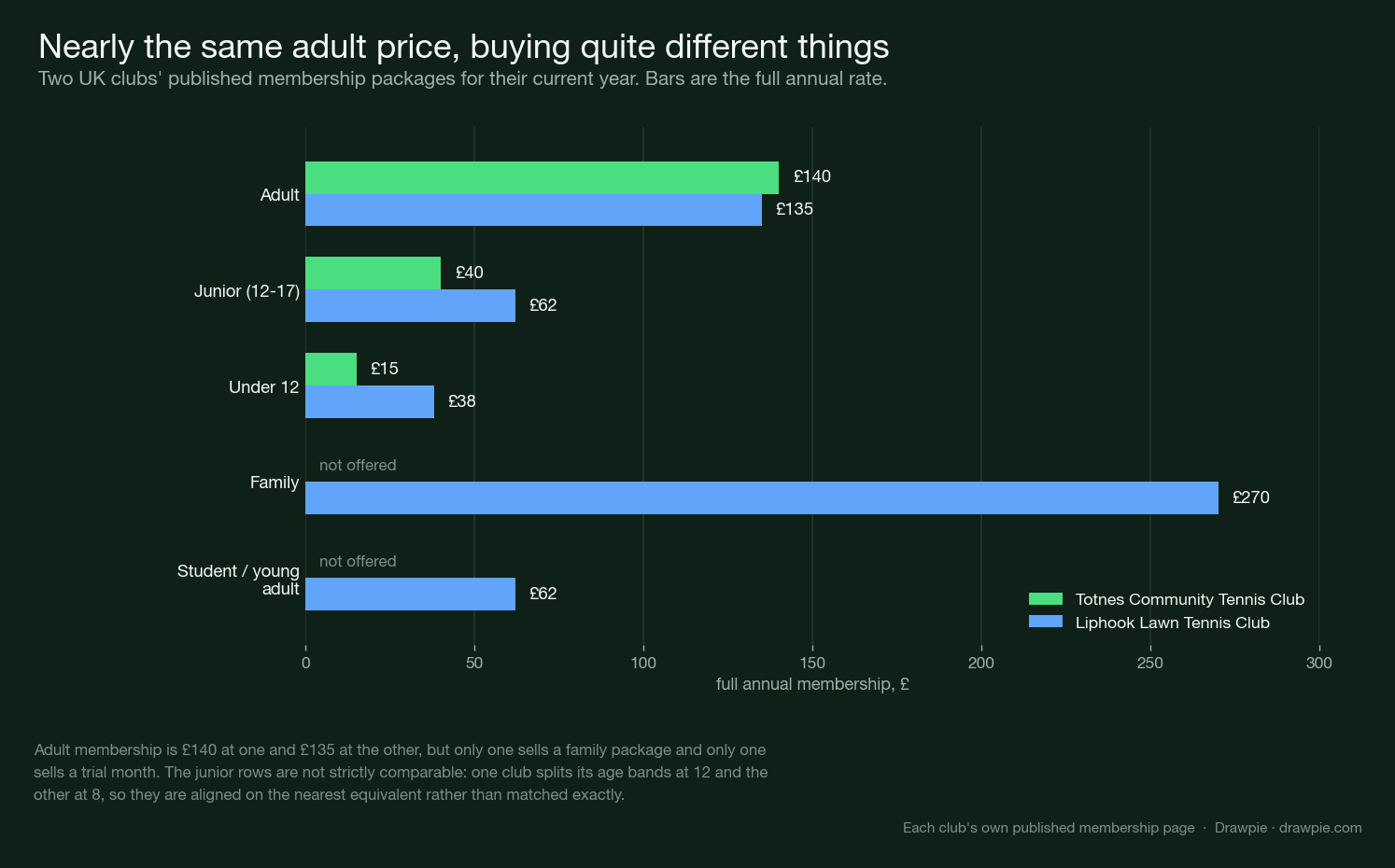
- Adult membership at the two clubs looked at here is £140 and £135 a year. The headline prices are close; what they include is not.
- Court booking is generally not a separate fee. At the club that publishes its rules, members book free, up to five days ahead.
- The routine extra is floodlighting — £1 per 30 minutes per court, which is what winter evening play actually costs.
- Neither club prices coaching on its membership page. One includes two Saturday sessions in the junior package, but lessons beyond that are a separate budget line.
- Joining mid-year is cheaper and both clubs publish the reduced rate rather than making you ask.
- Junior membership is dramatically cheaper than adult — £40 and £62 at the two clubs, and £15 for the youngest band at one of them.
- One club sells a £15 one-month trial. If you are unsure, that is the cheapest way to find out.
Adult membership at the two clubs below is £140 and £135. Once you are in, booking a court costs nothing.
That second sentence is the one that surprises people, because “court fees” is what everyone expects to be asked about. Here is what the money actually buys, using two real clubs’ published prices rather than a national average nobody can check.
What two real clubs charge
| Package | Totnes Community TC | Liphook Lawn TC |
|---|---|---|
| Adult | £140 | £135 |
| Junior | £40 (12–17) | £62 (8–17) |
| Youngest band | £15 (under 12) | £38 (under 8) |
| Family | not offered | £270 |
| Student / young adult | 50% off adult | £62 |
| One-month trial | £15 | not offered |
Five pounds separates the adult prices. Almost everything else differs.
One club sells a family package covering two adults and two juniors; the other does not. One sells a trial month; the other does not. One treats students as a discount on the adult rate; the other gives them their own category.
So “how much is a tennis club” has a tidy answer and a useless one. The tidy answer is about £135–140 a year for an adult. The useful answer depends on whether you are joining alone, as a couple, or with children — and that is where the two clubs stop resembling each other.
Court fees: there usually aren’t any
At the club that publishes its rules, members book courts free, up to five days in advance through ClubSpark.
That is the thing worth internalising before you compare clubs on price: for most UK clubs the membership fee is the court fee. You are not buying access and then paying per hour on top. You are buying the year.
Pay-and-play courts, where you book by the hour, are a different model and a reasonable alternative if you play rarely. But a club membership at £140 works out at under £3 a week, and it stops being a per-session decision — which for most people is the actual point.
The costs that aren’t in the membership
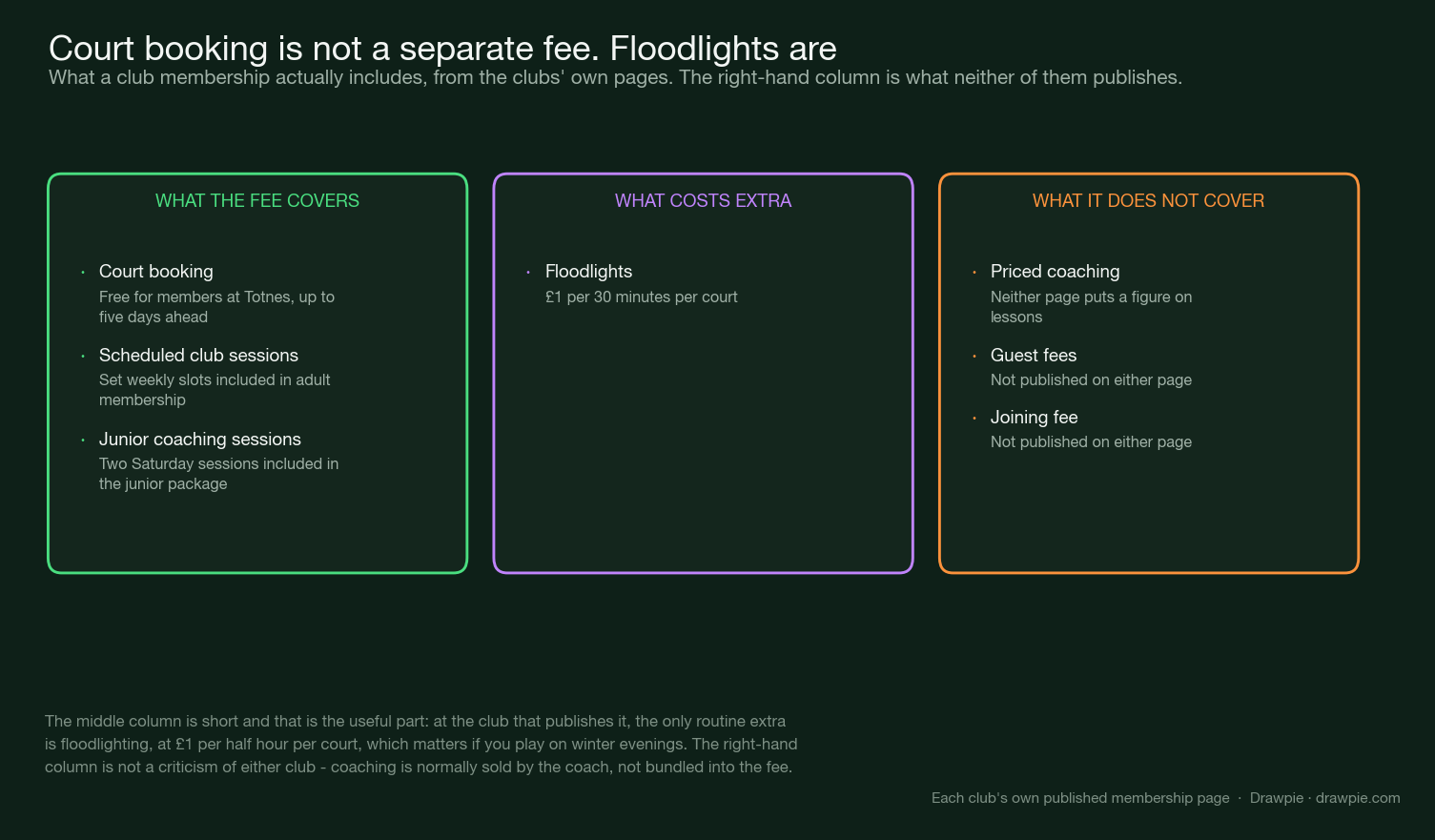
What the fee covers, at the club that spells it out: court booking, the scheduled weekly club sessions, and — in the junior package — two Saturday coaching sessions.
What costs extra: floodlights, at £1 per 30 minutes per court.
That is a small number with a real consequence. From October to March, if you play in the evening, you are playing under lights. An hour a week through the winter is a few pounds a month, not nothing but not a hidden trap either — the point is to know it exists before you are standing on a dark court looking for the meter.
What neither club publishes on its membership page:
- Priced coaching. Neither page puts a figure on lessons. The junior package at one club includes two Saturday sessions, but anything beyond that — adult lessons, one-to-ones, a block of group sessions — has no published price. Coaching at LTA clubs is generally sold by the coach rather than bundled into membership, so it is a separate budget line and you will need to ask what it costs.
- Guest fees, for bringing someone who is not a member.
- Joining fees, which some clubs charge on top of the annual rate.
None of that is a criticism of either club. It is a note about what a membership page will and will not tell you, and therefore what to ask before you sign up.
Joining mid-year is cheaper
Both clubs publish a reduced rate for joining part-way through the year, rather than making you negotiate for it.
- At Totnes, joining from 11 August drops adult membership from £140 to £80 for the remainder of the year to 31 March.
- At Liphook, whose year began on 1 July, the adult rate is currently showing £108 against a full £135, with every other category reduced in proportion.
Which makes September a good month to start. You get the autumn and winter, you find out whether you actually go, and you renew in April at the full rate having already answered the question.
How to choose between clubs
Price is the least useful thing to compare, because the prices are close. These are the questions that actually separate them:
- Is court booking included, and how far ahead can you book? Five days at one of these. A club where the courts are always full at your time of day is worse value at any price.
- Are there floodlights, and what do they cost? This decides whether the club is usable between October and March.
- What scheduled sessions run, and when? The clubs above list specific weekly slots. If none of them fits your week, the membership is theoretical.
- Is there a package for how you will actually use it? A family package changes the arithmetic completely if two adults and two children are joining.
- Is there a trial? £15 for a month is a much better way to answer all of the above than reading a page like this one.
Social play
The scheduled sessions are the social play, and they are the part that decides whether a membership becomes a habit.
At the club that lists them, adult membership includes set weekly slots — a weekend morning, a weekday evening, a weekday afternoon. These are the sessions where you turn up without arranging a partner and play with whoever is there.
That matters more than court quality for most new members. A court you can book is only useful if you have someone to play with; a session you can walk into solves the harder half of the problem.
If you are joining a club specifically to find people to play with, the question to ask is not how many courts there are. It is how many organised sessions run each week, and whether any of them are at a time you can reliably make.
The bottom line
About £135–140 a year for an adult, courts included, floodlights a pound per half hour, coaching separate.
Join now rather than in April and you will pay a reduced rate — both clubs publish it. And if a trial month is offered, take it: three visits will tell you more than any comparison table, including this one.
All prices from each club’s own published membership page on ClubSpark, for membership years ending 31 March 2027. Two named clubs, not a national average.