Strawberry Moon 2026: When, Where, and How to See June's Full Moon

The 2026 Strawberry Moon — June’s full moon — reaches peak illumination on Monday, June 29 at about 7:57 p.m. EDT (23:57 UTC). It’s the first full moon of summer and the lowest-riding full moon of the year, which is exactly why it can glow a warm gold or orange near the horizon. Below is when and where to catch it, why it looks the way it does, and an honest answer to the “once in 18 years” claim you may have seen.
When is the Strawberry Moon in 2026?
The Strawberry Moon peaks on Monday, June 29, 2026, at around 7:57 p.m. EDT (23:57 UTC). That’s the instant of 100% illumination, but you don’t need to catch that exact minute — the Moon will look full for a night or two on either side, from roughly June 28 to 30.
The best moment to look isn’t the peak time at all; it’s as the Moon rises around sunset, when it sits low on the horizon and looks its most dramatic. Since moonrise times depend on your location, check a local moonrise time for where you are rather than relying on the peak-illumination figure.
Where and how can you see the Strawberry Moon?
Look toward the southeastern horizon as the sun sets on June 29. The Moon will climb into the early-summer sky among the stars of the constellation Sagittarius.
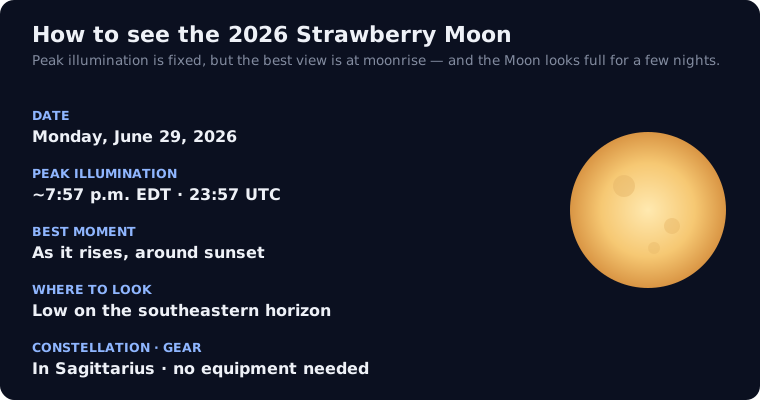
No equipment is needed — the full moon is easily visible to the naked eye — but a few tips help:
- Pick a spot with a clear, unobstructed view of the southeastern horizon. Hilltops, open fields, and coastlines are ideal; tall buildings and trees can block a low moon.
- Get away from bright lights if you can, though the moon is bright enough to see from a city.
- Look just after moonrise for the warmest color and the biggest-looking moon.
As a bonus, scan to the west after sunset for bright Venus and Jupiter, and look for the Summer Triangle of stars to the Moon’s upper left.
Why does the Strawberry Moon look so low, large, and golden?
Because it’s the full moon closest to the June solstice, the Strawberry Moon traces the lowest path across the sky of any full moon all year in the Northern Hemisphere. (In the Southern Hemisphere, it’s the opposite — it rides high.)
That low path is what creates its signature look. When the Moon sits near the horizon, its light travels through a thicker slice of Earth’s atmosphere, which scatters away blue light and lets gold, orange, and red tones through — the same reason sunsets are warm-colored. It can also look surprisingly large just after it rises, thanks to the “moon illusion,” a trick of human perception that makes a low moon appear bigger than one high overhead.
One thing the name does not describe is color. Despite the imagery, the Strawberry Moon isn’t usually pink or red because of its name.
Is the 2026 Strawberry Moon a “once in 18 years” event?
No — and this is worth clearing up, because the claim is everywhere. The “once in a generation” or “lowest in nearly 18 years” Strawberry Moon was 2025, not 2026.
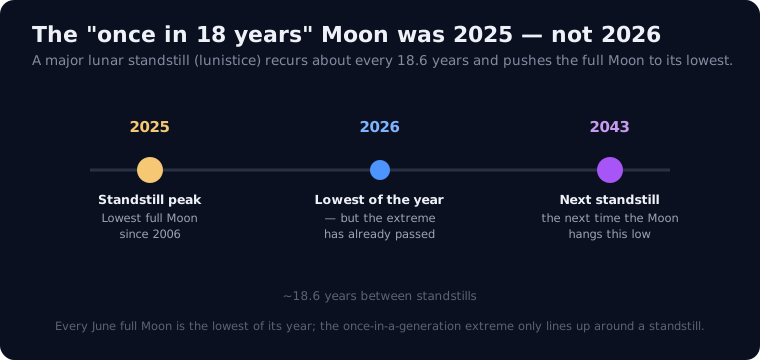
That 2025 moon was special because of a major lunar standstill (also called a lunistice), a slow cycle that recurs about every 18.6 years. Around a standstill, the Moon’s rising and setting points swing to their farthest extremes, pushing the full moon to its lowest position in the Northern Hemisphere — the 2025 Strawberry Moon was the lowest since 2006, and the next such extreme won’t come until 2043.
The 2026 Strawberry Moon is still the lowest full moon of this year, and it will still look low and golden, but the once-in-a-generation low has passed. In short: every June full moon is the lowest of its own year, but the headline-grabbing extreme only lines up around a standstill — so 2026 is lovely, not historic.
Why is it called the Strawberry Moon?
The name has nothing to do with the Moon’s color. It comes from Native American Algonquian peoples — and is also used by the Ojibwe, Dakota, and Lakota — to mark the short season when wild June-bearing strawberries ripen and are gathered.
Plenty of other cultures named June’s moon for what was happening in nature at the time. A few examples: the Haida “Berries Ripen Moon,” the Cherokee “Green Corn Moon,” and the Tlingit “Birth Moon.” In old European tradition it was the “Mead Moon” or “Honey Moon,” tied to the June honey harvest — and, some say, to the word “honeymoon” itself.
The bottom line
Catch the 2026 Strawberry Moon as it rises low in the southeast around sunset on June 29, when it’s most likely to glow gold and look its largest. Peak illumination is about 7:57 p.m. EDT (23:57 UTC), but the night before and after work nearly as well. Just don’t expect a once-in-18-years spectacle — that was last year’s moon. This one is simply the lowest, warmest full moon of 2026, and well worth a look.
Times reflect the moment of peak illumination; local moonrise and moonset times vary by location, so check a source for your area. Information confirmed as of late June 2026.