Strait of Hormuz: Iran's Biggest Weapon Against the US Is Losing Its Edge

- The weapon is real and it fired: Iran’s 2026 closure of the Strait of Hormuz — the passage for about 20 million barrels of oil a day — drove crude past $100 and, for a stretch, near $126. American drivers paid too, at around $4.31 a gallon.
- But the leverage over the US specifically has faded. America is now the world’s biggest oil producer and, since 2020, a net petroleum exporter — so a Gulf cutoff raises US export revenue instead of starving US supply.
- US crude exports hit an all-time record of about 5.6 million barrels a day in April 2026 (up 21% on the previous record), and EIA ties the jump directly to the Hormuz disruption. That is the backfill, and it is real.
- It is also partial. That extra flow is roughly a twentieth of what Hormuz carries, it is the wrong grade of crude for many Gulf-fed refiners, and the US still pays the global price. The weapon hasn’t vanished — it has changed shape.
There is a version of this story that is triumphant and wrong, and a version that is accurate and more interesting.
The wrong version: America’s shale boom made the Strait of Hormuz irrelevant, Iran’s oldest threat is dead, and Texas now runs the oil world. The accurate version: Iran can still close the strait — it did in 2026, and prices went through the roof — but the closure hurts the United States far less than it once would have, because the US now sells oil to the world instead of depending on the Gulf for it. The weapon still fires. It just no longer points where it used to.
This explainer was written on 10 July 2026, while the strait was still contested. Every market figure is from the EIA and every price is a snapshot that moves.
What is actually happening in the Strait of Hormuz?
The Strait of Hormuz is the narrow neck of water between Iran and Oman through which roughly 20 million barrels of oil a day pass — about a fifth of the oil the world consumes and more than a quarter of all oil moved by sea. There is no real substitute route for most of it.
In 2026 that chokepoint was used. After a war that began with US and Israeli airstrikes on Iran in late February, Iran’s Revolutionary Guard confirmed on 2 March that it had closed the strait, and by 4 March claimed full control, backing the threat with mines, drones, anti-ship missiles and GPS jamming. This was not a bluff or a drill — traffic collapsed. In April the US declared its own naval blockade of Iran, producing what one paper called a “dual blockade.”
A US–Iran memorandum of understanding on 17 June was meant to end it. It did not hold: Iran re-closed the strait on 20 June, and on 6–7 July tankers were attacked and the US struck Iranian military sites in response. As of 10 July 2026 the strait is neither cleanly open nor fully closed — it is contested and militarized. Anyone telling you the crisis is “over” is ahead of the facts.
Why the strait is called Iran’s biggest weapon
Because for fifty years it was the one card that reliably hurt everyone. Choke Hormuz and you don’t just cut off Iran’s rivals — you spike the global oil price, and a global price hits every importer at once. It worked in 2026: Brent crude pushed past $100 for the first time in years and, at its late-April intraday peak, touched around $126. The EIA later described the first quarter of 2026 as the sharpest quarterly jump in oil prices, adjusted for inflation, since at least 1988.
One point that gets lost: the strait is an indiscriminate weapon. Iran’s own exports are only around 1.5 million barrels a day, most of it sold to China. The 20 million barrels crossing Hormuz are overwhelmingly Saudi, Iraqi, Emirati, Kuwaiti and Qatari — and 84% of the crude heads to Asia. Closing the strait squeezes Iran’s own best customer, China, harder than it denies oil to America.
Why the weapon is losing its edge against the United States
Here is the structural change since the 1970s, when an oil embargo could put Americans in gas lines.
The US is now the world’s largest oil producer — a record 13.6 million barrels a day in 2025 — and, since 2020, a net petroleum exporter. The turning point was policy: a roughly 40-year ban on exporting US crude was lifted in December 2015. Exports climbed from under half a million barrels a day that year to about 4 million by 2024.
So when the Gulf is choked, the US is in a strange position. It is not scrambling for barrels; it is selling them into a hungry market at high prices. Anne Bradbury, who runs the American Exploration and Production Council, put the bullish case this way: as an energy superpower, America “can absorb short-term shocks in global energy markets and act with greater autonomy.” Bob McNally of Rapidan Energy — a former White House energy adviser — has a sharper phrase for what the US became during the crisis: “an arsenal of energy,” shipping oil and gas to importers across Asia and Europe.
That is the mechanism behind the headline. And it is visible in the data.
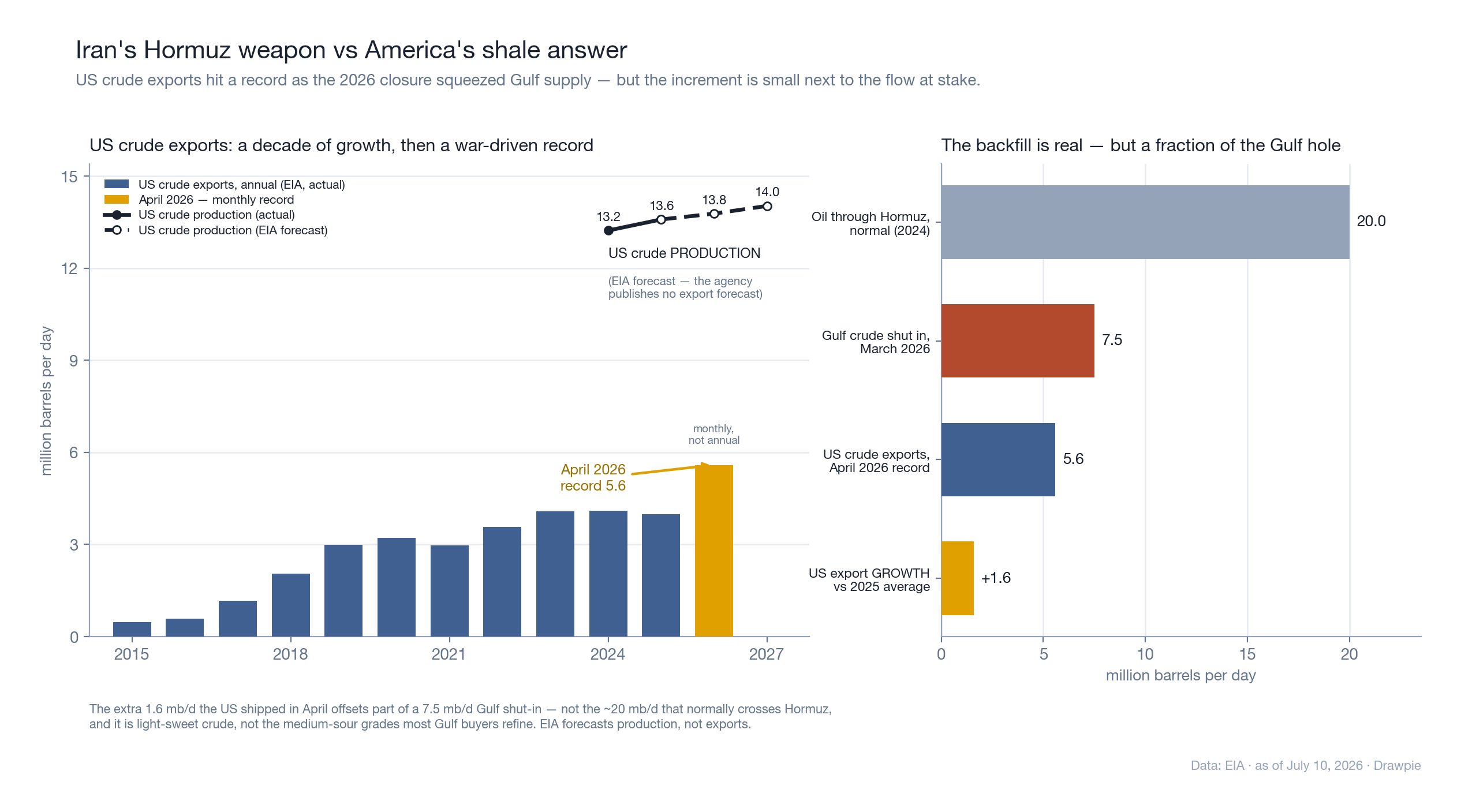
| US crude exports & Gulf supply | Figure (million b/d) | Basis |
|---|---|---|
| Oil through Hormuz, normal (2024) | ~20.0 | EIA, all oil |
| Gulf crude shut in, March 2026 | 7.5 | EIA (actual) |
| US crude exports, April 2026 | 5.6 (record) | EIA, monthly |
| US export growth vs 2025 average | +1.6 | EIA |
| US crude production (2025 → 2027) | 13.6 → 14.0 | EIA forecast |
A note on that chart, because it matters for honesty. There is no published “Texas crude exports” number — the US doesn’t break exports out by state. The record 5.6 million barrels a day is the US total; the Gulf Coast, which handles about 97% of it and is overwhelmingly Permian (West Texas and New Mexico) crude, is the honest stand-in for “Texas.” And the “future growth” line is US crude production, not exports — because the EIA forecasts production, not exports. It projects output reaching a record 14 million barrels a day by 2027.
The record: how the price spike pulled crude out of America
The clearest single fact in this whole story is an EIA release from 8 July 2026: US crude oil exports averaged a record 5.6 million barrels a day in April 2026, 21% above the previous record set in December 2023. The agency attributed it plainly — disruptions to flows through the Strait of Hormuz “increased global demand for US exports.”
You can see the pull in the price. As Iran’s closure drove WTI from around $60 at the start of the year to a monthly average above $100 in the spring, US crude exports jumped to their all-time high.
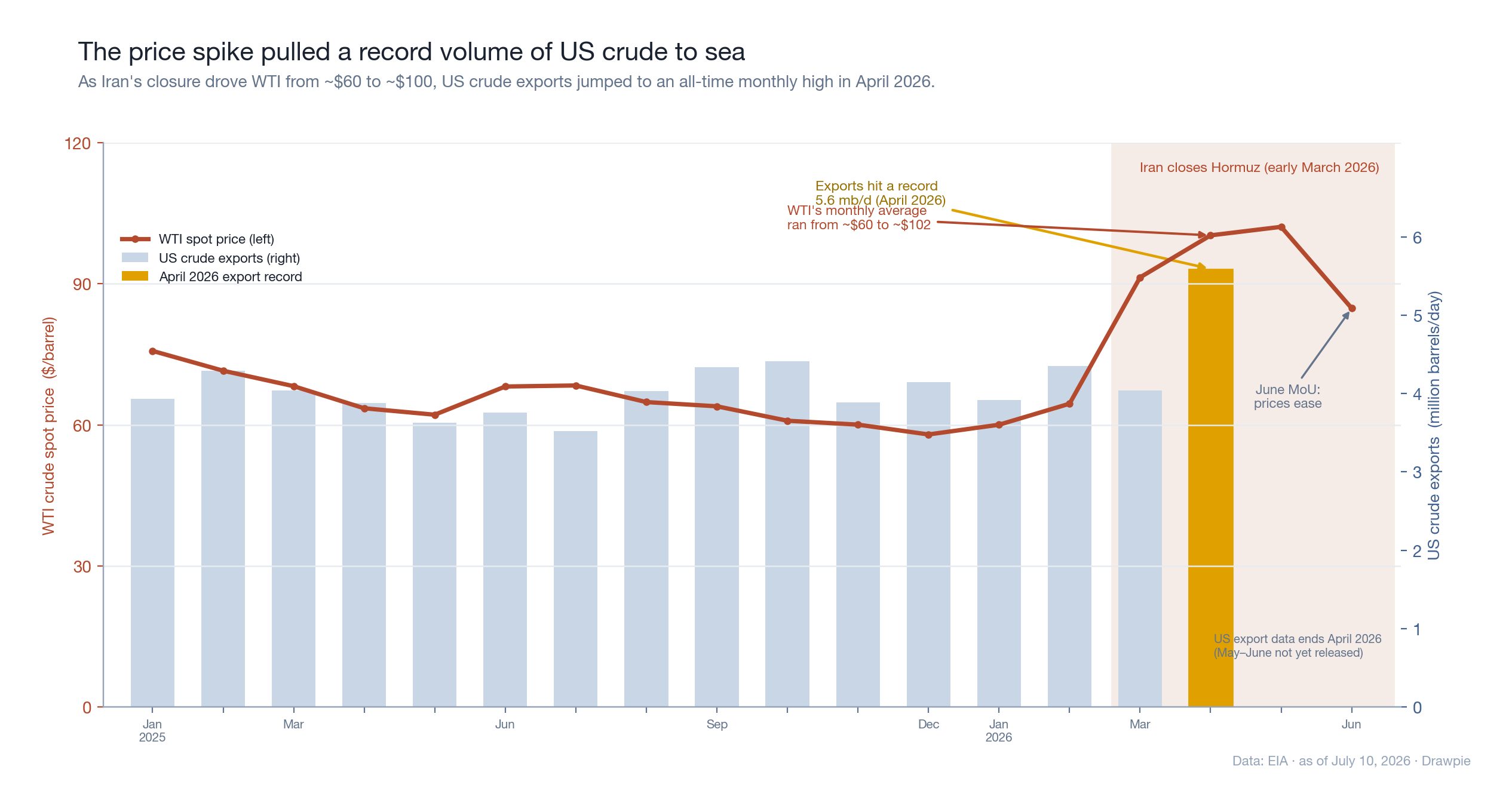
| Month (2026) | WTI spot ($/bbl) | US crude exports (mb/d) |
|---|---|---|
| January | 60.04 | 3.92 |
| February | 64.51 | 4.35 |
| March | 91.38 | 4.04 |
| April | 100.32 | 5.59 (record) |
| May | 102.13 | not yet released |
| June | 84.81 | not yet released |
The trade press caught the same shift in real time: Argus reported North American crude cargoes being redirected toward Asia to make up for Hormuz, a Japanese refiner buying 2 million barrels of US WTI, and freight for the biggest tankers from the US Gulf to China roughly doubling — the highest since 2012. Permian frac crews ramped about 20% to their busiest since May 2025.
That is the backfill, actually happening.
Why “backfill” is still the wrong word
Now the discipline. If the story stopped at the record, it would be the triumphant-and-wrong version. Three hard limits keep it honest.
Scale. Hormuz carries about 20 million barrels a day. US crude exports rose by roughly one million to a record 5.6 million. Even fully redirected, that is around a twentieth of the disrupted flow — enough to matter at the margin and for specific buyers, nowhere near a replacement. The energy analyst Robert Rapier has called the arithmetic of replacing 20 million barrels quickly “impossible math”: even a maximal coordinated release from strategic reserves covers only about a third of the loss, and the bypass pipelines that skirt Hormuz have perhaps 2.6 million barrels a day of genuinely spare capacity.
Grade. US shale is light and sweet. Many of the world’s complex refineries — including America’s own — are built to run the heavier, more sulphurous crude the Gulf ships. As Brookings puts it, the US “imports heavy crude and exports light crude.” So American barrels can stand in for some lost Gulf supply abroad, but they are not a like-for-like swap for the medium-sour grades Asian refiners actually need.
Speed and steel. Record production is not the same as spare capacity waiting to be switched on. Wood Mackenzie’s Nathan Nemeth has said the Lower 48 can do very little in the near term against a sustained multi-million-barrel loss; the firm’s optimistic case adds at most about 600,000 barrels a day by late 2026, and only after a lag. And physically loading the biggest tankers is a bottleneck: only one US facility can fully load a supertanker without shuttling crude out in smaller boats first.
The gas flank is weaker still. Hormuz also carries about a fifth of the world’s liquefied natural gas, mostly Qatari, and new US LNG plants can replace only around a fifth of that lost output at short notice.
The part the thesis gets wrong: America still paid
The most common mistake in the optimistic version is treating “energy independent” as “insulated.” It isn’t. Oil is a global, fungible commodity — the price is set worldwide, so a Hormuz disruption raises the pump price everywhere, including in the country doing the exporting.
The proof is in Americans’ own wallets. As the crisis ran, US regular gasoline averaged about $4.31 a gallon and diesel about $5.35 in early June 2026, well above pre-war levels. Being a net exporter changed the trade balance — more export revenue flowing to US producers — but it did not shield US drivers from the shock. As McNally put it, net-export status “has not insulated US consumers from global price spikes.”
So is Iran’s weapon “slipping away”?
The honest answer is that it is changing shape, not disappearing.
What has genuinely faded is Hormuz as a weapon aimed at America specifically. In the embargo era, a Gulf cutoff threatened US supply. Today it threatens US prices but pads US revenue, and it hands Washington a card it never had before: the ability to ship its own crude to the exact allies — in Europe and Asia — most exposed to a Gulf shutoff.
What has not faded is the weapon itself. A closure still detonates a global price shock that reaches American consumers, still can’t be physically backfilled at scale or in the right grade, and — as the on-again, off-again events of June and July 2026 show — is still fully in Iran’s hands to pull. If anything, the strait has migrated from a supply-denial weapon pointed at the US toward a global price weapon that wounds everyone, America included, and Iran’s own patron China most of all.
That is a real strategic shift. It is just not a disarmament.
What to watch next
- Whether the strait reopens for good. The July 2026 EIA forecasts — WTI easing back toward the $60s in 2027 — assume Hormuz stays open after the June deal. The June re-closure and July attacks already strain that assumption.
- The May and June export numbers. April’s record is confirmed; the months that show whether the surge held aren’t published yet. The next EIA release fills that in.
- Whether prices stay eased or re-spike. WTI’s monthly average fell to about $85 in June after the memorandum, then wobbled with the July tanker attacks. A durable calm points to the glut some analysts now warn about; another closure points the other way.
Frequently asked questions
Did Iran actually close the Strait of Hormuz in 2026?
Yes. This was not only a threat. Iran’s Revolutionary Guard confirmed the closure on 2 March 2026 and enforced it with mines, drones, missiles and GPS jamming; traffic collapsed. A June memorandum of understanding briefly eased it before Iran re-closed the strait on 20 June, with further tanker attacks and US strikes in early July.
How much oil goes through the Strait of Hormuz?
About 20 million barrels a day in 2024 — roughly a fifth of global oil consumption and more than a quarter of all seaborne oil trade, plus about a fifth of the world’s liquefied natural gas. Saudi Arabia alone accounts for the largest share, and around 84% of the crude heads to Asia.
Can US oil replace Gulf oil if Hormuz closes?
Only partly. US crude exports hit a record 5.6 million barrels a day in April 2026, but that is about a twentieth of what Hormuz carries, and US light-sweet crude is the wrong grade for many refineries built to run heavier Gulf oil. American barrels can offset some lost supply for allies; they cannot replace the chokepoint.
Did US oil exports really rise because of the crisis?
Yes. The EIA reported US crude exports at a record 5.6 million barrels a day in April 2026 — 21% above the prior record — and attributed the jump directly to Hormuz disruptions raising global demand for US oil.
Does being energy independent protect Americans from oil price spikes?
No. Oil is priced globally, so a supply shock raises prices everywhere. Even as a net petroleum exporter, the US saw gasoline near $4.31 a gallon during the 2026 crisis. Net-exporter status helps the trade balance and producer revenue, not the price at the pump.
More market explainers from Drawpie: the rotation out of bitcoin into AI hardware and why Nvidia slipped below $200 .