SSS Emergency Loan for Maymay and Habagat: How to Apply, Eligibility & ₱20,000 Loan

- ₱20,000 is the maximum, not the amount. What you get is 50% or 100% of the average of your 12 latest posted MSCs, rounded up to the nearest thousand — so a member with an average MSC of ₱15,000 borrows ₱8,000 or ₱15,000 depending on their contribution count.
- The band matters more than the headline, and it has a hard ceiling. Members with 18 to 35 posted contributions get 50% of their average MSC; those with 36 or more get 100%. Because SSS caps Regular SS computations at ₱20,000 MSC, the 50% band cannot exceed ₱10,000 — and the relaxation from 36 contributions to 18 admits people into exactly that band.
- Apply online only, through the My.SSS portal or the SSS mobile app. You must first have a disbursement account enrolled through DAEM — without it the application cannot proceed.
- Seven per cent is not automatic. It applies to initial applications and to renewals where you have not used penalty condonation in the past five years. Renewals after condonation are charged 10%.
- Six months with no payment does not mean six months without interest. Interest accrues during the moratorium and is spread evenly across the 24 amortisations that follow.
The Social Security System has opened its Emergency Loan Program to members affected by Tropical Storm Maymay and the enhanced habagat. It was announced on 14 August 2026 and offers up to ₱20,000, payable over 30 months, at 7% a year for most borrowers and 10% for some.
The important thing to understand before you apply is that ₱20,000 is a ceiling, and the amount you will actually be offered is set by a formula most coverage of this loan leaves out.
What is the SSS emergency loan for Maymay and habagat?
It is an existing programme being opened to storm victims, not a new fund created for them. SSS President and CEO Robert Joseph M. de Claro announced that members affected by Maymay and the enhanced Southwest Monsoon “may avail themselves of the existing Emergency Loan Program (ELP)”, which has been in effect since 1 May 2026.
The ELP is a short-term member loan available to Philippine residents under a State of National Calamity or State of National Emergency declared by Presidential Proclamation, Executive Order or equivalent.
PAGASA records that a low-pressure area west of Luzon developed into Tropical Cyclone Maymay — international name Kujira — on 4 August 2026, strengthened into a tropical storm the next day and made landfall over Ilocos Sur. The enhanced habagat, further strengthened by a second system, Tropical Cyclone Dolphin, hit the western side of Luzon at the same time. In PAGASA’s own summary the two together “triggered flooding and landslides in Luzon”.
Philippine news reporting put the landfall at Magsingal at around 2am on 6 August with winds near 75km/h, and displacement at close to 7,000 people. Those specifics are press figures rather than PAGASA’s, and they are not what determines eligibility — the loan is open nationwide.
How much can you actually borrow?
Between a few thousand pesos and ₱20,000, depending on your contributions. The formula, in SSS’s own words, is 50% or 100% of the average of your 12 latest posted MSCs, “rounded up to the nearest thousand pesos, or the amount applied for, whichever is lower”.
| Posted contributions | You get |
|---|---|
| 18 to 35 | 50% of your average MSC |
| 36 or more | 100% of your average MSC |
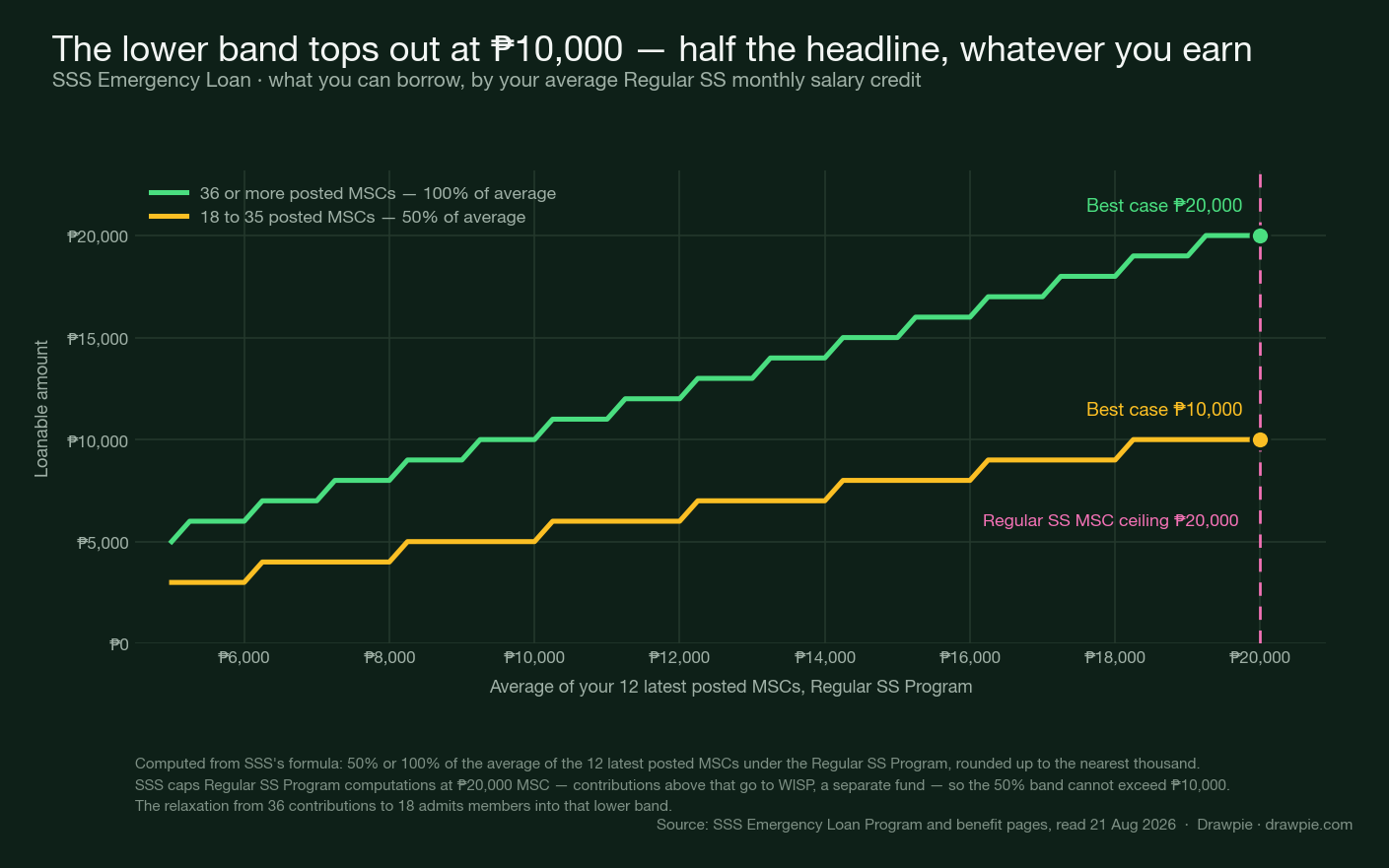
SSS gives its own worked example: a member with an average MSC of ₱15,000 gets ₱8,000 on the 50% band, or ₱15,000 on the 100% band.
This is where the widely reported relaxation matters more than it looks. The contribution requirement was cut from 36 to 18 — but 18 to 35 contributions is precisely the 50% band, so everyone the relaxation newly admits is on the lower multiplier.
And that band has a hard ceiling. The formula uses MSCs under the Regular SS Program, and SSS caps Regular SS computations at ₱20,000 MSC — contributions above that go to WISP, a separate fund. Half of ₱20,000 is ₱10,000, so a member with 18 to 35 contributions cannot borrow more than ₱10,000 no matter what they earn. The ₱20,000 headline is only reachable with 36 or more contributions.
One more deduction to expect: your net proceeds are the approved amount minus the outstanding balance of any previous emergency or calamity loan, with a minimum net release of ₱1,000 — or ₱100 for kasambahay and household employees.
Who is eligible for the SSS emergency loan?
The contribution test is the main one, and it has two parts — a lifetime count and a recent count. Beyond that there are age, address, account and existing-loan conditions, and employed members can be blocked by their employer’s remittance status rather than anything they did themselves.
- At least 18 monthly contributions, of which at least six must be posted in the last 12 months before the month you file.
- Self-employed, voluntary, non-working spouse and land-based OFW members additionally need at least six posted contributions under their current membership type.
You must also:
- Be of legal age and under 65 when you apply
- Have a valid Philippine home address on SSS records
- Have updated contact information in the SSS database
- Have an active disbursement account enrolled through DAEM in My.SSS
- Have no outstanding restructured loan
- Not have been disqualified for fraud against SSS
- Not have been granted a final benefit such as retirement or permanent total disability, unless it was cancelled because you returned to work
- If you are employed, your employer must be up to date on contributions and loan remittances, unless covered by an approved moratorium
Employed members have one more gate that is easy to miss. Your employer has to certify the application electronically in their own My.SSS account, attesting both that you work there and that your net take-home pay is enough to cover the monthly amortisation. You are also agreeing to payroll deduction, and to the balance being taken from your final pay if you leave that employer.
On existing loans, read SSS’s programme page rather than the summaries. The rule is that you must have no emergency, calamity, salary, SLERP, EALP or other member loans past maturity, and no unpaid arrears of more than three monthly amortisations. Being slightly behind is not automatically disqualifying.
How do you apply for the SSS emergency loan?
Online only. SSS names two channels and no others: the My.SSS portal at sss.gov.ph, and the SSS mobile app. There is no walk-in application for this loan and no third-party site is an SSS channel.
Before you can file, you need a disbursement account enrolled through the Disbursement Account Enrollment Module (DAEM) in My.SSS. Proceeds are released to one of:
- Your active MySSS Card or UMID ATM Pay Card, or
- An active single account in your own name at any PESONet participating bank, enrolled in DAEM
Two practical points. If you have moved, SSS says that members who update their local home address at a branch are not required to obtain a Calamity Loan Reference Number, and that they remain eligible regardless of what that address is — the ELP’s coverage is nationwide, so where you live does not gate it. And SSS says affected members may apply for a salary loan at the same time, subject to its own eligibility rules.
What interest will you pay?
7% a year, unless you have used penalty condonation in the last five years — then 10%. Interest is charged on the diminishing balance, and the rate is not fixed to this programme: it tracks whatever the Calamity Loan Program rate happens to be.
| Your application | Interest |
|---|---|
| Initial application | 7% per annum, effective 7.03–7.39% |
| Renewal, no penalty condonation in the past 5 years | 7% per annum, effective 7.03–7.39% |
| Renewal, condonation availed within the past 5 years | 10% per annum, effective 10.06–10.58% |
SSS publishes the first two as a single rate: one cell covering both, so the effective range is the same for each.
Late amortisations carry a penalty of 1% a month, charged for every day of delay. A loan still unpaid after the full term reverts to 10% a year plus that 1% monthly penalty until it is settled.
When do repayments start?
In the seventh month. The term is 30 months in total: a six-month moratorium followed by 24 equal monthly amortisations.
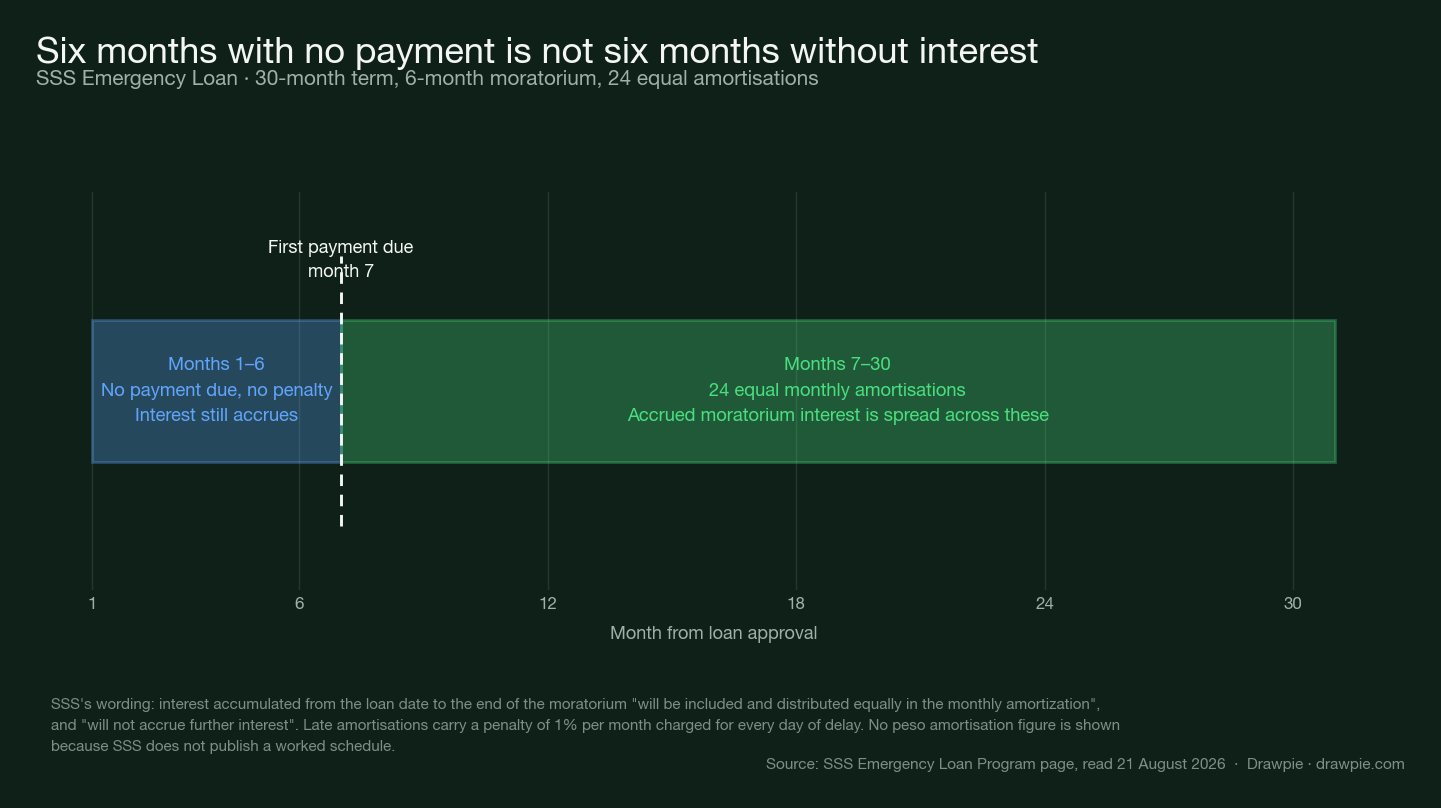
The moratorium is a deferral, not a discount. SSS states that interest accumulated from the loan date to the end of the six months “will be included and distributed equally in the monthly amortization” — so it is added to what you repay from month seven, though it does not then earn further interest.
Payments are due on or before the last day of the month following the applicable month.
Is there a deadline to apply?
Yes, and it can arrive earlier than you expect. There are three separate ways the window can close, and the earliest of them wins — including one that has nothing to do with you or with this storm.
SSS sets the availment period at one year from the date of the ELP’s own announcement, or for the duration of the declared national calamity or emergency, whichever comes first.
Read that first clause carefully, because it is easy to get wrong. The clock runs from the announcement of the programme, not from the 14 August bulletin about Maymay. The ELP has been in effect since 1 May 2026, so the one-year limit points at some time in 2027 well before August rather than a year from the storm. SSS does not publish the exact announcement date, so if the deadline matters to you, ask SSS for it rather than counting from the storm.
There is also a third way it can end. SSS states that the period “may be curtailed upon the announcement by the SSS of a new ELP, which shall automatically terminate and supersede any existing or ongoing ELP”, and that there are no overlapping ELPs — the most recent announcement supersedes all previous ones. If another disaster prompts a fresh programme, the current one closes.
How is this different from the SSS calamity loan?
The calamity loan needs your area to be declared. The emergency loan does not, and it asks for half the contributions.
Both are live short-term member loans and both appear under Member Loans on the SSS site, but they are not interchangeable and the differences are larger than the names suggest.
| Emergency Loan (ELP) | Calamity Loan (CLP) | |
|---|---|---|
| Trigger | A national calamity or emergency declared by Proclamation or Executive Order | Your area declared under a State of Calamity |
| Who qualifies | Philippine residents nationwide | People residing or working in a declared area, by SSS-registered home address or employer location |
| Contributions needed | 18, six in the last 12 months | 36, six in the last 12 months |
| Amount | 50% of your average MSC on 18–35 contributions, 100% on 36 or more, rounded up to the nearest thousand | 100% of your average MSC, rounded to the next higher MSC |
| Taken off the proceeds | Any previous emergency or calamity loan balance | A service fee and pro-rated interest, plus any previous calamity loan balance |
| Effective interest | 7.03–7.39% | 7.10–8.17% |
Two things follow that are worth weighing before you choose.
The emergency loan is the easier one to get and the cheaper one to receive. It needs 18 contributions rather than 36, it is not tied to where you live, and SSS deducts no service fee and no advance interest from the proceeds. What you give up is the 50% band, and “half” there means half the money, not half the interest. The lower threshold is what lets you in at 18 contributions, but everyone who comes in that way is lent half of their average MSC rather than all of it. At 36 contributions or more both loans lend 100%.
You cannot hold both. SSS states that an Emergency Loan “cannot be availed at the same time as a Calamity Loan”, and that any outstanding calamity loan balance is deducted from the emergency loan proceeds. Renewing an ELP also requires a new and separate Proclamation or Executive Order, distinct from the one your current loan was granted under.
What happens if you cannot repay?
The consequences reach past the loan itself, so this is worth reading before you borrow.
SSS treats the loan as in default once the total unpaid obligation — principal, interest and penalties together — passes six monthly amortisations, or once any balance remains after the 30-month term. At that point the full balance becomes “due and demandable… without the need for demand or notice”.
More significant for most borrowers is what happens afterwards. If the loan is still unpaid at maturity, SSS is authorised to collect it from whatever benefit is due to you or your beneficiaries. Where a final claim is filed — retirement, permanent total disability or death — the outstanding balance plus interest and penalties is deducted from those proceeds. An unpaid emergency loan does not simply lapse; it comes out of a later benefit, potentially your family’s.
How to pay. Amortisations are paid using a Payment Reference Number (PRN) at any SSS branch with a tellering facility or through an SSS-accredited collecting agent. Employed members have theirs deducted from payroll by their employer. If a payment deadline falls on a Saturday, Sunday or public holiday, you may pay on the next working day.
One thing to settle before you apply. If you have payments on an existing emergency or calamity loan that have not yet posted, SSS says you should file a reconciliation request at a branch first. Applying without doing so means accepting the amount deducted from your new loan as accurate and final.
Sources
| Source | Used for |
|---|---|
| SSS — Emergency Loan Program page | The loan formula and both contribution bands, the full eligibility list, the interest tiers and effective rates, the repayment term and moratorium treatment, disbursement channels, the availment period and the no-overlapping-ELPs rule |
| SSS — news release, 14 August 2026 | The announcement itself, the reduction from 36 to 18 contributions, the quotes from SSS President and CEO Robert Joseph M. de Claro, and the point that a salary loan may be applied for at the same time |
| SSS — Calamity Loan Program page | Every calamity loan cell in the comparison table: the residing-or-working test, the 36-contribution requirement, the next-higher-MSC rounding, the service fee and pro-rated interest deducted from proceeds, and the 7.10–8.17% effective rate |
| SSS — Calamity Loan Program guidelines release, July 2025 | The 7% calamity loan rate that the ELP rate tracks |
| SSS — sickness and maternity benefit pages | The ₱20,000 Regular SS Program MSC ceiling that caps the loan formula |
| PAGASA — Tropical Storm Maymay article, 17 August 2026 | The cyclone’s name and international name, its development and strengthening dates, landfall over Ilocos Sur, Tropical Cyclone Dolphin, and the flooding and landslides in Luzon |
| Philippine news reporting, August 2026 | The landfall municipality and time, the 75km/h figure and the displacement count — none of which appear in PAGASA’s account |
How we verified this
Everything here is from SSS’s own pages, and the site passed a control test. The figures come from the SSS news release datelined Quezon City, 14 August 2026 and posted on 17 August, and from the Emergency Loan Program page itself. An invented path on sss.gov.ph returns HTTP 404 while both real pages return 200, so a successful response distinguishes a real page from one that does not exist.
🔴 The ₱20,000 in the headline is a ceiling and most reporting does not say so. SSS’s programme page sets the loan at 50% of the average of the 12 latest posted MSCs for members with 18 to 35 contributions, or 100% for members with 36 or more, “rounded up to the nearest thousand pesos, or the amount applied for, whichever is lower”. SSS’s own worked example puts a member with an average MSC of ₱15,000 at ₱8,000 on the lower band. The chart on this page computes that formula rather than repeating the headline.
🔴 “As low as 7%” has a condition attached. SSS publishes three cases: initial applications at 7%, renewals without penalty condonation in the past five years at 7%, and renewals where condonation was availed within the past five years at 10%. Effective rates are given as 7.03–7.39% and 10.06–10.58%.
🔴 The moratorium defers payment, not interest. SSS’s wording is that interest accumulated from the loan date to the end of the six-month moratorium “will be included and distributed equally in the monthly amortization” and “will not accrue further interest”. A reader who takes no payments for six months to mean no cost for six months would be wrong. Those two phrasings are ours, not SSS’s, and the second chart exists to draw the distinction.
⚠️ The news release and the programme page describe the past-due rule differently, and the programme page is used. The release says applicants must “have no past-due emergency, calamity, salary, Educational Assistance Loan, or other short-term or long-term member loans”. The programme page is narrower and more favourable: no such loans “past maturity”, and no unpaid arrears “equivalent to more than three (3) monthly loan amortizations”. Someone slightly behind on a salary loan may still qualify, and the summary wording would wrongly discourage them.
🔴 Corrected on 21 August 2026. The first version of this page said the 50% band would need an average MSC of about ₱38,500 to reach ₱20,000, and its chart plotted average MSC to ₱40,000. That described a state that cannot exist. The ELP formula uses MSCs “under the Regular SS Program”, and SSS’s own sickness and maternity benefit pages state that “the computation of benefits under the Regular SSS Program shall be based on contributions up to ₱20,000 MSC”, with contributions above that going to WISP, a separate fund. The Regular SS MSC therefore tops out at ₱20,000, which makes the 50% band’s ceiling ₱10,000 — it cannot reach the headline figure at any salary. The chart and the text now say that.
⚠️ The storm paragraph separates what PAGASA states from what the press reported. PAGASA’s own article of 17 August 2026 confirms the cyclone’s name, its development on 4 August, its strengthening on 5 August, landfall over Ilocos Sur, the role of Tropical Cyclone Dolphin, and that the systems “triggered flooding and landslides in Luzon”. It does not carry the municipality, the landfall time, the 75km/h figure or any displacement count, so those are attributed to news reporting in the text. ⚠️ PAGASA also failed a control test — an invented article number returns HTTP 200 at almost the same size as a real one — so its page was judged on content rather than status.
This is a summary of published rules, not financial advice, and no application was made. Confirm your own position in My.SSS or with an SSS branch before relying on any figure here.