Southern Europe Heat Dome: What It Means If You're Flying Out This Week
Update log (1)
- — Added the one documented route by which Europe's summer reaches a British household. The UK weather section said, correctly, that Britain is not under this pattern, and that stands. What it was missing is that Ofgem's letter raising the October price cap by £60 lists extreme temperatures, cooling demand, thermal curtailment of continental power plants and low wind among the causes of an 11% rise in the wholesale allowance — while naming Middle East instability as the primary driver. The section now carries that, with the explicit caveat that Ofgem publishes no split, so no one can say what the heat cost in pounds.
Every warning counted on this page expires on 4 or 5 September 2026. From the 6th the numbers here describe weather that has already happened, and the page is either rebuilt from a fresh read of the feeds or retired. This is the shortest shelf life of anything on this site and it is deliberate — the value is that the figures are today’s.
Everything else on the page is unaffected; the figures below still say when they were read.

- 316 official high-temperature warnings are in force across twelve southern European countries, read this morning from the feeds each national weather service publishes.
- None of them is red. The highest level anywhere is orange, in Spain, France, Croatia, Serbia and Bosnia & Herzegovina.
- Spain has 186 of the 316 — more than the other eleven countries combined.
- Spain’s orange warnings are inland. The Ebro, Tagus, Guadiana and Guadalquivir valleys and the interior of Aragón, Extremadura and Castile. Of the forty listed, two touch the coastal strip — and none is in the Balearics or the Canaries.
- Greece has four heat warnings out of twenty-one live warnings. Most of what Greek forecasters are worried about this week is something else.
- Every warning counted here expires on 4 or 5 September, so on current alerts this ends at the weekend.
- Britain is not in it. The Met Office’s own position for early September is wetter than average in the north-west with temperatures near normal.
If you are flying to southern Europe in the next few days, the short version is: yes there is a heat dome, no country is on red alert, and on current warnings it ends on Saturday.
This page counts the actual alerts. Not coverage of them — the warnings each national weather service has issued, read from the feeds they publish, at 06:00 UTC on 4 September 2026.
The state of play right now
| Live heat warnings, southern Europe | 316 |
| Countries with at least one | 9 of 12 checked |
| Highest level anywhere | Orange — no red |
| Countries at orange | Spain, France, Croatia, Serbia, Bosnia & Herzegovina |
| Every warning expires | 4 or 5 September |
| UK | Not affected — near-average temperatures, wetter in the north-west |
Where the warnings actually are
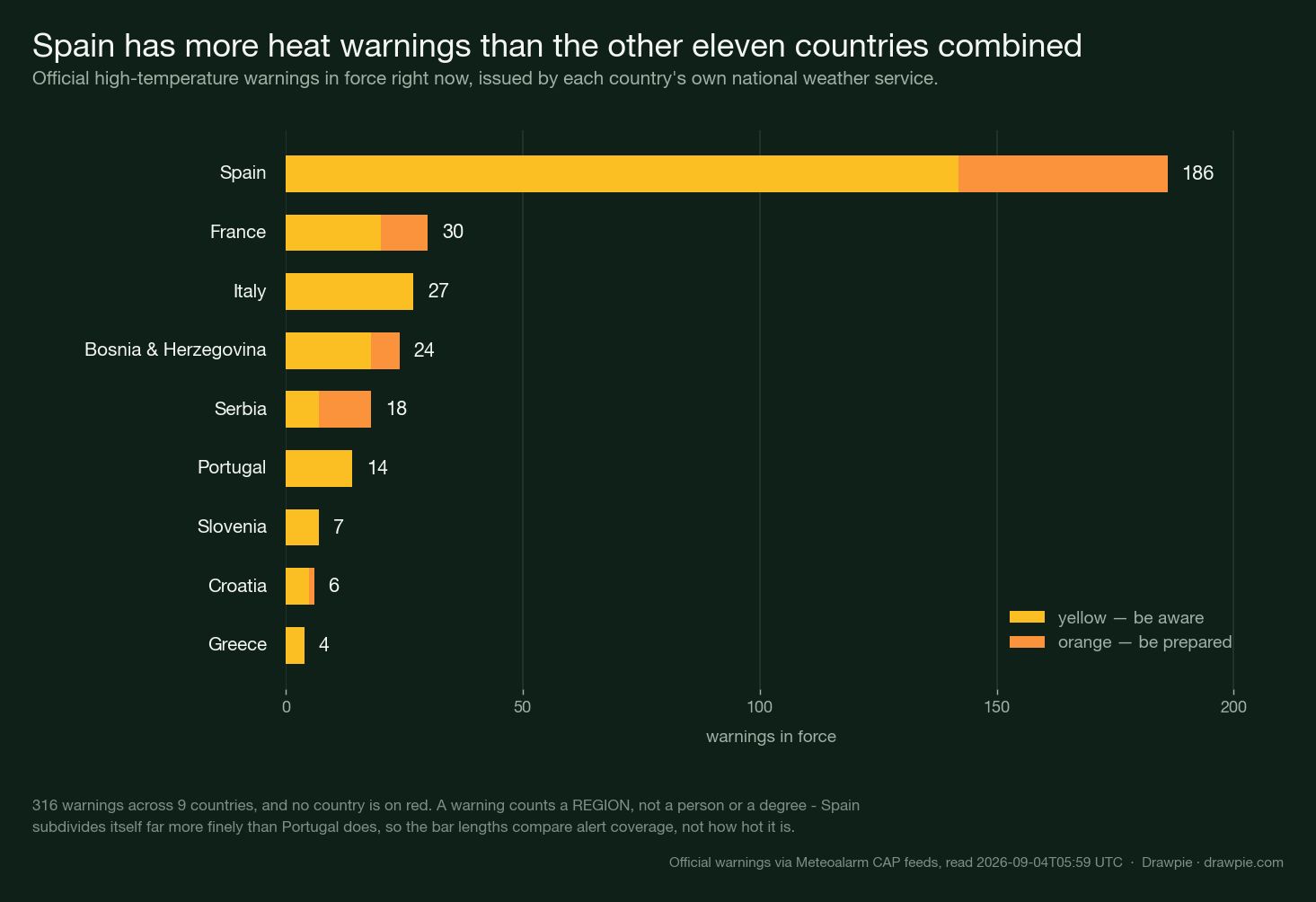
Spain has 186 of the 316 — more than every other country put together. France has 30, Italy 27, Bosnia & Herzegovina 24, Serbia 18, Portugal 14.
Greece has four.
That last number is worth pausing on, because Greece appears in most of the coverage of this event. It has 21 live weather warnings and only four of them are for heat.
One caution before you read the bars as a heat map. A warning covers a region, and countries divide themselves up very differently — Spain into dozens of small forecast zones, Portugal into a handful. Spain’s bar is long partly because Spain is finely subdivided. The counts compare how much of a country is under alert, not how hot it is.
Where heat is the whole story, and where it isn’t
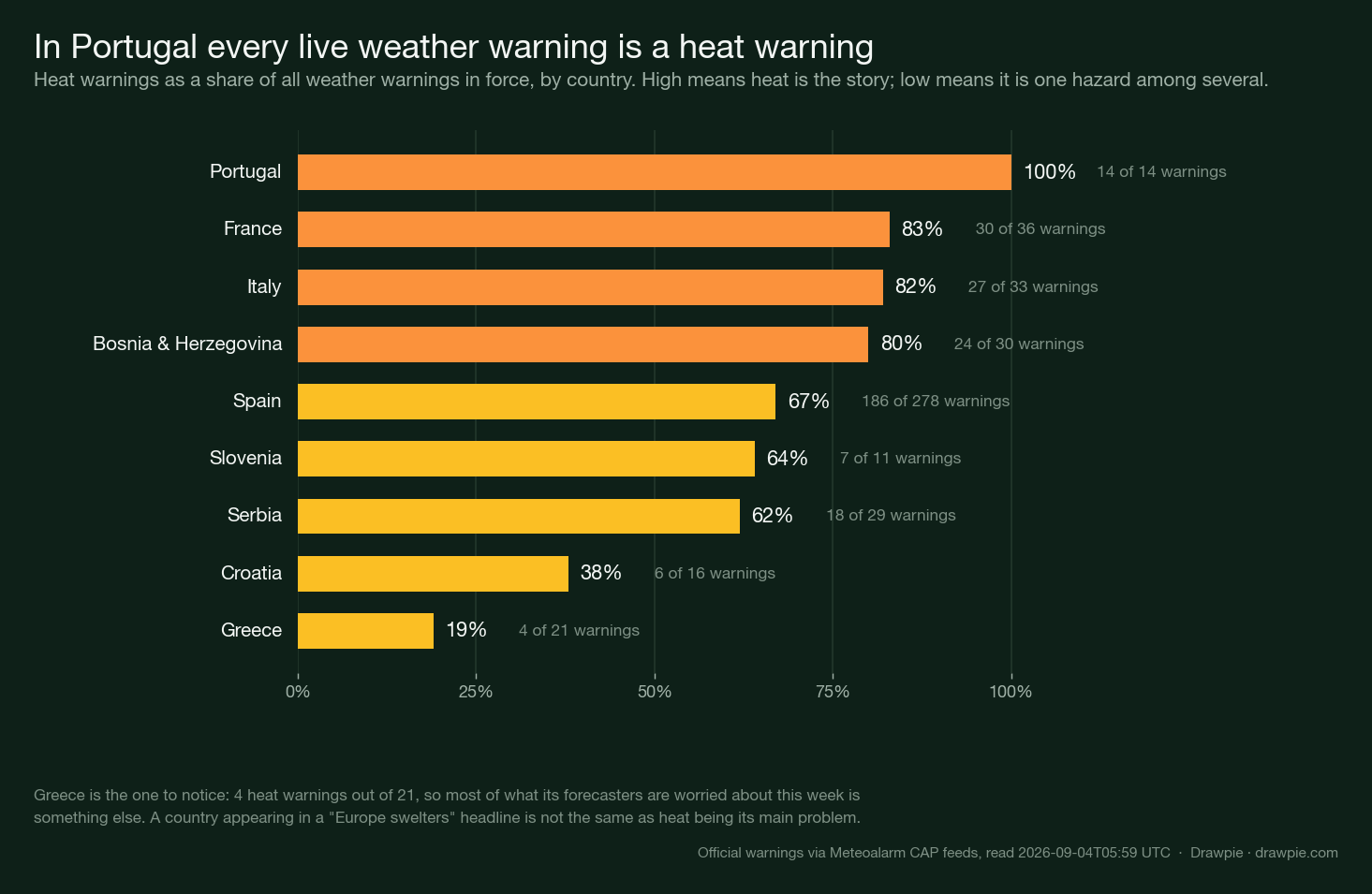
In Portugal, every single live weather warning is a heat warning — 14 out of 14. In France it is 30 of 36, in Italy 27 of 33.
In Greece it is 4 of 21, and in Croatia 6 of 16. Both appear in “Europe swelters” headlines; in both, most of what forecasters are actually worried about this week is something else.
The bit that matters if you have already booked
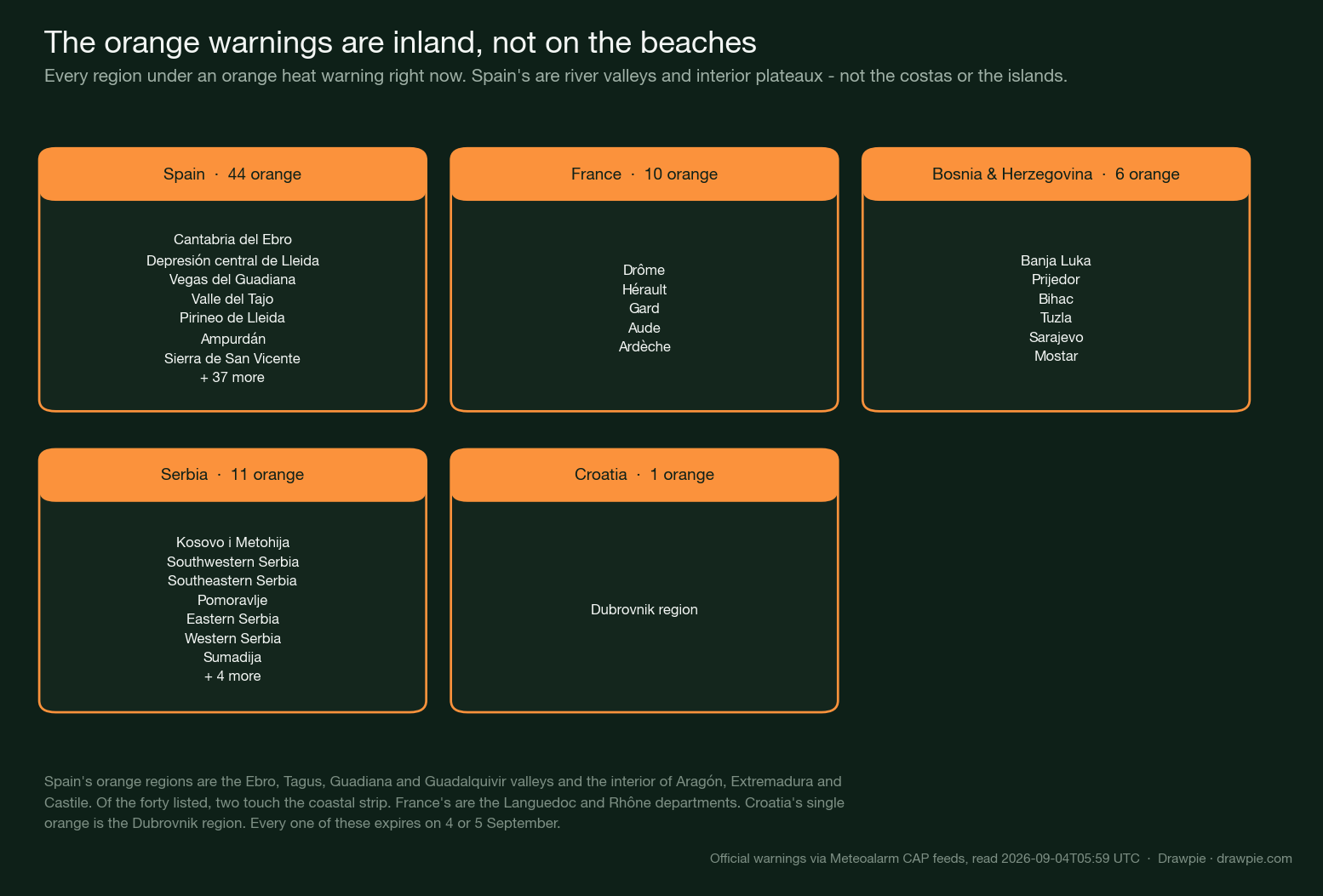
Orange is the highest level in force anywhere, and where those orange warnings sit is the most useful fact on this page.
Spain’s are inland. The Ebro valley through Navarre, La Rioja and Zaragoza. The central depression of Lleida. The Tagus and Guadiana valleys. Extremadura — Cáceres, La Siberia extremeña. The Guadalquivir valley around Jaén and the Seville countryside. The Madrid sierra and the metropolitan corridor.
Of the forty orange regions listed in the feed, two touch the coastal strip, and both are in Catalonia. There is no orange warning in the Balearics, none in the Canaries, none on the Costa del Sol, the Costa Blanca or the Costa Brava proper.
If you are going to a beach resort, you are very probably not going to a region under an orange warning. If you are driving inland — Seville, Córdoba, Extremadura, the Ebro — you are.
France’s orange warnings are the Languedoc and Rhône departments: Drôme, Hérault, Gard, Aude, Ardèche.
Croatia has exactly one, and it is the Dubrovnik region.
Is Britain getting any of this?
No, and the Met Office has said so in the plainest way available: it has been publicly reviewing the headlines that claim otherwise.
In its own headline review it described a September UK heatwave as “far from certain” and only one of several scenarios, and said that forecast temperature drops being written up as a cold snap were seasonal norms. Its actual position for early to mid-September is wetter than average, particularly in the north-west, with near-average temperatures and a north-west to south-east split.
So the pattern that is baking the Iberian and Balkan interiors is not the pattern Britain is under. Both things are true at once and neither causes the other in any way this page can demonstrate.
Britain is not getting the weather. It is getting part of the bill.
There is one route by which Europe’s summer reaches a British household, and it is documented rather than inferred — because the regulator wrote it down.
Ofgem raised the energy price cap by £60 a year from 1 October, and in the letter announcing it, published on 26 August, it set out what moved. The wholesale cost allowance rose 11%. Ofgem names continued conflict and geopolitical instability in the Middle East as the primary driver — that is its word, and the heat does not displace it. But it lists the summer alongside it, in its own terms:
- prices compounded by extreme temperatures affecting much of Britain and Europe;
- increased cooling demand, meeting tighter-than-normal margins caused by thermal curtailment of power generating plants across continental Europe — plants throttled back because it was too hot to run them at full output;
- those conditions, paired with low wind generation, driving greater reliance on gas-fired power.
That is three of the five factors the regulator lists being, broadly, the weather.
So the honest version has two halves that do not contradict each other. Britain is not under the heat dome, and nothing on this page says otherwise. But Britain shares a power market with the continent that was, and a share of the October increase comes back through it. We have gone through what the October cap actually does to a UK bill , including the region-by-region numbers.
One caution on how far to push that. Ofgem does not publish a split showing how much of the 11% was heat and how much was the Middle East, so nobody — including this page — can tell you what the hot summer cost you in pounds. What is on the record is that the regulator listed it among the causes — alongside the primary driver it named, not in place of it.
What to actually do if you are travelling
Practical, and none of it is dramatic:
Check your specific region, not the country. “Spain is on alert” is true and nearly useless — 186 warnings, almost all inland. Your resort may have none.
The alerts have expiry times, and these ones are short. Every warning counted here expires on 4 or 5 September. A Saturday arrival is landing as this clears, on current alerts.
Orange means be prepared, not stay away. Meteoalarm’s own wording is yellow “be aware”, orange “be prepared”, red “take action”. Nowhere in southern Europe is on red today.
Inland excursions are the real exposure. The heat is in the river valleys and on the plateaux. A day trip from a coastal resort to Seville or Córdoba is a trip into the warned area, not away from it.
Which countries are worst affected by the heat dome?
By the number of warnings, Spain by a wide margin — 186 of the 316 in force across the region.
By the share of their weather warnings that concern heat, Portugal is at 100%, France 83% and Italy 82%. Those two measures answer different questions: the first is how much of a country is under alert, the second is whether heat is the dominant hazard there this week.
By severity, five countries are at orange and none is at red: Spain, France, Croatia, Serbia and Bosnia & Herzegovina.
Is it safe to travel to Spain right now?
Nothing in the official alerts says otherwise, and the highest level in force in Spain is orange rather than red.
The more useful question is where in Spain. The orange warnings are inland — the Ebro, Tagus, Guadiana and Guadalquivir valleys and the interior of Aragón, Extremadura and Castile. The coastal resorts and the islands are not under orange warnings today. If your plans involve inland cities or driving through the river valleys, that is where the alerts are, and orange means take the usual precautions rather than change plans.
When does the southern Europe heat dome end?
On the warnings currently issued, 4 or 5 September.
Every one of the 316 alerts counted here expires on one of those two dates. That does not guarantee the weather pattern breaks — forecasters reissue warnings, and a new set could be published tomorrow for the days after. It does mean that as of this morning, no national weather service in southern Europe has an active heat warning running beyond Saturday.
Why do the news reports and the official warnings not match?
Because they are measuring different things, and one of them is easier to write.
Most coverage of this event traces back to a small number of enthusiast weather sites publishing model output — forecast temperatures for individual towns, days ahead. That is legitimate, and it is not the same as an alert. A national weather service issues a warning when it judges the impact merits one, against local norms, for a defined region and a defined window.
The two diverge most where a place is hot but used to being hot. Greece is the clearest case here: it is in the coverage, and it has four heat warnings.
The bottom line
316 official heat warnings, no red anywhere, and Spain holding more than half of them — almost all inland rather than on the coasts most British holidaymakers fly to.
Greece, which is in most of the headlines, has four.
And all of it expires this weekend on the alerts as they stand this morning. If you are flying out, check your own region on your destination’s own weather service before you decide anything on the strength of a map.
Warnings read from Meteoalarm’s CAP feeds at 06:00 UTC on 4 September 2026 and current only for that moment. Alerts are reissued daily; check the live feed or your destination’s national weather service before travelling.