Shipwrecked: Nightmare at Sea — The True Story of the Costa Concordia, and What Really Happened

- Shipwrecked: Nightmare at Sea is a Netflix documentary film (about 90 minutes) released on 10 July 2026, directed by Chiara Messineo. It retells the 13 January 2012 Costa Concordia disaster using survivor and crew interviews, passengers’ own phone footage, and translated bridge audio.
- What really happened: after a show-off ‘sail-past salute’ took the ship too close to the island of Giglio, it struck rocks at about 21:45, lost power and grounded near shore. Of roughly 4,229 people aboard, 32 died — a toll widely credited to the ship grounding close to land rather than to anything the captain did well.
- The core failure was delay. The abandon-ship order wasn’t given until around 22:50 — about 65 minutes after impact — by which point the ship was listing too far to launch many lifeboats. Captain Francesco Schettino then left the ship with an estimated 300+ people still aboard.
- Schettino was convicted in 2015 (a sentence of 16 years, upheld by Italy’s highest court in 2017) for manslaughter, causing the shipwreck and abandoning ship. Prosecutors argued a prompt evacuation could have saved all 32 lives; investigators found the delay made the disaster far worse.
Netflix’s Shipwrecked: Nightmare at Sea pulls one of the century’s most infamous maritime disasters back into view: the sinking of the Costa Concordia on 13 January 2012, in which 32 people died and a cruise captain became a global symbol of how not to command a ship in a crisis. Here’s what the documentary is, the true story of what really happened, what the courts actually found, and whether the film earns its ninety minutes. Everything was checked on 11 July 2026, and we’ve kept the account of a real tragedy factual rather than lurid.
What is “Shipwrecked: Nightmare at Sea”?
| Detail | |
|---|---|
| Format | Netflix documentary film — about 90 minutes, not a series |
| Released | 10 July 2026 |
| Director | Chiara Messineo |
| Subject | The 2012 Costa Concordia disaster off Isola del Giglio, Italy |
It’s built from survivor and crew interviews, passengers’ own phone footage shot on the night, and translated bridge (black-box) audio, with rescue and forensics personnel among those interviewed. Notably, several early write-ups say it resists the easy story of one villain: rather than pinning everything on the captain, it leans into the systemic failures — the culture that allowed the risky “sail-past salute,” the confused communications — that turned a grounding into a catastrophe.
The true story: what really happened
A show-off manoeuvre too close to shore
The Concordia was a huge ship — roughly 290 metres long, carrying about 4,229 people (around 3,206 passengers and 1,023 crew) — at the start of a Mediterranean cruise out of Civitavecchia. That evening, Captain Francesco Schettino took her off the planned route, which would have kept the ship several nautical miles offshore, to perform an inchino — a “sail-past salute,” a close pass by the island of Giglio as a showy gesture. He navigated by sight, close to land.
Impact, blackout, and a grounding that saved lives
At about 21:45, the ship’s hull tore open on rocks called Le Scole, opening a gash the official investigation put at about 53 metres below the waterline (early estimates said 35). Seawater flooded the engine room, the ship lost power, and — now dark and adrift — it drifted back toward the island and grounded near the shore, listing further and further until it lay almost on its side. Grim as it looks, that grounding close to land is the single biggest reason the death toll was 32 and not many hundreds.
The failure that cost lives: the delay
This is the heart of it. For a long, critical stretch, passengers were told the problem was merely “electrical.” The order to abandon ship wasn’t given until around 22:50 — roughly 65 minutes after the impact. By then the ship was listing so badly that many lifeboats couldn’t be launched, and the evacuation descended into darkness and confusion. Under international rules, that clock should have started almost immediately.
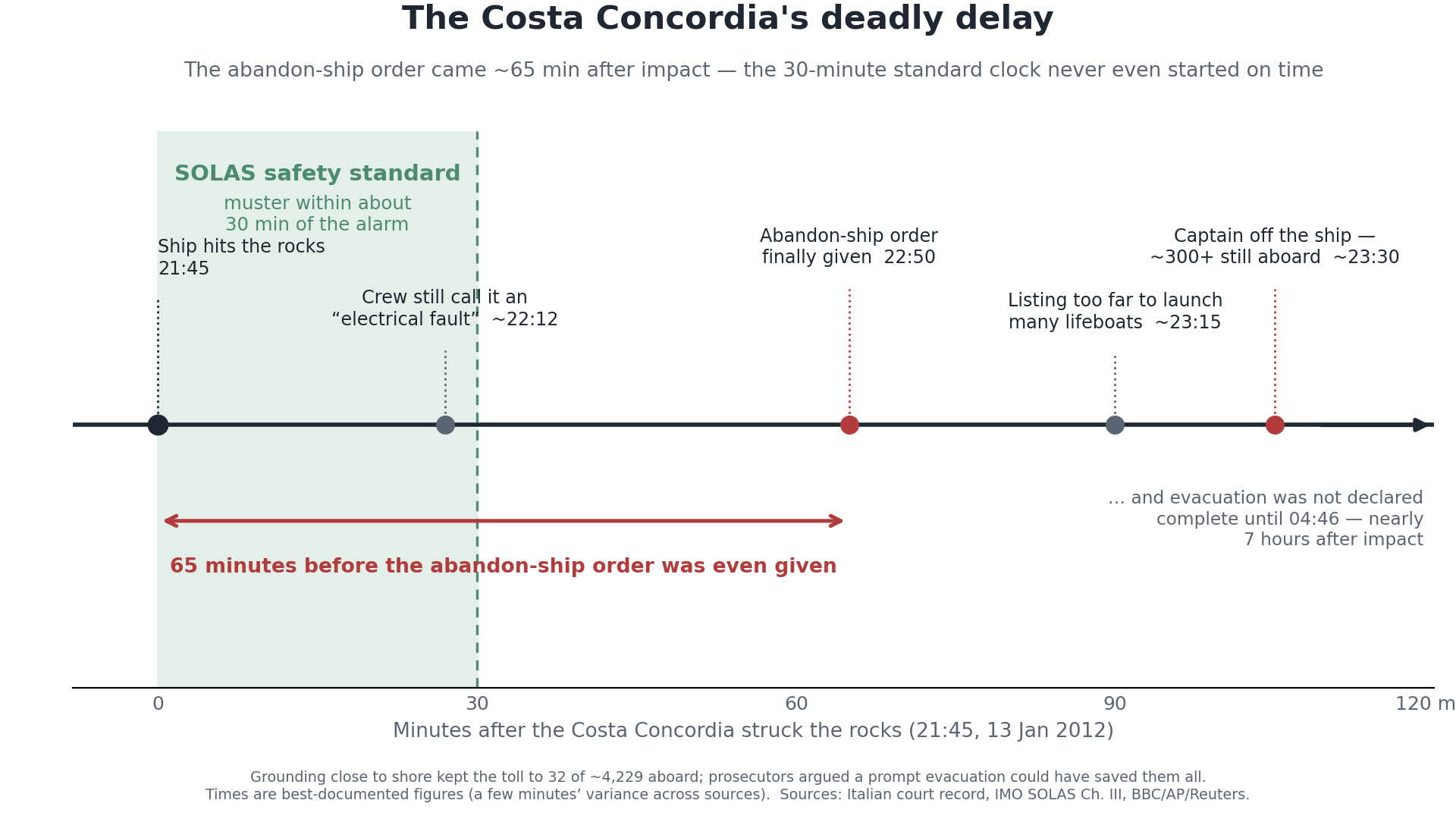
International safety rules (the SOLAS convention) envisage a prompt, orderly evacuation — passengers at their lifeboat muster stations within roughly 30 minutes of the alarm, and lifeboats launchable within 30 minutes of the order to abandon ship. On the Concordia, that order itself came about 65 minutes after impact — so the clock never even started on time. The full evacuation wasn’t declared complete until 04:46 the next morning, nearly seven hours after the ship hit the rocks.
Captain Schettino, and “Get back on board”
What made the story infamous was the captain’s own conduct — and because he was tried and convicted, these are matters of court record, not speculation. Schettino left the ship while hundreds of people were still aboard — an estimated 300-plus when he went over the side, and he was later found onshore in dry clothes, contradicting his account that he had “fallen” into a lifeboat.
Then came the exchange that defined the disaster in the public mind. Italian Coast Guard commander Gregorio De Falco, on the radio, ordered him again and again to return to the ship and lead the evacuation, culminating in the furious line that became a national catchphrase: “Vada a bordo, cazzo!” — “Get back on board, damn it!” Schettino did not return.
What the courts found
In February 2015, an Italian court convicted Schettino and sentenced him to 16 years (10 for multiple manslaughter, 5 for causing the shipwreck, 1 for abandoning ship). Appeals courts upheld it, and Italy’s Supreme Court of Cassation confirmed the sentence in May 2017, after which he began serving it in Rome’s Rebibbia prison. Five other people — crew, officers and a company official — had earlier been convicted via plea bargains for their roles in the accident and the botched evacuation.
Two findings are worth keeping distinct. Prosecutors argued that a prompt evacuation could have saved all 32 who died — that the delay was, as one put it, effectively the reason they died. That’s the prosecution’s contention. What investigators established more broadly is narrower but damning: the delay in ordering the evacuation significantly worsened the disaster, because it let the ship list until lifeboats on the low side could no longer be launched.
The aftermath: raising the wreck
The Concordia lay on its side off Giglio for months. Its fuel — thousands of tonnes of heavy oil — was pumped out early to avert a spill in ecologically sensitive waters. In September 2013, engineers performed a parbuckling operation, rotating the 114,000-tonne wreck upright in what was then the largest salvage of its kind. It was refloated and towed to Genoa in July 2014 for scrapping, which finished in 2017. The last victim, Indian crew member Russel Rebello, was recovered in November 2014, nearly three years on. The total cost of the disaster — salvage, compensation, removal — ran to roughly $2 billion, more than three times what the ship cost to build.
Is it worth watching?
There is no aggregate score worth quoting. Rotten Tomatoes had a single critic review logged at publication and too few audience ratings to display a percentage — treat any number you see attached to this film as premature. So the assessment below is about what the film is built from, which is knowable.
Its unusual advantage is that almost nothing here has to be reconstructed. Most disaster documentaries are guesswork dressed as narrative, because the evidence went down with the event. The Costa Concordia is the opposite: a criminal trial that ran to Italy’s highest court, an official casualty investigation, recovered bridge audio, and several thousand passengers who were carrying phones. A film about this can play the record rather than dramatise around it, and the choice to use survivor and crew interviews alongside translated bridge audio suggests that is the intention. It is the same fact-versus-drama test worth running on Netflix’s Facing El Chapo , where the film’s most cinematic beat — the refused bribe — is documented in the official account of the real capture.
The structural problem is that there is no mystery. The captain was convicted, the conviction was upheld in 2017, and “Schettino” became international shorthand within a week of the sinking. A documentary arriving fourteen years later cannot sell you a question that was settled in court. It has to be about something other than who was to blame.
Which leaves exactly one version worth ninety minutes: the institutional one. The sail-past salute is the hook — it is reckless, it is easy to explain, and it makes the better trailer. But the sail-past is not what killed 32 people. The 65 minutes between impact and the abandon-ship order are what killed them, because by the time the order came the ship had listed too far to launch many of the lifeboats. That gap is a question about procedure, chain of command and why nobody overrode a captain who was not acting — and it is the part that generalises to every other ship at sea.
So the thing to watch for is proportion. How much of the runtime goes to the collision, and how much to the hour afterwards? Passenger phone footage is the most viscerally effective material available here and the least informative; a film weighted toward it will feel immersive and explain nothing. The translated bridge audio is the tell in the other direction — used to build the timeline of the delay it is the most valuable thing in the film, used for tension it is set dressing.
One more thing that matters with this subject. Thirty-two people died and there is an enormous amount of footage of them dying. Restraint is not squeamishness here; it is the difference between a documentary and a reconstruction of a disaster for entertainment.
Our read: the underlying record is strong enough that a serious film is clearly available in this material, and the interview-plus-bridge-audio construction points at the right one. The failure mode is not inaccuracy — the facts are settled and hard to get wrong — it is spending ninety minutes on the twenty seconds that everyone already knows about.
The bottom line
Shipwrecked: Nightmare at Sea revisits a disaster whose horror was less about the sea than about the hour that was wasted after the ship hit the rocks. The Costa Concordia grounded close enough to shore that almost everyone lived; 32 people did not, and the courts found the delay and the captain’s abandonment of his post made a survivable accident far deadlier than it should have been. If the documentary does its job, it’s less a thriller than a warning about what happens when the person in command stops leading.
Frequently asked questions
Is Shipwrecked: Nightmare at Sea a true story?
Yes. It’s a documentary about the real 2012 Costa Concordia cruise-ship disaster, in which the ship struck rocks off the Italian island of Giglio, grounded and partially sank, killing 32 people.
What happened to Captain Francesco Schettino?
He was convicted in 2015 of multiple manslaughter, causing the shipwreck and abandoning ship, and sentenced to 16 years. The conviction was upheld by Italy’s Supreme Court in 2017, and he is serving the sentence.
How many people died on the Costa Concordia?
32 people died — 27 passengers and 5 crew — out of roughly 4,229 aboard. More than 4,200 were rescued, largely because the ship grounded close to shore. (A salvage diver who died during the 2014 recovery is counted separately.)
Why is the Costa Concordia disaster considered so avoidable?
The ship was deliberately taken close to shore for a “sail-past salute,” and after it struck the rocks the order to abandon ship was delayed by roughly an hour, by which time the list made many lifeboats unusable. Prosecutors argued a prompt evacuation could have saved everyone who died.
Where can I watch Shipwrecked: Nightmare at Sea?
It’s a Netflix original documentary, released on 10 July 2026.
More to stream: our roundup of the best movies on Netflix and the Little House on the Prairie cast and ending explainer .