September 2026 Social Security Payment Dates: SSI, SSDI & Retirement Schedule
The last September payment lands on 23 September, and the October rounds begin on 1 October. From that date the schedule at the top of this page is a past month.
Everything else on the page is unaffected; the figures below still say when they were read.

- Five payment dates in September 2026: SSI on Tuesday 1 September, the 3rd-of-month group on Thursday 3 September, and the birth-date groups on Wednesdays 9, 16 and 23 September.
- Nothing shifts this month. No payment date falls on a weekend, and the one federal holiday — Labor Day, Monday 7 September — lands on a day with no payment scheduled.
- The Wednesday is set by the birthday of the person whose work record the benefit is paid on. If you collect as a widow, widower or child, that is not your own birthday.
- There are five separate routes onto the 3rd of the month, not one. Filing before May 1997 is only the first; also receiving SSI, living abroad, having your State pay your Medicare premium, and switching records without a break each do it too.
- SSA no longer publishes this calendar on its open website. The old schedule page is a 404 and its replacement tells you to sign in, so every date here is derived from 20 CFR 404.1807 and 416.502.
- Eleven payments arrived early somewhere in 2026. The one almost nobody flags is November: Veterans Day falls on Wednesday 11 November, so the born-1st-to-10th payment moves to Tuesday 10 November.
Social Security and SSI pay on five dates in September 2026: Tuesday 1 September, Thursday 3 September, and the Wednesdays of 9, 16 and 23 September. Not one of them moves. No payment date falls on a weekend this month, and the only federal holiday — Labor Day, Monday 7 September — lands on a day with nothing scheduled.
That makes September one of the straightforward months, which is worth saying plainly because most of the year is not. Eleven payments arrived earlier than their scheduled day somewhere in 2026.
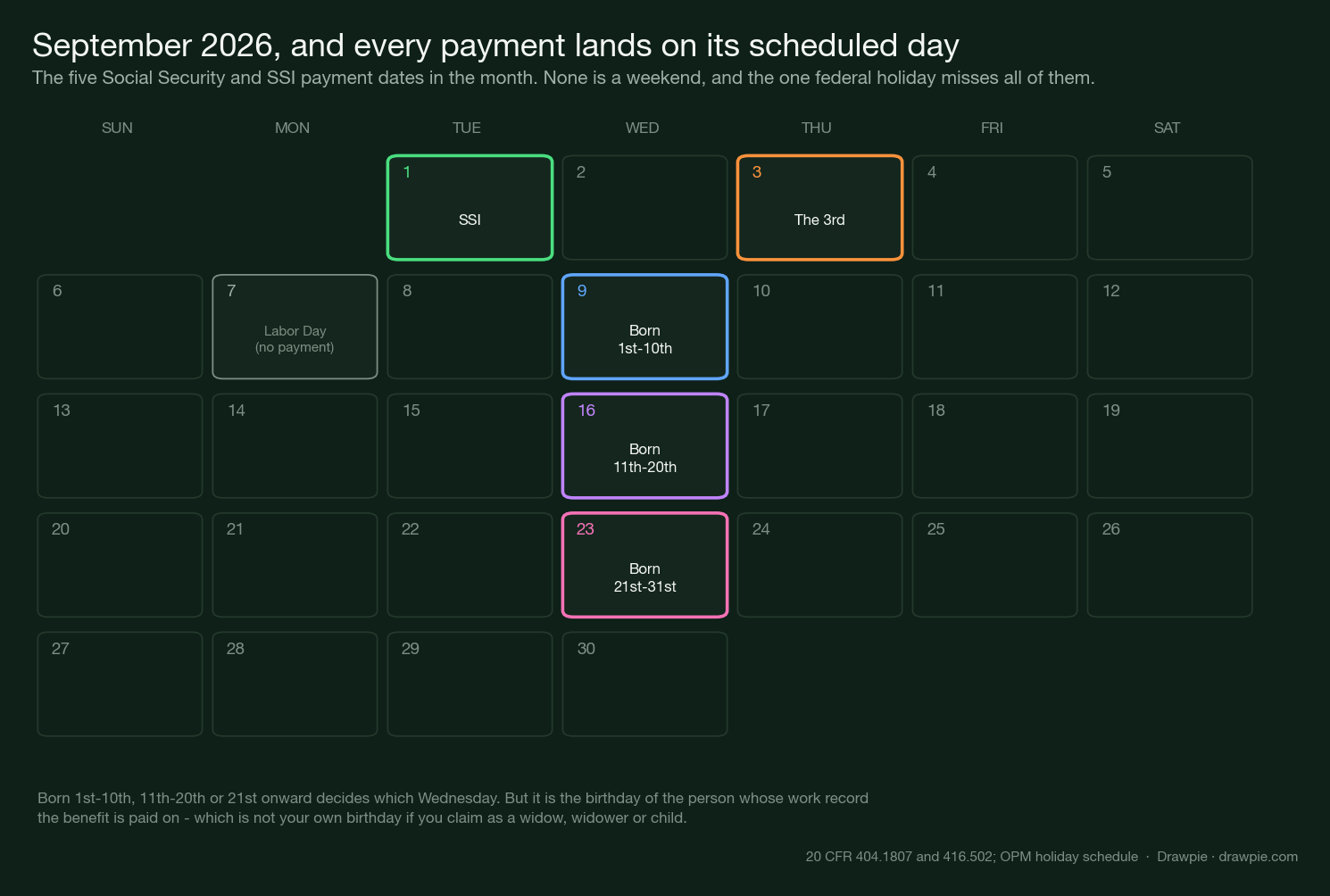
The September 2026 payment dates
| Date | Who is paid | Rule |
|---|---|---|
| Tuesday 1 September | SSI recipients | 20 CFR 416.502 |
| Thursday 3 September | Five groups, including anyone also receiving SSI | 20 CFR 404.1807(c) |
| Wednesday 9 September | Born on the 1st–10th | 20 CFR 404.1807(b)(2) |
| Wednesday 16 September | Born on the 11th–20th | 20 CFR 404.1807(b)(2) |
| Wednesday 23 September | Born on the 21st–31st | 20 CFR 404.1807(b)(2) |
Retirement, survivors and disability benefits all run on the same rule. Part 404 of the regulations covers “Federal Old-Age, Survivors and Disability Insurance”, so SSDI is not on a separate calendar — a disability payment follows the same birth-date Wednesdays as a retirement payment, subject to the same exceptions.
Which of those dates is yours
The birthday rule is the one everybody knows, and it is the last of three tests, not the first. Two things override it.
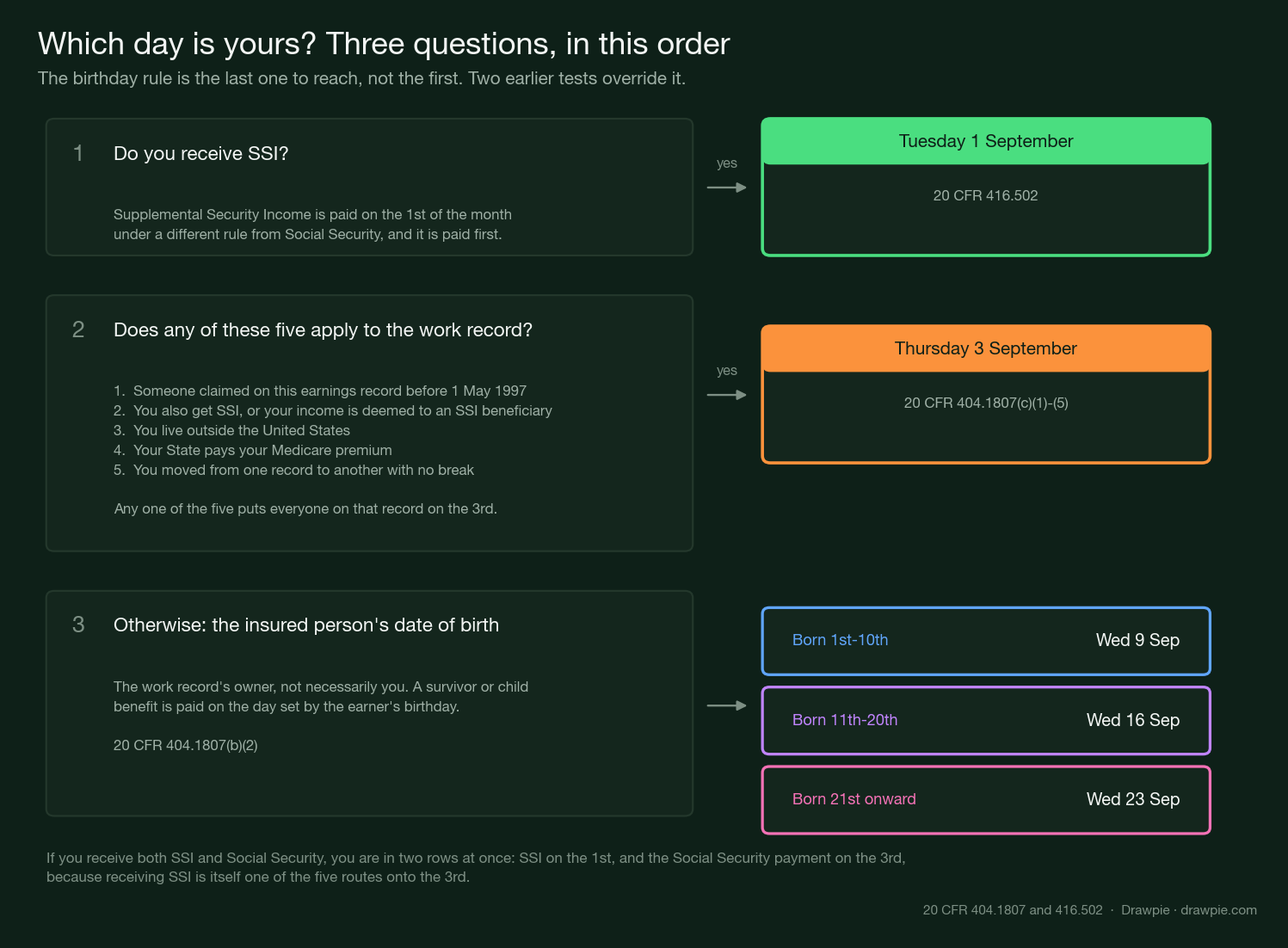
Start with SSI. Supplemental Security Income is paid under a different regulation from Social Security, on the 1st of the month. In September that is Tuesday the 1st.
Then check the five routes onto the 3rd. This is where most coverage goes thin. Nearly every article says the 3rd-of-month group is people who filed before May 1997. That is one of five paragraphs. Section 404.1807(c) lists all of these:
- Someone claimed on that work record before 1 May 1997. Note the wording: the regulation says “you or any other person became entitled to benefits on the earnings record of the insured individual”. If anyone claimed on the record before that date, all persons who subsequently become entitled on it go onto the 3rd — including somebody claiming for the first time this year.
- You also receive SSI, or you have income deemed to an SSI beneficiary.
- You live outside the United States.
- Your State pays your Medicare premium under section 1843 of the Act — the Medicare Savings Program population.
- You became entitled on one record and later on another with no break in entitlement. The common case is a surviving spouse moving from a retirement benefit to a survivor benefit.
Any one of the five puts everybody on that work record onto the 3rd of the month.
Only then does the birthday matter — and here is the detail that catches people out. The regulation says the day is chosen “based on the day of the month on which the insured individual was born”. Not the person receiving the money. If you collect on someone else’s work record — as a widow, a widower, or a child — your payment day is set by their birthday. A widow born on the 4th collecting on a husband born on the 25th is paid on the fourth Wednesday, not the second.
That follows from the paragraph just above it, which assigns “the same payment day for all individuals who receive benefits on the earnings record of a particular insured individual”. The payment day is a property of the work record, not of a person.
Why these dates are derived rather than looked up
Until recently SSA published a payment calendar on its open website. That page, ssa.gov/prepare/receive-benefits-payment-schedule, now returns a 404. Following the 404 page’s own navigation leads to ssa.gov/manage-benefits/view-benefit-payment-schedule, which is live — and publishes no dates whatsoever. Its entire content on the question is:
Check the schedule to see your upcoming and past payments. Sign in to your account.
Plus one sentence noting that your date depends on your birthday and benefit type.
So the calendar is behind a login now. The dates on this page therefore come from the regulations that set them, which are public and have not moved: 20 CFR 404.1807 for Social Security and 20 CFR 416.502 for SSI, both read from the government’s own XML. Federal holidays are OPM’s published schedule.
That is a slower route to the same answer, but it has one advantage: the rules explain why a date is what it is, which a printed calendar never does.
When payments move, and which direction
Both rules move payments earlier, never later. Section 404.1807(c)(6) is explicit:
If the day regularly scheduled for the delivery of your benefit payment falls on a Saturday, Sunday, or Federal legal holiday, you will be paid on the first preceding day that is not a Saturday, Sunday, or Federal legal holiday.
416.502 says the same thing for SSI in almost the same words, with one small textual difference worth knowing: it says “legal holiday” where 404.1807 says “Federal legal holiday”.
Because the shift only ever runs backwards, a payment can be pulled out of its own month into the one before. That is the whole mechanism behind the two things people ask about most — months with no SSI deposit, and months with two.
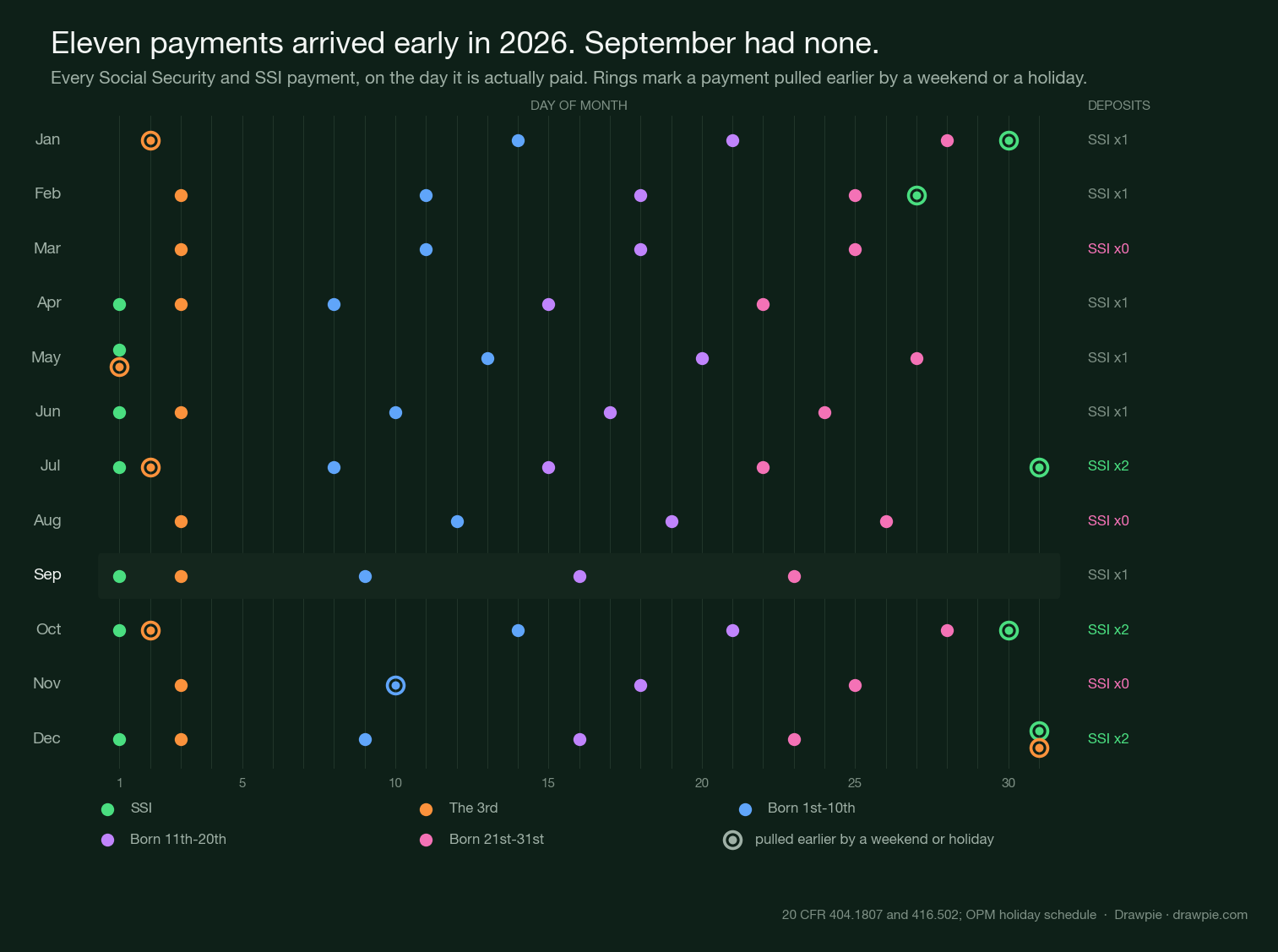
In 2026, twelve SSI deposits land in the calendar year. March, August and November contain none at all, because in each case the 1st fell on a weekend and the money arrived at the end of the previous month. July, October and December each contain two.
None of that is an extra payment or a missed one. The regulation settles it in four words — an SSI payment made on the 1st “represents payment for that month” — so a deposit arriving on 30 October is November’s payment arriving early, not a bonus.
The case most worth marking in advance is November. Veterans Day 2026 falls on Wednesday 11 November, which is the second Wednesday of the month. So the born-1st-to-10th group is paid on Tuesday 10 November instead. A federal holiday landing squarely on a payment Wednesday is rare, and it is the kind of thing that gets noticed on the day rather than before it.
How to check your own date without signing in
Signing in to a my Social Security account is the route SSA now points everyone to, and it shows your own upcoming and past payments. But it is not the only one, and the alternative is easy to miss because it sits at the bottom of that same page.
SSA runs automated phone assistance on +1 800-772-1213, 24 hours a day, seven days a week, in English and Spanish. Its own instruction for reaching the schedule is specific: when you hear “How can I help you today?”, say “check delivery.” The TTY line is +1 800-325-0778.
That matters for anyone who cannot get through the account sign-in — which, for a population that skews older, is not a small group.
If a payment has not arrived, it is also worth checking whether the date you expected was the right one to begin with. The two questions above — whether anyone claimed on that work record before May 1997, and whose birthday actually sets the date — are the two that most often explain a payment that seems to be missing on the second Wednesday.
Why did I get two SSI payments in one month?
You did not get two months of money. SSI is paid on the 1st, and when the 1st falls on a weekend or holiday the payment is moved to the last working day before it — which can be in the previous month. A month containing two deposits is holding its own payment plus the next month’s, arriving early.
In 2026 this happens in July, October and December. The mirror image is March, August and November, which contain no SSI deposit at all for the same reason.
Is an early payment an extra payment?
No. The regulation says a payment made on the first day of the month “represents payment for that month”, so moving the delivery date does not create or skip a month’s entitlement. Twelve SSI deposits land in calendar 2026 and each one is a single month’s payment.
The calendar year is simply not aligned with the payment year. In 2026 the January payment arrived on 31 December 2025, and both of January 2027’s arrive on 31 December 2026.
Does my payment date change if I move to a different benefit?
It can, and paragraph (c)(5) is the one that governs it. If you become entitled on one work record and later on another with no break in entitlement, you are paid “no later than” your current payment day — and if you were already being paid on the 3rd, you stay on the 3rd.
The common version of this is a surviving spouse switching from a retirement benefit to a survivor benefit. The payment day follows the record, so it can move even though nothing about your own birthday has changed.
Is SSDI paid on a different schedule from retirement?
No. Both are paid under Part 404 of the regulations, which covers old-age, survivors and disability insurance, and 404.1807 applies to all of them. An SSDI payment falls on the same birth-date Wednesday as a retirement payment on the same record.
The reason SSDI recipients so often appear in the 3rd-of-month group is not a separate disability rule — it is exception (c)(2). Anyone receiving SSI alongside their Social Security benefit is moved to the 3rd, and concurrent SSI and SSDI entitlement is common.
The rest of 2026
For anyone planning ahead, these are the remaining months of the year where something moves:
| Month | What moves | Paid instead |
|---|---|---|
| October | The 3rd-of-month payment (3 Oct is a Saturday) | Friday 2 October |
| October | November’s SSI (1 Nov is a Sunday) | Friday 30 October |
| November | Born 1st–10th (Veterans Day is Wednesday 11) | Tuesday 10 November |
| December | January 2027’s SSI and 3rd-of-month payments | Thursday 31 December |
Everything else in those months lands on its scheduled day. The next COLA is a separate question with its own timetable — the 2027 adjustment is announced on 14 October 2026 , the day the September CPI is published.
How we verified this
ssa.gov/prepare/receive-benefits-payment-schedule now returns a 404. The page that replaced it publishes no dates at all — it says only “Check the schedule to see your upcoming and past payments. Sign in to your account.”
⚠️ The chart of the full year plots payments by the day they arrive, not the month they are dated to. Those are different counts. Eleven shifted payments land inside calendar 2026; ten are dated to a 2026 month. January 2026’s SSI arrived on 31 December 2025, and both of January 2027’s arrive on 31 December 2026.
⚠️ This page is a schedule, not advice, and it contains no benefit amounts. What you are paid, and any cost-of-living change, are separate questions with their own sources.