Russia–China Arctic Oil Route 2026: Shipping Cost vs Transit Time
Update log (1)
- — Written on 14 August 2026, mid-season. Reuters counted seven tankers carrying about six million barrels in transit on 11 August; gCaptain, counting vessels staged in the Kara Sea as well as those under way, put it at more than a dozen ships and roughly eight million barrels. Both figures are in the article because they measure different things.

- Reuters reported on 11 August 2026 that the Northern Sea Route saves roughly two weeks against the Suez Canal on Russia-to-Asia crude voyages. That saving is real but conditional: it depends on the loading port and on the ice, and there is a documented case where it disappeared entirely.
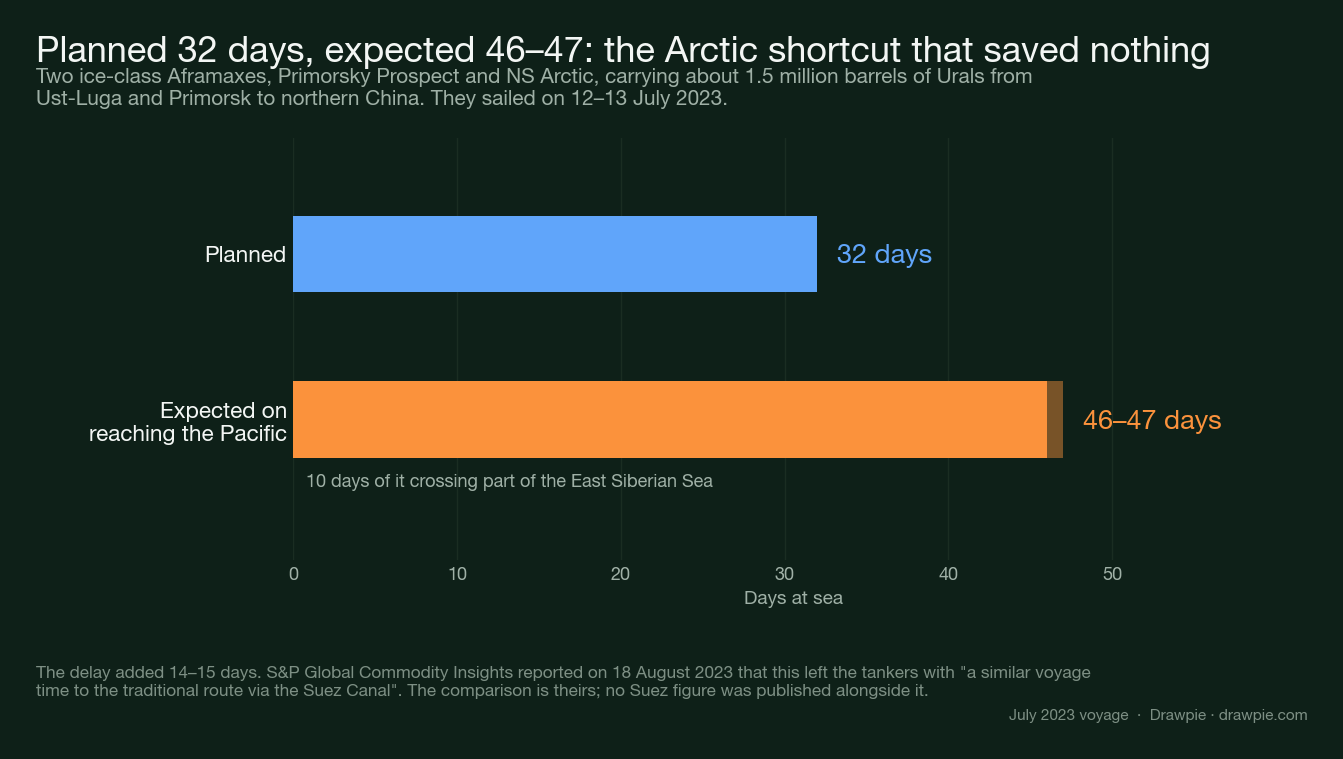
- In July 2023 two ice-class Aframaxes carrying about 1.5 million barrels of Urals from the Baltic to northern China planned a 32-day passage and were expected to need 46 to 47 days once they reached the Pacific — ten of those days spent crossing part of a single sea.
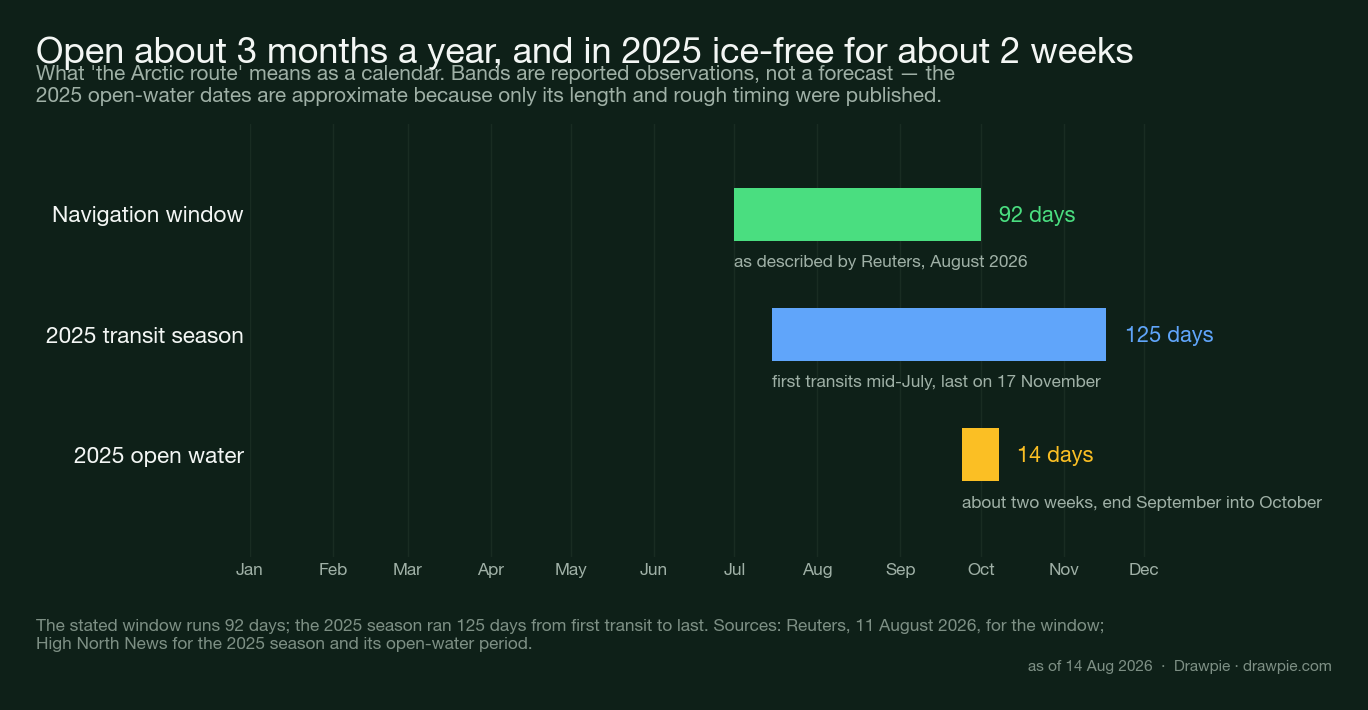
- The route is usable for about three months a year. Reuters describes a navigation window of 1 July to 1 October; in 2025 transits ran from mid-July to 17 November, and genuinely open water lasted about two weeks.
- The cost comparison moved this summer, but not in the Arctic. From 15 July 2026 the Suez Canal charges laden crude tankers a 37% surcharge on standard dues, up from 25% — a change on the other route, not this one.
The Arctic route from Russia to China saves about two weeks against the Suez Canal, and in one documented case it saved nothing at all. Both statements are true, which is the whole difficulty with pricing this passage.
Reuters put the saving at roughly two weeks on 11 August 2026, with seven tankers carrying around six million barrels then in transit. Three years earlier, two ice-class tankers that left the Baltic for northern China planned a 32-day run and were looking at 46 to 47 days by the time they reached the Pacific. Nothing about the route had changed except the ice.
How much time does the Arctic route actually save?
About two weeks on a Russia-to-Asia crude voyage, according to Reuters’ reporting of 11 August 2026. That is the figure to use for this trade, and it is smaller than the numbers usually attached to the Northern Sea Route.
The widely quoted claims — a 40% shorter distance, transits of 18 to 22 days — come from container voyages between Europe and Asia. They are not wrong, but they describe a different journey. For crude, what decides the saving is where the oil is loaded: a cargo leaving Murmansk is already on the Barents Sea, while one leaving Primorsk or Ust-Luga has to sail out of the Baltic and around Scandinavia before the Arctic leg even begins.
Why did the 2023 Baltic voyage take longer than planned?
Ice in the East Siberian Sea, and it cost the voyage its entire advantage. In July 2023 the ice-class Aframaxes Primorsky Prospect and NS Arctic sailed from Ust-Luga and Primorsk with about 1.5 million barrels of Urals for northern China.
| Stage | Days |
|---|---|
| Planned passage | 32 |
| Expected on reaching Pacific | 46–47 |
| Added by delays | 14–15 |
| Of which, East Siberian Sea | 10 |
S&P Global Commodity Insights reported on 18 August 2023 that this left the pair with “a similar voyage time to the traditional route via the Suez Canal”. They had an icebreaker with them; they still spent ten days crossing part of one sea, where ice extent that summer was high by recent standards.
This is a 2023 voyage, not a 2026 one, and it is here as the documented downside case rather than as a description of this season. Conditions differ year to year — a trader told Reuters this month that ice this year is relatively mild.
How long is the Arctic route open each year?
About three months, and far less than that in genuinely open water. This is the constraint that makes the route a seasonal instrument rather than an alternative to Suez.
| Period | Dates | Days |
|---|---|---|
| Navigation window | 1 Jul – 1 Oct | 92 |
| 2025 transit season | mid-Jul – 17 Nov | 125 |
| 2025 open water | end Sep – early Oct | ~14 |
The first row is the window Reuters describes. The second is what actually happened in 2025, as recorded by High North News: transits continued into November behind icebreakers, well past the nominal window. The third row is the part that rarely appears in coverage — for most of even a good season, ships are moving through ice, not around it.
What does it cost to send oil this way?
The published change this summer is on the Suez side, not the Arctic one. From 15 July 2026 the Suez Canal Authority charges laden crude tankers a 37% surcharge on standard canal dues, raised from 25%; ballast voyages went from 15% to 27%. The change was made through Periodical No. 16/2026, amending Circular No. 1/2022.
That matters because the Arctic route’s costs are mostly not tolls. They are:
- An ice-class hull, or an icebreaker escort, or both. Vessels without ice classification have used the route and have got into trouble doing it: a Suezmax carrying about a million barrels toward China was stuck for several days in 2025.
- Damage risk that is now on the record. In 2026 the insurer AlfaStrakhovanie paid 53 million roubles, about $638,000, for hull deformation on a loaded tanker navigating Arctic ice under icebreaker assistance. It withheld the ship’s name, the date and the location. Its own summary is the useful part: even with an icebreaker, Arctic navigation means “increased hull stress and the risk of damage”.
- Escort fees, which Russia’s operator publishes as a tariff schedule by tonnage, ice class, season and number of zones. We could not open that schedule, so this article does not put a number on it.
So the honest shape of the cost comparison is: Suez charges a toll that just went up by a published amount, and the Arctic charges a hull, an escort and a risk that are harder to price and, on the evidence of the insurance claim, are not zero.
How much Russian oil is going this way in 2026?
More than in any previous season, and the mid-August count depends on what you count.
| Season | Reported volume |
|---|---|
| 2025, full season | ~13 million barrels |
| 2026, in transit 11 Aug | ~6 million barrels |
| 2026, incl. staged 12 Aug | ~8 million barrels |
Reuters counted seven tankers under way on 11 August — six Aframaxes at roughly 750,000 barrels each and one Suezmax at about a million — flagged in Russia, Oman and Cameroon. gCaptain, counting vessels staged in the Kara Sea as well as those already moving, reached more than a dozen ships and about eight million barrels. Cargo staged in the Kara Sea has not made the passage yet, which is why both numbers are here rather than one.
For scale, High North News recorded the whole 2025 season as 103 transit voyages by 88 vessels, 3.2 million tonnes of transit cargo, of which about 1.9 million tonnes was crude moving east across 34 tanker transits.
Why is the traffic rising now?
The reasons on the record are ice and chokepoints, in that order. A trader told Reuters this month that ice conditions this year are relatively mild, and that logistical problems in the Strait of Hormuz and the Black Sea are supporting Arctic shipments of Russian crude to China.
The Suez surcharge rise on 15 July 2026 pushes the same way, though no source we read attributed the Arctic increase to it. Both routes lead to the same buyers; only one of them has a canal authority that publishes its prices.
What this does not tell you
Whether any of this holds for the rest of the season. This article does not forecast volumes, freight rates, oil prices or ice, and the charts contain only things that have already happened.
It does not tell you the escort fee, because the tariff schedule would not open for us. It does not tell you which vessel was damaged, because the insurer did not say. And it does not tell you how many of this season’s voyages were made with the required permits — reporting has raised that question, and it is not something a page like this can settle.
What the numbers do support is narrower and more useful: the Arctic saves about two weeks when it works, it is open about three months a year, and the one voyage we have a full before-and-after for lost every day of its advantage to ice.
How we verified this
Every figure here is dated, and the dates matter more than usual. The most quoted numbers about this route — “40% shorter”, “18 to 22 days” — describe container voyages between Europe and Asia, not Russian crude going to China. We have not used them for crude, because the loading port changes the arithmetic completely: a cargo leaving Murmansk on the Barents Sea starts thousands of miles closer to the Arctic than one leaving Primorsk on the Baltic.
The 32-day and 46-to-47-day figures are from July 2023, not this season. They come from S&P Global Commodity Insights reporting of 18 August 2023 on the Primorsky Prospect and NS Arctic, and the voyage is separately documented by Rigzone, ArcticToday and the Barents Observer. We have dated it explicitly in the chart, the table and the text, because a delay figure detached from its year is exactly the kind of number that gets re-used as if it were current.
The two 2026 volume figures are not a contradiction. Reuters counted seven tankers actually transiting with about six million barrels on 11 August. gCaptain, publishing on 3 August and updating on 12 August, counted more than a dozen ships and about eight million barrels by including vessels staged in the Kara Sea. Cargo waiting in the Kara Sea has not made the passage. Both counts appear here with their definitions attached.
The Suez surcharge is the Canal Authority’s own published change, made through Periodical No. 16/2026 amending Circular No. 1/2022, effective for transits beginning on or after 15 July 2026: laden crude tankers to 37% from 25%, ballast to 27% from 15%. We have not calculated what that is worth per voyage, because that depends on the vessel’s tonnage and the base dues schedule.
We could not read the Russian icebreaker tariff schedule. Rosatom’s tariff page refused the connection, so this article does not print an escort fee. The insurance figure — 53 million roubles, about $638,000, paid by AlfaStrakhovanie for hull deformation — is what the insurer disclosed; it withheld the vessel’s name, the date and the location, and we say so rather than filling the gaps.
This article contains no forecasts. It does not project freight rates, oil prices, ice conditions or volumes for the rest of the season, and the charts are drawn only from events that have already been reported. Where a source describes a trend, we attribute it to that source rather than adopting it.
CNN’s 14 August feature on this route could not be read from our location — the page returns a legal block — so nothing here relies on it.