Reform UK Conference Clash: What Happened During Farage's Speech and Why It Matters
The donations investigation is live — Reform is investigating itself and no regulator has reported. Any of that can change within weeks, and the section on it is written as of 6 September 2026. Re-read before relying on it.
Everything else on the page is unaffected; the figures below still say when they were read.

- Farage’s conference speech in Birmingham on 4 September 2026 was delayed by what he told delegates was a ‘security alert’, then interrupted several times by protesters.
- Two women held up a banner reading ‘Reform works for billionaires’. They were booed and removed; Farage chanted ‘boring, boring, boring’.
- The interruption he could not laugh off was a Channel 4 News investigation into party donations, broadcast the night before.
- Two officials — Head of Policy James Orr and adviser Dan Jukes — stepped down, and Reform opened its own investigation.
- Farage said the party ‘has done nothing wrong’ and ‘has taken no illegal money’, and called his aides’ comments ’loose pub talk’. No regulator or court has found otherwise.
- The substantive part of the speech named three obstacles to a Reform government: the House of Lords, the judiciary and the civil service.
- He threatened to appoint hundreds of peers, or hold a referendum on the composition of the Lords, and to ‘consider how judicial appointments work in the future’.
- He also signed a small boats returns agreement with Jordan Bardella’s National Rally. Neither party is in government.
Nigel Farage’s conference speech was delayed by a security alert, interrupted several times by protesters, and overshadowed by an undercover investigation into his party’s donations that had aired the night before.
He laughed off the protesters. The rest was harder to wave away — and buried in the speech itself was the part that will still matter in a year.
What interrupted the speech
Three things, in order.
A long delay before he got on stage. Farage told delegates it was down to a “security alert”. He filled the time by walking through the crowd and greeting delegates.
Protesters, several times. Including two women who held up a banner reading “Reform works for billionaires”. Audience members booed and shouted “out” as security removed them. Farage’s response was to chant “boring, boring, boring”.
And the donations row, which he was forced to address from the stage. That one did not have a security team.
The donations row he had to address
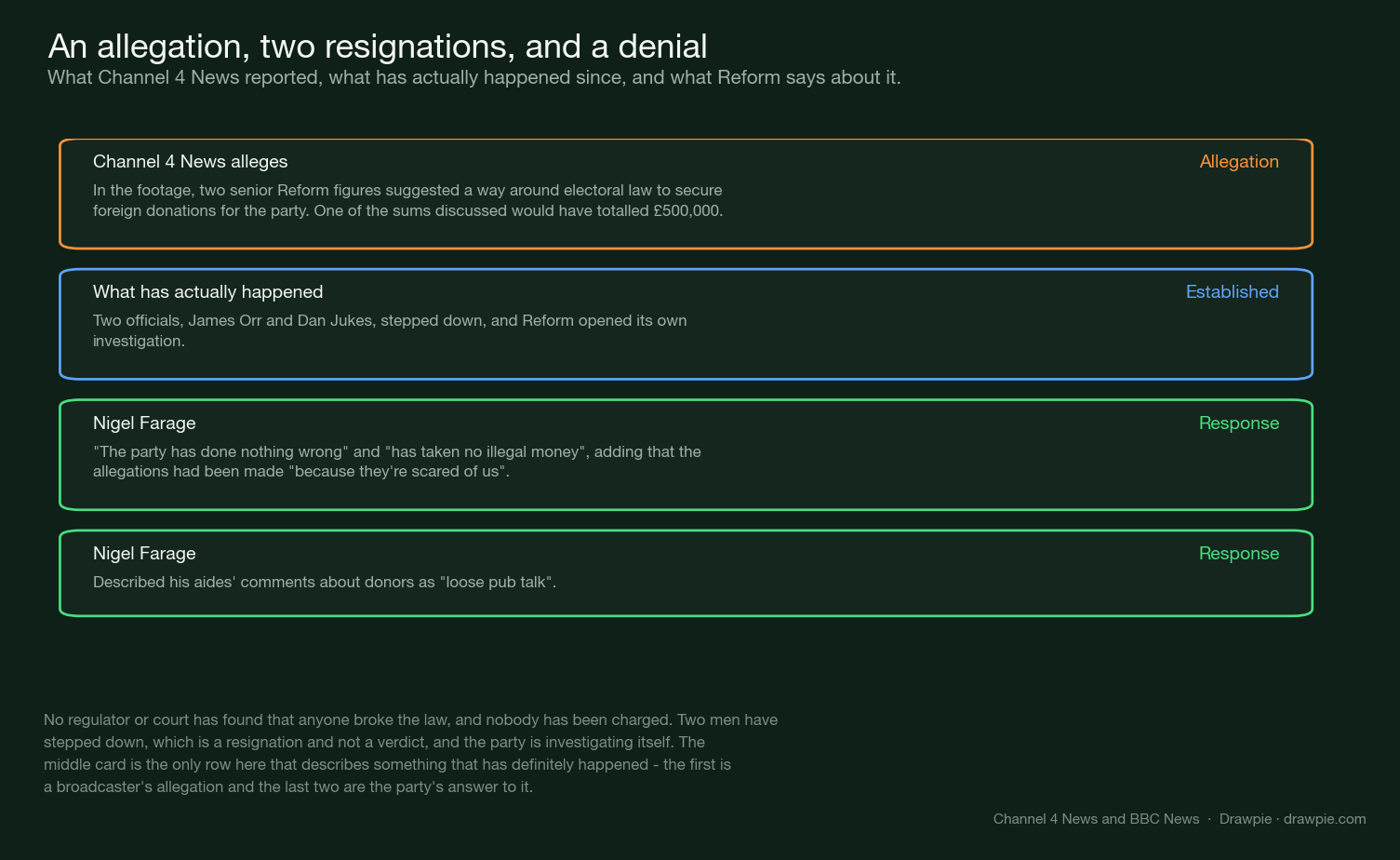
Channel 4 News broadcast undercover footage on the Thursday evening, filmed by Verbatim Investigations — a group founded by journalists from the Centre for Climate Reporting.
The allegation: in the footage, two senior Reform figures suggested a way around electoral law to secure foreign donations for the party. One of the sums discussed would have totalled £500,000. Channel 4 News described this as a secret plot to break the law on party donations; that is the broadcaster’s characterisation of what its footage shows.
What has actually happened since: Reform’s Head of Policy James Orr and adviser Dan Jukes stepped down, and the party opened its own investigation.
What Reform says:
- Farage: the party “has done nothing wrong” and “has taken no illegal money”, and the allegations were made “because they’re scared of us”.
- Farage, on his aides’ comments about donors: “loose pub talk”.
- Nadine Dorries, who joined Reform the night before the conference, told Channel 4 News that all donations are “above board” and accused Channel 4 and Verbatim of running a “sting”.
Labour’s party chair Bridget Phillipson said the row “goes right to the top”.
Nobody has been charged and no regulator or court has found that any law was broken. Two men have stepped down and a party is investigating itself. Those are the only established facts in this section; everything else is an allegation or an answer to one.
Reform had wanted the conference to regain momentum after a summer dominated by questions about its finances. Instead the main day was overshadowed by them.
What he actually pledged
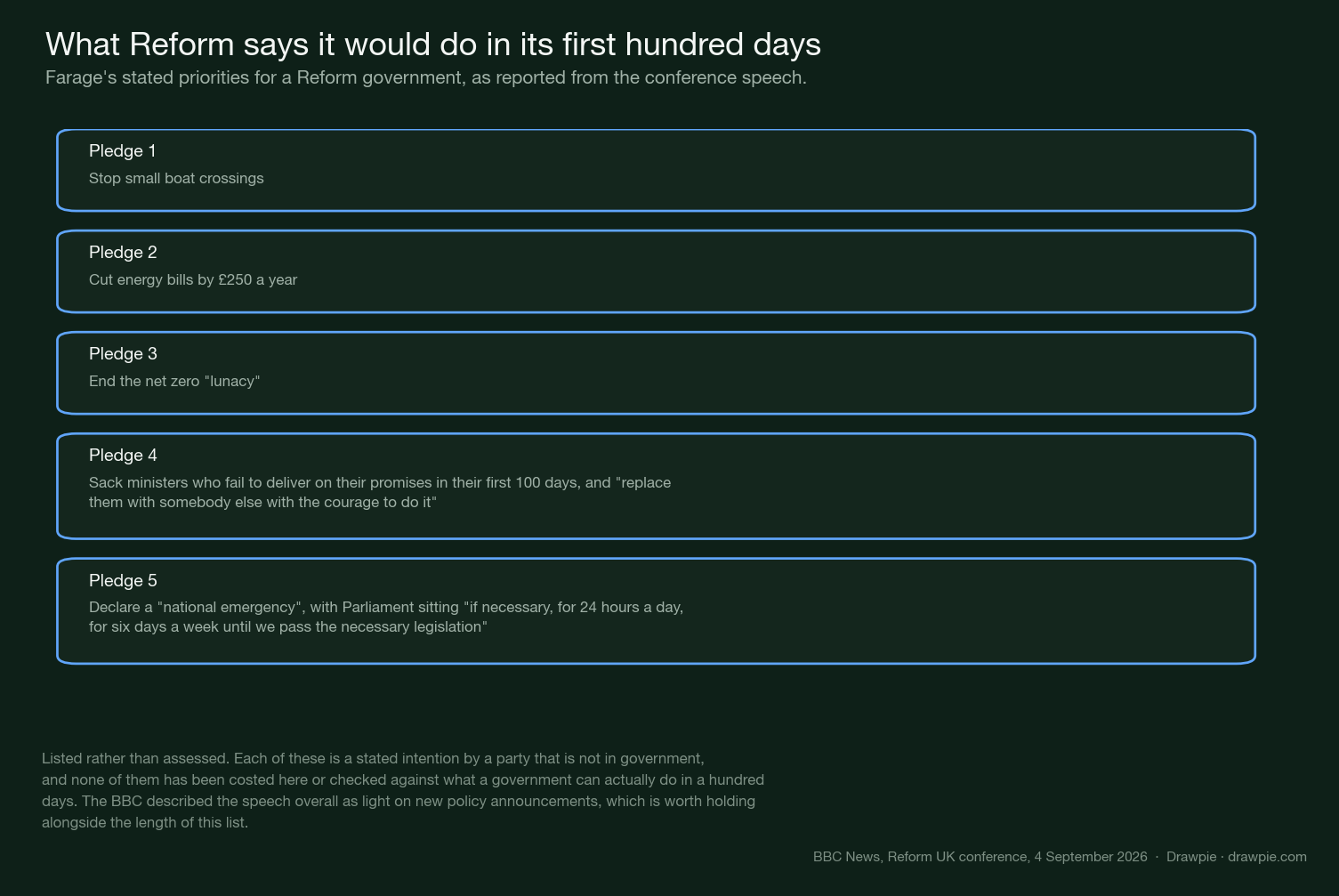
The BBC described the speech as light on new policy announcements. What was in it, for a Reform government’s first 100 days:
- Stop small boat crossings.
- Cut energy bills by £250 a year.
- End the net zero “lunacy”.
- Sack ministers who fail to deliver in their first 100 days and “replace them with somebody else with the courage to do it”.
- Declare a “national emergency” — with Parliament sitting “if necessary, for 24 hours a day, for six days a week until we pass the necessary legislation”.
The three obstacles he named
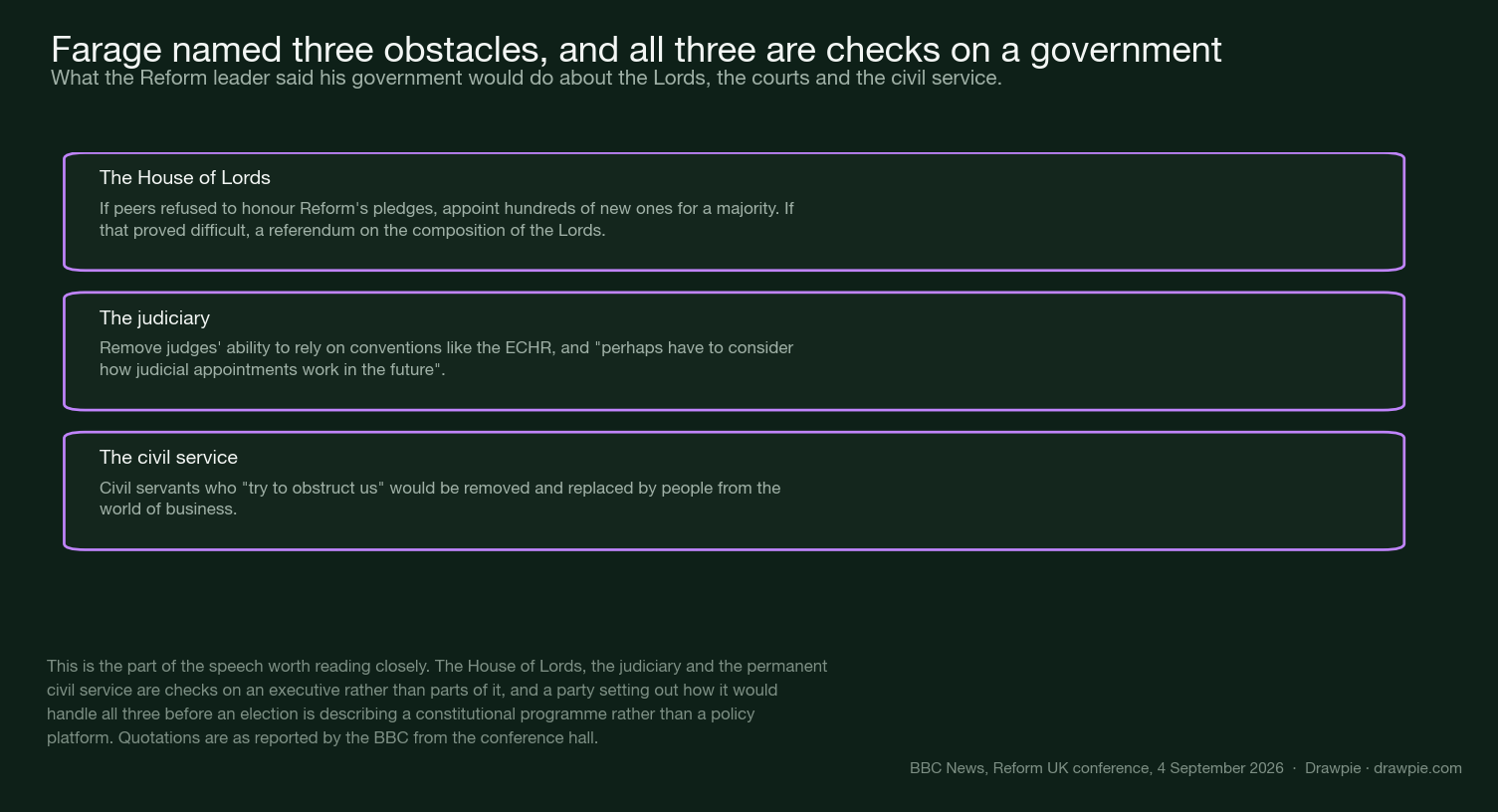
This is the part of the speech worth reading closely, and it got less attention than the banner.
Farage identified three parts of the British state as potential obstacles, and said what he would do about each:
The House of Lords. He said he expected peers to “honour” Reform’s pledges. If they refused, he threatened to appoint hundreds of new peers so the party had a majority in the upper chamber. And: “if that proves difficult, we will hold a referendum on the current composition of the House of Lords, and they would be swept away by a British public appalled by them.”
The judiciary. He promised to remove judges’ ability to rely on conventions like the European Convention on Human Rights, which critics blame for hindering some deportations. “We don’t want the courts striking down, do we, the will of the people… Parliament makes the law, judges interpret the law. We will do whatever it takes, and perhaps have to consider how judicial appointments work in the future.”
The civil service. Civil servants who “try to obstruct us” would be removed from their posts and replaced by people from the world of business. “I’m tired of being told what can’t be done.”
The Bardella deal
Reform signed a small boats returns agreement with France’s hard-right National Rally, at the conference.
It was signed by National Rally President Jordan Bardella, who addressed the main hall. Under it, a Reform government would intercept boats in the Channel and return them to France using the Royal Navy, with France “ordinarily” accepting those on board and then repatriating them to their home country.
It binds nobody. It is an agreement between two political parties, neither of which is in government. Bardella’s party leads French opinion polls ahead of presidential elections in April 2027.
Why it matters
Because the Lords, the courts and the permanent civil service are checks on a government rather than parts of one.
A party setting out, before an election, how it would handle the second chamber, judicial appointments and obstructive officials is describing a constitutional programme, not just a policy platform. Whether you welcome that or find it alarming, it is a bigger thing than a banner in a conference hall, and it is the part of the day most likely to still be argued about in a year.
Two other things give it weight. Farage predicted Prime Minister Andy Burnham would call an early general election in spring 2027 — so this is a platform written for a campaign that may be months away, not years. And he dismissed the Conservatives as having “had 14 years in power and failed absolutely miserably”, which closes the door on the right-wing alliance some had hoped for.
One thing cuts the other way. As the BBC notes, Reform is no longer consistently topping national opinion polls after more than a year of a comfortable lead. Labour’s ratings have risen since Burnham entered Downing Street, and Reform has lost some support to Restore Britain, the new party founded by former Reform MP Rupert Lowe. We looked at where Reform’s polling actually stands separately.
What is allegation and what is established
Established: the speech happened and was delayed and interrupted; two officials resigned; Reform opened an investigation; the Bardella document was signed; and Farage said the things quoted above.
Alleged: that two senior figures discussed a way around electoral law to obtain foreign donations. That is Channel 4 News’s reporting of its own undercover footage.
Denied: by Farage, in the terms quoted, and by Nadine Dorries.
Not determined by anyone: whether any law was broken. No regulator has reported and no charges have been brought.
The bottom line
The banner was the most visible interruption and the least important one.
The donations investigation is unresolved and could run for months. And the section of the speech that dealt with the Lords, the judges and the civil service is the one to go back to — it is a description of how a Reform government would deal with the parts of the state designed to be able to say no.
Speech and scene reported by BBC News from the conference hall; donations investigation broken and verified by Channel 4 News. No regulator or court has made any finding in the donations matter.