The International Team Has One Player in the World's Top 20. The 2026 Presidents Cup Is in Three Weeks.
The Presidents Cup begins on 24 September 2026. On that day the projected pairings on this page are replaced by actual ones, and the prediction starts being tested against results.
Everything else on the page is unaffected; the figures below still say when they were read.

- Both 12-man rosters were completed on 1 September. Si Woo Kim, ranked 13th, is the only International player inside the world’s top 20 — the United States has eight players ranked 11th or better.
- Mean world ranking is 16.2 for the United States against 48.5 for the International team. Eleven of twelve Americans are inside the top 30; five of twelve Internationals are.
- The Presidents Cup runs 24–27 September at Medinah Country Club, which becomes the only club in the world to have hosted a US Open, a PGA Championship, a Ryder Cup and a Presidents Cup.
- The United States leads the all-time series 13–1–1. The International team has won once, in 1998, and tied once, in 2003.
- Thirty points are available and 15.5 wins it. Sunday’s twelve singles are 40% of the Cup on their own.
- Our prediction is a United States win, 18.5–11.5. That is an opinion reasoned from rankings, history and home advantage — not a model, and not odds.
Si Woo Kim, ranked 13th in the world, is the only International player inside the world’s top 20. The United States has eight players ranked 11th or better.
Both teams were completed on 1 September, when Brandt Snedeker and Geoff Ogilvy announced their captain’s picks on a televised special. The 2026 Presidents Cup begins at Medinah Country Club on 24 September.
The gap, in one chart
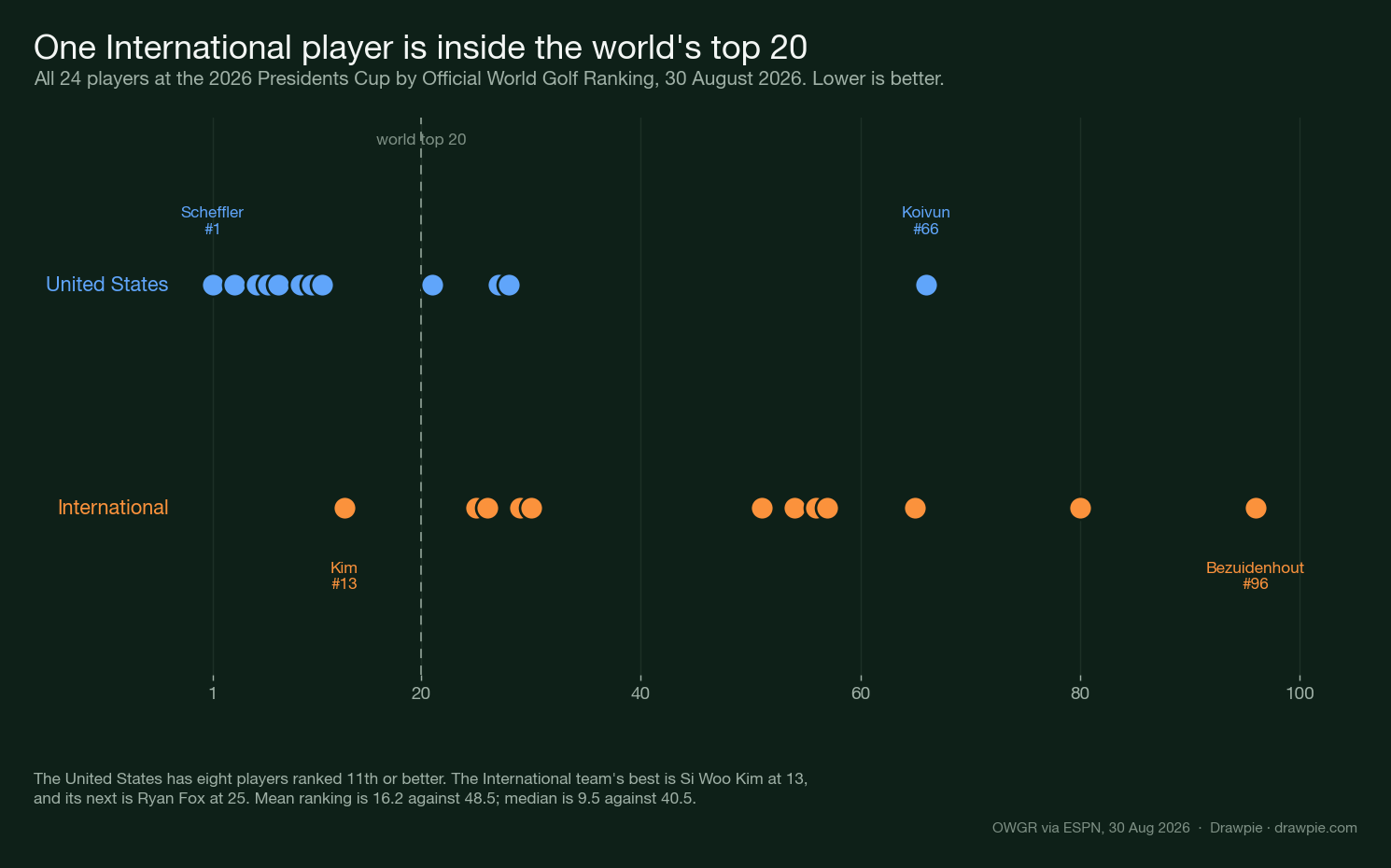
This is the whole preview in a single line of dots. The American ranks read 1, 3, 5, 6, 7, 9, 10, 11, 21, 27, 28 and 66. The International ranks read 13, 25, 26, 29, 30, 51, 54, 56, 57, 65, 80 and 96.
Mean ranking: 16.2 against 48.5. Median: 9.5 against 40.5.
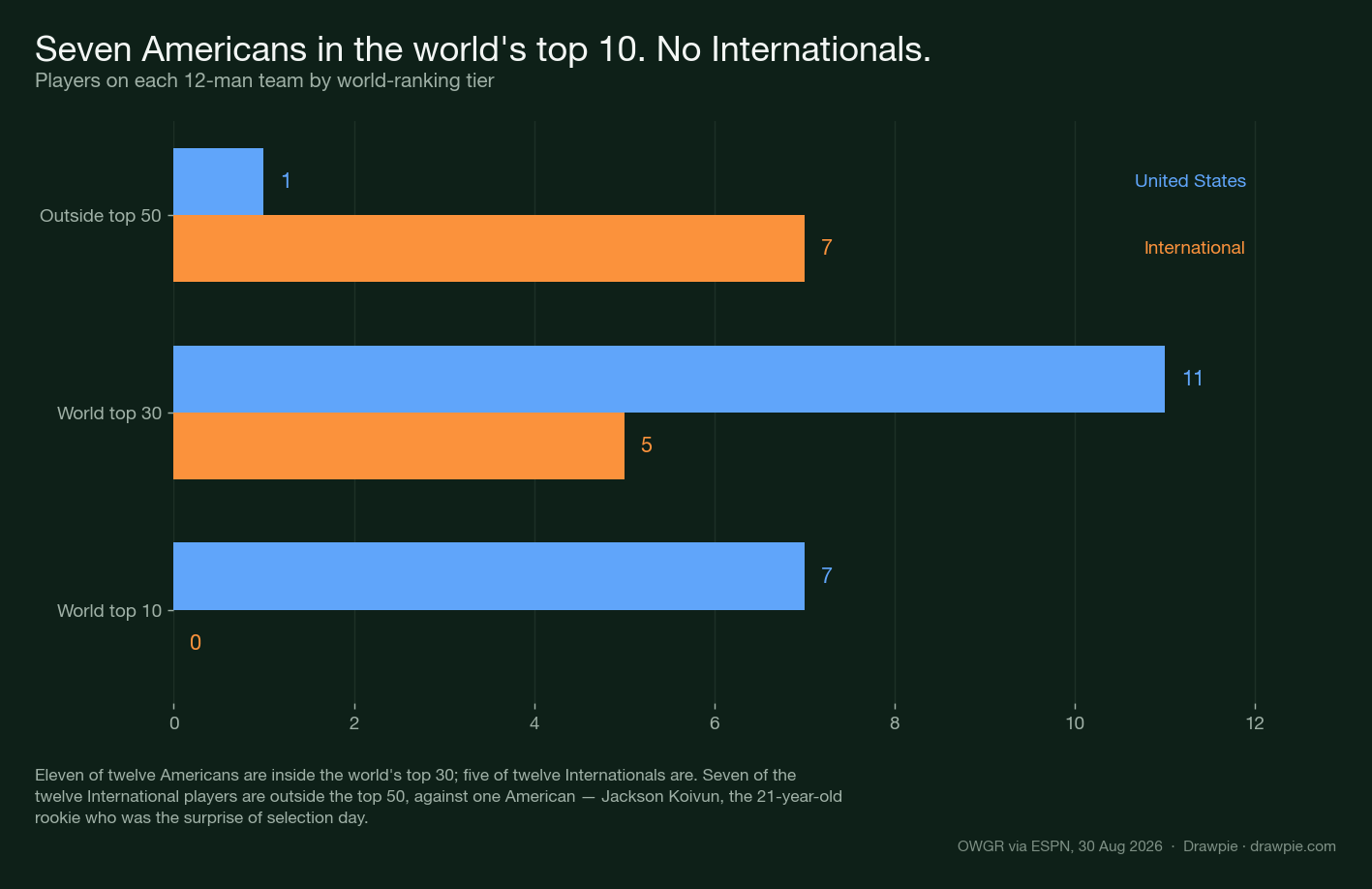
Seven of the twelve Americans are in the world’s top ten. None of the Internationals are. Seven of the twelve Internationals sit outside the top 50, against one American — and that one is the story of selection day.
The two teams
| United States | Rank | International | Rank | |
|---|---|---|---|---|
| Scottie Scheffler | 1 | Si Woo Kim | 13 | |
| Cameron Young | 3 | Ryan Fox | 25 | |
| Wyndham Clark | 5 | Hideki Matsuyama | 26 | |
| Russell Henley | 6 | Min Woo Lee | 29 | |
| Chris Gotterup | 7 | Tom Kim | 30 | |
| Sam Burns | 9 | Adam Scott | 51 | |
| Xander Schauffele | 10 | Corey Conners | 54 | |
| Collin Morikawa | 11 | Nico Echavarría | 56 | |
| Justin Thomas | 21 | Sungjae Im | 57 | |
| Patrick Cantlay | 27 | Ryo Hisatsune | 65 | |
| Jacob Bridgeman | 28 | Nick Taylor | 80 | |
| Jackson Koivun | 66 | Christiaan Bezuidenhout | 96 |
Both captains picked three first-timers among their six selections. For the United States: Chris Gotterup, Jacob Bridgeman and Jackson Koivun. For the International team: Nico Echavarría, Ryo Hisatsune and Nick Taylor.
Jackson Koivun is the one everybody wrote about. A 21-year-old PGA Tour rookie ranked 66th, taken as Snedeker’s final pick ahead of more established names. It is by some distance the boldest selection on either side, and the only American outside the world’s top 50.
What history says
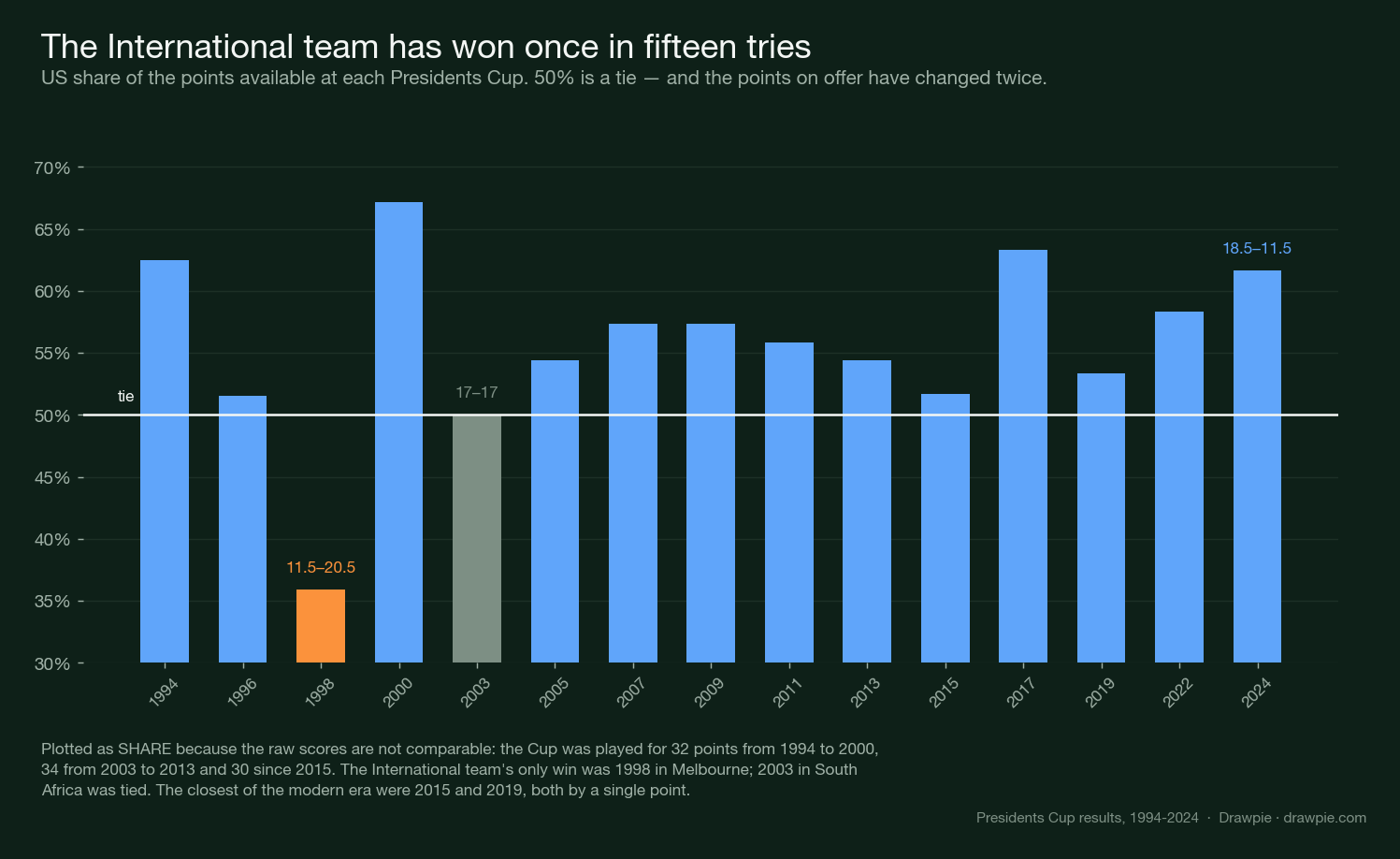
The United States leads 13–1–1. The International team has won exactly once — in 1998 at Royal Melbourne, and comprehensively, 20½–11½. The 2003 meeting in South Africa was tied 17–17.
A note on why this chart plots percentages. The points available have changed twice: 32 from 1994 to 2000, 34 from 2003 to 2013, and 30 since 2015. A 20–12 win in 1994 and an 18½–11½ win in 2024 look similar and are not the same margin. Share of points is the comparable measure.
The other thing the chart shows: it has been closer than the record suggests. 2015 and 2019 were both one-point matches. A 13–1–1 record contains several editions that came down to the last few holes.
How the Cup is actually won
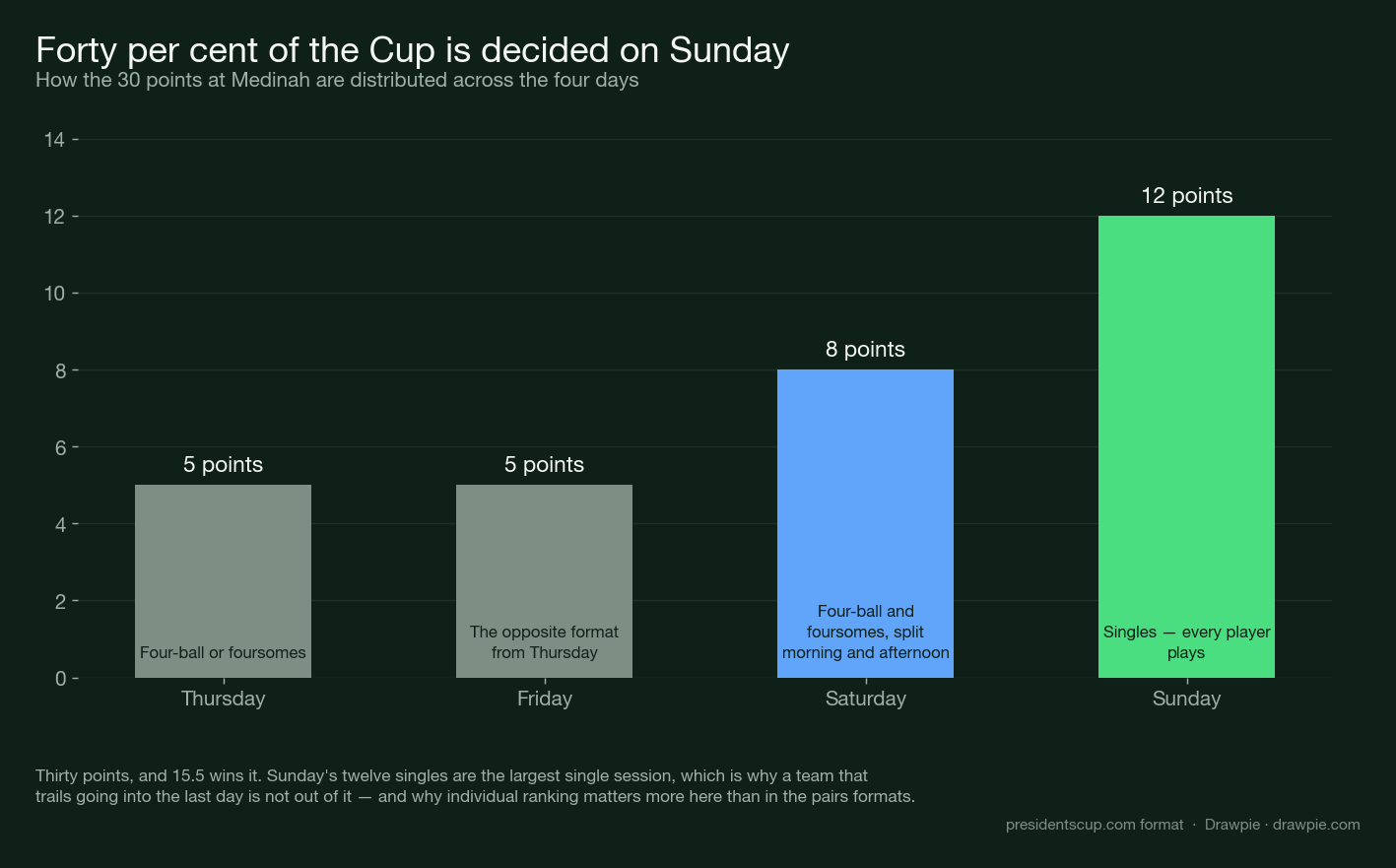
Thirty points, 15.5 to win.
| Day | Matches | Format |
|---|---|---|
| Thursday | 5 | Four-ball or foursomes |
| Friday | 5 | The opposite format |
| Saturday | 8 | Both, split morning and afternoon |
| Sunday | 12 | Singles — everybody plays |
Sunday’s singles are 40% of the whole event, and they are the session where the ranking gap matters most, because there is nowhere to hide a weaker player behind a partner. In the pairs formats a captain can shelter a rookie; in singles, all twelve go out alone.
That cuts both ways for the International team. It is the session where being outranked hurts most — and also the only realistic route back if they trail after three days.
Projected pairings
Nothing here is announced. Captains name pairings the evening before each session, so what follows is a projection built from rankings, nationality and past partnerships — not reporting.
United States — the likely anchors. Scheffler is the obvious spine of the team and captains have historically paired the world number one with a reliable ball-striker rather than another star. Scheffler and Henley is the pairing that most resembles recent American practice. Schauffele and Cantlay have played together repeatedly in team events and would be a surprise to split. Morikawa’s iron play makes him a natural foursomes partner, most plausibly with Young.
The interesting question is what Snedeker does with Koivun. A 21-year-old rookie is normally protected — one four-ball with a senior partner, then singles. Using him more than twice would be a genuine statement.
International — the pods pick themselves. Ogilvy has two Koreans in the top 30 in Si Woo Kim and Tom Kim, plus Sungjae Im; the Australians Min Woo Lee and Adam Scott are an obvious pairing with Scott as the senior partner; the Canadians Conners and Taylor have played together before and would be a natural foursomes pair.
Matsuyama and Hisatsune is the Japanese pairing that suggests itself, with Matsuyama by far the more experienced.
If Ogilvy has an edge to press, it is that his team has more natural pairings — established partnerships and shared languages — while Snedeker has more raw quality to distribute.
Who will win the 2026 Presidents Cup?
Our prediction: the United States, 18½–11½.
That is an opinion, and here is the reasoning rather than just the number.
The ranking gap is the widest of the modern era, the United States is at home, and 40% of the points come in the session where individual quality is hardest to disguise. The last four American home wins landed between 17½ and 19½ points. Applying that shape to a 30-point card puts the likely range at 17½–19½, and 18½ sits in the middle of it.
The case against, which is real. The one International win came in 1998 with a similar gap on paper, on their own continent. Two of the last five editions were decided by a single point, so the record overstates how comfortable this usually is. Match play over 18 holes is high-variance by design — the better player loses often enough that the format exists. And three weeks is long enough for form, injury and a hot week from anyone to change the picture.
There are no betting odds anywhere on this page, and there will not be. This is a reasoned call from public facts, and you should treat it as one person’s read.
When is the 2026 Presidents Cup?
24–27 September 2026, at Medinah Country Club in Medinah, Illinois, just outside Chicago.
Medinah becomes the only club in the world to have hosted a US Open, a PGA Championship, a Ryder Cup and a Presidents Cup. It hosted the 2012 Ryder Cup, remembered for Europe’s final-day comeback from 10–6 down — which is a useful thing to keep in mind before assuming any lead here is safe.
Has the International team ever won the Presidents Cup?
Once, in 1998 at Royal Melbourne, by 20½–11½.
They also tied in 2003 at Fancourt in South Africa, 17–17, after a playoff between Tiger Woods and Ernie Els was halted for darkness and the captains agreed to share the Cup. Those are the only two editions in fifteen that the United States has not won.
Who are the rookies at the 2026 Presidents Cup?
Three on each side, all of them captain’s picks.
For the United States: Chris Gotterup, Jacob Bridgeman and Jackson Koivun. For the International team: Nico Echavarría, Ryo Hisatsune and Nick Taylor. Koivun, 21 and ranked 66th, is the youngest and the most debated — the only American on either roster outside the world’s top 50.
The bottom line
The United States arrives at Medinah with seven of the world’s top ten. The International team arrives with one player in the top twenty.
That gap is the largest in the modern history of the event, and it points one way. What stops it being a formality is the format: eighteen-hole match play is the most forgiving structure in golf for the weaker side, Sunday’s twelve singles can swing four or five points in an afternoon, and two of the last five Presidents Cups came down to a single point.
Our call is a United States win, 18½–11½. The reasoning is above; the case against it is above too.