Plug-In Solar UK 2026: What It Costs, What the Rules Allow, Where to Buy
Every savings figure on this page is calculated by DESNZ at Ofgem’s price cap unit rate for 1 July to 30 September 2026. Ofgem has already published the cap for 1 October to 31 December 2026, so from 1 October the £110 and £70 figures — and the payback arithmetic built on them — are one cap period behind and need recalculating. The rules, the limits and the register do not move on that date.
Everything else on the page is unaffected; the figures below still say when they were read.

- Plug-in solar became legal in the UK on 27 August 2026. Two statutory instruments did it: SI 2026/848 amends the plug and electricity-supply safety regulations, and SI 2026/896 changes permitted development in England. Both were made in July and both came into force on the same day.
- The headline saving of ‘up to £110 a year’ is DESNZ’s figure for a panel at 30 degrees facing south — a roof or a garden frame. Its own table puts a vertical, east or west facing balcony railing at about £70.
- A compliant kit may send no more than 800 VA to the socket, however much panel is attached, and may not be connected to a battery. One inverter per household circuit. Telling your network operator is mandatory, both when you connect it and when you remove it.
- 24 devices from 11 manufacturers were already listed on the Energy Networks Association register on day one, including Octopus Energy, EcoFlow, Anker and FoxESS. That register — not a retailer’s description — is where you check a product is actually approved.
For years the answer to “can I just plug a solar panel into a socket in Britain?” was no — and not as a matter of taste. A standard 13A plug could not lawfully be used to connect a generating device to a socket-outlet, because BS 1363 prohibits exactly that, and a product that cannot have a legal plug fitted cannot be legally sold.
That changed on 27 August 2026.
Two pieces of legislation came into force that day. One rewrote the plug rules and the electricity supply rules to create a route for these products. The other changed what you are allowed to bolt to a building in England without applying for planning permission. Neither is a press release; both are on the statute book, and both were made in July with the same commencement date.
What follows is what the rules actually say, what the government’s own analysis says you will save, and where the approved products are.
Is plug-in solar legal in the UK now?
Yes, from 27 August 2026. Before that date these devices could not be sold or used lawfully anywhere in the UK.
The instrument that did it is SI 2026/848, made on 16 July 2026, which amends the Plugs and Sockets etc. (Safety) Regulations 1994 and the Electricity Safety, Quality and Continuity Regulations 2002. It creates a way for a notified body to approve a standard plug intended for use with a “plug-in microgenerator” — a plug that would otherwise fail BS 1363 solely because of the prohibition on connecting generating equipment.
Alongside it, SI 2026/896, made on 29 July 2026, amends permitted development rights so that mounting the panels does not automatically require a planning application in England.
There is no transitional period and no grace window in the product-safety instrument. A device either complies with the specification or it must not be installed or operated.
What do the rules actually allow?
No more than 800 VA may reach the socket, whatever is attached to the other end. That single limit explains most of what a compliant kit looks like.
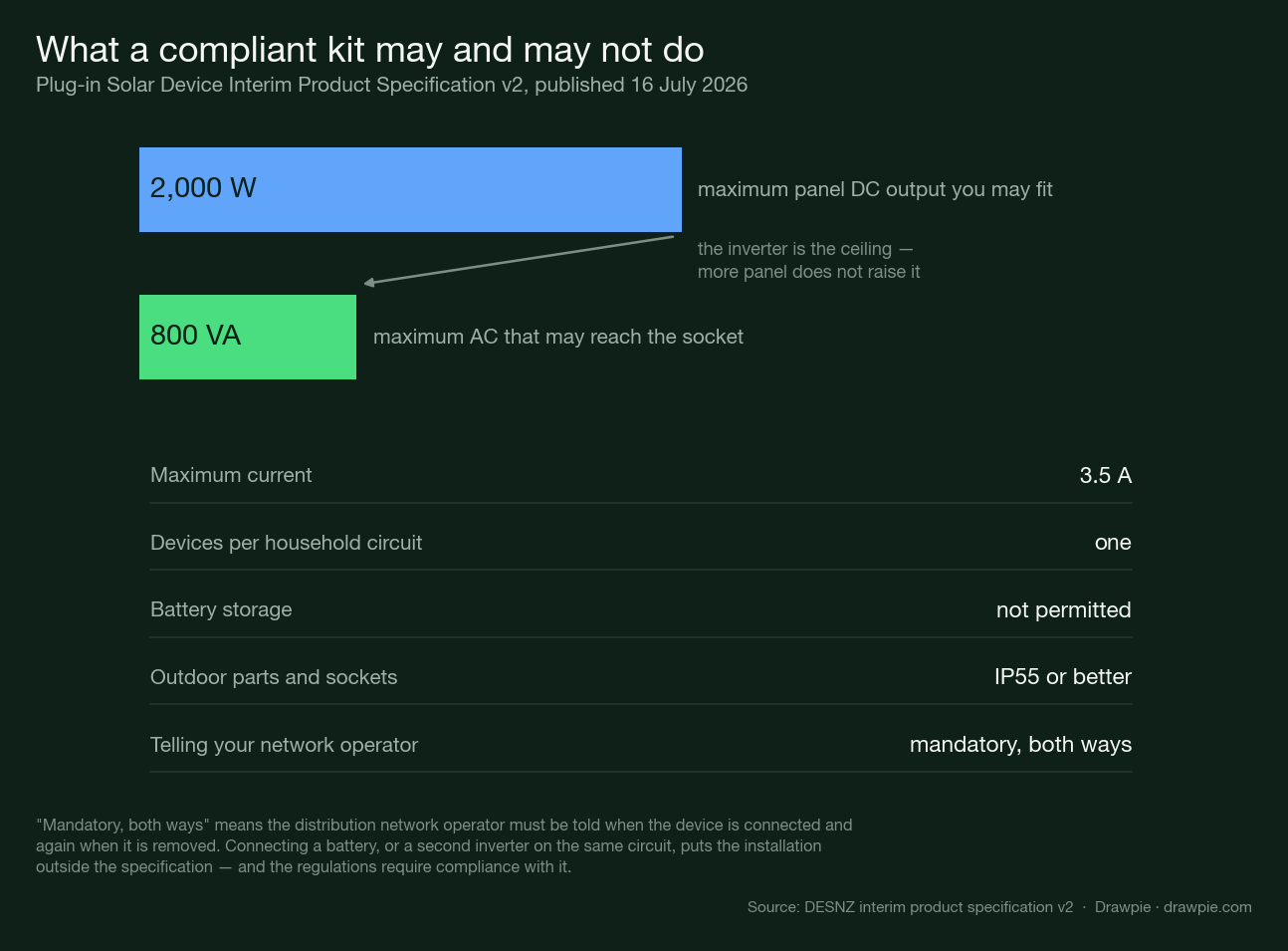
The gap between those two numbers is deliberate and it is why you will see kits sold with more panel than inverter — Octopus, for instance, sells a two-panel bundle totalling 920W of panel behind an 800W inverter. Panels rarely hit their rated output in British light, so oversizing the DC side is how you get closer to the ceiling more often. It does not raise the ceiling.
The other limits from the specification, which is version 2, published on 16 July 2026:
| Limit | Value |
|---|---|
| Maximum AC to the socket | 800 VA |
| Maximum current | 3.5 A |
| Maximum panel DC output | 2,000 W |
| Devices per household circuit | one |
| Battery storage | not permitted |
| Outdoor parts, plugs and sockets | IP55 or better |
The battery exclusion is the one most likely to catch people out, because the European products this market is modelled on very often include storage. The specification lists plug-in battery systems and “plug-in solar PV devices integrated with battery systems” as outside its scope, and requires the instructions to carry a prominent warning that the device is not to be used with a battery energy storage system. A kit that includes a battery is not a compliant plug-in solar device under these rules.
There is also an anti-islanding requirement: on disconnection, dangerous voltages must be gone from the plug contacts within two seconds, so that pulling the plug out mid-generation does not leave live pins.
Do the rules apply the same everywhere in the UK?
No, and this is the part that headlines flatten. Three different geographies are involved.
| What | Where it applies |
|---|---|
| Plug approval route (SI 2026/848, regs 1–2) | England and Wales, Scotland, Northern Ireland |
| Duty to comply before installing or operating (reg 3) | England and Wales, Scotland |
| Permitted development changes (SI 2026/896) | England only |
| G98 network notification | Great Britain only |
In practice: the product route is UK-wide, so compliant kits can be sold anywhere. The operating requirement and the network notification framework are Great Britain. And the planning easement is England alone — Scotland, Wales and Northern Ireland run their own permitted development regimes, so if you are outside England the planning question has not been answered by this change and needs checking locally.
Do I need to tell anyone before plugging one in?
Yes. Telling your distribution network operator is mandatory, and so is telling them when you take it out again.
The product specification requires every compliant device to carry a statement that notification to the DNO about connection and disconnection is mandatory, along with a link to instructions. This is not the same thing as asking permission — G98 is a notify-and-connect framework for small generators — but it is not optional either, and the two-way part is easy to miss.
Approval also has a product-side step you can check yourself. Manufacturers must have their devices type-tested and registered on the Energy Networks Association’s register before the product goes on sale. If a device is not on that register, it has not completed the process, whatever the listing says.
On planning, in England the permitted development changes do not cover everything:
- Listed buildings — solar installation is not permitted under these rights.
- Scheduled monuments — not permitted.
- Conservation areas — installations on front-facing walls, balconies or roof enclosures are excluded.
- Timber cladding — plug-in solar is restricted on timber-clad exterior surfaces, and for blocks of flats it cannot go on wooden walls, balconies or timber-clad components.
And permitted development is a planning concept, not a property one. If you rent, or live in a flat, or hold a leasehold, the freeholder or landlord’s permission is a separate question that the legislation does not touch.
How much will it actually save me?
About £110 a year if the panel is on a roof or a tilted garden frame facing south — and about £70 if it is upright on a balcony railing. Both numbers are DESNZ’s, from the same table.
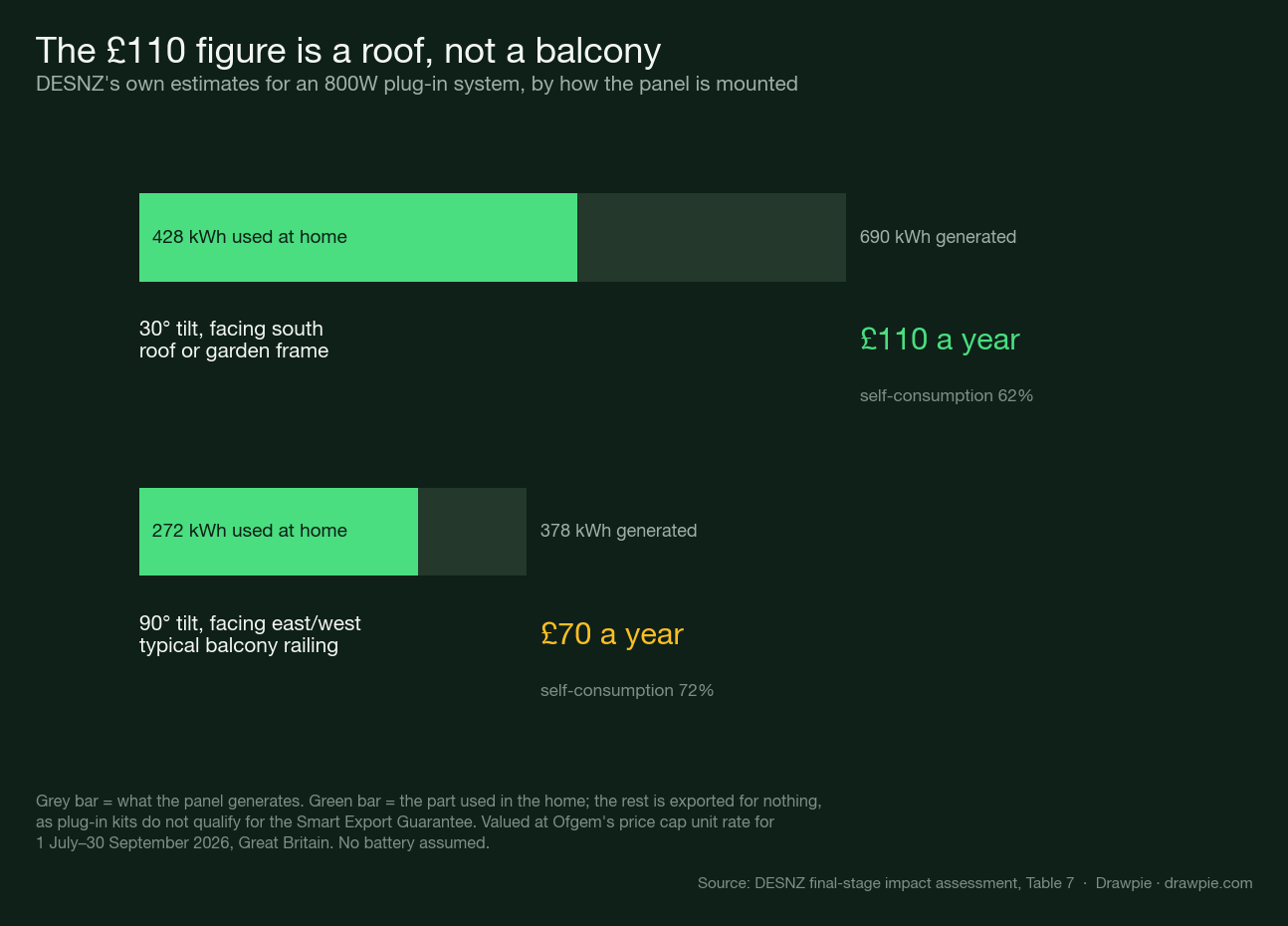
The government’s announcement quotes the first figure. This article is about the second kind of installation, so it is worth being plain about which is which.
Notice the counter-intuitive part. The balcony scenario has the better self-consumption rate — 72% against 62% — because a vertical east/west panel spreads its output across the morning and evening, when a household is more likely to be using power. It still saves less, because it generates barely half as much in the first place.
Three assumptions sit underneath both numbers, and all three can move a household a long way from them:
- Exported electricity is worth nothing. The Smart Export Guarantee requires half-hourly export metering and MCS-certified installation; DESNZ says this is likely not to apply to many plug-in installations. Everything not used as it is generated is given away.
- Someone is home in the daytime. The modelling follows the MCS definition of a property “generally occupied by at least one occupant between 9:00am to 5:00pm on weekdays”. An empty house on weekdays exports far more of what it makes, and saves less.
- Electricity costs what it costs today. The values use Ofgem’s price cap unit rate for 1 July to 30 September 2026, in Great Britain. Northern Ireland may differ, and the cap moves quarterly.
How long does it take to pay for itself?
Between about three and a half and nine years, and the mounting decides where in that range you land.
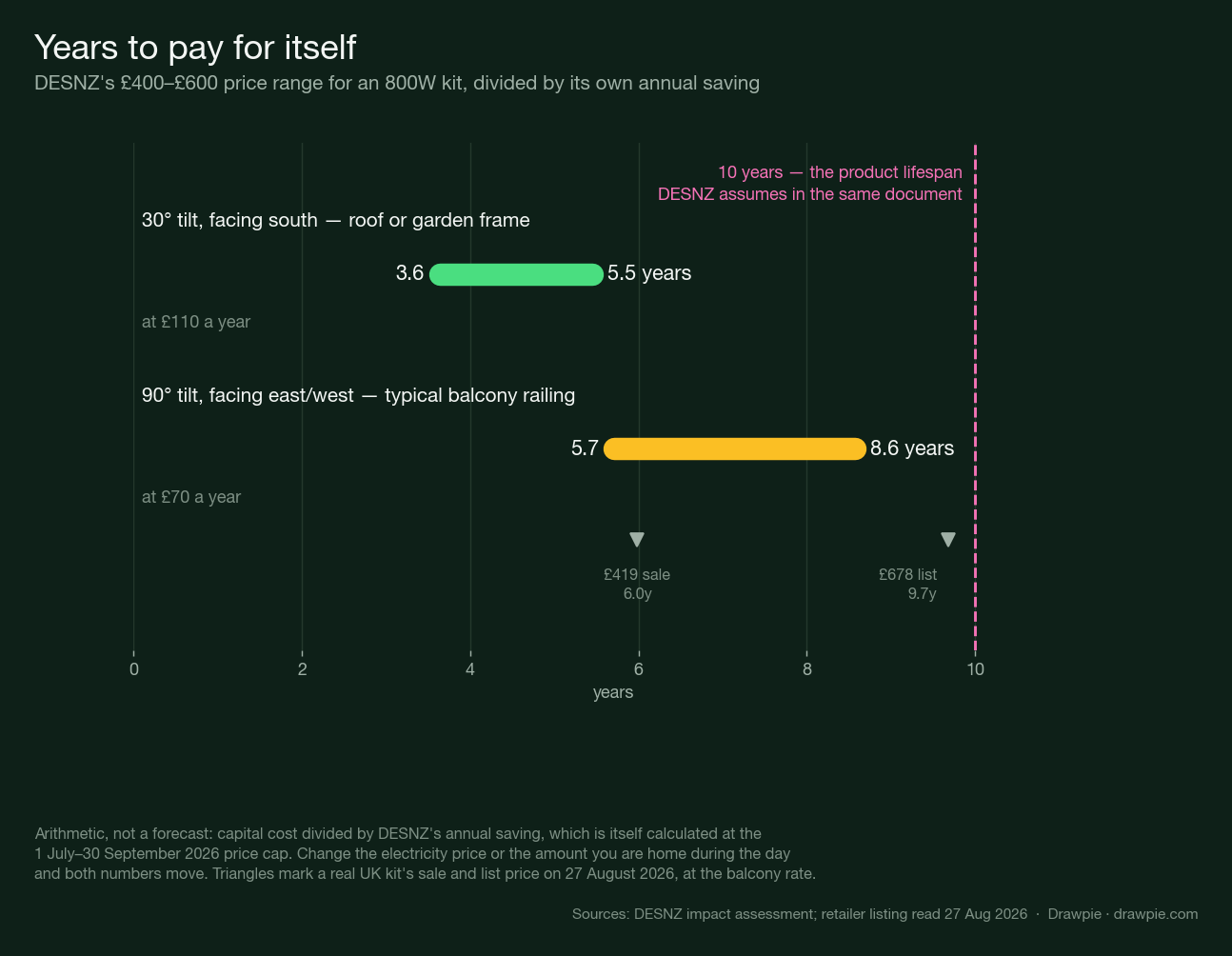
The 10-year line matters. DESNZ’s own modelling assumes a 10-year initial product lifespan, so a balcony installation bought at the top of the price range is recovering its cost across most of the life the department expects it to have. Bought on offer, on a south-facing frame, it is a very different proposition.
This is arithmetic, not a promise. It divides one DESNZ number by another, and both rest on the electricity price holding still — which the department itself flags will not be true indefinitely.
Where can I buy one, and what does it cost?
Start with the register rather than the retailer. The Energy Networks Association’s type test register listed 24 plug-in solar devices from 11 manufacturers on 27 August 2026.
| Manufacturer | Devices listed |
|---|---|
| UKSOL | 7 |
| Perlight Solar | 4 |
| FoxESS | 3 |
| InstaGroup | 2 |
| TSUNESS | 2 |
| Anker Innovations | 1 |
| EcoFlow | 1 |
| Octopus Energy | 1 |
| City Plumbing Supplies | 1 |
| Modular Solar Technologies | 1 |
| Segen | 1 |
On price, the government’s own working assumption in the impact assessment is £400 to £600 for an 800W system, excluding installation — roughly £500 to £750 per kW.
Two real listings on the day the rules changed, for comparison:
- EcoFlow STREAM 800W Microinverter Kit — £419 on a bank holiday sale against a £678 list price, tax included. The sale price sits inside the government’s range; the list price sits above it.
- Octopus Energy sells a single-panel bundle (one 460W panel) and a two-panel bundle (920W of panel), each with microinverter, three-pin plug cable and mounting kit. Prices appear only after you enter a postcode, and delivery was estimated for the end of September 2026.
That last detail is worth carrying: being legal from 27 August and being deliverable on 27 August are not the same thing.
What should I check before buying?
Six things, in this order.
- Is the exact model on the ENA register? Not the brand — the model. Registration is a condition of being placed on the market.
- Does it have a battery? If yes, it is outside the specification and outside these rules.
- Is the inverter rated at 800 VA or below? Panel wattage above that is fine and expected; AC output above it is not.
- Are the outdoor parts IP55 or better, including the socket if the plug lives outside?
- Where will it actually point? A vertical railing facing east or west is the £70 case, not the £110 one. If you have a south-facing wall, a tilted frame, or a shed roof, the same kit is worth substantially more.
- Can you notify your network operator, and do you know you must do it again when the kit comes down?
One more, which comes from the specification rather than any retailer: older RCBO-type circuit protection can be desensitised by devices that leak DC current into an AC circuit, and plug-in solar is on that list alongside EV chargers and IT equipment. The specification’s advice is to press the test button on the RCBO periodically while the panel is generating; if it does not trip immediately, that is a conversation with a qualified electrician about replacing it.
How we verified this
🔴 The commencement date comes from the legislation, not the press release. SI 2026/848, which amends the Plugs and Sockets etc. (Safety) Regulations 1994 and the Electricity Safety, Quality and Continuity Regulations 2002, was made on 16 July 2026 and comes into force on 27 August 2026. SI 2026/896, the permitted development order, was made on 29 July 2026 and comes into force on the same day. Both were read on legislation.gov.uk.
🔴 The territorial split is real and this page states all three parts. Regulations 1 and 2 of SI 2026/848 extend to England and Wales, Scotland and Northern Ireland. Regulation 3 — the one requiring compliance with the product specification in order to install or operate — extends to England and Wales and Scotland only. SI 2026/896 is England only. And the interim product specification’s own footnote states that Engineering Recommendation G98 applies to Great Britain only. Anyone in Northern Ireland is in a different position on two of those three counts.
⚠️ There are two interim product specifications on gov.uk and one of them is withdrawn. Everything here is read from version 2, published 16 July 2026, which is the version the regulations name. The withdrawn version is still downloadable from the same page and has a different page count; both were fetched to confirm they differ.
✅ The savings gap is DESNZ’s own table, not a recalculation. Table 7 of the final-stage impact assessment gives two mounting scenarios: 30° tilt facing south, 62% self-consumption, 428 kWh used on site, about £110; and 90° tilt facing east/west, 72% self-consumption, 272 kWh, about £70. The press release quotes only the first. This page quotes both and says which is which.
⚠️ The payback figures are arithmetic under stated assumptions, not a projection. Capital cost is DESNZ’s own £400–£600 range for an 800W system, divided by its own annual saving. Both inputs move if electricity prices change or if the household is not home during the day, and the department says so itself: its estimates “will not provide an accurate picture of longer-term savings if tariff arrangements and energy prices change in future”.
🔴 Exported electricity is valued at nothing here, because that is how DESNZ values it. The Smart Export Guarantee needs half-hourly export metering and MCS-certified installation, and the impact assessment says this is “likely not to apply in the first instance for many plug-in solar installers”. Any saving that depends on being paid for surplus is not in these numbers.
✅ The device count was read from the register itself. The Energy Networks Association’s type test register listed 24 plug-in solar devices from 11 manufacturers when it was queried on 27 August 2026. An earlier attempt to read it with a plain HTTP request returned an identical page for a real filter and an invented one, so the figure comes from the rendered register rather than that request.
⚠️ One retail price on this page is a promotion. The £419 quoted for the EcoFlow STREAM 800W Microinverter Kit was a bank holiday sale price against a £678 list price, read on 27 August 2026. Both are given, because only one of them will still be there next month.