Perseid Meteor Shower 2026: Where to Watch and Where to Stay
Update log (1)
- — Written the day before the peak. The rate forecasts, the dark-sky designations and the Kielder Observatory availability are all as they stood on 11 August 2026; ticket availability in particular can only get worse from here.

- The Perseids peak overnight on 12-13 August 2026, under a new moon — the same new moon that produces the total solar eclipse on the 12th. There is no moonlight to fight this year.
- Expect tens, not hundreds. The American Meteor Society forecasts nearly 40 an hour by 3 a.m. at a dark site, and says plainly that this is ‘considerably lower than many published predictions’. The Royal Observatory Greenwich says 150. Both are respected; they are nearly four times apart.
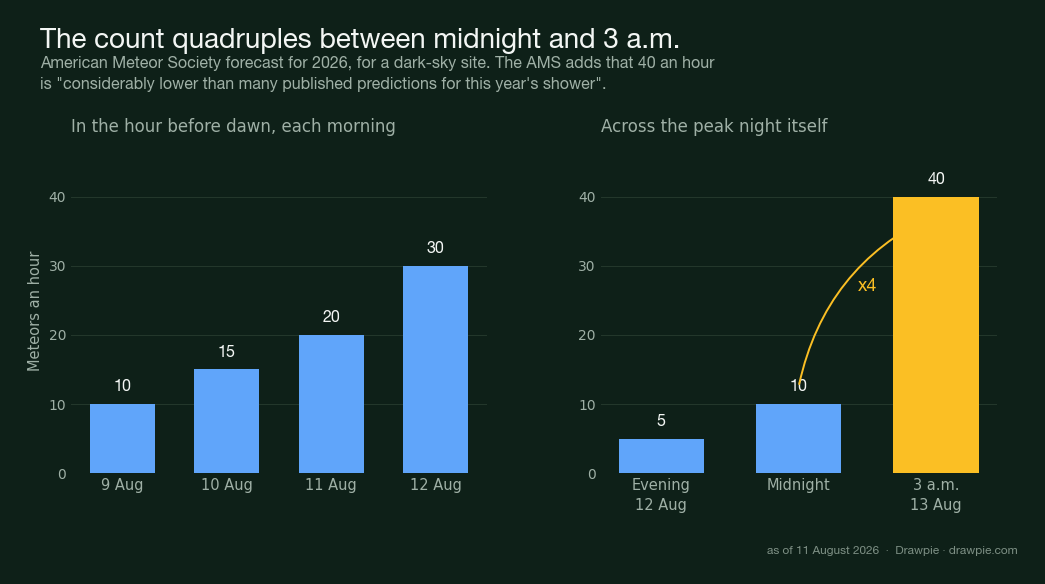
- The hour matters more than the night. On the AMS numbers the rate goes from 5 an hour in the evening to 10 at midnight to about 40 by 3 a.m. — four times as many for staying up three more hours.
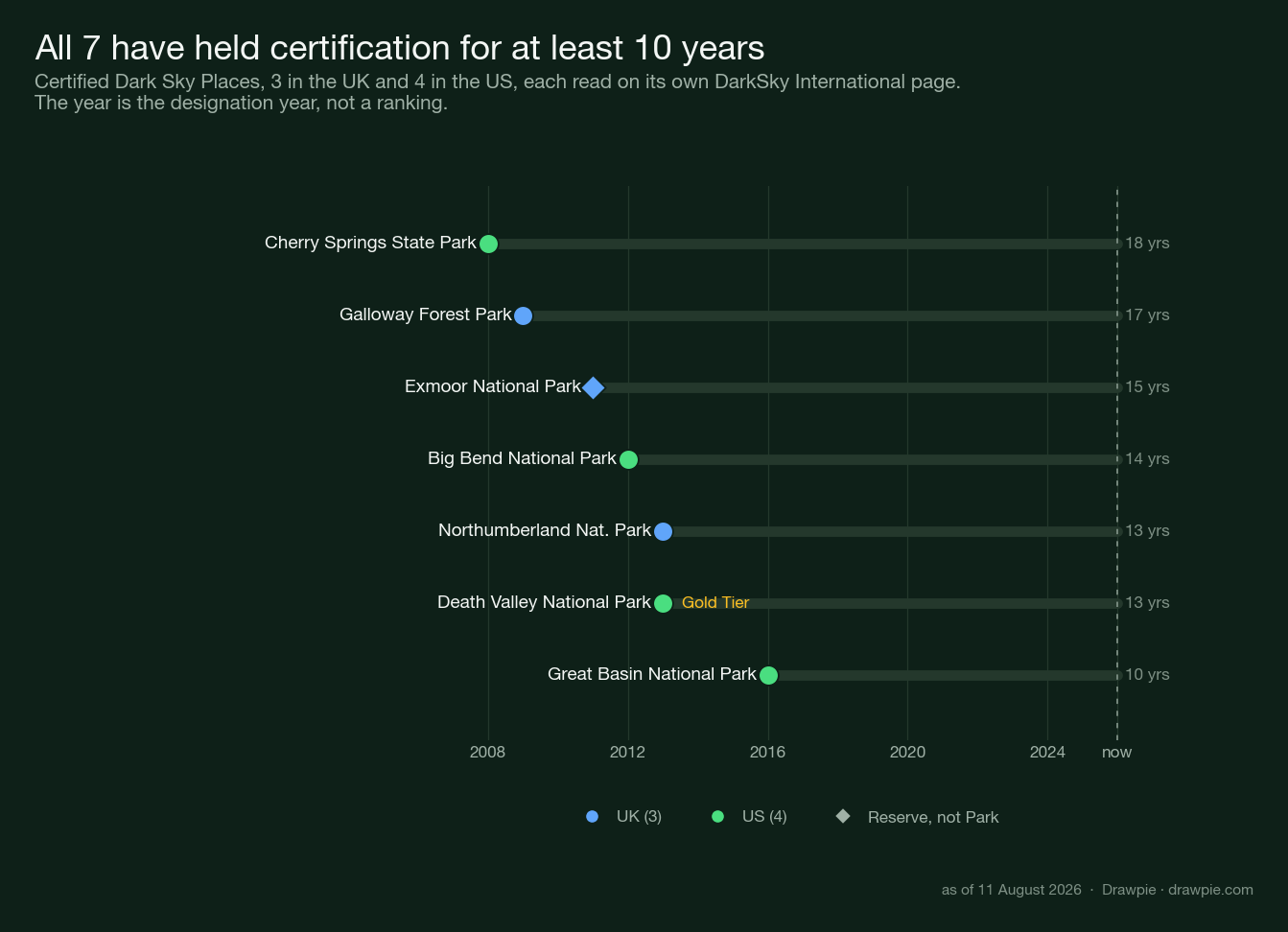
- Seven Dark Sky Places checked on DarkSky International’s own pages, three in the UK and four in the US, every one certified for at least a decade. Death Valley is Gold Tier.
- If you wanted the organised version, you are late. Every Kielder Observatory event on the peak nights was sold out when we checked on 11 August, at £39 a ticket.
The Perseids peak overnight on 12-13 August 2026, and this year there is no moon in the way. The peak falls on a new moon — the same new moon that produces the total solar eclipse on 12 August .
The catch is that a dark sky and a busy sky are different things, and the two most quoted forecasts for this year disagree by nearly four times.
How many Perseids will you actually see?
Tens an hour, not hundreds — and the two organisations most likely to be quoted at you do not agree.
The American Meteor Society’s own 2026 forecast builds to nearly 40 an hour by 3 a.m. at a dark-sky site. It then adds a sentence almost nobody repeats: “A peak rate of 40 Perseids per hour is considerably lower than many published predictions for this year’s shower.”
The Royal Observatory Greenwich, on its own Perseids page, gives 150 an hour at maximum.
Both are serious institutions. We are not in a position to referee them, so here is what we can say usefully: the AMS number is the conservative one, it is explicitly framed as a dark-site figure, and it comes with a warning about the higher numbers circulating. If you plan for tens and get more, that is a good evening. If you plan for 150 you will probably be disappointed, whatever the sky does.
| When | Meteors an hour |
|---|---|
| Morning of 9 Aug | 10 |
| Morning of 10 Aug | 15 |
| Morning of 11 Aug | 20 |
| Morning of 12 Aug | 30 |
| Evening of 12 Aug | 5 |
| Midnight | 10 |
| 3 a.m. on 13 Aug | 40 |
The shape of that table is the practical advice. The hour matters more than the night. Going out at ten in the evening on the peak night puts you on the 5-to-10 rows; staying until three in the morning puts you on the 40 row. Four times the meteors for three more hours of cold.
When exactly do the Perseids peak in 2026?
Overnight on 12-13 August, with the best window from midnight to dawn.
The Royal Observatory Greenwich puts the useful window at midnight to 5.30 a.m., and notes that in the UK the radiant — the point in Perseus the meteors appear to stream from — stays above the horizon all night, so you can see some as soon as it is properly dark.
Two things follow from that. You do not need to find Perseus: meteors appear all over the sky and looking straight at the radiant actually gives you the shortest trails. And you do not need equipment. The Royal Observatory is explicit that binoculars and telescopes make things worse, because they cut down how much sky you can see at once. Give your eyes at least 15 minutes to adjust, and keep them adjusted by not looking at your phone.
Where are the best places to watch in the UK and the US?
Somewhere certified dark, if you can reach one. Seven of them, checked on DarkSky International’s own pages:
| Place | Category | Since |
|---|---|---|
| Cherry Springs, PA | Park | 2008 |
| Galloway Forest, Scotland | Park | 2009 |
| Exmoor, England | Reserve | 2011 |
| Big Bend, Texas | Park | 2012 |
| Northumberland, England | Park | 2013 |
| Death Valley, California | Park | 2013 |
| Great Basin, Nevada | Park | 2016 |
Death Valley carries DarkSky’s Gold Tier rating, the top grade. Exmoor is a Reserve rather than a Park, which is a difference in how the protected area is structured rather than a difference in darkness. Every one of the seven has held its certification for at least ten years, which is a reasonable proxy for the lighting controls actually being enforced.
That list is a checked selection, not a ranking and not the full register — DarkSky certifies many more places than this in both countries, and the list changes.
If you cannot reach one, the certification matters less than you think for this particular event. Perseids are bright. A field twenty minutes outside town with a clear horizon and no security light in your eye will show you most of what a certified reserve does. What ruins a meteor night is a nearby white light, not the glow of a city thirty miles away.
Where can you stay near a dark-sky site?
If you are reading this on 11 August and wanted the organised version, it has gone.
We checked Kielder Observatory, which sits inside the Northumberland dark sky park and runs the best-known Perseid events in Britain. Its own August 2026 calendar on the morning of 11 August:
| Event | When | Price | Status |
|---|---|---|---|
| Discovering New Worlds | Tue 11 Aug | £39 | Sold out |
| Space Kids | Wed 12 Aug | £25 | Sold out |
| Shooting Star Spectacular | Wed 12 Aug | £39 | Sold out |
| Shooting Star Spectacular | Thu 13 Aug | £39 | Sold out |
| Dark Sky Discovery | Fri 14 Aug | £59 | Sold out |
Both Shooting Star Spectacular nights carry “no future dates available” alongside the sold-out label. That is the honest state of organised Perseid viewing in the UK’s flagship dark sky park, one day out.
So the realistic options are the unglamorous ones:
- Drive out and drive back. The peak window ends at dawn, and most dark-sky sites are within a couple of hours of somewhere you can already sleep. This is what most people do and it is fine.
- Check what the site actually asks of you at night. This is the step people skip. Cherry Springs, the best-documented example, requires you to register and acquire a permit before using its Overnight Astronomy Observation Field, recommends a red filter or cover on your torch to protect everyone’s night vision, asks that campfires be kept as small as possible, and tells you that after dark you keep your headlights on and follow the one-way signs so the beams point away from the field. None of that is onerous; all of it is the difference between being welcome and being the person who ruined the field’s dark adaptation.
- Book anything at all, further out. Accommodation inside a dark-sky park a day before the Perseid peak in a new-moon year is not a realistic search. Accommodation an hour away, and an alarm, is.
The thing not to do is drive somewhere you have not checked and find a locked gate at half past midnight.
Does the solar eclipse change anything?
Only if you are travelling for it — and if you are, you have a rare double.
The total solar eclipse on 12 August 2026 and the Perseid peak fall on the same date, for the same reason: an eclipse only happens at new moon, and a new moon is exactly what makes a meteor shower good. The eclipse crosses Greenland, Iceland and Spain; we have covered the path, the timings and where to stand separately.
If you are already in northern Spain or Iceland for the eclipse, you are also in reasonable shape for the meteors that night. If you are not, the eclipse has no bearing on your Perseids at all — it is a daytime event on the other side of the world from most readers, and it does not affect the sky above you that night. The Moon has one more appointment this month either way: the UK’s only lunar eclipse of 2026 comes before dawn on Friday 28 August .
What this does not tell you
Whether it will be clear where you are, which is the only thing that really decides the night.
We have not forecast the weather, and neither should anyone else at this range. Cloud decides meteor nights more than any of the numbers above, and the only forecast worth having is the one you check a few hours before you leave.
We have not counted anything ourselves. Every rate here is a published forecast, and the gap between the two we quote is the honest state of the information, not something we can resolve.
We have not checked accommodation availability anywhere except Kielder. The sold-out picture there is a strong hint about the rest, but it is a hint rather than a survey.
And the list of dark-sky places is a selection we verified, not the full register. If you live near a certified site that is not in the table, that is a limit of this article rather than a comment on the site.
Sources
Checked on 11 August 2026, the day before the peak.
| Source | What it supports here |
|---|---|
| American Meteor Society — viewing the Perseids in 2026 | Every rate in the table and the chart, that they describe dark-sky sites, and the quoted sentence that 40 an hour is considerably lower than many published predictions |
| Royal Observatory Greenwich — Perseids guide | The 150 an hour figure, the midnight to 5.30 a.m. window, the radiant staying above the UK horizon, the 15-minute dark adaptation and the advice against binoculars and telescopes |
| DarkSky International — Exmoor | Exmoor as a Dark Sky Reserve, designated 2011 |
| DarkSky International — Galloway Forest Park | Galloway as a Dark Sky Park, designated 2009 |
| DarkSky International — Northumberland | Northumberland as a Dark Sky Park, designated 2013 |
| DarkSky International — Death Valley | Death Valley as a Gold Tier Dark Sky Park, designated 2013 |
| DarkSky International — Cherry Springs | Cherry Springs as a Dark Sky Park, designated 2008 |
| DarkSky International — Big Bend | Big Bend as a Dark Sky Park, designated 2012 |
| DarkSky International — Great Basin | Great Basin as a Dark Sky Park, designated 2016 |
| Kielder Observatory — events | The August 2026 calendar, the £39, £25 and £59 prices and the sold-out status on the peak nights |
| Pennsylvania DCNR — stargazing at Cherry Springs | The permit and registration requirement for the overnight field, the recommended red filter, the small-campfire request and the after-dark headlight guidance |
Where a URL could be checked from the command line it was requested alongside a deliberately wrong path on the same domain, so a site that answers everything with “200” could not pass as verified. The DarkSky and Kielder pages were additionally read in a browser, which is how the stale 2017 Kielder event page was caught and discarded.
How we verified this
The two rate forecasts were read on the organisations’ own pages, and they disagree. The American Meteor Society’s 2026 Perseids article gives 10, 15, 20 and 30 meteors an hour on the mornings of 9 to 12 August, then 5 on the evening of the 12th, 10 by midnight and “nearly 40 per hour by 3:00 a.m. local daylight time” — followed by the sentence “A peak rate of 40 Perseids per hour is considerably lower than many published predictions for this year’s shower.” The Royal Observatory Greenwich page gives 150 an hour at maximum. We have printed both and named both rather than picking the flattering one.
All the AMS rates are for a dark-sky site. Its own wording for the first figure is “as seen from dark sky sites”. A suburban garden is not the same measurement, which is the whole reason the location section exists.
Every dark-sky designation was read on that place’s own page at darksky.org, not from a listicle and not from DarkSky’s own 2016 round-up article, which is a decade old and still uses superseded names. The category and the designation year in the chart and the table come from those individual pages.
The Kielder Observatory availability is a first-hand reading with a trap avoided. A search result led to a Kielder event page marked “Sold out” — for 12 August 2017. We ignored that and read the observatory’s live August 2026 calendar instead, which is where the £39 price and the sold-out status for the 11th to the 14th come from.
The Cherry Springs rules are quoted at the strength the park states them. Its stargazing page requires a permit for the overnight field but recommends rather than mandates a red filter, and asks for small campfires rather than banning them. A first draft here repeated a stricter version picked up from summaries of other pages; we cut it back to what the page we cite actually says.
We have not forecast the weather and we have not counted anything ourselves. No cloud forecast appears here, because a useful one does not exist several days out and would be wrong by the time you read this.