Ken Paxton 2026 Texas Senate Campaign: Polls, Predictions and the Race vs James Talarico
Update log (2)
- — Updated 2 September 2026. Two polls have been fielded since the last update: University of Texas/Texas Politics Project on 5–13 August (Talarico 42, Paxton 39) and Texas Public Opinion Research (D) on 21–24 August (Talarico 48, Paxton 42), the largest lead recorded in this race. Emerson's 9–10 August Paxton lead has not been repeated. The seven polling averages, updated 27 August, now run from Talarico +1.9 to +4.4, averaging 2.7. Cook Political Report moved Texas from Lean Republican to Toss-up on 20 August and Sabato's Crystal Ball followed on 26 August; Inside Elections remains at Lean Republican.
- — Polling in this article was read on 14 August 2026 and runs to fields closing on 10 August. The newest poll, Emerson College on 9–10 August, is the first since 21 June to put Paxton ahead. The seven polling averages, updated 13 August, all still had Talarico in front.

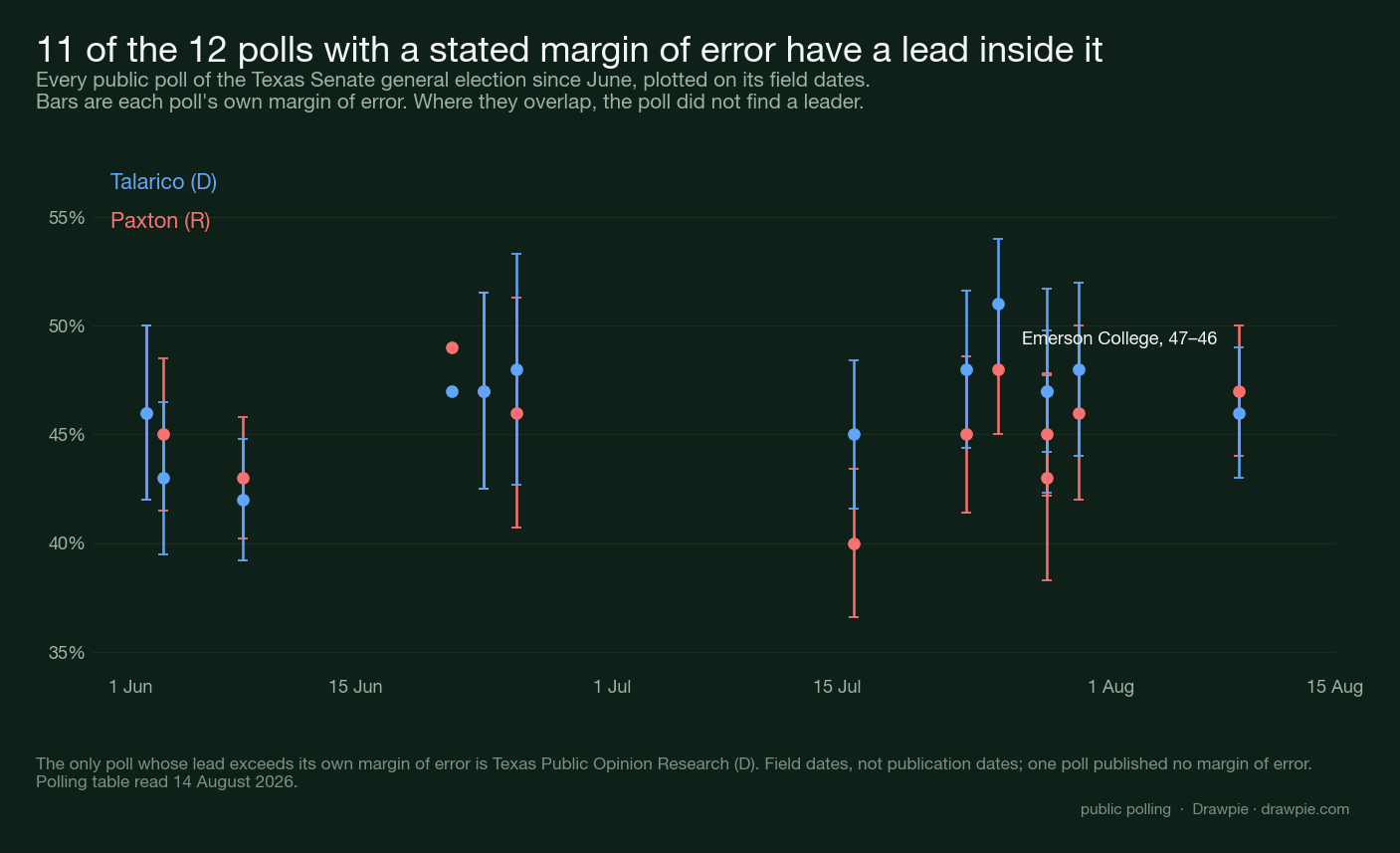
- Texas is a statistical tie. Thirteen public polls since 1 June give Talarico a lead in seven, Paxton in four, and two are ties — and the biggest lead either way is five points. Eleven of the twelve polls that publish a margin of error have a lead smaller than it.
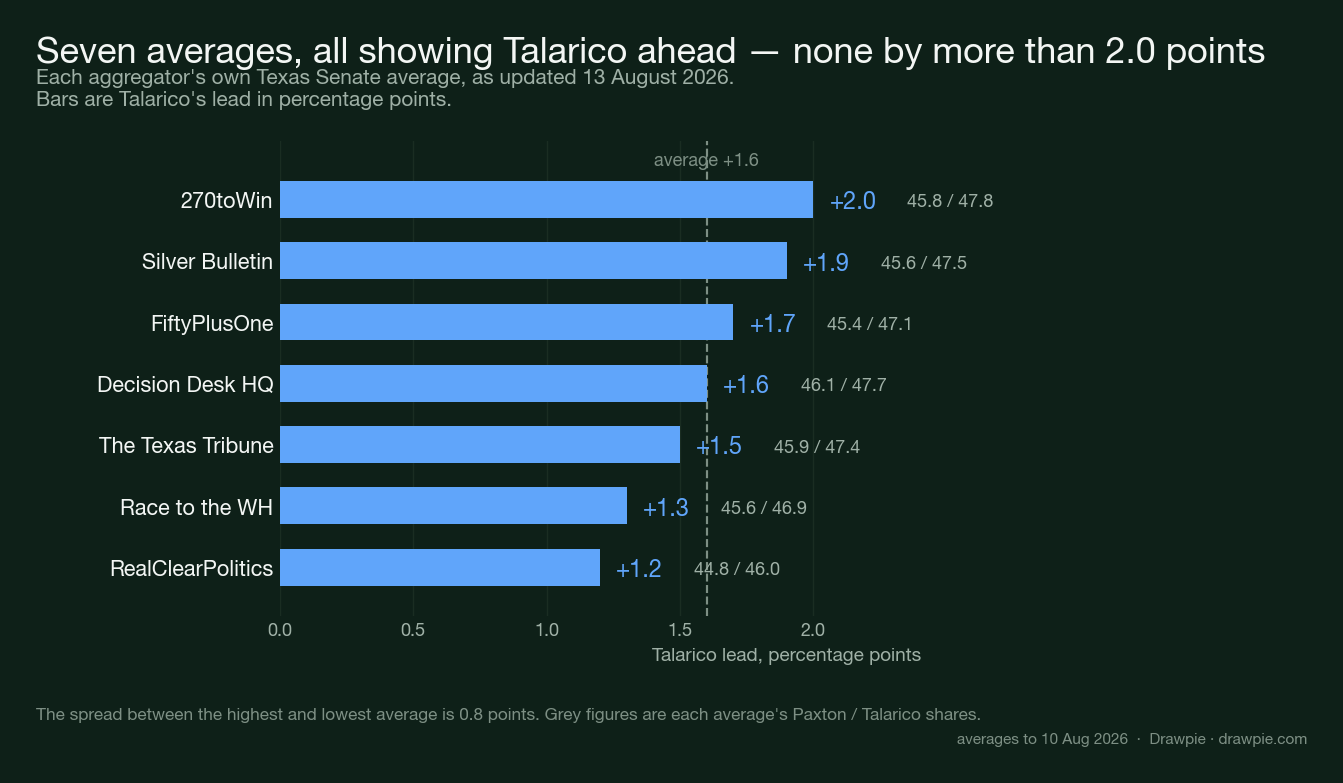
- The averages have widened, and the newest polls agree with them. All seven aggregators still had Talarico ahead in late August, now by between 1.9 and 4.4 points, averaging 2.7 — up from about 1.6 in mid-August. Emerson’s one-point Paxton lead on 9–10 August has not been repeated in the two polls fielded since.
- Paxton did not win the Republican runoff by adding voters. He gained 9,632 votes between the March primary and the May runoff; Cornyn lost 406,944. Turnout fell 35.8%, and Paxton’s share went from 40.5% to 63.8% on an electorate a third smaller.
- The raters have started following the polls. Cook Political Report moved Texas from Lean Republican to Toss-up on 20 August and Sabato’s Crystal Ball followed on 26 August; Inside Elections is the last of the three still at Lean Republican, having moved there from Likely Republican on 6 August.
The 2026 Texas Senate race is a statistical tie, and it has been one all summer. Thirteen public polls since 1 June put James Talarico ahead in seven of them, Ken Paxton in four, with two ties — and not one of those leads is large enough for the poll that found it to call a leader.
The general election is on 3 November 2026. Below is every poll with its field dates and margin of error, what the seven averages say, and the runoff arithmetic that explains how Paxton got here.
Who is running in the 2026 Texas Senate race?
Ken Paxton for the Republicans and James Talarico for the Democrats, in a seat with no incumbent on the ballot. John Cornyn, the sitting senator, lost his own primary. A third name will be on the ballot: Ted Brown, nominated by the Libertarian Party at its Abilene convention in April, who draws 1–3% in the polls that offer him.
Talarico won the Democratic nomination outright on 3 March 2026 with 52.4% against Jasmine Crockett’s 46.2%, clearing the 50% threshold by 2.4 points and avoiding a runoff. Paxton needed a second round: he finished second in March, then won the 26 May runoff.
What do the polls say in the Texas Senate race?
They say nobody is ahead. Every poll below is plotted on the dates it was in the field, with its own margin of error drawn as a bar.
| Poll | Dates | Pax | Tal |
|---|---|---|---|
| Texas Public Opinion (D) | 21–24 Aug | 42 | 48 |
| UT/Texas Politics | 5–13 Aug | 39 | 42 |
| Emerson College | 9–10 Aug | 47 | 46 |
| Wedgewood | 30–31 Jul | 46 | 48 |
| YouGov Blue (D) | 15–31 Jul | 45 | 48 |
| Texas A&M/Siena | 27–30 Jul | 43 | 47 |
| Texas Southern | 27–30 Jul | 45 | 47 |
| Beacon/Shaw | 23–27 Jul | 48 | 51 |
| Texas Public Opinion (D) | 15–17 Jul | 40 | 45 |
| A2 Insights | 23–28 Jun | 46 | 48 |
| NYT/Siena | 19–27 Jun | 47 | 47 |
| SoCal Strategies (R) | 21 Jun | 49 | 47 |
| UT/Texas Politics | 5–12 Jun | 43 | 42 |
| Quantus | 3–4 Jun | 45 | 43 |
| Texas A&M/Siena | 1–4 Jun | 46 | 46 |
Twelve of these publish a margin of error. In eleven of them, the gap between the candidates is smaller than that margin — which is the technical way of saying the poll did not find a leader. The single exception is Texas Public Opinion Research, a Democratic-sponsored poll with a five-point lead on a stated ±3.4.
Do the polling averages agree?
All in the same direction, though no longer as tightly bunched. Seven different aggregators had Talarico ahead as of 27 August, by between 1.9 and 4.4 points, and the whole spread between the highest and lowest is 2.5 points.
| Average | Talarico lead |
|---|---|
| Decision Desk HQ | +4.4 |
| The Texas Tribune | +2.9 |
| 270toWin | +2.8 |
| FiftyPlusOne | +2.5 |
| Silver Bulletin | +2.1 |
| Race to the WH | +1.9 |
| RealClearPolitics | +1.9 |
The agreement is worth less than it looks. These averages are drawn from the same small pool of public polls, so they are not seven independent measurements — they are seven ways of smoothing one set of numbers. What the consensus does establish is that no reasonable weighting of the available data puts Paxton ahead.
Has the race moved?
Toward Paxton, in the newest single poll, and not yet anywhere else. Emerson’s 9–10 August survey is the first since 21 June to give him a lead.
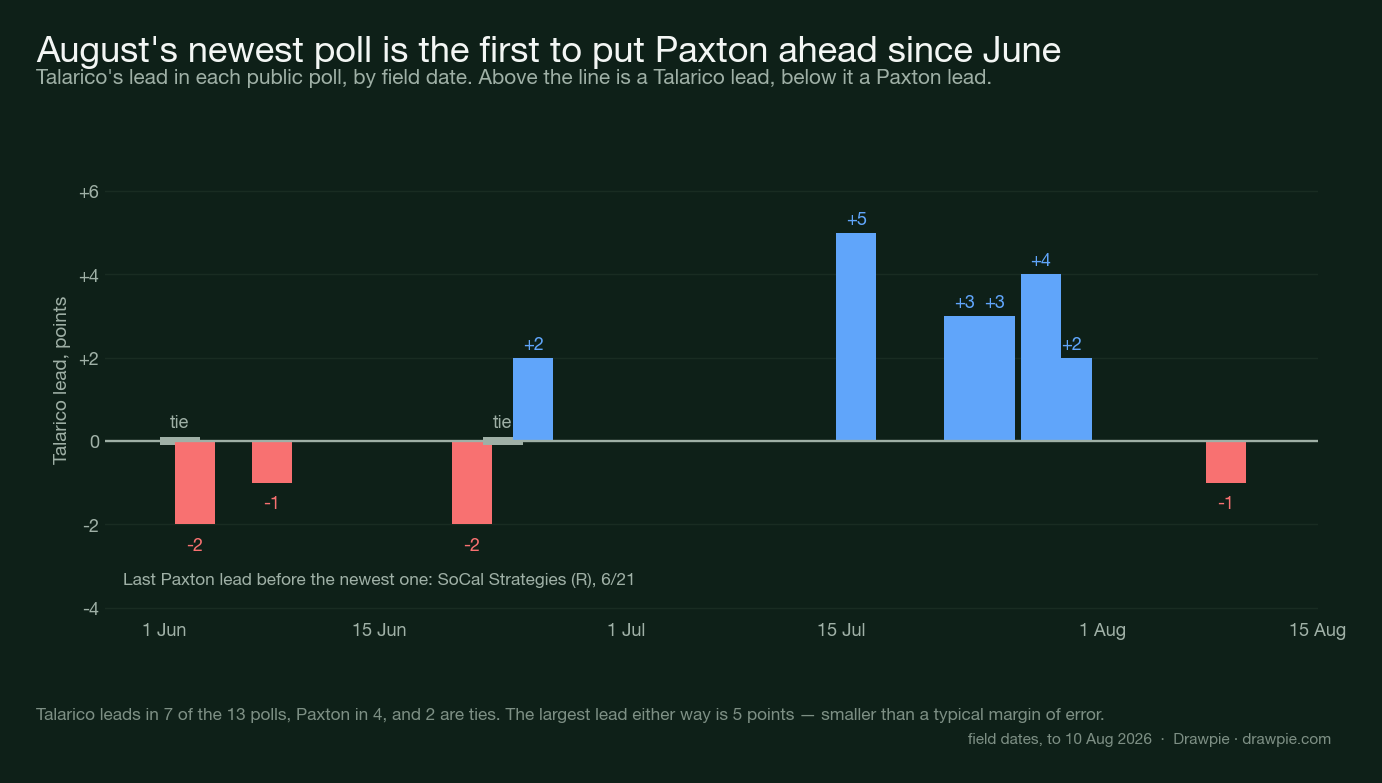
One poll was not a trend. The two surveys fielded after Emerson’s both had Talarico ahead, by three and six points, and every aggregator moved further in his direction through late August. An average lead of roughly two to three points is still a race no single poll has resolved — but it is no longer a race that has stopped moving.
How did Paxton beat John Cornyn?
By losing fewer voters, not by winning more. This is the most misread part of the story, and the vote totals settle it.
| Round | Paxton | Cornyn |
|---|---|---|
| 3 Mar primary | 878,564 | 910,382 |
| 26 May runoff | 888,196 | 503,438 |
| Change | +9,632 | −406,944 |
Paxton added 9,632 votes between the two rounds. Cornyn lost 406,944. Total Republican turnout fell from 2,166,910 to 1,391,634 — a drop of 35.8% — and on that much smaller electorate Paxton’s share rose from 40.5% to 63.8%, making Cornyn the first sitting Texas senator beaten in a primary since 1970.
One more number that rarely appears next to it: the Democratic primary drew 2,319,187 votes to the Republican primary’s 2,166,910, a difference of 152,277, or 7%. That is a turnout comparison between two contests with different fields and different levels of drama, so it is not a prediction of November — but it is the kind of fact that explains why the raters moved this seat at all.
What do the race raters say?
All three still favour the Republican, and one has moved toward the Democrat. As of early August, Cook Political Report, Sabato’s Crystal Ball and Inside Elections all had Texas at Lean Republican, with Inside Elections shifting it from Likely Republican on 6 August.
That is the gap worth understanding in this race: the polls have Talarico narrowly ahead, and the professional raters still favour Paxton. The raters are weighting things a poll does not measure — how the state has actually voted, the size of the Republican baseline, and how often a summer polling lead in Texas has survived to November. We set out the same tension across the four seats that decide the chamber in our 2026 Senate control guide .
What the polling cannot tell you
Who will win. A two-to-three-point average lead at the end of August, inside the margin of error in all but two polls, on a race with no incumbent, is not a prediction — and this article does not make one.
It cannot tell you what the electorate will look like in November: most of these polls screen for likely voters using models built before either candidate began advertising at scale. It cannot separate the effect of Paxton’s runoff victory from the effect of Cornyn’s collapse, because the same voters produced both. And it does not price the race, in the literal sense — no odds appear here, from us or from anyone else.
How we verified this
No betting or prediction-market odds appear in this article. Searches on this race surface forecast sites that publish them; none are used here, and that is a site-wide rule rather than a judgement about this contest.
Polls are listed by their field dates, not their publication dates, because that is when the opinion was measured. Each is shown with its sample size, whether it polled registered or likely voters, and its stated margin of error. Partisan sponsorship is marked: (D) and (R) after a pollster’s name means the poll was conducted for a party-aligned client, and one entry is a bipartisan pairing.
The only polls whose lead exceeds their own margin of error are Democratic-sponsored ones. Texas Public Opinion Research (D) had a five-point lead on a stated ±3.4 in July and a six-point lead on a stated ±3.3 in August. Every other poll with a published margin found a gap inside it, which is the statistical definition of not having found a leader.
The runoff arithmetic is ours, from the certified vote totals. Paxton 888,196 to Cornyn 503,438 in the 26 May runoff, against 878,564 and 910,382 in the 3 March primary. The conclusion that Paxton’s win came from Cornyn’s collapse rather than Paxton’s growth is subtraction, and the inputs are printed so it can be checked.
We have not repeated any claim about why Cornyn’s vote fell. Turnout in a runoff is lower by default, and attributing the rest to any single cause would be speculation. The numbers say what happened, not why.
Race ratings are quoted with the date they were issued and are the raters’ own published judgements, not ours. A rating is a categorical call about who is favoured; it is not a forecast of a margin, and the three agencies use slightly different ladders.
This is a race between two living candidates and we have stuck to the electoral record. Nothing here characterises either man’s personal or legal history, which is not what this page is about and not something a polling summary should adjudicate.