Palworld 1.0 Ranch Guide: All Drops, Best Pals & Output Tips

- A Ranch (Tech Lv5; Wood 30 / Stone 20 / Fiber 30) holds exactly four Pals with the Farming suitability. Twenty-nine Pals can work one, and each has a species-fixed drop — Lamball gives Wool, Chikipi gives Egg, Mozzarina gives Milk.
- Levelling raises how MUCH a Pal drops, never how many kinds. Drop variety is locked to the species: a Level 1 Vixy rolls seven different items, while a Level 4 Dumud Gild rolls two.
- The scaling sits under Partner Skill level (raised by Pal Condensation), not the Farming suitability number — and condensation caps at rank 4, so the Lv6–10 rows in the datamine have no known way to reach them.
- Nobody has published Palworld 1.0’s ranch drop interval, so any “items per hour” figure you read is a guess. MonsterFarmActionSpeedRate is the only world setting that changes ranch output — CollectionDropRate does nothing for it.
Quick answer: the Ranch takes four Pals with the Farming suitability, and each one drops a fixed item — Lamball gives Wool, Chikipi gives Egg, Mozzarina gives Milk. Twenty-nine Pals can work it. Levelling makes them drop more, never more kinds. And here’s the thing most guides won’t tell you: nobody has published 1.0’s drop interval, so every “items per hour” number online is a guess. Here’s what’s actually known.
What every Ranch Pal drops
The Ranch unlocks at Technology Lv 5 (Wood 30 / Stone 20 / Fiber 30), holds exactly four Pals, and needs Farming Lv 1 to be worked. Here’s the whole roster and what each one produces:
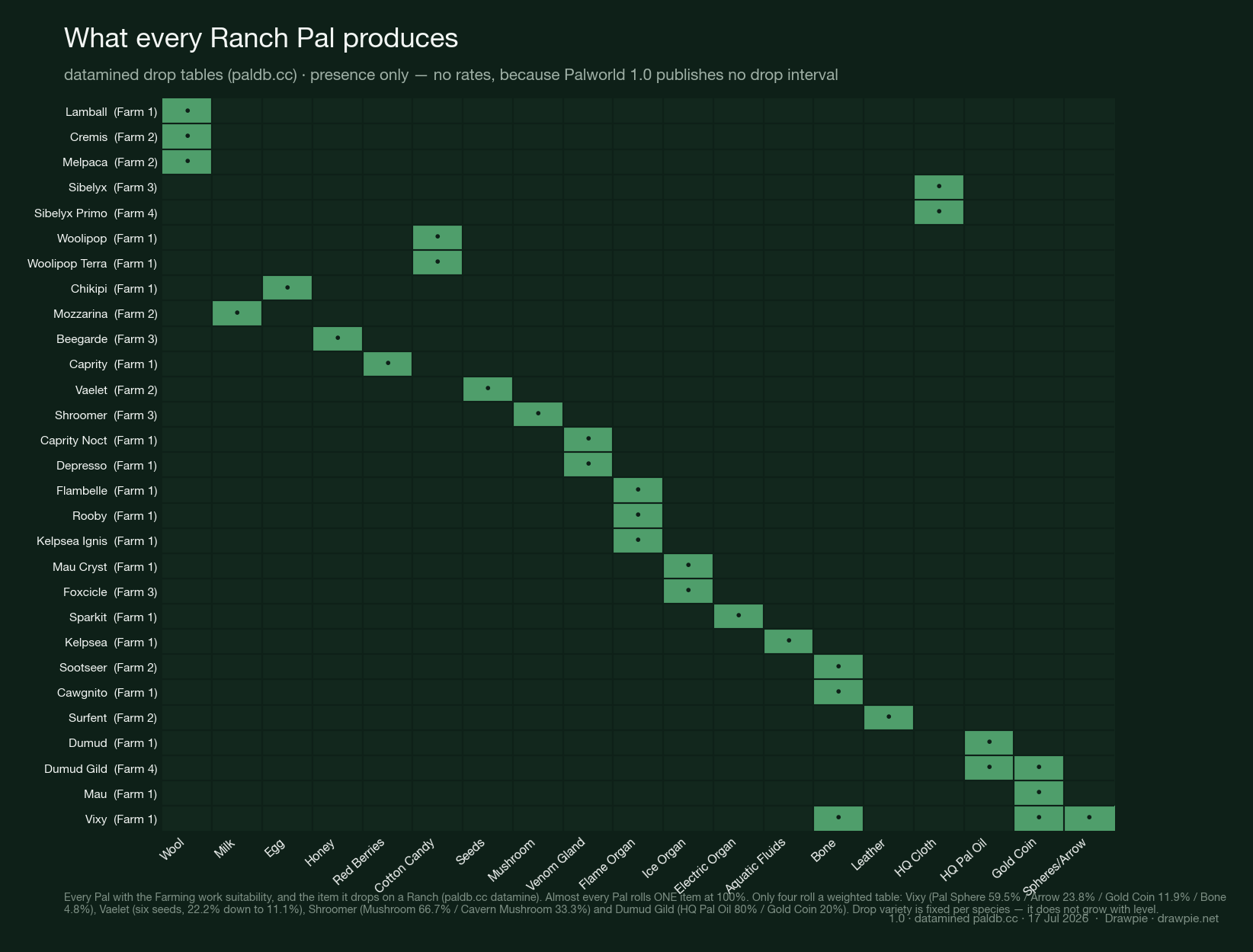
Two things jump out. First, almost every Pal rolls one item at 100% — the roster is a near-perfect diagonal. Only four roll a weighted table: Vixy (Pal Sphere 59.5% / Arrow 23.8% / Gold Coin 11.9% / Bone 4.8%), Vaelet (six seeds), Shroomer (Mushroom 66.7% / Cavern Mushroom 33.3%) and Dumud Gild (HQ Pal Oil 80% / Gold Coin 20%).
Second — and this kills a myth — drop variety is locked to the species, not the level. A Level 1 Vixy rolls seven different items; a Level 4 Dumud Gild rolls two. Levelling a Lamball to the moon still gets you Wool and only Wool. Natural Farming levels only span Lv1–Lv4 anyway, with Dumud Gild and Sibelyx Primo the only Lv4 farmers on the roster.
Does levelling actually help?
Yes — but it raises quantity, and the axis isn’t the one you’d expect:
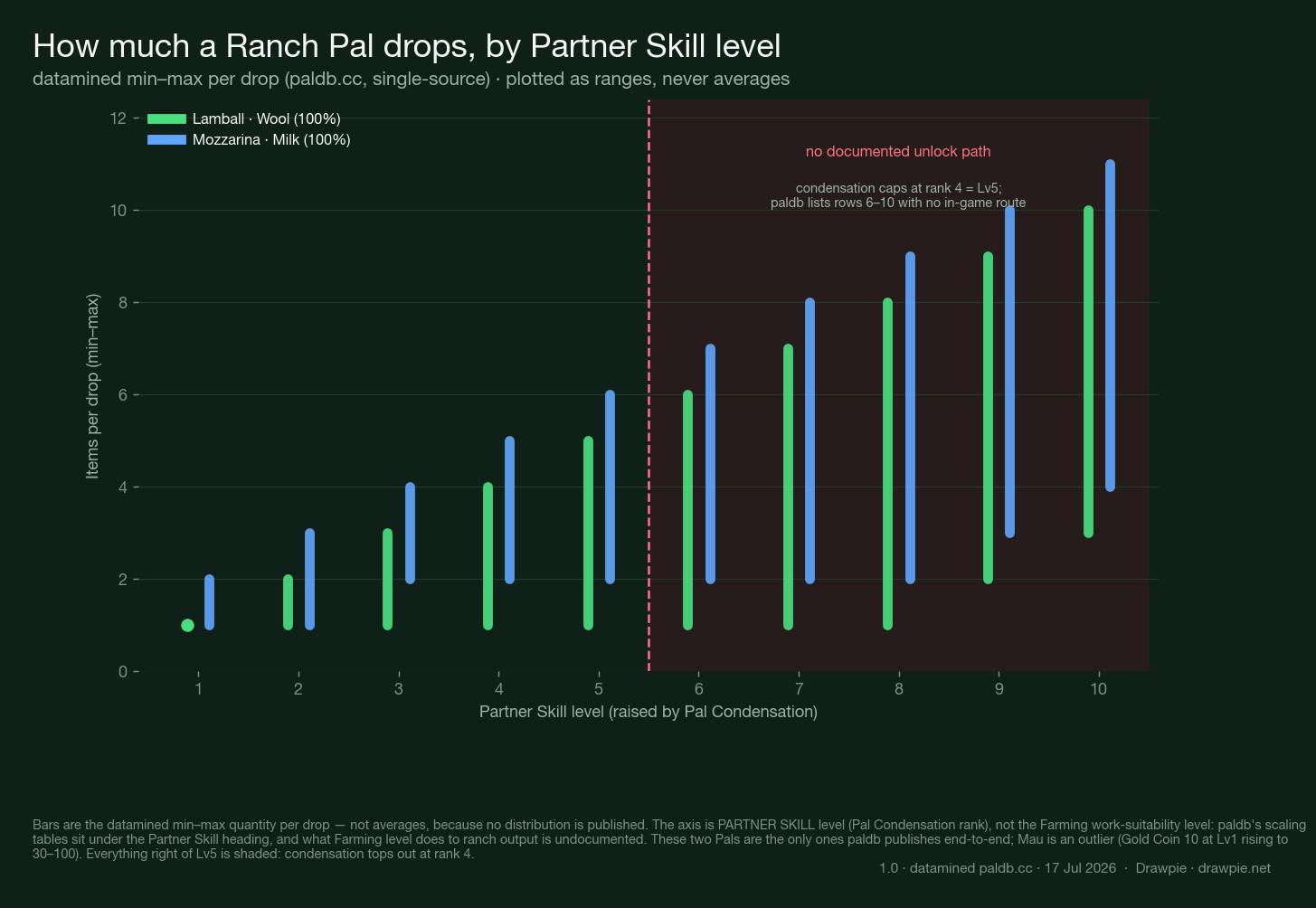
The scaling tables sit under Partner Skill — the level you raise by Pal Condensation — not under the Farming suitability number. What Farming level itself does to ranch output is genuinely undocumented; game8 says it raises the amount rather than the speed, but no datamine states a formula, so treat that as a community claim.
Two honesty notes on that chart, because they matter. These are min–max ranges, not averages — no drop distribution is published, so averaging them would invent a number. And everything past Lv5 is shaded: condensation tops out at rank 4, so while paldb lists rows 6–10, no one knows how to actually reach them. Don’t plan around 3–10 Wool.
The four-Pal setups worth building
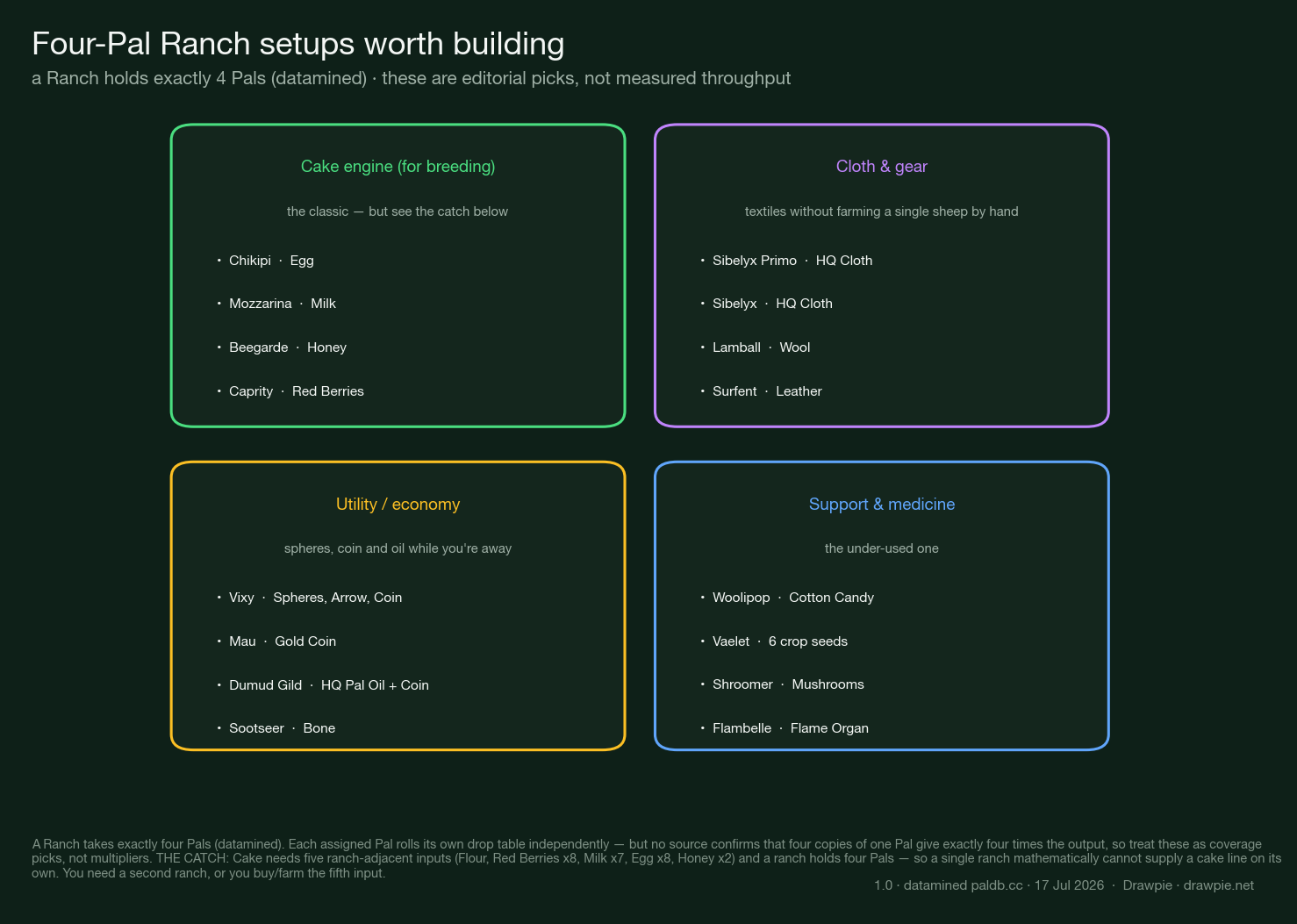
These are coverage picks, not multipliers — no source confirms that four copies of one Pal give exactly four times the output, so we won’t pretend otherwise.
And here’s the genuinely useful bit of arithmetic: Cake needs five ranch-adjacent inputs (5 Flour, 8 Red Berries, 7 Milk, 8 Egg, 2 Honey) and a ranch holds four Pals. A single ranch mathematically cannot supply a cake line on its own. You need a second ranch, or you farm the fifth input by hand. Nobody tells you that before you build one ranch and wonder why the breeding farm keeps stalling.
The only setting that actually matters
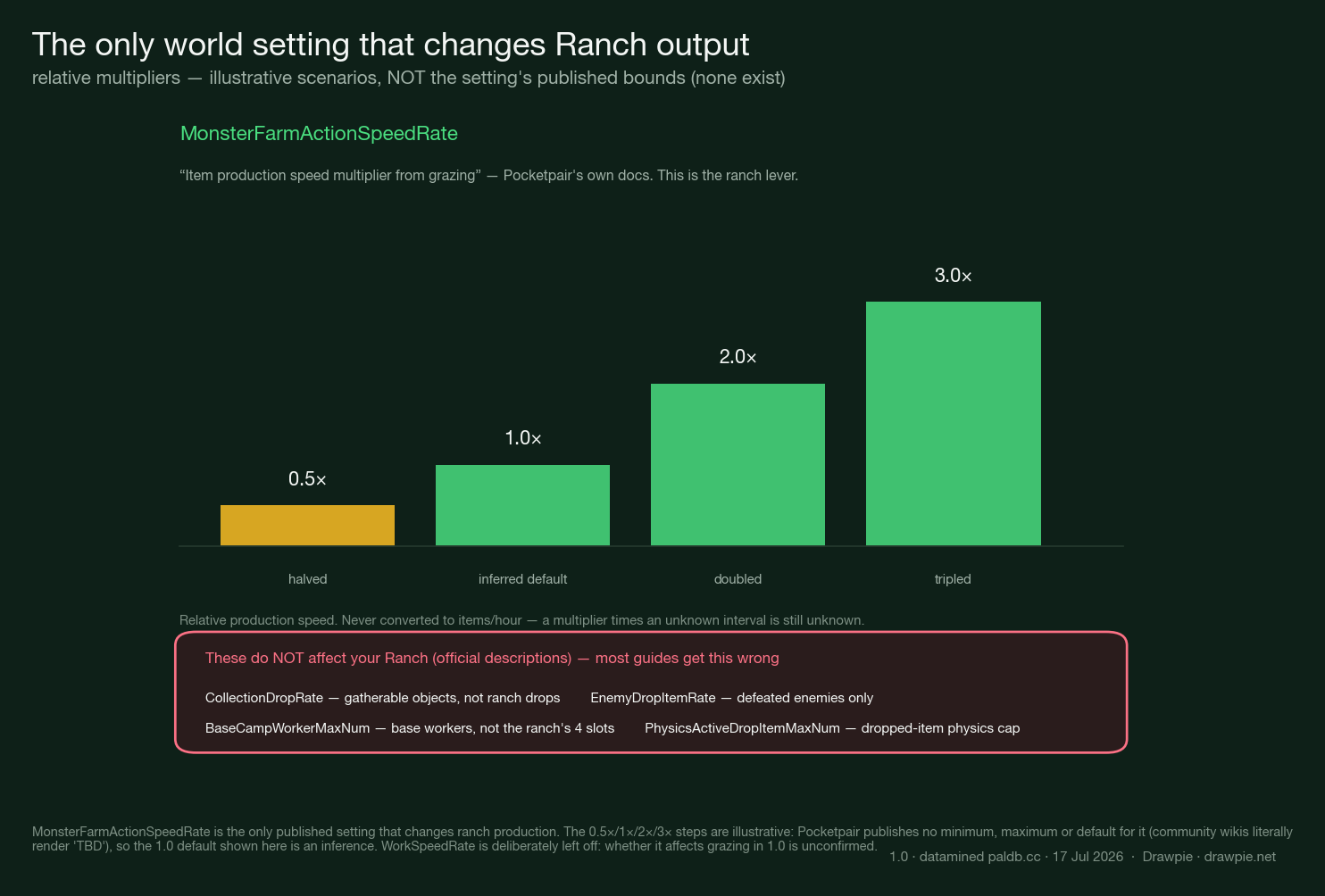
MonsterFarmActionSpeedRate — “item production speed multiplier from grazing”, in Pocketpair’s own docs — is the only published setting that changes ranch output. The red panel is the real value here: CollectionDropRate does nothing for your ranch (it governs gatherable objects), and plenty of guides still tell people to raise it. Note the multiplier steps are illustrative — Pocketpair publishes no minimum, maximum or default, so even the 1.0× baseline is our inference.
What the drops actually feed
A ranch drop is rarely the goal — it’s an input:
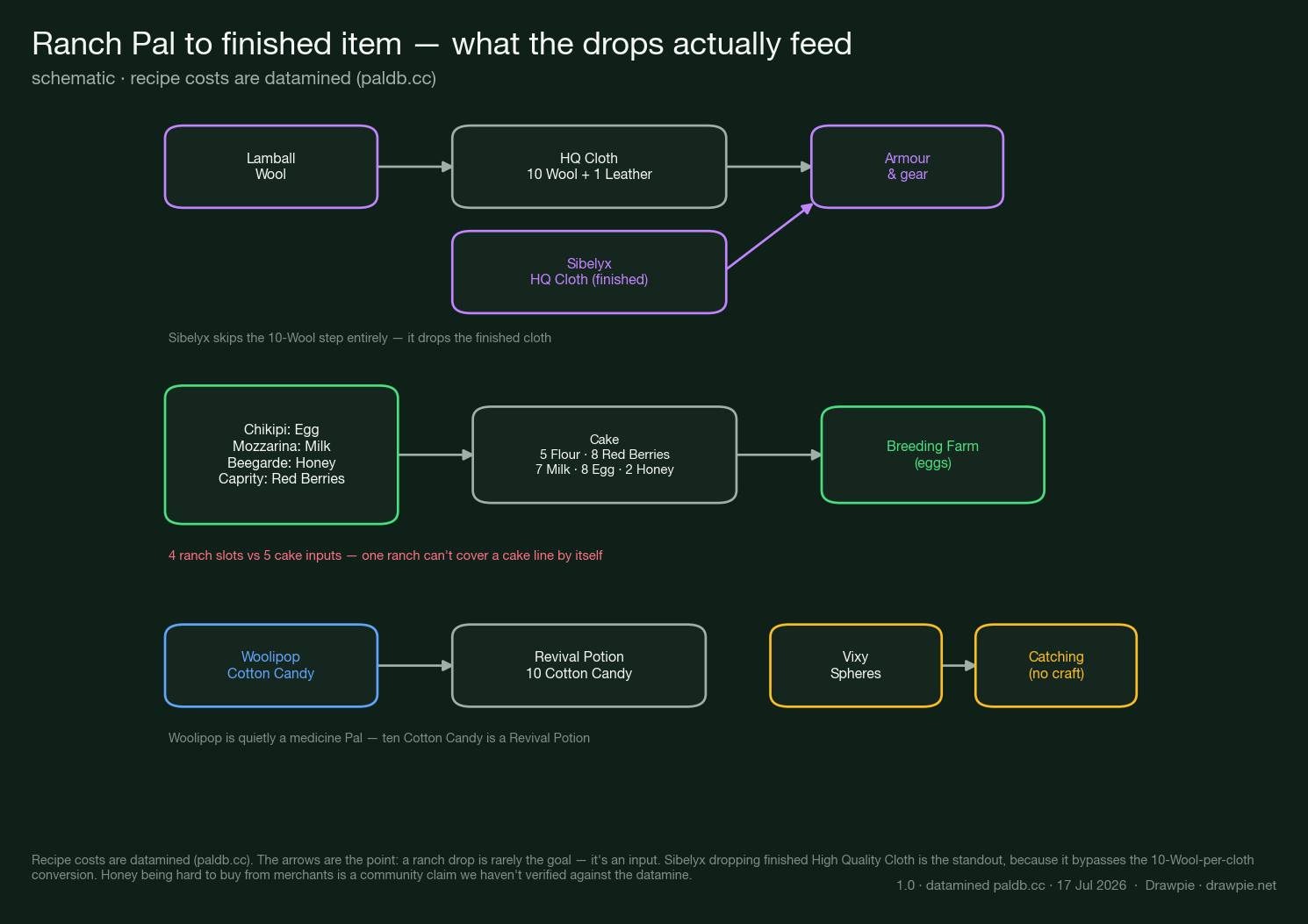
The standout is Sibelyx: it drops finished High Quality Cloth, skipping the 10-Wool-per-cloth conversion entirely. That’s why it’s worth more than its Farming level suggests. And Woolipop is quietly a medicine Pal — ten Cotton Candy is a Revival Potion, which almost nobody uses it for.
Why we won’t tell you items per hour
Every ranch guide online quotes a rate. We’re not going to, and here’s why.
Palworld 1.0 publishes no drop interval. The “~50 seconds” figure everyone repeats traces back to a single uncited page, written during the 1.0 migration — and wiki.gg cites that page, so it’s one source wearing two hats, not two sources. Worse, the v1.0.0 patch notes explicitly state the default production interval “has been adjusted”, which means even that stale number describes a game that no longer exists.
So when you see “~72 items per hour”, that’s literally 3600 ÷ 50 — a real-looking number built on a guess. We’d rather count what’s actually knowable: items per production cycle, which is exactly what our calculator does.
Plan your ranch
Our Ranch Output Calculator fills the four slots, applies the datamined drop ranges at your Partner Skill level, and tells you how many production cycles a Cake or Cloth run needs — with no invented clock.
Frequently asked questions
How many Pals can work a Ranch in Palworld 1.0?
Four. That’s a hard cap on the structure, and it’s why a single ranch can’t cover Cake’s five inputs.
Does a higher Farming level mean more drops?
It raises how much, not how many kinds — but the documented scaling is tied to Partner Skill level (Pal Condensation), not the Farming number. Farming level’s own effect on ranch output isn’t documented.
What’s the best Ranch Pal?
For value per slot, Sibelyx — it drops finished High Quality Cloth, skipping the 10-Wool conversion. For breeding, the Chikipi / Mozzarina / Beegarde / Caprity cake set. For passive income, Vixy (spheres) and Mau (Gold Coin).
How long does a Ranch drop take?
Nobody knows for 1.0 — the interval isn’t published, and the patch notes say it changed. Treat every items-per-hour figure online as an estimate built on a pre-1.0 guess.
The bottom line
Pick by product, not by level: each Pal’s drop is fixed, so your four slots are a coverage decision. Take Sibelyx if you want cloth without the wool tax, run the cake four if you’re breeding — and remember a single ranch can’t feed a cake line alone. Level for quantity via condensation, ignore CollectionDropRate, and be sceptical of any rate a guide quotes you.
More Palworld 1.0: the best base Pals guide (work suitability across every job), the breeding guide , and the Aquatic Pal Fluids guide — which covers the Kelpsea ranch in detail.
How we verified this
MonsterFarm, unlocks at Technology Lv 5, costs Wood 30 / Stone 20 / Fiber 30, holds a maximum of FOUR Pals and requires Farming Lv 1. The suitability’s English name is Farming (only the “Applied Ranching Handbook I” item title says “Ranching”; 1.0 did not rename it). Natural Farming levels across the roster span Lv1–Lv4 only, with Dumud Gild and Sibelyx Primo the sole Lv4 farmers. Chikipi drops Egg, Lamball drops Wool, Mozzarina drops Milk (some search summaries get this backwards). Dumud Gild is the only ranch Pal splitting across two different items (HQ Pal Oil 80% / Gold Coin 20%); the other weighted tables are Vixy (Pal Sphere 59.5% / Arrow 23.8% / Gold Coin 11.9% / Bone 4.8%), Vaelet (six seeds, 22.2% down to 11.1%) and Shroomer (Mushroom 66.7% / Cavern Mushroom 33.3%). Recipes are datamined: Cake 5 Flour / 8 Red Berries / 7 Milk / 8 Egg / 2 Honey; High Quality Cloth 10 Wool + 1 Leather; Revival Potion 10 Cotton Candy. IMPORTANT LIMITS, stated rather than papered over. (1) NO DROP INTERVAL EXISTS for 1.0: the widely-copied “~50 seconds” traces to a single uncited page written during the 1.0 migration, and the v1.0.0 patch notes explicitly say the default production interval “has been adjusted” — so we publish no seconds figure and no items-per-hour figure anywhere, and the calculator counts production cycles instead. Any “~72/hour” you see online is literally 3600÷50. (2) The 10-row quantity-scaling tables are SINGLE-SOURCE (paldb.cc); wiki.gg and game8 stop at five levels. They sit under the Partner Skill heading, i.e. the axis is Partner Skill level (Pal Condensation rank), NOT the Farming work-suitability level — what Farming level does to ranch output is undocumented (game8 asserts it raises amount rather than speed, but no datamine states a formula, so we treat that as a community claim). (3) Pal Condensation caps at rank 4 = Partner Skill Lv5, and paldb’s rows 6–10 have no documented in-game unlock path, so we shade them and gate them behind an off-by-default toggle rather than present 3–10 Wool as attainable. (4) Quantities are min–max integer ranges; no distribution is published, so we never average them — a midpoint is an explicit assumption, not an expected value. (5) Linear stacking is unsourced: no source confirms four copies of a Pal give exactly four times the output, so the four-Pal setups are coverage picks, not multipliers. (6) MonsterFarmActionSpeedRate (“item production speed multiplier from grazing”) is the only published ranch lever, and Pocketpair publishes no minimum, maximum or default for it — the 1.0× default shown is our inference, and the multiplier steps are illustrative. WorkSpeedRate’s effect on grazing is unconfirmed for 1.0, so it’s excluded. Two charts originally planned for this guide were cut rather than faked: “Farming level vs drop variety” (the relationship does not exist — variety is species-locked) and “estimated items per hour” (no interval to base it on). Correct as of 17 July 2026; a patch can change any of these.