Palworld 1.0 Breeding: Passives, IVs, Mutations and Which Cake to Use
Update log (1)
- — Published 24 July 2026. Mutation rates remain unpublished by Pocketpair; the figures here are community estimates and are labelled as such throughout.

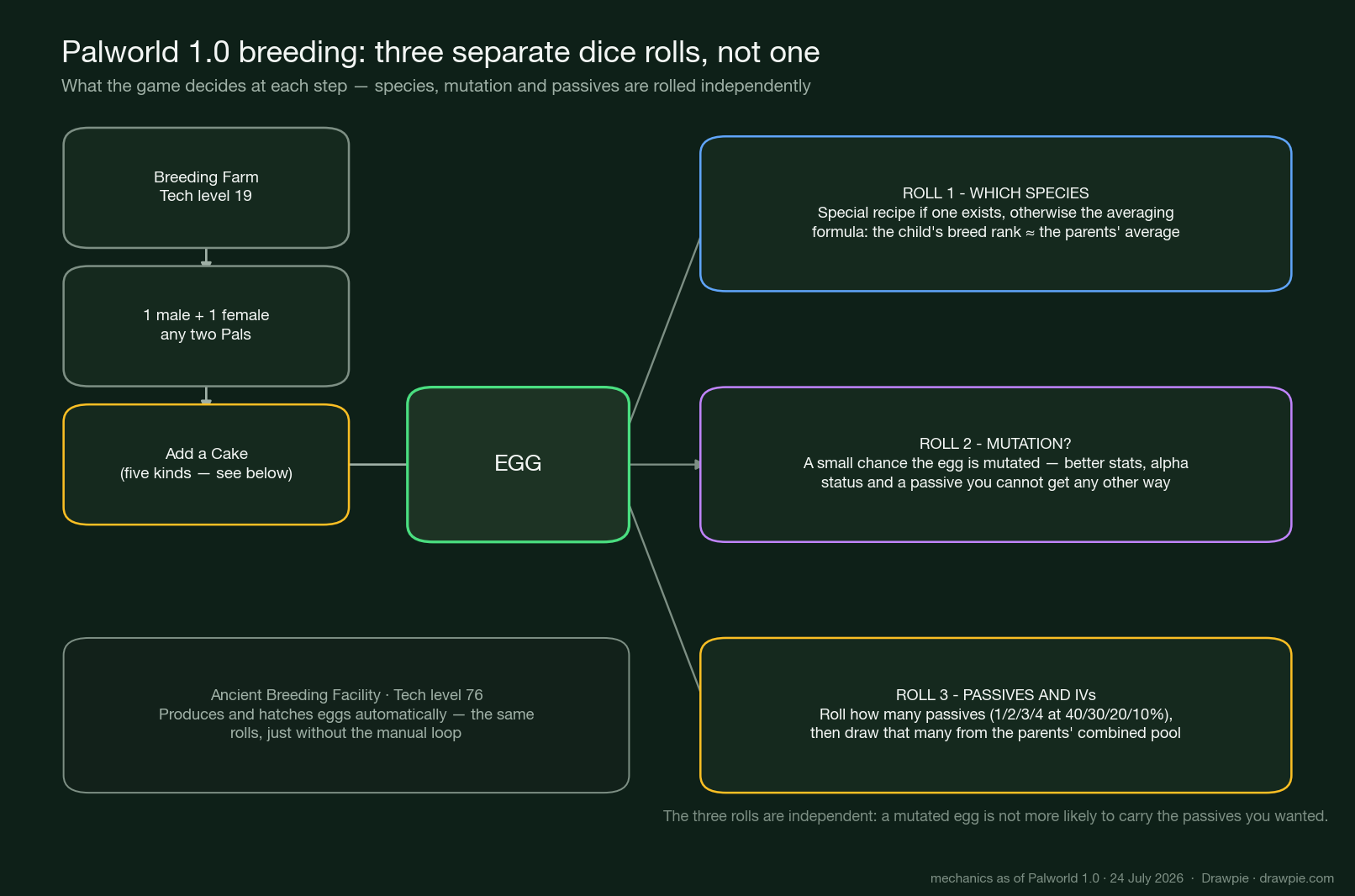
- Breeding rolls three separate dice: which species, whether the egg mutates, and which passives and IVs the hatchling gets. They are independent — a mutated egg is no more likely to carry the passives you wanted.
- The passive roll picks how many to inherit first — 1, 2, 3 or 4 at 40/30/20/10% — then draws that many at random from the parents’ combined pool. Everything about passive breeding follows from that one rule.
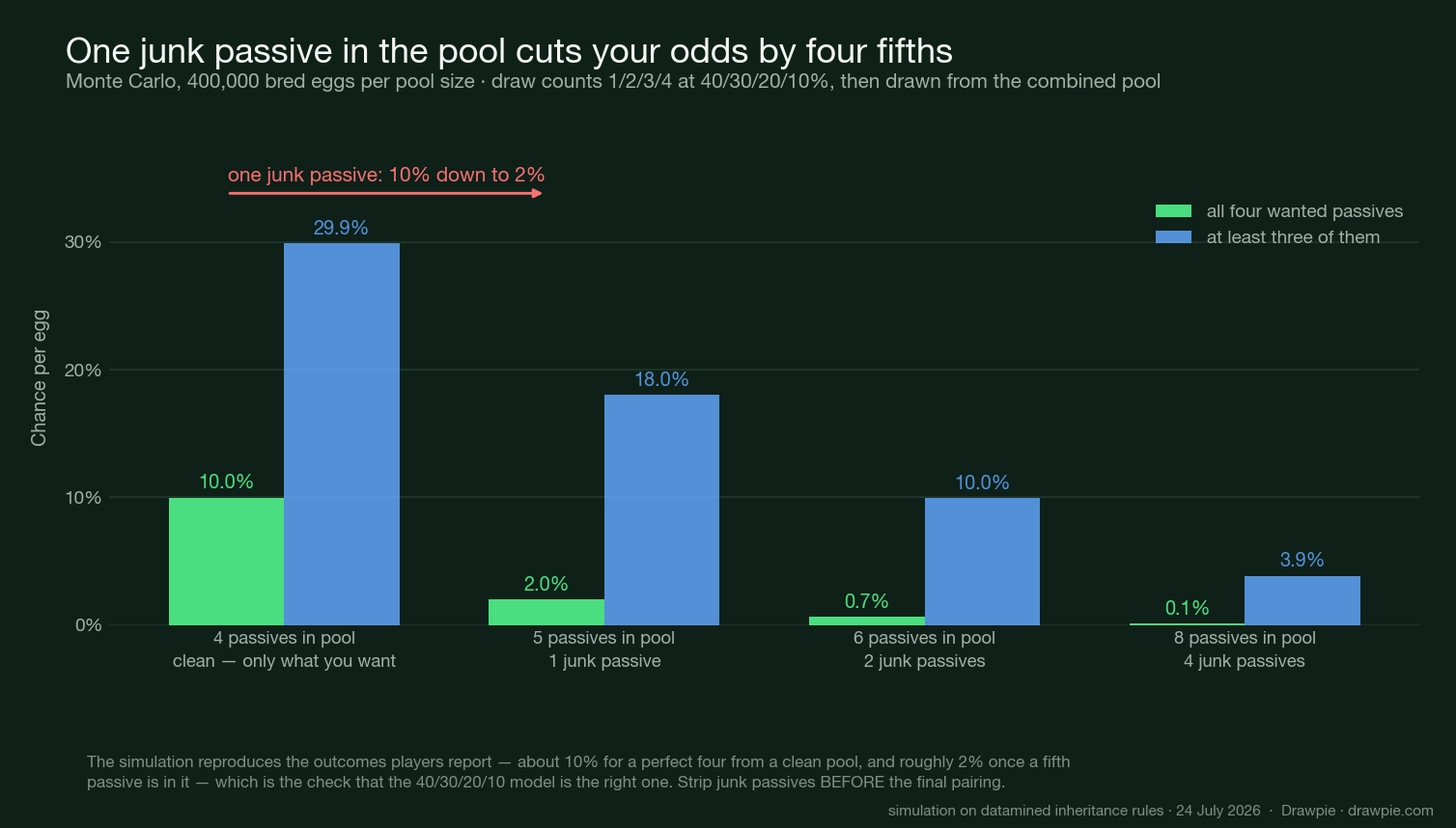
- Keep the pool clean. Our simulation of 400,000 eggs puts a perfect four-passive hatchling at 10.0% from a four-passive pool and 2.0% once a single junk passive is in it. One useless trait costs you four fifths of your odds.
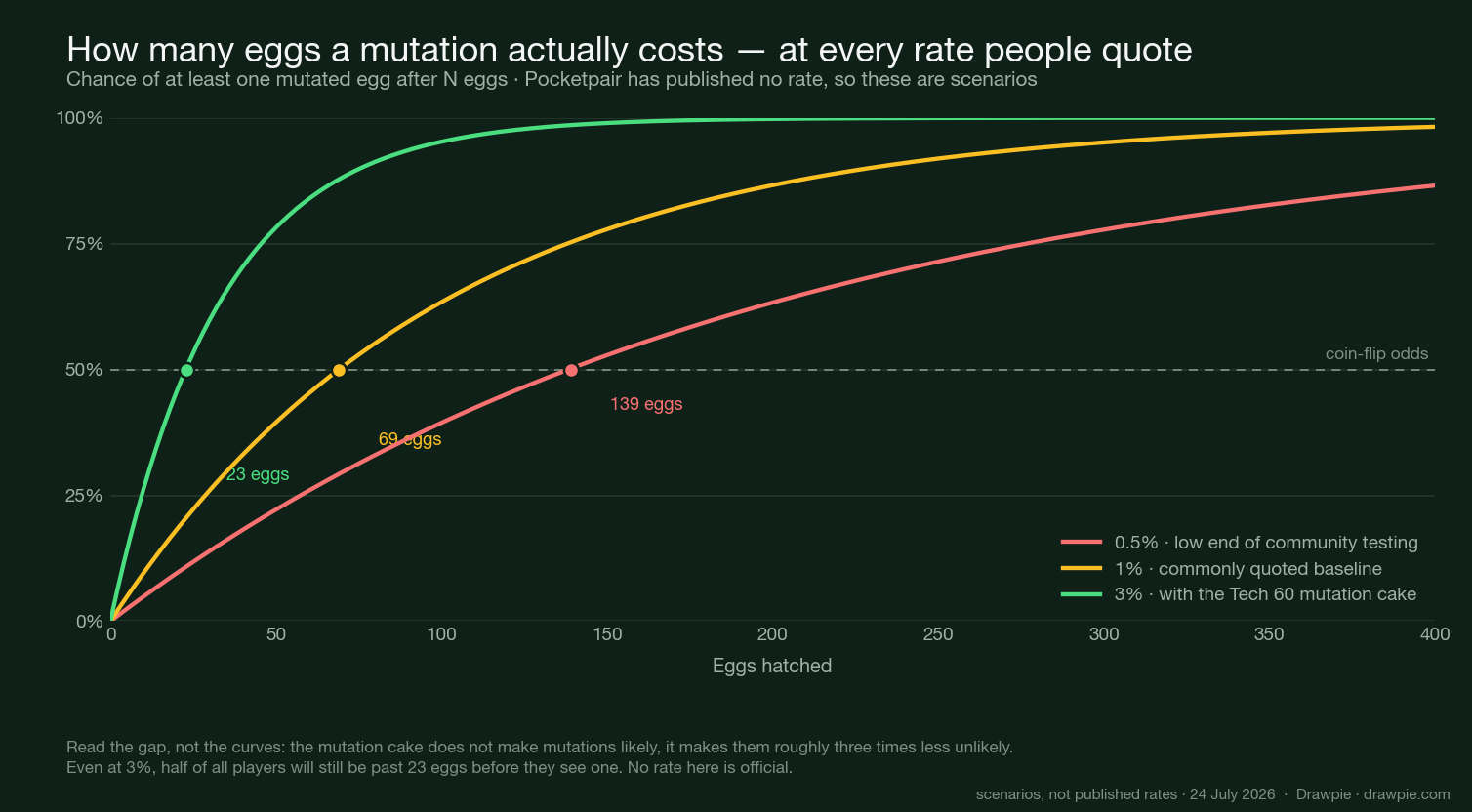
- Only one cake raises mutation odds, and Pocketpair has never published a rate. Community testing puts it near 1% baseline and 3% with the Tech 60 cake — at 3%, half of all players still need more than 23 eggs.
Getting the species you want is the easy half of Palworld breeding, and we covered it separately in the full guide to how combinations work . This is the other half — the part that decides whether the Pal you hatch is actually worth keeping.
Passives, IVs and mutations are three different systems with three different sets of odds, and almost all the frustration in breeding comes from treating them as one thing.
All mechanics checked on 24 July 2026. Where a number is a community estimate rather than something Pocketpair published, we say so.
Breeding is three dice rolls, not one
| The roll | What decides it |
|---|---|
| Which species | A fixed special recipe if one exists, otherwise the averaging formula |
| Mutation | A flat chance per egg, raised only by the Tech 60 cake |
| Passives | Roll how many, then draw that many from the parents’ combined pool |
| IVs | Roughly 30% from the father, 30% from the mother, 40% rerolled |
The important word is independent. A mutated egg does not come with better passive odds, and a perfect passive set does not make the next egg more likely to mutate. People chain these together in their heads and then feel cheated when a mutation hatches with junk traits.
Passives: one rule explains everything
Here is the mechanic, and it is worth reading twice because every piece of breeding advice you have ever seen is a consequence of it.
First the game rolls how many passives the child inherits — one, two, three or four, at 40%, 30%, 20% and 10%. Then it draws that many at random from the combined pool of both parents’ unique passives.
Two things follow immediately.
Getting all four is capped at 10% before you do anything else, because that is simply how often the game decides to hand over four. No pairing, no cake, no amount of patience changes that ceiling — it is the first roll.
And every extra passive in the pool dilutes the draw. If the pool is exactly the four you want, a four-passive roll gives you all four. If there is a fifth trait in there, that same roll now has five candidates to choose four from.
What that costs you, simulated
We ran 400,000 eggs per scenario against those rules:
| Passives in the combined pool | All four wanted | At least three |
|---|---|---|
| 4 — clean | 10.0% | 29.9% |
| 5 — one junk trait | 2.0% | 18.0% |
| 6 — two junk traits | 0.7% | 10.0% |
| 8 — four junk traits | 0.1% | 3.9% |
One useless passive costs four fifths of your odds. Not a little. Four fifths.
That is the entire argument for the “clean pool” approach that experienced players talk about: before your final pairing, breed away the traits you do not want, even though it takes extra generations. Going from 10% to 2% means going from about ten eggs to about fifty.
A useful sanity check on the model: this simulation reproduces what players actually report — around 10% for a perfect four from a clean pool, and roughly 2% once a fifth trait is in the mix. That agreement is why we trust the 40/30/20/10 rule rather than the various exact percentages floating around.
Two smaller things worth knowing. A passive that both parents carry transfers about 46% of the time — noticeably better than one only a single parent has, which is why doubling up on your key trait matters. And gender has no effect on passive odds at all; which parent holds which trait, and which one is male, changes nothing.
IVs: quietly the least controllable part
Each combat stat is rolled with roughly 30% chance from the father, 30% from the mother, and 40% rerolled at random.
That means a strong parent tends to pass its stat down, but never reliably — and with three stats each rolling separately, the chance of inheriting all of them from good parents is small. IVs are the part of breeding you improve by volume, not by planning. The Mushroom Cake nudges hatchling stats, and that is about the extent of your control.
The exception is mutation, which bypasses the whole system.
Mutations: what they give, and what nobody knows
A mutated egg is not a slightly better egg. Reported effects are substantial:
- IVs in the 90–100 range, skipping the whole inheritance lottery above
- Pre-condensed to two stars, and alpha status
- At least two rainbow-tier passives
- A guaranteed strong type-appropriate attack, and one work suitability raised by +2
- At least one of five passives you cannot obtain any other way
| Mutation-only passive | Effect |
|---|---|
| Babysitter | Egg production and incubation 30% faster |
| Immortal | +5% lifesteal, +15% attack, +100% HP regeneration |
| Anomaly | Poison and burn immunity, +25% defence, +50% HP regeneration |
| Bulwark | Immune to explosion damage |
| Skyrunner | Mount only — two extra jumps |
Now the part every guide gets wrong: nobody outside Pocketpair knows the rate. It has never been published. What exists is community testing, which lands somewhere around 0.5–1% per egg normally and roughly 3% with the Tech 60 cake. Treat any site quoting a precise figure with suspicion.
Since the rate is unknown, the honest way to plan is to look at the whole plausible range:
| If the rate is | Eggs for a coin-flip chance | Eggs for 90% |
|---|---|---|
| 0.5% | 139 | 460 |
| 1% | 69 | 230 |
| 3% (mutation cake) | 23 | 76 |
Read the gap rather than the curves. The mutation cake does not make mutations likely — it makes them about three times less unlikely. Even in the best case, half of all players are past 23 eggs before they see one. If you are hunting mutations without the Tech 60 cake and the Ancient Breeding Facility automating the loop, you are signing up for a very long evening.
Which cake to use
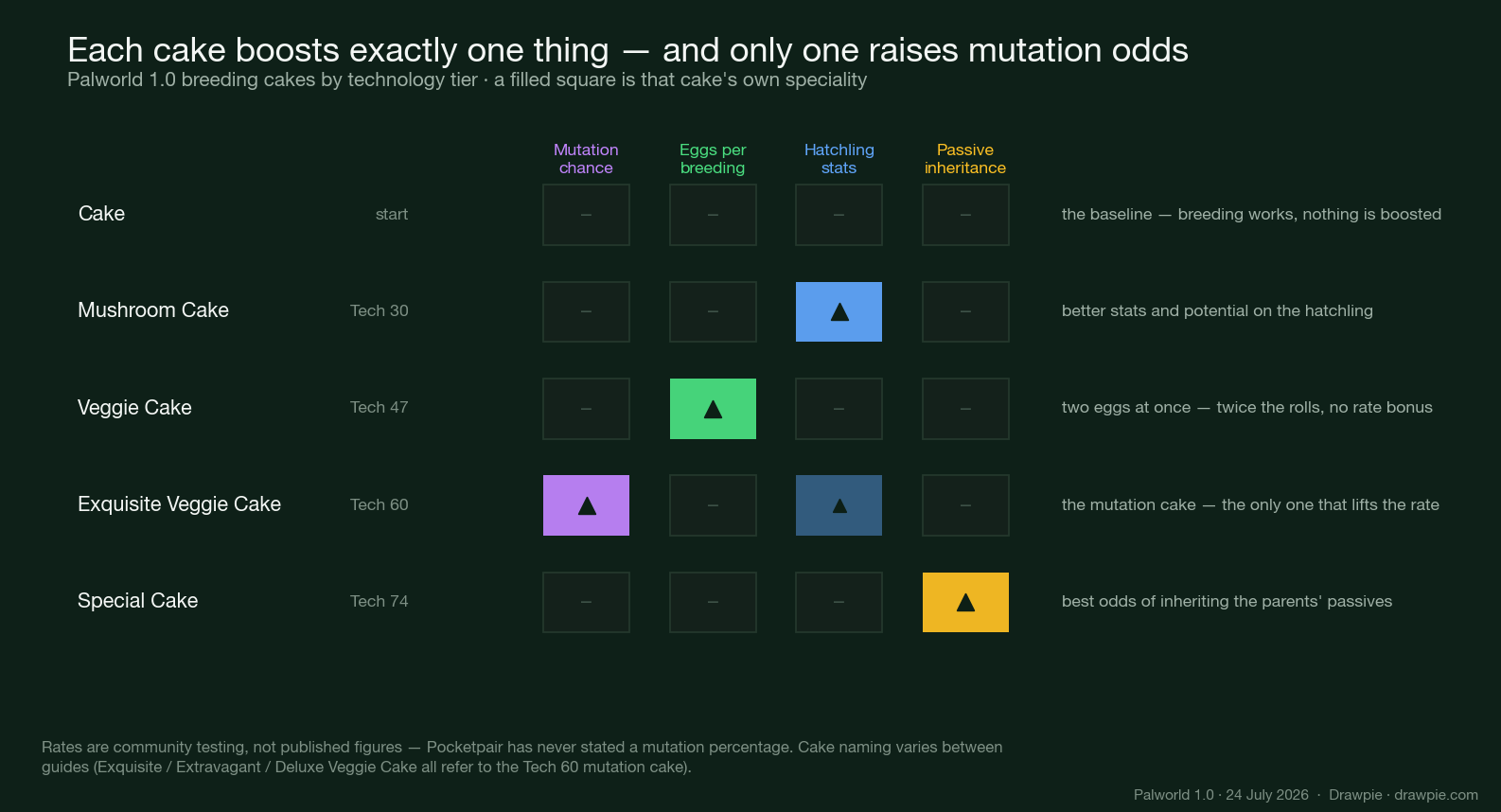
There are five, they unlock at different technology tiers, and each one boosts exactly one thing.
| Cake | Unlock | What it does | Use it when |
|---|---|---|---|
| Cake | start | nothing extra | you have no choice yet |
| Mushroom Cake | Tech 30 | better hatchling stats | grinding IVs |
| Veggie Cake | Tech 47 | two eggs per breeding | any volume grind — twice the rolls |
| Exquisite Veggie Cake | Tech 60 | mutation chance to ~3% | hunting mutations, and only then |
| Special Cake | Tech 74 | better passive inheritance | the final pairing of a passive chain |
The practical order is Veggie Cake for the middle of a project and Special Cake for the end of it. Volume while you are cleaning up the passive pool, then maximum inheritance odds on the pairing that actually matters. The mutation cake is a separate activity, not an upgrade to the others.
⚠️ Naming warning. The Tech 60 cake appears as Exquisite, Extravagant and Deluxe Veggie Cake across different guides. They are the same item; a guide that lists two of them as separate cakes has not checked.
And at Tech 76 the Ancient Breeding Facility removes the manual loop entirely — it produces and hatches eggs automatically. It does not change any of the odds above. It just lets you run them while you do something else, which for mutation hunting is the difference between viable and not.
Why there are 267 ways to breed the same Pal
One more thing that confuses people about targeted breeding. Take Anubis:
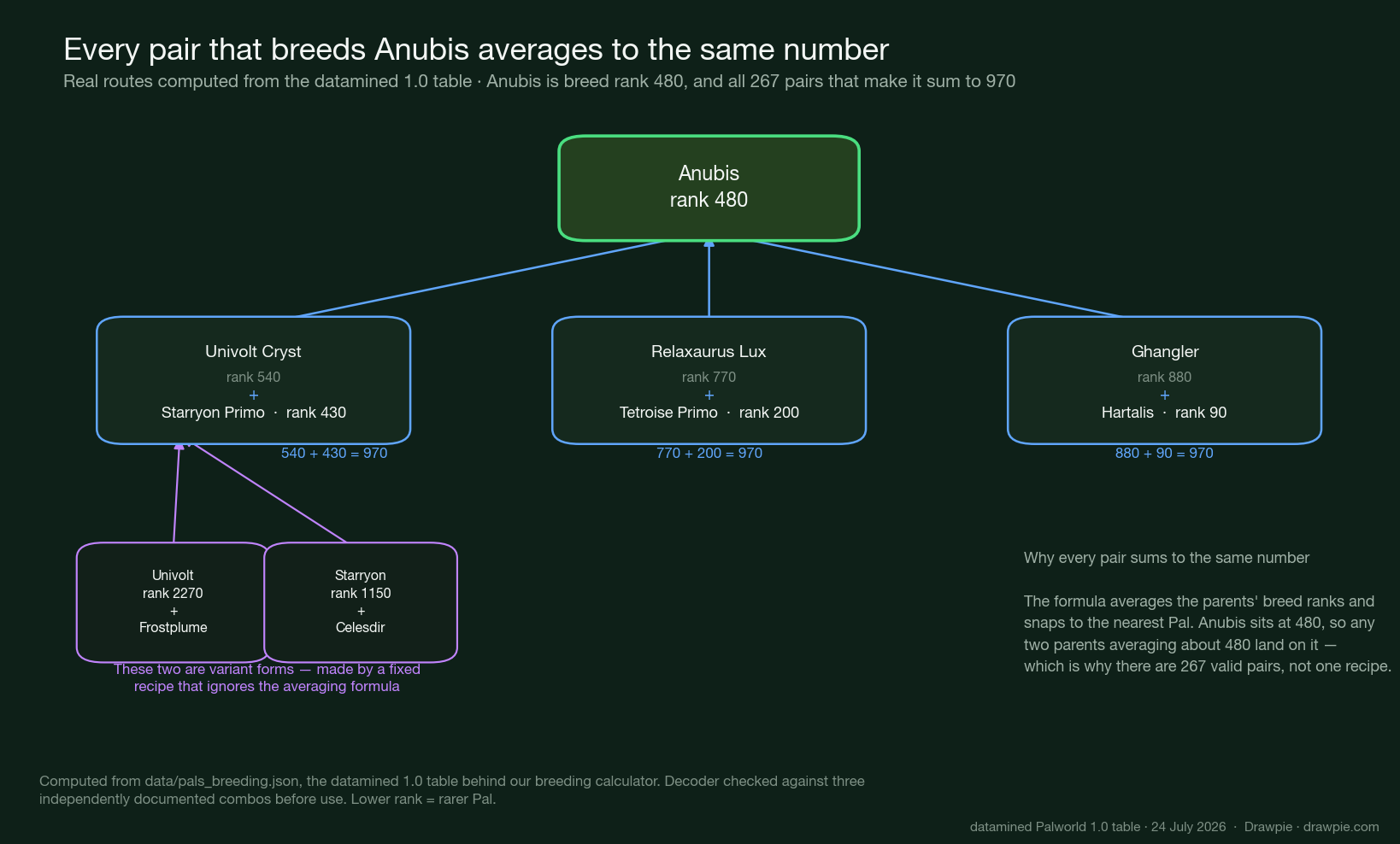
Anubis sits at breed rank 480. Every single one of the 267 pairs that produces it has parents whose ranks sum to 970 — we computed that directly from the 1.0 table rather than taking it from anywhere. That is the averaging formula made visible: the game averages the parents’ ranks and snaps to the nearest valid Pal, so any two parents that average out near 480 will do.
This is why there is no single “recipe” for most Pals, and why a lookup tool beats a memorised list. Our breeding calculator does both directions — two parents to child, or a target Pal to every pair that makes it. If a pair needs a species you have never caught, buying one is an option: the Black Marketeer deals in Pals rather than items , from a fixed pool that restocks every 48 minutes.
The purple branch on that chart shows the other kind of edge: variant forms like Univolt Cryst are made by fixed recipes that ignore the formula entirely. Those are the ones worth memorising, because they are the only ones that are actually recipes.
Putting it together: a breeding plan that respects the odds
- Decide the four passives first, before you catch or breed anything for the project.
- Clean the pool. Breed intermediate generations whose only job is to carry your wanted traits and nothing else. This step feels like a detour and it is worth more than everything else on this list.
- Double up on your key trait across both parents — shared passives transfer around 46%.
- Use Veggie Cake while grinding and switch to Special Cake for the final pairing.
- Do not chase mutations and passives at once. They are separate rolls; a mutation hunt is a volume game with the Tech 60 cake and the Ancient Breeding Facility, and the passive work happens on different pairings.
- Accept that IVs are mostly volume. Plan for passives, take the stats you get, and let mutation be the lottery ticket rather than the plan.
Want the numbers for your own pairing? Our Perfect Pal Breeding Planner takes both parents’ passives and the ones you actually want, and returns the exact chance per egg, how many eggs to expect, and what cleaning the pool would buy you. It uses the same rules as everything above, calculated exactly rather than simulated. And if the project is a travel mount, step one is already decided for you: the four move-speed passives worth breeding stack to +75% .
Frequently asked questions
How many passive skills can a Pal inherit in Palworld?
Up to four. The game rolls how many to inherit — one, two, three or four at 40%, 30%, 20% and 10% — then draws that many at random from both parents’ combined unique passives. Empty slots can be filled by a random passive.
Why do I keep failing to get all four passives?
Because the ceiling is 10% before the pool is even considered — that is how often the game hands over four passives at all. If either parent carries a trait you do not want, the odds fall further: our simulation puts a clean four-passive pool at 10.0% and a five-passive pool at 2.0%.
Does it matter which parent has which passive?
No. Gender and which parent holds a trait have no effect on passive inheritance odds.
What is the mutation chance in Palworld 1.0?
Pocketpair has not published one. Community testing suggests roughly 0.5–1% per egg, rising to about 3% with the Tech 60 Exquisite Veggie Cake. Any guide quoting an exact official figure is inventing it.
Which cake is best for breeding?
There is no single best one. Veggie Cake (Tech 47) gives two eggs per breeding for volume, Special Cake (Tech 74) maximises passive inheritance for a final pairing, Exquisite Veggie Cake (Tech 60) is the only one that raises mutation odds, and Mushroom Cake (Tech 30) nudges hatchling stats.
How do IVs work in Palworld breeding?
Each combat stat rolls roughly 30% from the father, 30% from the mother and 40% at random. Strong parents help but guarantee nothing, which is why IVs are improved by hatching volume rather than by planning.
Are mutated Pals worth hunting?
They are powerful — IVs of 90–100, two-star condensed, alpha status and a passive unavailable any other way. But at the community-estimated 3% best case, half of all players need more than 23 eggs to see one, so it is worth doing only with the Tech 60 cake and the Ancient Breeding Facility running the loop for you.