Palworld Nightstar Sand Guide: Locations, Farming & Uses

- Nightstar Sand is a Common crafting material added in the Feybreak update (Dec 2024) and carried into 1.0. Despite the name, you don’t mine it — it appears as glowing yellow spots on sandy ground at night and you just walk up and collect it.
- It’s mostly on the endgame Feybreak Island (Withered Seaside, Loess Plains, Scorched Ashland, Deserted Ash Plateau), plus the base-map Desiccated Desert near the PIDF Tower — the earliest spot you can reach. No source publishes exact node coordinates, only regions.
- Each pickup point comes back on a 20-minute cooldown (datamined). It also drops 1–2 (guaranteed) from the Pals Starryon Primo and Wistella — but those live in a separate endgame zone, and the amount does not scale with level.
- Its main use is Palworld’s traversal gear: the Anti-Gravity Belt (10), the jump and air-dash boots line (20 up to 50 for Triple Jump Boots), plus the Beam Sword (20), Metal Detector (20) and Advanced Bow — roughly 20 recipes in all.
If you’ve picked up a Palworld recipe that calls for Nightstar Sand and gone looking for a mine, stop — there isn’t one. Despite the name, Nightstar Sand isn’t ore you dig up; it’s a glowing pickup you gather off the sand at night. This guide covers exactly where it appears, how the night-and-respawn cycle works, and everything it’s used for — with one honest caveat up front: no source publishes exact node coordinates, so the maps here are landmark schematics, not pin drops.
What is Nightstar Sand?
Nightstar Sand is a Common crafting material added in Palworld’s Feybreak update (December 2024) and carried into the 1.0 release. In the datamine it’s typed as “MaterialOre” with the internal name NightStone — but in practice it behaves nothing like ore:
- You don’t mine it. No pickaxe, no Mining Pal. It appears as glowing yellow spots on sandy ground after dark, and you collect it by walking up and interacting.
- It’s a “night” resource. The glowing nodes are a night-only phenomenon — they light up in the dark and are how you spot the sand at all. (Sources disagree on whether an already-spawned node can still be grabbed once day breaks, so don’t count on daytime farming.)
- It’s cheap and stackable — weight 1, stacks to 9999, sells for 1000 Gold — so once you find a good region you can hoard a lot of it.
Where to farm Nightstar Sand
Nightstar Sand shows up across a handful of sandy regions. The bulk of it is on the endgame Feybreak Island, with one spot on the base Palpagos map.
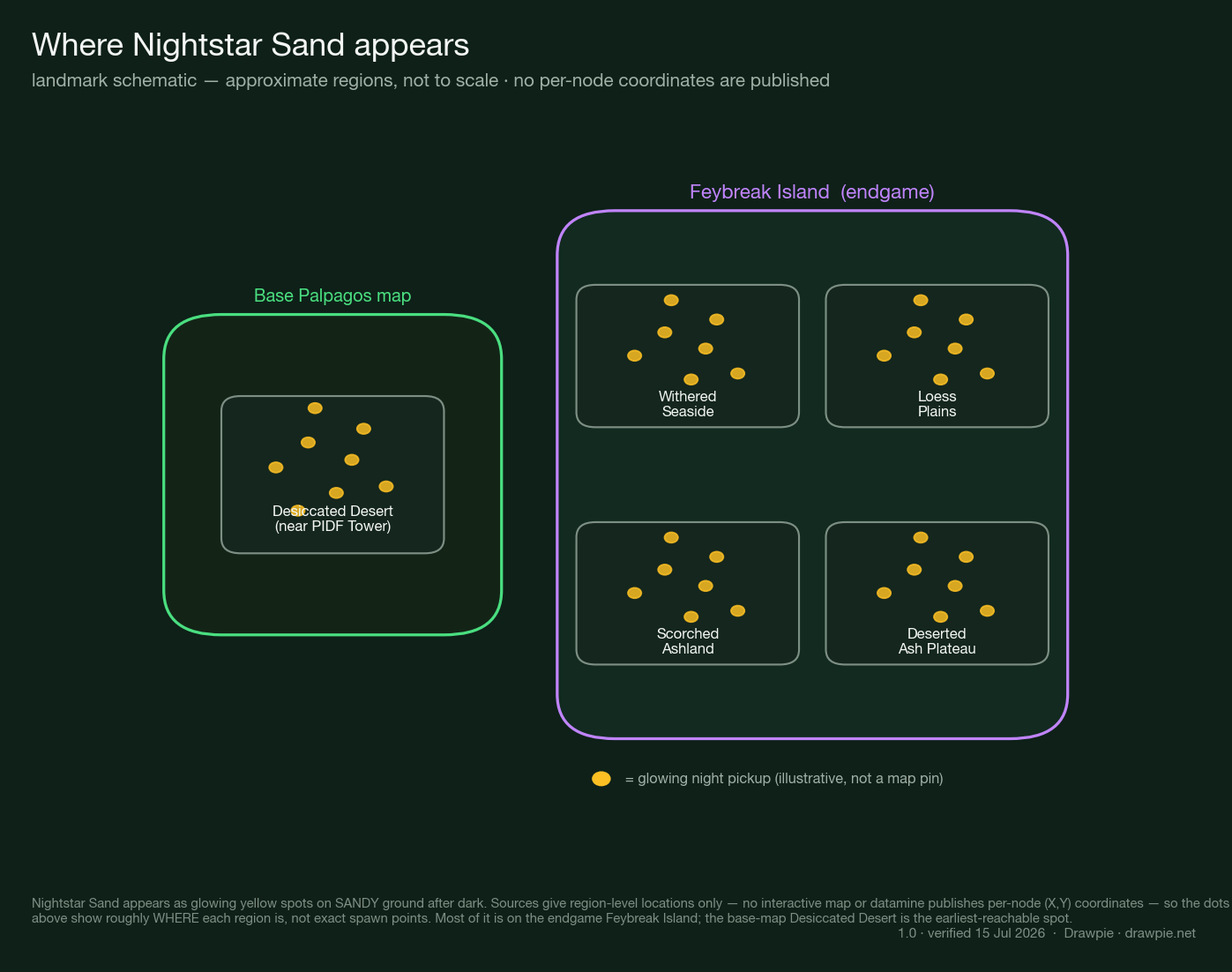
| Location | Region | Notes |
|---|---|---|
| Desiccated Desert (near PIDF Tower) | Base Palpagos map | Earliest-reachable spot — no Feybreak progression needed |
| Withered Seaside | Feybreak Island | Sandy coastline |
| Loess Plains | Feybreak Island | Sandy plains |
| Scorched Ashland | Feybreak Island | Harsher biome |
| Deserted Ash Plateau | Feybreak Island | Harsher biome |
Two things to keep straight:
- There are no exact coordinates. Every source describes these at the region level — “the Desiccated Desert,” “Withered Seaside” — and no datamine or interactive map pins individual nodes. So head to the region and sweep it after dark; the glow does the rest.
- The Pal-drop source is separate. Nightstar Sand is also a guaranteed 1–2 drop from the Pals Starryon Primo and Wistella. But those live in The World Tree endgame region (levels 74–76) — a completely different area from the sand nodes — and the amount is a flat 1–2 that does not increase with level. Treat it as a bonus while you’re up there, not a farming plan.
Farming spots compared
Because no one publishes node counts or yield numbers, there’s no honest way to rank these spots by output. What we can compare is the stuff that’s actually known — region, terrain, and a common-sense read on how hard each is to reach:
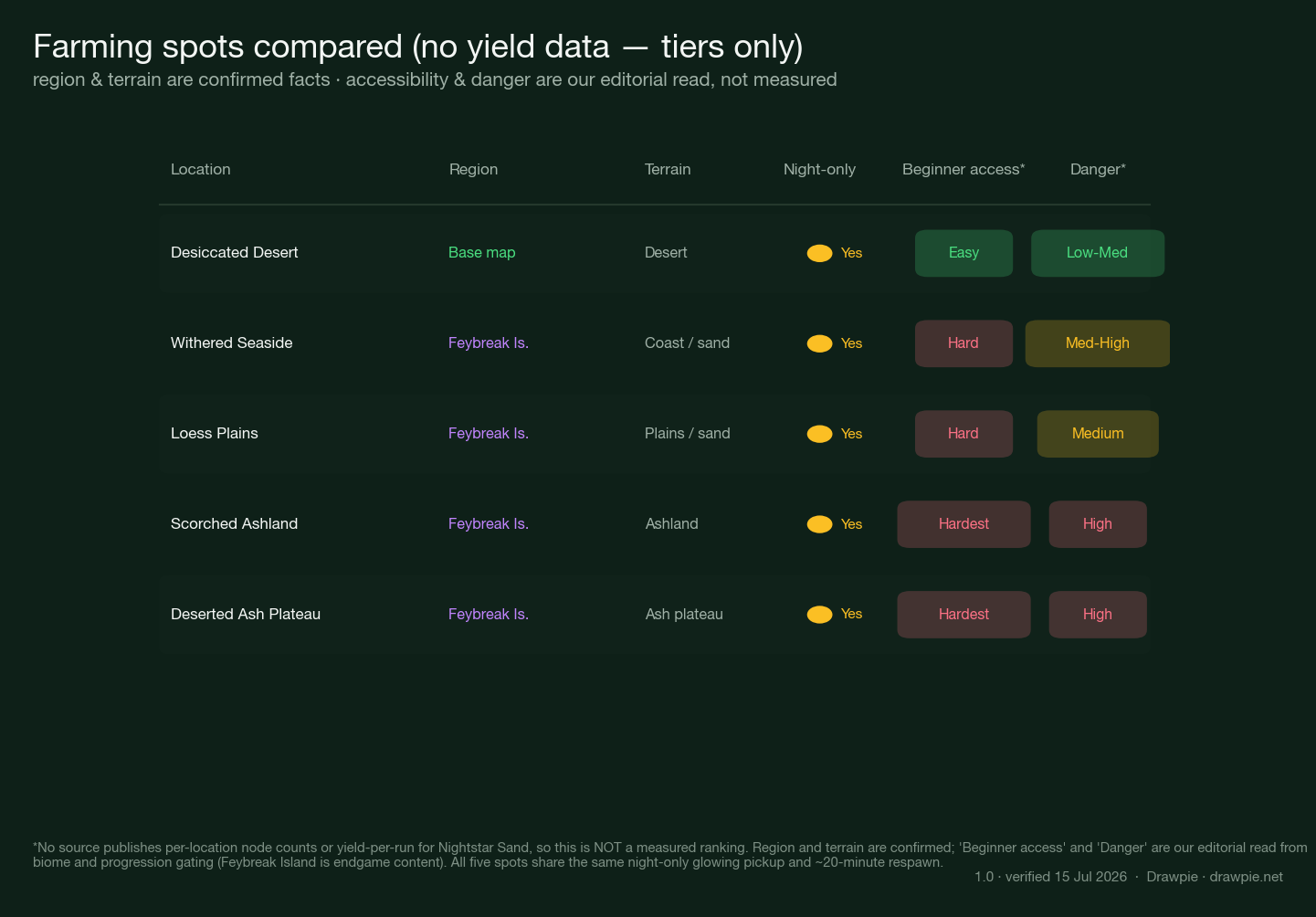
The one column that’s a hard fact: all five spots share the same night-only glowing pickup and the same ~20-minute respawn. “Beginner access” and “danger” are our editorial read from biome and progression gating — Feybreak Island is endgame content, so everything there is harder to reach than the base-map desert — not a measured ranking.
Which spot should you actually use?
Here’s the trade-off in one picture. It’s a judgment call, not a benchmark:
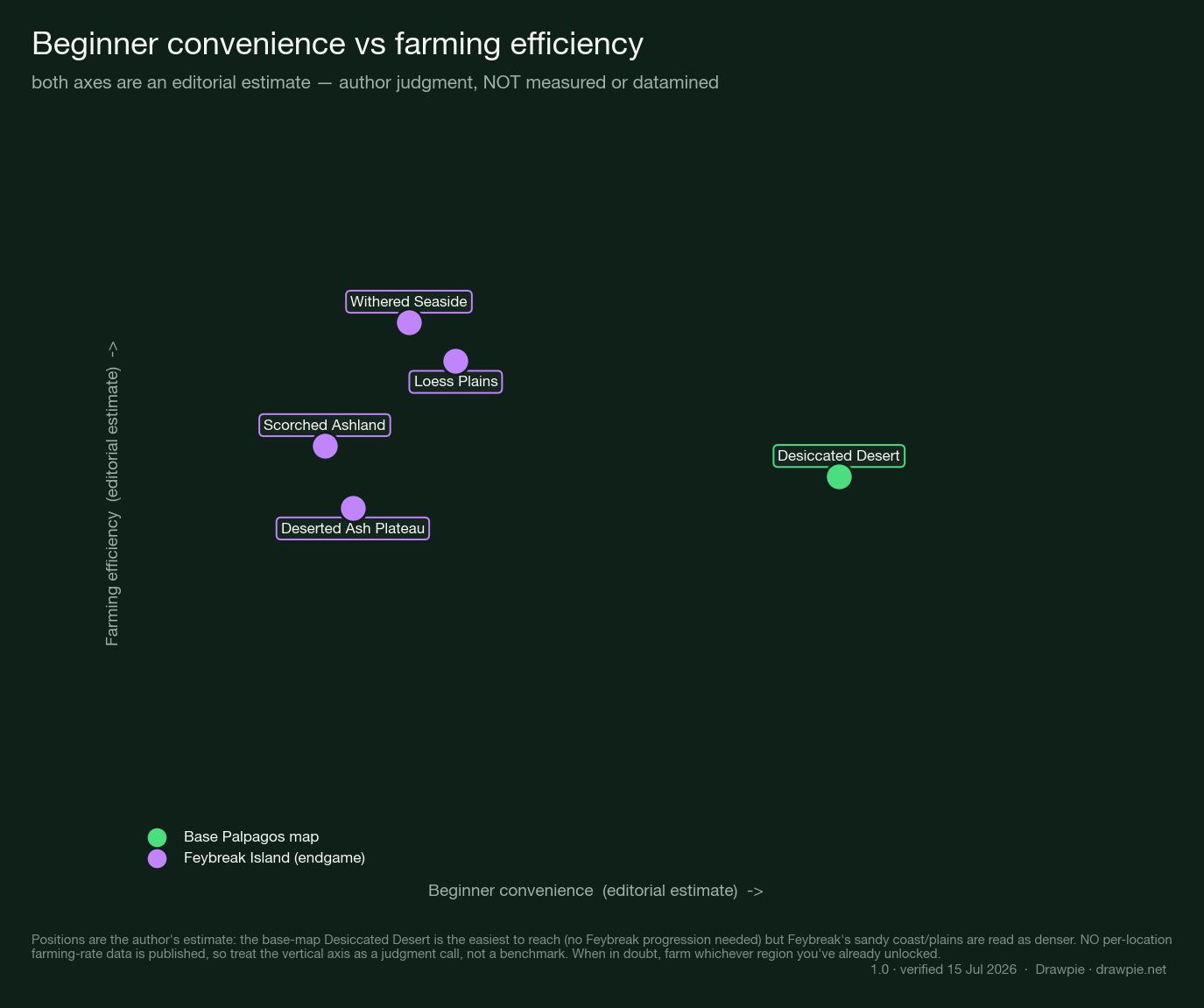
- If you’re still working through the base game, the Desiccated Desert is the answer — it’s the only spot you can reach without full Feybreak progression, and it’s plenty for early recipes.
- If you’re already on Feybreak Island, its sandy coast and plains (Withered Seaside, Loess Plains) are the denser-feeling sweeps, so farm whichever you’ve unlocked and can move through safely.
Because there’s no published farming-rate data, the vertical axis is a read, not a stopwatch. The practical rule: farm the region you’ve already unlocked rather than travelling for a spot that “might” be better.
How collection and respawn works
The farming loop is simple, and it hangs on the one solid number in this whole topic:
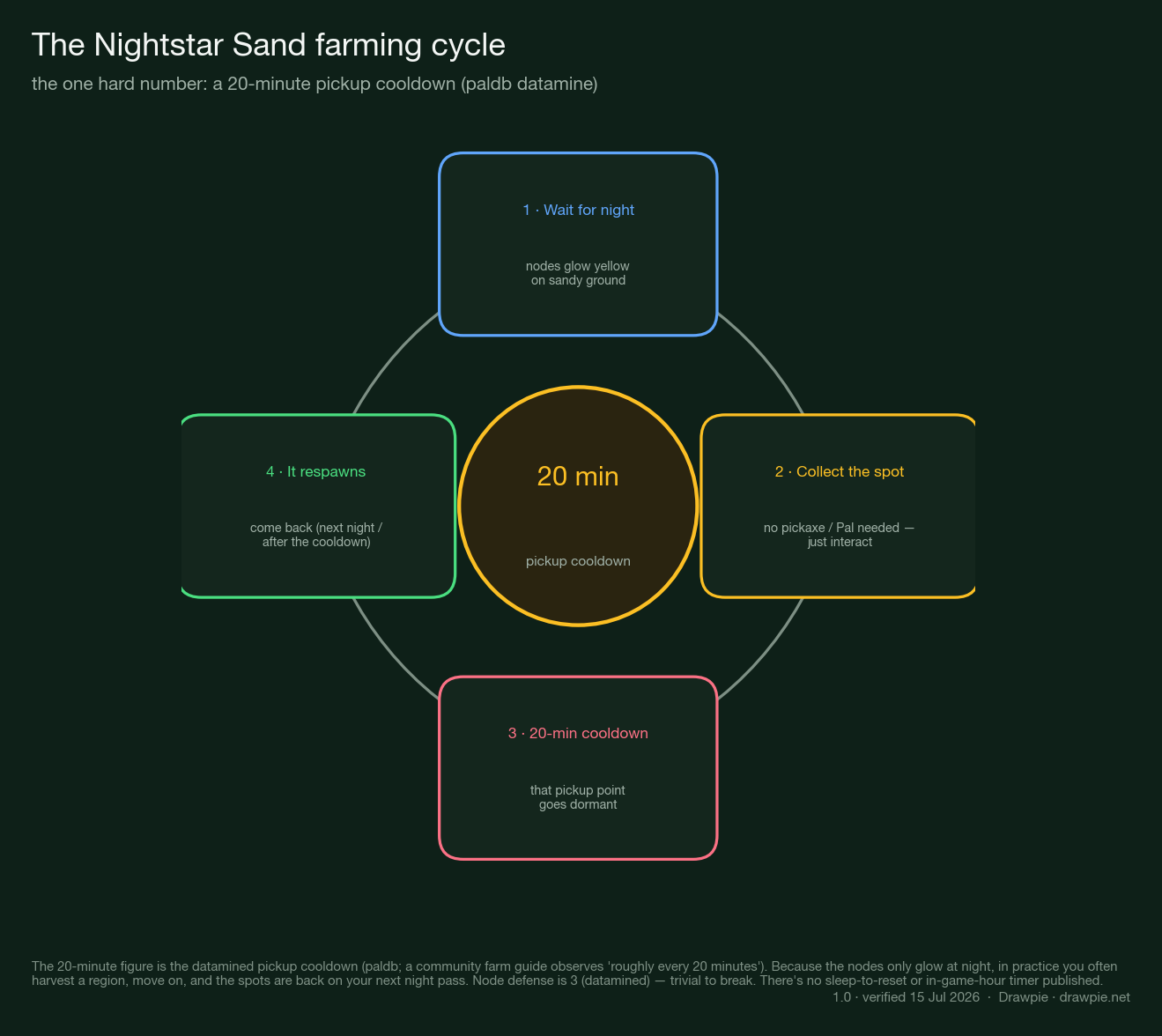
- Wait for night — the nodes only glow after dark.
- Collect the spot — walk up and interact; no tool or Pal required. (Node defense is 3 in the datamine, i.e. trivial.)
- 20-minute cooldown — that pickup point goes dormant. This is the datamined pickup cooldown (paldb), and a community farm guide independently clocks it at “roughly every 20 minutes.”
- It respawns — because the glow is night-gated, in practice you’ll often clear a region, move on, and find the spots back on your next night pass.
There’s no sleep-to-reset trick or in-game-hour timer published beyond that cooldown — so the efficient play is to loop a region each night rather than wait around.
What Nightstar Sand is used for
Nightstar Sand feeds roughly 20 datamined recipes, and the theme is clear: it’s the traversal-and-gadget material. Most of Palworld’s mobility gear runs on it.
| Item | Nightstar Sand | Category |
|---|---|---|
| Anti-Gravity Belt | 10 | Traversal |
| Beam Sword | 20 | Weapon |
| Metal Detector | 20 | Utility |
| Air Dash Boots | 20 | Traversal |
| Double Jump Boots | 20 | Traversal |
| Advanced Bow | 20–25* | Weapon |
| Double Air Dash Boots | 30 | Traversal |
| Triple Air Dash Boots | 40 | Traversal |
| Triple Jump Boots | 50 | Traversal |
*Advanced Bow: sources disagree (paldb 25 vs wiki.gg 20). The full Air Walker mobility line (Mk I/II/III/EX) and higher schematic tiers also use Nightstar Sand, but not every amount is published, so we’ve left those off rather than guess.
The takeaway: if you’re chasing double jumps, air dashes and the Anti-Gravity Belt — the gear that makes late-game exploration bearable — Nightstar Sand is the bottleneck, and the higher-tier boots (up to 50 for Triple Jump Boots) eat a lot of it. Stock up whenever you’re out at night on sandy ground.
Frequently asked questions
Where do you get Nightstar Sand in Palworld?
It appears as glowing yellow spots on sandy ground at night, mostly on the endgame Feybreak Island (Withered Seaside, Loess Plains, Scorched Ashland, Deserted Ash Plateau) and in the base-map Desiccated Desert near the PIDF Tower — the earliest spot you can reach. No exact coordinates are published; go to the region and sweep after dark.
Do you mine Nightstar Sand?
No. Despite the name and its “ore” datamine type, you don’t mine it — there’s no pickaxe or Mining Pal involved. You just walk up to the glowing spot and collect it.
How long does Nightstar Sand take to respawn?
Each pickup point has a 20-minute cooldown (datamined). Because the nodes only glow at night, in practice you’ll usually find them back on your next night pass through the region.
Can you farm Nightstar Sand during the day?
The glow is a night-only thing, so that’s when you find nodes. Sources disagree on whether an already-spawned node can still be grabbed after daybreak, so don’t rely on daytime farming — plan your runs for night.
What is Nightstar Sand used for?
Mainly Palworld’s traversal gear — the Anti-Gravity Belt (10), and the jump/air-dash boots line from 20 up to 50 for Triple Jump Boots — plus the Beam Sword (20), Metal Detector (20) and Advanced Bow. Around 20 recipes use it in total.
The bottom line
Nightstar Sand trips people up because the name says “mine me” and the reality is “gather me at night.” Get to a sandy region — the Desiccated Desert early, or Feybreak Island late — sweep the glowing spots after dark, and let the 20-minute cooldown refill them while you loop. It’s the material behind Palworld’s best mobility gear, so once you’re building double jumps and air dashes, you’ll want a steady night route.
More Palworld 1.0 farming, mapped out: Pure Quartz , Chromite , Cryogenic Coolant , and the full map guide .