Operation Economic Outcast: Bessent's 'Economic D-Day' Sanctions on Iran, Explained

- The campaign has an official name and it is not ‘Economic D-Day’. Treasury calls it Operation Economic Outcast. The D-Day phrase comes from Secretary Bessent’s own remarks, where it describes the opening of the campaign rather than the campaign itself.
- The largest structural change is five new sectoral determinations under Executive Order 13902: digital assets, technology, gold, aviation and shipping. That lets OFAC sanction any foreign person operating in those sectors, wherever they are.
- OFAC sanctioned nearly 60 entities, individuals, and vessels in multiple jurisdictions, covering nuclear and missile procurement, a state-directed cyber group, and oil-revenue networks running through the UAE, Hong Kong, China, Singapore, Switzerland and Europe.
- Treasury also suspended general licences that had authorised certain remittance payments to Iran and Iranian access to the US cultural and academic system — a withdrawal of existing permissions rather than a new prohibition.
- The part aimed at other governments is a clock. Treasury says every country will be given a defined timeline to shut down identified Iran-related activity, and that it will act itself if they do not.
The US Treasury has given the campaign a name, and it is not the one in the headlines. On 24 August 2026 it announced Operation Economic Outcast, which it describes as an unprecedented, whole-of-government economic campaign against Iran and its enablers. The “economic D-Day” phrase everyone quoted comes from Secretary Scott Bessent’s remarks that afternoon, where it describes the campaign’s opening rather than its name.
What was actually issued matters more than the branding, and most of it is structural.
What is Operation Economic Outcast?
A campaign announced on 24 August 2026, at President Trump’s direction, that bundles several different sanctions instruments into one push. Treasury’s release describes it as beginning “a sustained and systematic campaign” rather than a single action, and says the Departments of Treasury, State and War are approaching other governments in parallel.
The operative parts are four: new sectoral determinations, a large batch of designations, the suspension of some existing general licences, and new guidance about the Strait of Hormuz.
That last one is the least discussed and the most specific. OFAC issued guidance on the sanctions risks of “bowing to Iranian demands related to shipping in the Strait of Hormuz” — which is aimed at shipowners and operators making commercial accommodations to keep cargo moving, rather than at Iran directly.
What did Bessent actually say about a “D-Day”?
He drew the comparison himself, in prepared remarks Treasury published. His words were: “In the Second World War, D-Day marked the historic beginning of a campaign with our allies to target and drive the enemy from its positions, including those in third countries. Today, in that same spirit, we are launching an economic onslaught against Iran’s financial c…”
He also framed the choice facing Tehran in binary terms — “Iran now faces a very clear choice, with only two paths before them: complete global isolation and a subsistence economy, or a path back to normalcy, with an opportunity to rejoin the global economy.” — and described the enforcement standard as “we are enforcing a zero-leakage approach”. Those are the administration’s characterisations of its own policy, and this page reports them as such rather than as assessments of what the sanctions will achieve.
Which sectors of Iran’s economy are now exposed?
Five more than on 23 August. Treasury issued determinations covering digital assets, technology, gold, aviation and shipping under Executive Order 13902. The practical effect is that OFAC can now sanction any person operating in those sectors of the Iranian economy regardless of where that person is located.
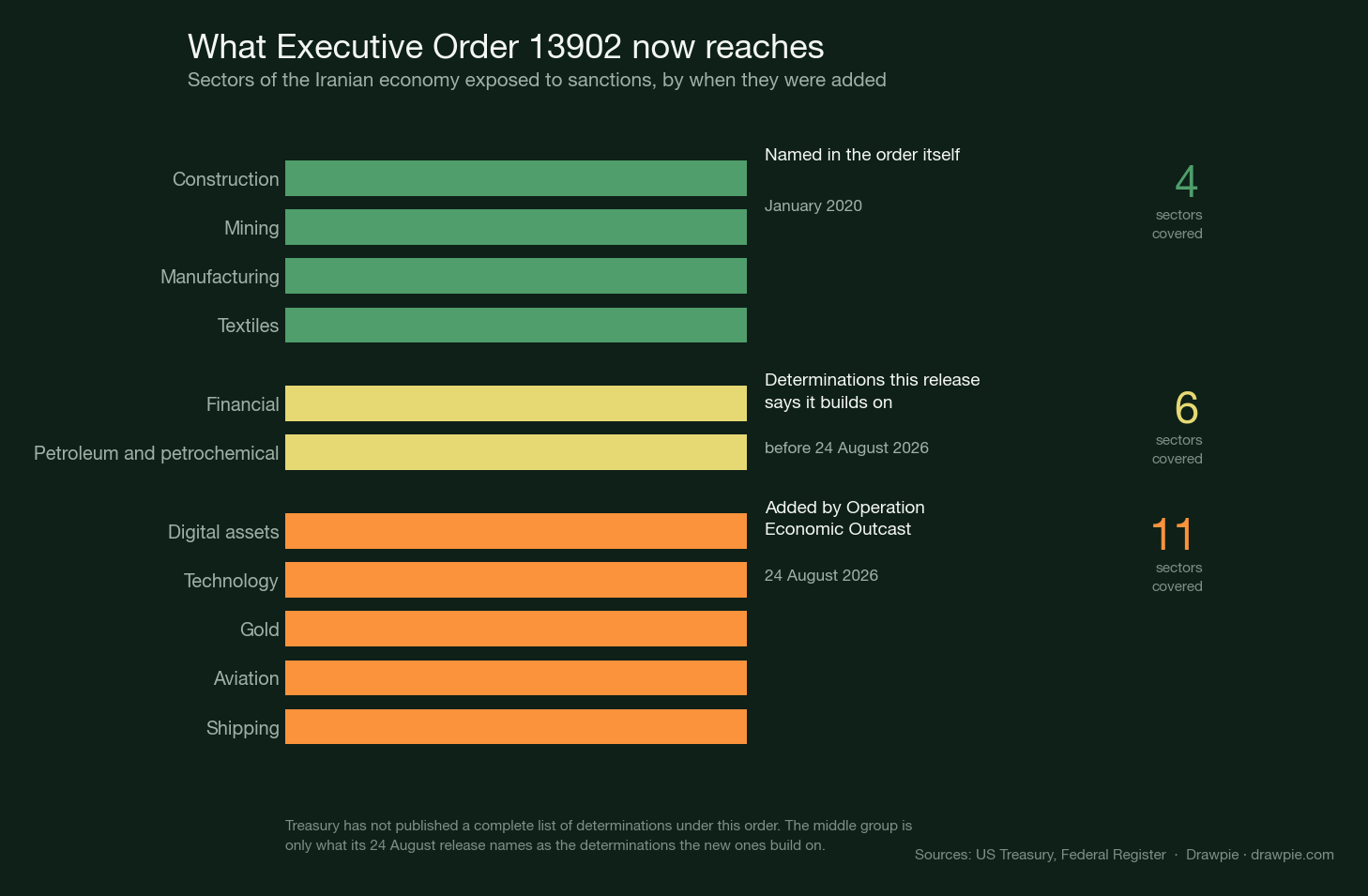
The chart separates three things that are easy to blur. The order itself, signed in January 2020, named construction, mining, manufacturing and textiles. Treasury’s own release says the new determinations “build on” earlier ones covering the financial and the petroleum and petrochemical sectors. The five from 24 August are the third group. Treasury has never published a consolidated list, so treat any single total as a reconstruction rather than an official figure.
How many people and companies were sanctioned?
OFAC sanctioned nearly 60 entities, individuals, and vessels. The release groups them into three networks: a procurement scheme serving Iran’s Ministry of Defence and Armed Forces Logistics, a cyber group directed by the Ministry of Intelligence and Security, and a shadow-fleet oil network.
The legal basis is not one authority but four. Treasury lists Executive Order 13382, which targets proliferators of weapons of mass destruction; Executive Order 13694 as amended, which targets malicious cyber activity; Executive Order 13902, the sectoral authority; and Executive Order 13224, the counterterrorism authority. Which one a given name falls under determines what it takes to remove it later.
The procurement action alone covers more than 20 entities and individuals across the Middle East and East Asia, tied to acquiring proliferation-sensitive equipment for entities including Malek Ashtar University of Technology. The cyber action was coordinated with the FBI, which on 18 August unsealed a superseding indictment charging 17 Iranian cyber actors; four of them were designated on 24 August. Separately the State Department designated seven members of Iran’s defense leadership and two Iranian entities.
Two details in the cyber portion are worth pulling out because they are dated facts rather than characterisations. Treasury notes that OFAC designated the Ministry of Intelligence and Security in September 2023 over the wrongful detention of US citizens, including former FBI agent Robert Levinson. And the State Department’s Rewards for Justice programme is offering up to $10 million for information on people acting for a foreign government who attack US critical infrastructure.
What does this mean for companies outside the United States?
More exposure, and a stated deadline. Treasury says it is expanding the categories of Iran-related conduct that may attract secondary sanctions, and states plainly: “Any entity that facilitates money laundering or sanctions evasion on behalf of Iran risks being cut off from the U.”
For governments the mechanism is explicitly a clock: “Every country will be given a defined timeline to shut down the Iran-related activity we have identified.” The release names the UAE, Hong Kong, China, Singapore, Switzerland and Europe as jurisdictions the oil network runs through, which is a reasonable guide to where that engagement is aimed.
Secondary sanctions exposure is worth stating precisely, because it is routinely described too loosely. It does not make a foreign company’s conduct illegal under its own law. It creates a risk that the United States designates that company, at which point its access to the US financial system and to US counterparties is cut. For a bank, a shipping line or a commodities trader, that risk is usually decisive long before any designation happens — which is the point of announcing the expansion rather than simply using it.
What did Treasury take away rather than add?
Permissions. OFAC suspended several general licences that had authorised certain remittance payments to Iran and Iranian access to the US cultural and academic system.
That is a different kind of move from a designation and it is worth separating. A designation adds a name to a list. Suspending a general licence removes a standing authorisation that people were relying on, which means conduct that was lawful on 23 August may not be on 25 August without a specific licence.
The two categories named — personal remittances and academic or cultural access — are also the ones least likely to involve the regime and most likely to involve ordinary Iranians and Iranian-Americans. Treasury did not say how long the suspensions run or what replaces them, and this page will not guess; but it is the part of the announcement whose effect falls furthest from the IRGC, and it deserves naming rather than being folded into a designation count.
How is this different from the earlier August actions?
Earlier actions named targets; this one changes the rules. The 7 August and 20 August actions were designations — including the 20 August move re-designating Hizballah as controlled by the IRGC’s Qods Force, which we covered separately.
Operation Economic Outcast does that too, at larger scale, but its durable component is the five sectoral determinations, because they expand who can be sanctioned in future without any further announcement. That is why the sector chart above is the part of this story most worth keeping.
What happens next?
By Treasury’s own account, enforcement rather than announcement. It says it has “mapped the networks, facilitators, and financial channels” Iran uses and will be “uncompromising” in targeting the regime’s illicit revenue, and that the countries it has approached now have timelines to act.
What that produces is not something this page will guess at. The checkable markers to watch are the ones this article is built from: further OFAC designations under the five new sectoral authorities, further suspensions or reissues of general licences, and whether any of the named jurisdictions announce action of their own before their timeline runs out.