Onimusha: Way of the Sword Review Round-Up: Every Score and Why They Disagree

- Nobody at this site has played it. This is a round-up of what other people published, not our verdict.
- OpenCritic has it at a Top Critic Average of 86 with 95% of critics recommending it, from 112 reviews.
- Metacritic runs 89 on Switch 2, 85 on PS5, 83 on PC and 83 on Xbox Series X/S.
- The Switch 2 figure is the highest and rests on 12 reviews. The PS5 figure rests on 91. It is not a ranking of the ports.
- Individual scores run from 100 down to 60 — a 40-point spread, with IGN at the top and Video Games Chronicle at the bottom.
- Not one critic review on any platform was scored negative, because Metacritic’s negative band for games starts below 50.
- Steam players are at 87.9% positive from about 8,900 reviews, which is a different measurement and is not averaged in.
- Reviews at both ends name the same flaws: padding, repetition in the back half, mid-game pacing. They disagree about how much that costs.
IGN gave it a perfect 10. Video Games Chronicle gave it 3 out of 5. They played the same game, in the same week, and — this is the part worth knowing — they largely agree about what is in it.
Onimusha: Way of the Sword arrived on 4 September 2026 from Capcom, on PS5, Nintendo Switch 2, Windows and Xbox Series X/S. It is the first mainline entry in the series in twenty years, and the critical response has a wider spread than the aggregate numbers suggest.
We have not played it. There is no Drawpie score here and no verdict from us. What follows is what other people published, with their names and numbers attached, plus the one thing the average hides.
The aggregate scores
| Source | Figure | From |
|---|---|---|
| OpenCritic | 86 Top Critic Average · 95% recommend | 112 reviews |
| Metacritic — Nintendo Switch 2 | 89 | 12 reviews |
| Metacritic — PlayStation 5 | 85 | 91 reviews |
| Metacritic — PC | 83 | 28 reviews |
| Metacritic — Xbox Series X/S | 83 | 10 reviews |
| Steam — players, not critics | 87.9% positive | ~8,900 reviews |
All four Metacritic figures sit in the band it labels generally favourable.
The Switch 2 number is a sample-size artefact
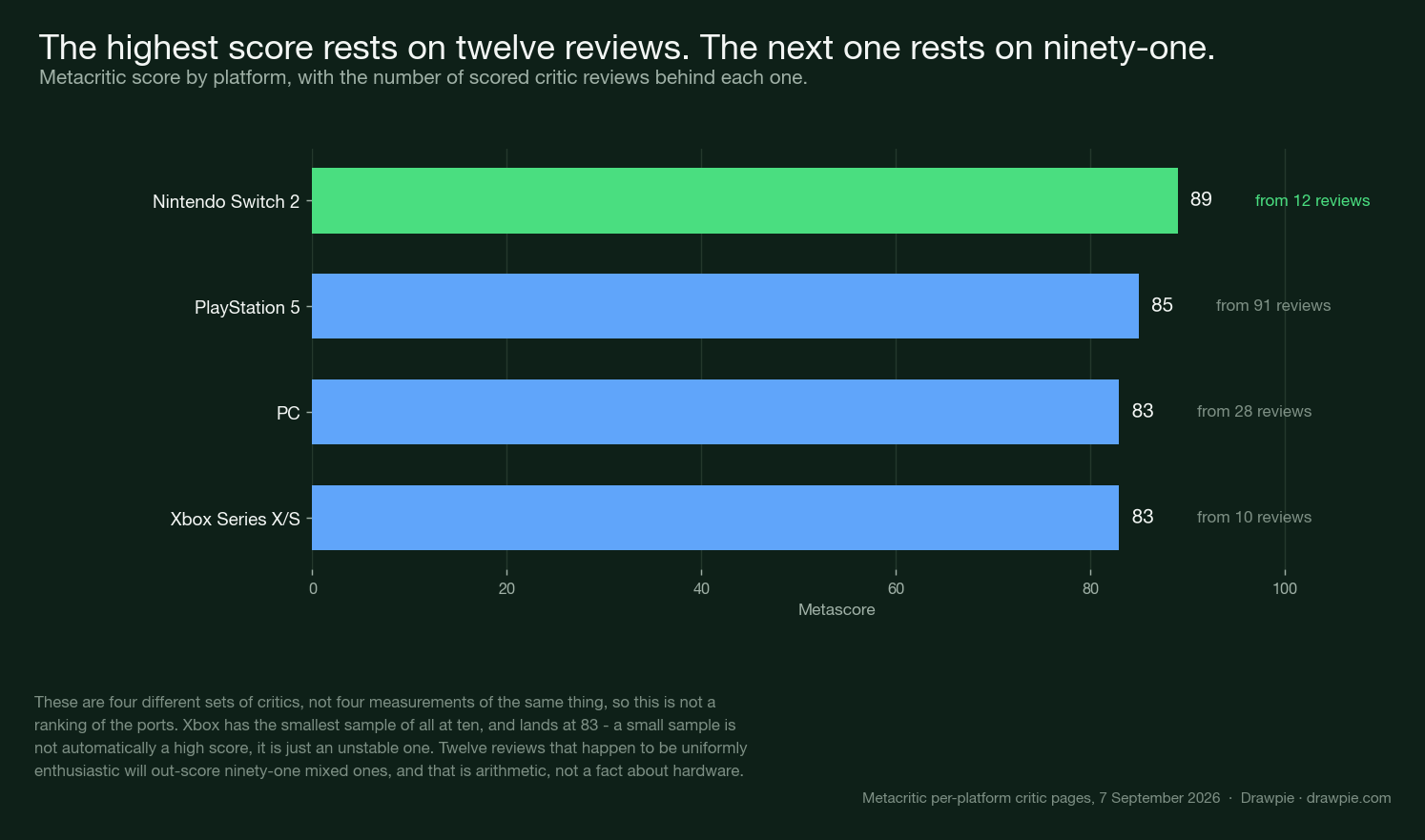
The highest score comes from the second-smallest sample.
The Switch 2 sits at 89 on the strength of twelve reviews, all positive. The PlayStation 5 sits at 85 on the strength of ninety-one, seven of which were mixed. Those are two different sets of critics, not two measurements of the same object.
Twelve uniformly enthusiastic reviews will out-score ninety-one mostly-enthusiastic ones every time. That is arithmetic, not a fact about the hardware — and the Xbox version, with the smallest sample of all at ten, landed on 83. A small sample is not a high score; it is an unstable one.
So no, this is not evidence that the Switch 2 version is the best one to buy. If you want that, you need reviews that compare the ports directly, and those are a different thing from four separately-computed averages.
The 40-point spread
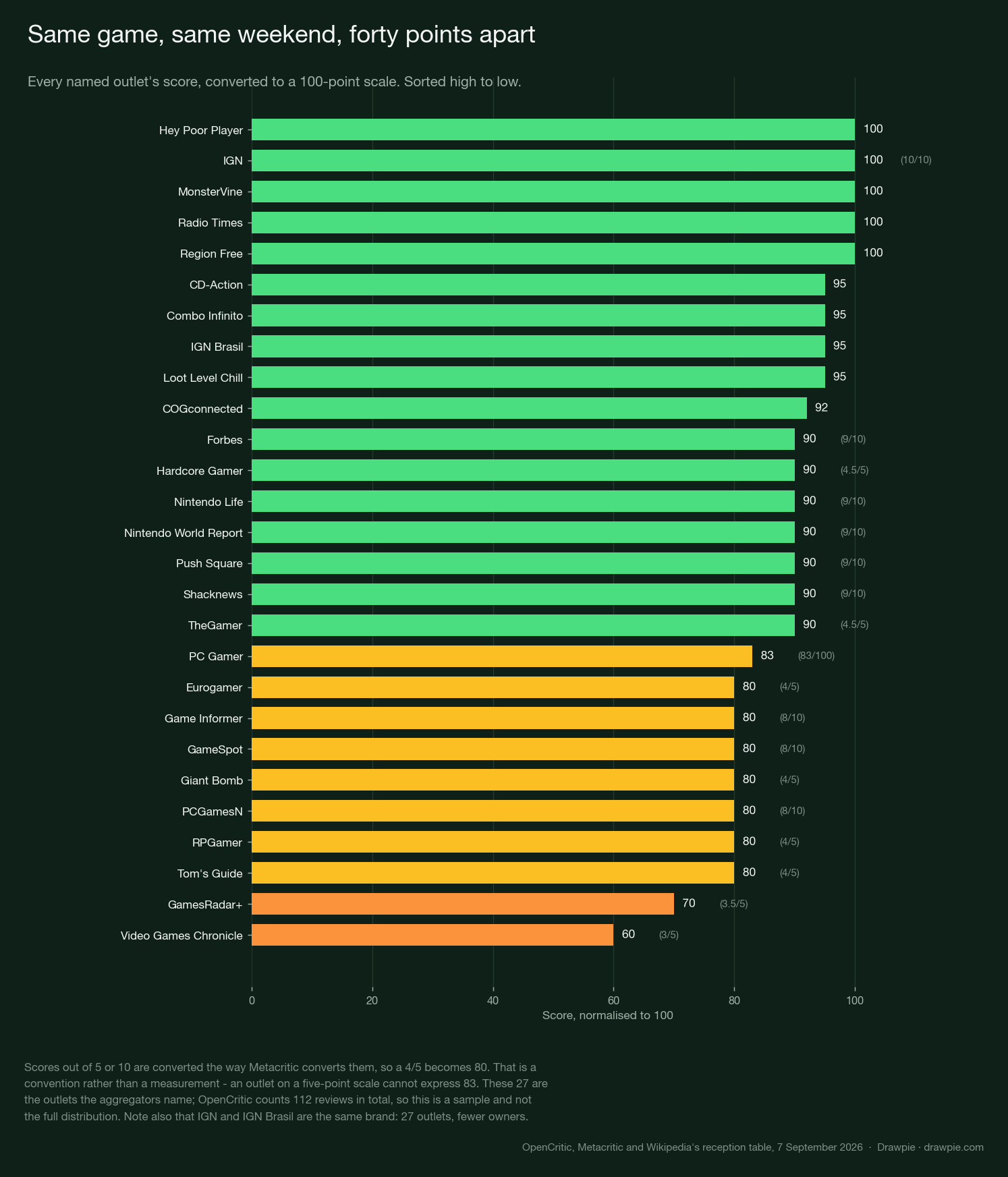
Twenty-seven named outlets, converted to a common scale:
| Score | Outlets |
|---|---|
| 100 | IGN · MonsterVine · Hey Poor Player · Region Free · Radio Times |
| 95 | CD-Action · Combo Infinito · Loot Level Chill · IGN Brasil |
| 92 | COGconnected |
| 90 | Forbes · Hardcore Gamer · TheGamer · Nintendo Life · Nintendo World Report · Push Square · Shacknews |
| 83 | PC Gamer |
| 80 | Eurogamer · Game Informer · GameSpot · Giant Bomb · PCGamesN · RPGamer · Tom’s Guide |
| 70 | GamesRadar+ |
| 60 | Video Games Chronicle |
Two cautions on that table. The clustering at 80 and 90 is partly an artefact — an outlet scoring out of five can land on 80 or 100 but never on 83, so five-point scales pile up on the round numbers. And these 27 are the outlets the aggregators put on their front pages, out of 112. It is a sample, and not a random one.
Nobody gave it a bad review. The scores still run 100 to 60.
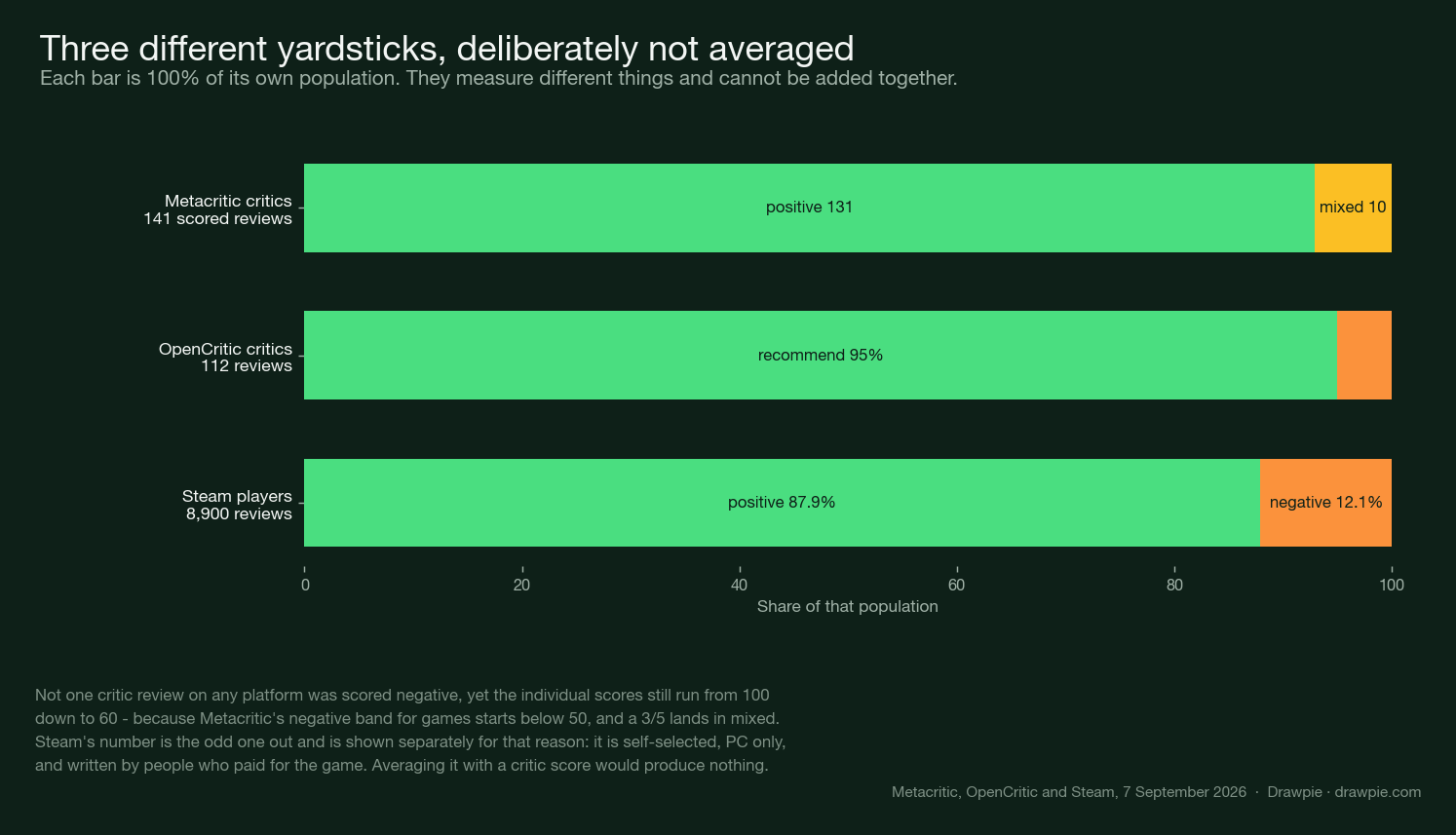
Across all 141 scored critic reviews on Metacritic, there is not a single negative one. 131 positive, 10 mixed, zero negative.
That sounds incompatible with a 60 until you know where the lines are: Metacritic’s negative band for games starts below 50. A 3/5 normalises to 60, which lands in mixed. So “no negative reviews” is true and much less impressive than it sounds — it means nobody scored it below half marks, not that nobody had reservations.
Steam sits apart deliberately. About 8,900 players are at 87.9% positive, which Steam labels Very Positive. That number is self-selected, PC-only, and written by people who chose to buy it. It is worth knowing and it is not comparable to a critic average, which is why it is a separate bar rather than folded into one.
What every reviewer agrees on
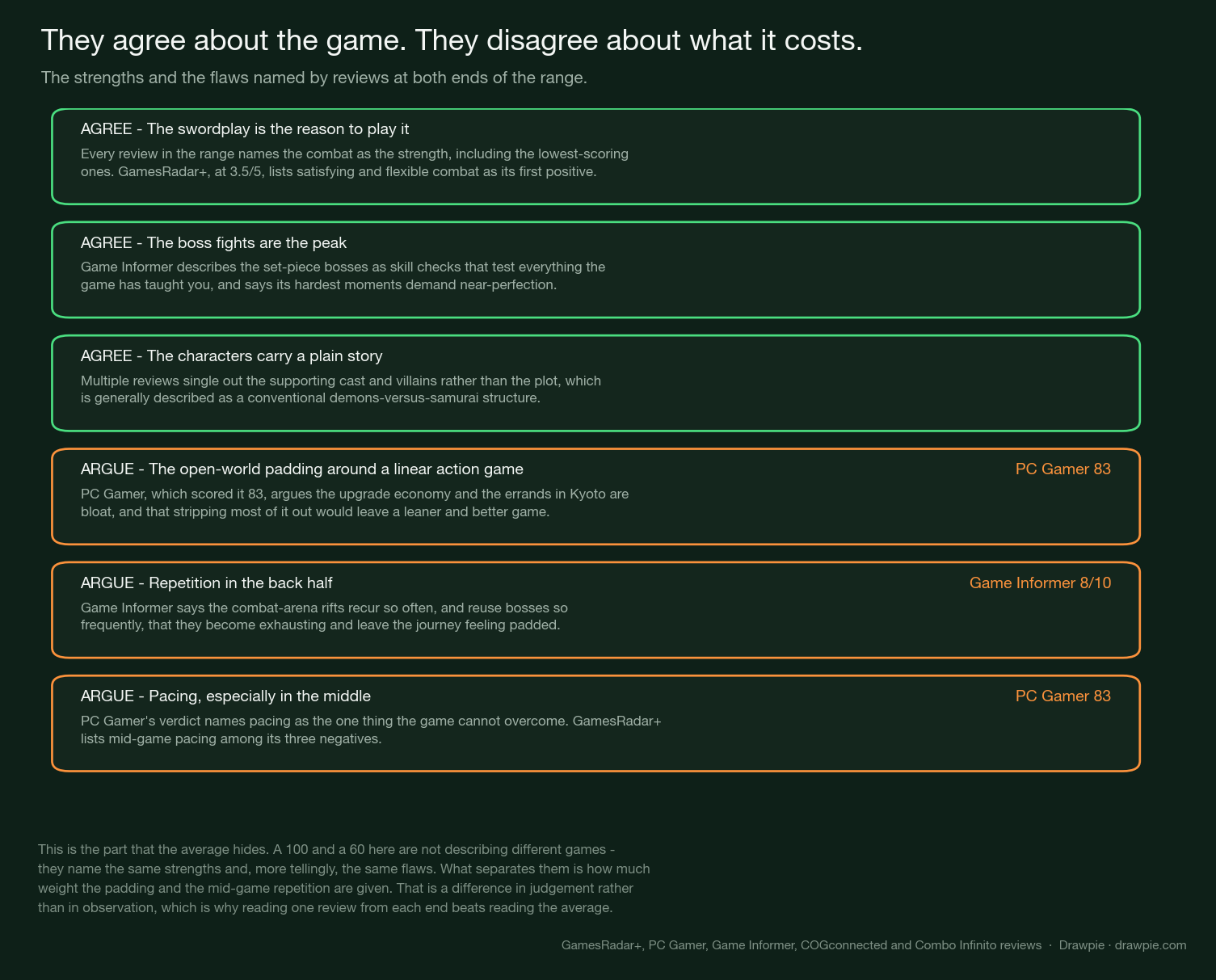
The swordplay. Every review in the range names the combat as the reason to play it — including the low ones. GamesRadar+, at 3.5/5, opens its list of positives with satisfying, flexible combat.
The boss fights. Game Informer describes the set-piece bosses as exams: skill checks that ask whether you have been using everything the game taught you, with its hardest moments demanding near-perfection.
The cast, more than the plot. Reviews consistently single out the villains and companions rather than the story, which is generally described as a conventional demons-versus-samurai structure.
And it is more forgiving than its reputation. GamesRadar+ makes the point that this is not a Soulslike: death costs you the last autosave, the difficulty ramps gradually, you can pause, and the game opens with an accessibility menu.
What they actually argue about
It is one thing, seen three ways: the modern open-world scaffolding built around a linear action game.
PC Gamer (83) is the bluntest. It calls the errands around Kyoto busywork and the upgrade economy bloat, and argues that stripping most of it out would leave a leaner game — and a better one. Its verdict names pacing as the one enemy the game cannot overcome.
Game Informer (8/10) lands on the same target from a different angle: the combat-arena rifts in the back half recur so often, and reuse bosses so frequently, that they become exhausting and leave the journey feeling padded.
GamesRadar+ (3.5/5) lists three negatives — inconsistent tone, a wonky difficulty curve, and mid-game pacing. Its reviewer found the game closer to a B-movie than a samurai classic, where other outlets read the same goofiness as charm.
Video Games Chronicle (3/5) is the lowest score, and its published headline points the same way: a series reborn with great fights, but carrying too many of the wrong modern lessons.
Notice what is not happening here. The 100s and the 60 are not describing different games. They name the same strengths and, more tellingly, the same flaws. What separates them is how much weight the padding and the repetition are given. That is a difference in judgement, not in observation — which is why reading one review from each end of the range tells you more than the average does.
How long it runs
Somewhere between 20 and 28 hours, and now with a range rather than a single figure.
- GamesRadar+ reached the credits at 28 hours, including side content.
- COGconnected puts it at roughly 20 hours.
- PC Gamer notes the contrast with the originals, which ran about three and a half and eight and a half hours.
That last point is the padding argument in numbers: this entry is several times the length of the games it is reviving, and the reviewers who dislike the additions are the ones pointing at where the extra hours came from.
So should you buy it?
We cannot tell you whether you will like it, but the reviews are unusually clear about who this is for.
Strong yes if you are here for the combat. That is the one thing 27 outlets agree on, and the people who scored it lowest agree on it too.
Think harder if open-world busywork is a dealbreaker for you. The reviews that scored lowest are not complaining about the fighting; they are complaining about what sits between the fights. If collecting upgrade materials in a hub city is the part of modern games you skip, the critics who share that view scored this 60 to 83.
And ignore the platform scores when choosing where to buy it. They measure different critic pools, not port quality.
If you want the systems rather than the verdicts — the three difficulty modes, the parry window, what the soul colours do — that is on our combat and difficulty guide .
The bottom line
An 86 average conceals a 40-point argument, and the argument is more useful than the average.
Everyone thinks the swordfighting is excellent. Everyone can see the padding around it. The reviews differ only on the exchange rate between those two facts — and that is a question about your taste, which no aggregate score has ever been able to answer.
Scores from OpenCritic game 20764, Metacritic’s four platform pages and Steam appid 2638890, all read on 7 September 2026, plus Wikipedia’s reception table. Drawpie has not played this game and publishes no score of its own.