Onimusha: Way of the Sword: Combat, Difficulty Settings and How Long It Takes
Update log (1)
- — Re-checked the scores three days after release and two of this page's claims did not survive. The Metacritic range had moved from 82-90 to 83-89, and more importantly the 'Switch 2 version highest' framing was an artefact of sample size — that 89 rests on 12 reviews where the PS5's 85 rests on 91. Both are corrected. The single-sourced 20-hour length now has a real range, 20 to 28 hours, from COGconnected and GamesRadar+. The stale per-platform chart has been removed rather than redrawn, because the full picture now lives on the review round-up this page links to.
Written from published material the day after release, when no community data existed. The completion-time gap has since been closed to a 20-28 hour range and the review section rewritten. Still outstanding: a boss list, verified upgrade costs, soul drop rates and a per-difficulty time breakdown. Fill the gaps section in when those appear.
Everything else on the page is unaffected; the figures below still say when they were read.

- There are three difficulty modes — Story, Action and Carnage — but only two are choices. Carnage does not unlock until you have finished the game once.
- Story is not just a damage adjustment. It widens the parry and Issen windows and turns on the button prompts, which changes what you are actually practising.
- The defensive timing window is a separate setting from the difficulty preset. You can run Action with a generous guard window, or tighten it on Story.
- Break Issen is the execution that becomes available once an enemy’s stamina is gone — the payoff for winning a timing exchange rather than trading hits.
- Souls come in three colours: yellow restores health, red pays for upgrades, blue unlocks special weapons.
- It runs roughly 20 to 28 hours depending on how much side content you do. There is still no per-difficulty breakdown.
- Metacritic runs 83 to 89 depending on platform, but the highest figure rests on 12 reviews against the PS5’s 91 — it is not a port ranking.
There are three difficulty settings, and one of them you cannot pick. There is also a fourth dial that most write-ups miss entirely.
Onimusha: Way of the Sword arrived on 4 September 2026 from Capcom, on PS5, Nintendo Switch 2, Windows and Xbox Series X/S. It puts Miyamoto Musashi — modelled on Toshiro Mifune — through a dark-fantasy Edo-period Kyoto.
Here is what the combat actually asks of you, which setting to start on, and how long it runs.
Which difficulty should you start on?
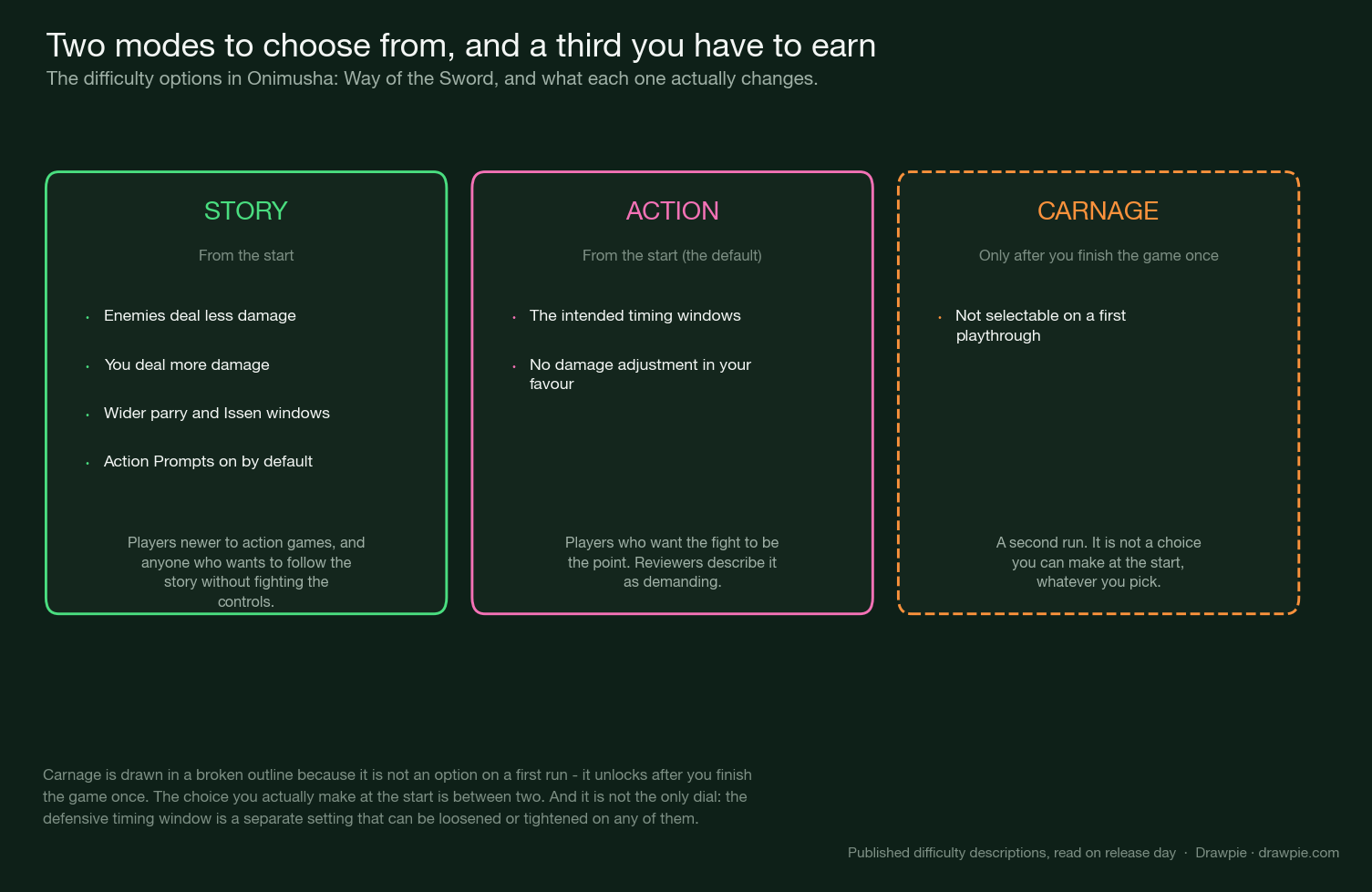
| Mode | Available | What it does |
|---|---|---|
| Story | From the start | Enemies deal less damage, you deal more, the parry and Issen windows are wider, and Action Prompts are on by default |
| Action | From the start — the default | The intended timing windows, with no damage adjustment in your favour |
| Carnage | Only after you finish once | Not selectable on a first playthrough |
So the real choice is between two. Carnage exists, but it is a second-run mode, and no amount of confidence at the main menu will get you into it.
Story is doing more than softening the numbers. Widening the parry and Issen windows changes the skill you are building. If your plan is to learn the timing and then move up, be aware that the timing you learn on Story is not the timing Action expects.
Reviewers broadly suggest starting on Story if you are not already fluent in this kind of combat, and several note that the difficulty curve is uneven — some stretches spike, others are trivial.
The setting almost nobody mentions
The defensive timing window is separate from the difficulty preset.
It controls how forgiving the input is for a perfect guard, and it can be adjusted independently. That means:
- You can play on Action with a generous guard window while you learn the rhythm.
- You can play on Story with a tight one, if you want the timing pressure without the damage penalty.
Most coverage treats difficulty here as a single dial. It is two, and the second one is the one that decides whether parrying feels fair.
The combat systems, explained
The grammar is small and it is meant to be:
- Striking, guarding and parrying, including deflecting incoming projectiles.
- Oni Vision, which locates demons in an area.
- Break Issen, the execution.
The whole design points at one behaviour: win the exchange rather than out-damage it. Trading hits is available. It is just not what the systems reward.
Break Issen and the parry window
Break Issen becomes available once an enemy’s stamina is gone, and it finishes them with a dismemberment.
That is the loop the game is built around. You pressure or parry until stamina breaks, then you take the opening. It is why the parry window setting matters more than the damage numbers — the window is what decides whether you can reach the payoff at all.
The three soul colours
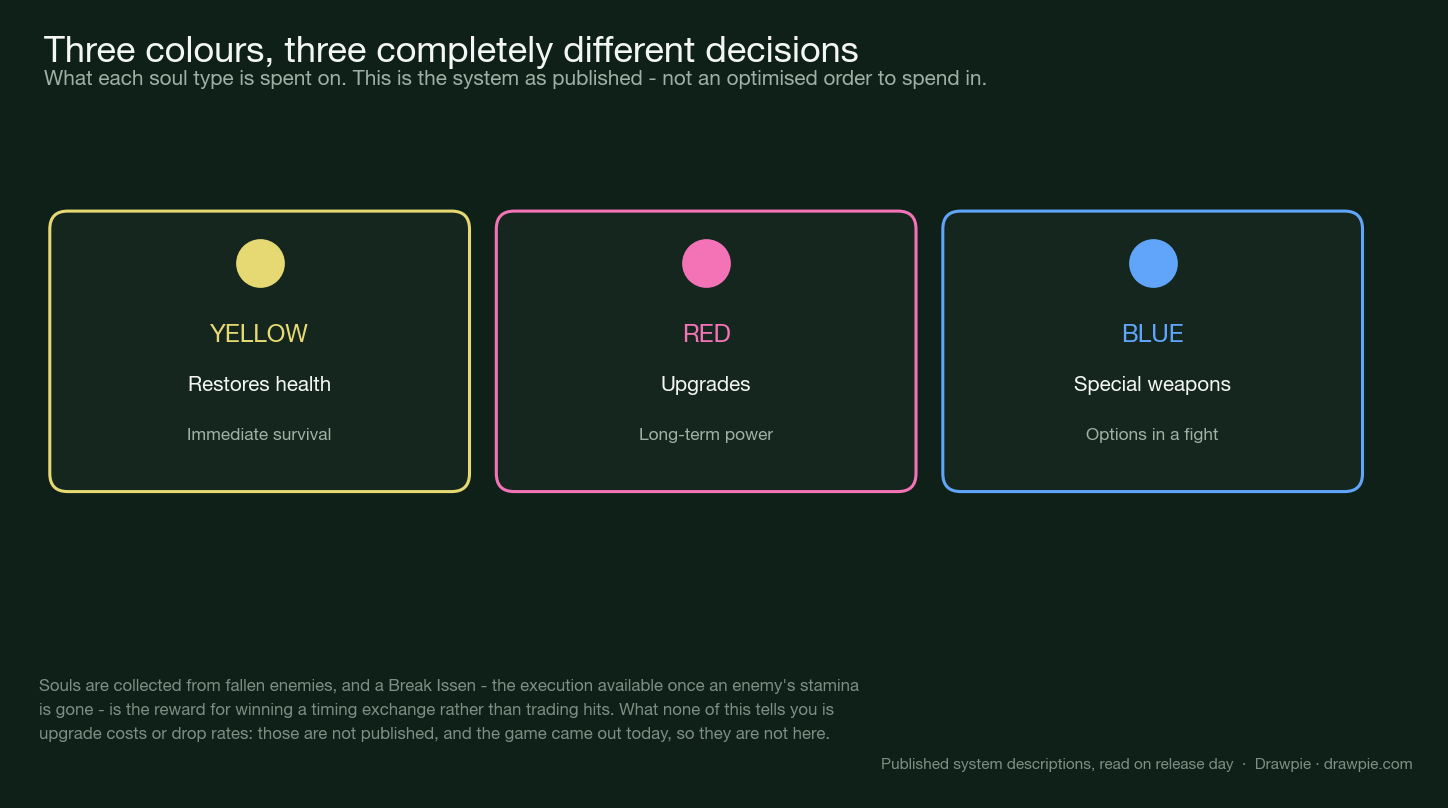
| Colour | Spent on | What it really is |
|---|---|---|
| Yellow | Restoring health | Immediate survival |
| Red | Upgrades | Long-term power |
| Blue | Special weapons | Options in a fight |
This is the system, not a build. Upgrade costs and drop rates are not published, and a day after release nobody has established them. Any page telling you the optimal spending order right now is guessing.
How long it takes
Roughly 20 to 28 hours.
That range replaces the single 20-hour figure this page carried on release day, when only one source had published one. It now has ends: COGconnected puts it at about 20 hours, and GamesRadar+ reached the credits at 28 hours including side content. The gap between those two is mostly how much of the optional material in Kyoto you engage with.
For scale, PC Gamer notes the original Onimusha games ran about three and a half and eight and a half hours — so this entry is several times the length of what it is reviving, and that extra length is exactly what the more critical reviews object to.
There is still no per-difficulty breakdown. Story will presumably run faster than Action for the same player; nobody has measured it.
How it reviewed
OpenCritic has it at a Top Critic Average of 86, with 95% of critics recommending it from 112 reviews. On Metacritic it runs 89 on Switch 2, 85 on PS5, and 83 on both PC and Xbox Series X/S — all inside the band it calls generally favourable.
Do not read the platform spread as a port ranking, and in particular do not read the Switch 2 figure as the best version. That 89 rests on twelve reviews; the PS5’s 85 rests on ninety-one. They are different sets of critics, not different measurements of the same thing.
The individual scores are far more spread out than an 86 average suggests — from 100 down to 60 — and the reviews at opposite ends name the same flaws as each other. We have taken all of that apart in the full review round-up .
What we can’t tell you yet
Being straight about the holes, because a guide published the day after release has them:
- No boss list, and no count of how many there are.
- No upgrade costs or soul drop rates.
- No completion times by difficulty, or by how much optional content you do.
- No optimised build order, for the same reason.
All four of those come from players accumulating hours, and the hours do not exist yet. They will within weeks, and this page is dated so you can tell how old its gaps are.
The bottom line
Start on Story unless you are already good at this, then go to Action — and change the defensive timing window separately, because that is the setting that actually decides how the game feels.
Break stamina, take the Issen. Yellow heals, red upgrades, blue arms. About twenty hours, and Carnage is waiting on the other side of the credits.
Systems, platforms and scores from the game’s published information, read on 5 September 2026. Difficulty detail corroborated across several outlets. Nobody at this site has played it — there is no review here.