Nvidia Stock ($NVDA): Hugging Face Acquisition Report and What Already Shipped

- The $12.9 billion figure is a report, not an announcement. The Information reported an agreement on 26 August 2026; Business Insider had reported days earlier that talks had produced no signed agreement and could still collapse. Neither company has commented.
- There is no SEC filing. Nvidia’s two most recent 8-Ks, on 17 and 26 August, cover an SB Energy partnership and quarterly results. A transaction of this size would require disclosure, and none exists as of this writing.
- Whatever happens to the deal, the integration is already deep. Hugging Face’s price list is denominated in Nvidia part numbers — T4, L4, L40S, A100, H100, H200, B200 — and the word ‘DGX’, the brand the two announced joint services under, appears zero times on that page.
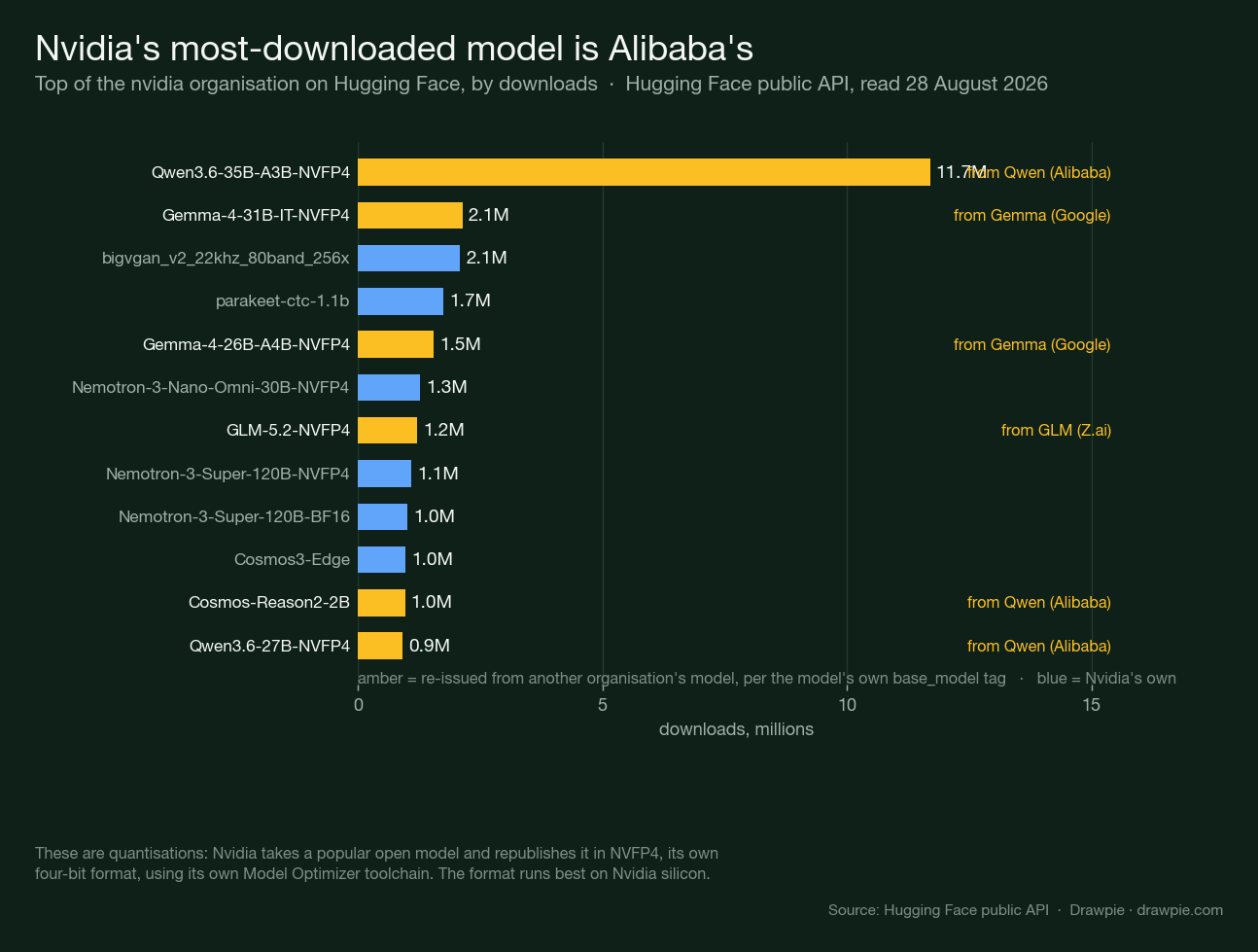
- Nvidia is already one of the Hub’s largest publishers: 920 models, 54.2 million downloads. But 196 of those models and half of those downloads are other organisations’ models, re-issued in Nvidia’s own NVFP4 format. Its single most-downloaded model is Alibaba’s.
On the evening of 26 August 2026, The Information reported that Nvidia had agreed to buy Hugging Face for $12.9 billion. Days earlier, Business Insider had reported that Hugging Face was fielding takeover interest and that the talks had produced no signed agreement and could still fall apart.
Both things can be true. What is certain is narrower than either headline, so start there.
Has Nvidia actually agreed to buy Hugging Face?
Not as far as any disclosure shows. It is a report from two outlets, uncorroborated by either company, with no filing behind it.
Three places the news is not:
- Nvidia’s newsroom. No acquisition language of any kind.
- Hugging Face’s blog. The same.
- Nvidia’s SEC filings. Its two most recent 8-Ks are 17 August, an Item 1.01 covering a multi-year partnership with SB Energy, and 26 August, an Item 2.02 attaching quarterly results. Neither mentions Hugging Face.
A $12.9 billion acquisition is material for a company of any size and requires prompt disclosure. Its absence from the filing record is not proof that no talks are happening — Business Insider’s own framing was that nothing had been signed — but it is the difference between “reported” and “announced”, and most coverage of this has not made that check.
Neither company responded to requests for comment. TechCrunch noted that Nvidia’s silence is itself unusual, since the company has previously moved fast to correct reports it considers wrong.
If the deal is not confirmed, what is?
The integration, which is already deeper than any of the joint announcements suggested. This is the part that does not depend on the report being right.
Hugging Face rents GPU time, and every option in its price list is an Nvidia part: T4, L4, L40S, A100, H100, H200 and B200, each with an hourly rate. The word “NVIDIA” appears 37 times on that page. The word “DGX” — the brand under which the two companies announced their joint services — appears zero times.
The second half is a publishing account, and it is large.
Why is Nvidia publishing other companies’ models?
Because the format is the product. The top item on that chart is a quantisation: Nvidia takes an open model — here Alibaba’s Qwen — converts it to NVFP4, its own four-bit numeric format, using its own Model Optimizer toolchain, and republishes it.
NVFP4 runs best on Nvidia silicon. So the most convenient way to run the most popular open models at low precision arrives pre-packaged for the hardware Nvidia sells. Nobody has to be persuaded of anything; the default path simply routes through Nvidia’s software.
None of it is concealed. Every one of those models declares its parent in a base_model tag, which is how they are counted here.
How big is that position, in numbers anyone can check?
920 models, 54.2 million downloads, and half of that traffic is re-issued from elsewhere.
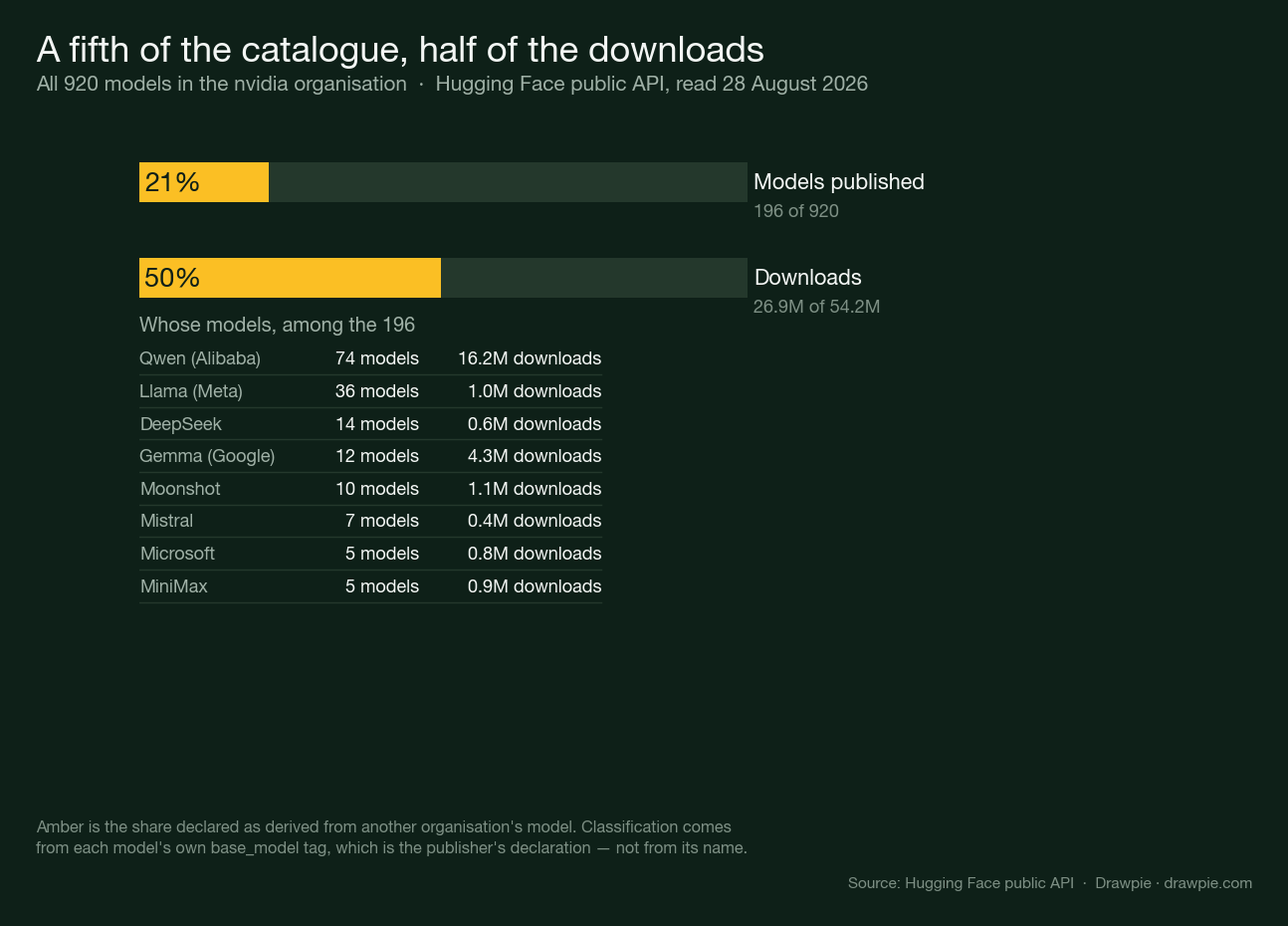
The asymmetry is the point: a fifth of the catalogue by count, half of it by use. Qwen alone accounts for 74 models and 16.2 million downloads — more, on its own, than every Google-derived, Meta-derived and DeepSeek-derived model in the account combined.
What happened to the services the two companies announced?
Two of the five things on this list are on a live product surface. Three are not.
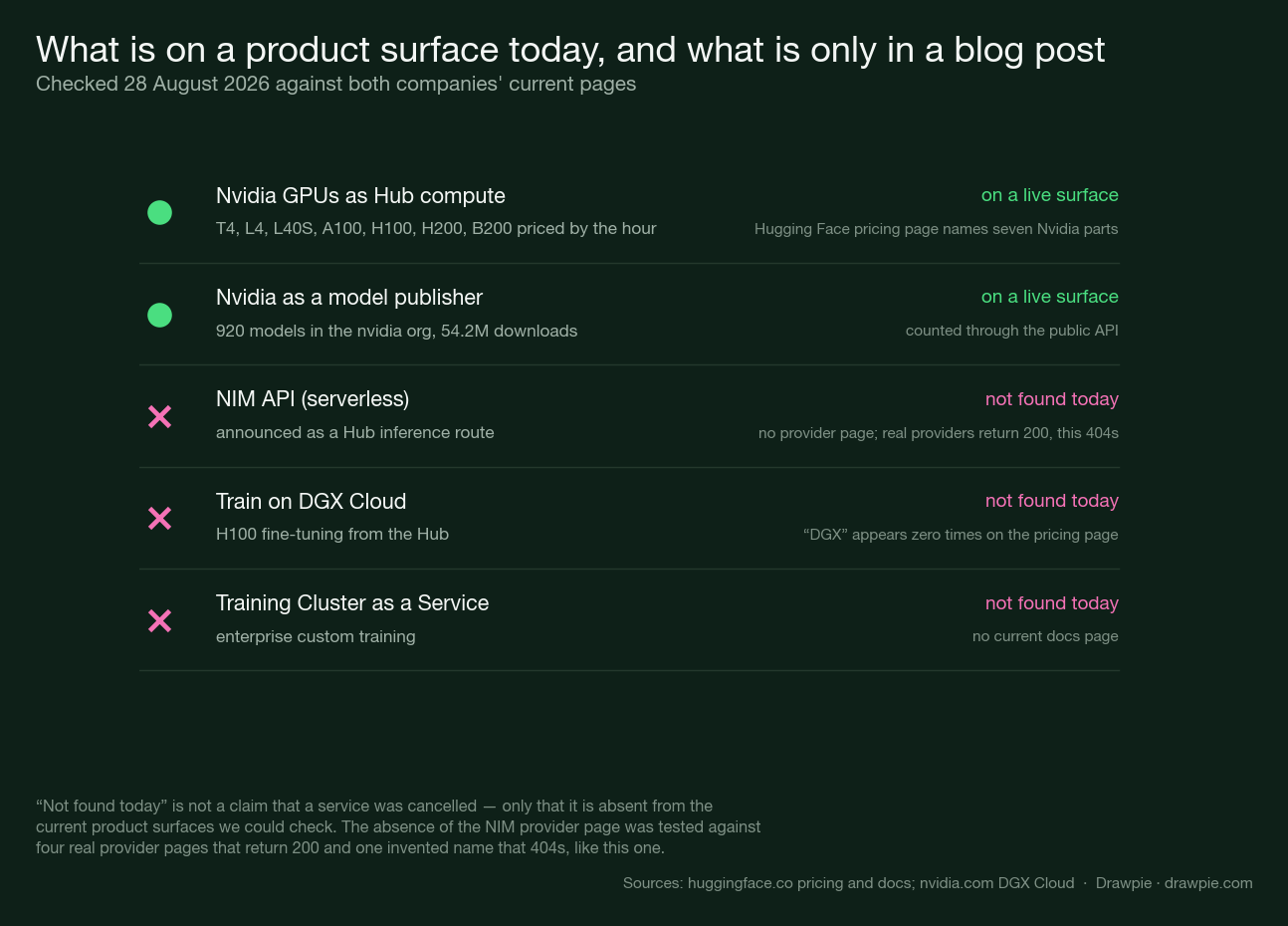
The NIM absence is the most checkable. Hugging Face documents its inference providers one page each: nebius, together, groq and cerebras all resolve. The equivalent addresses for nvidia and nvidia-nim return 404 — the same response as a provider name invented for the test. Ask the Hub’s API which providers serve that Qwen model and it names deepinfra, featherless-ai and scaleway. Nvidia is not among them.
Nvidia’s own DGX Cloud page, half a megabyte of it, does not contain the words “Hugging Face”.
That is not proof anything was cancelled. Services get renamed, move behind enterprise sales, or live on pages we did not find. But a reader going looking today, on the pages both companies actually maintain, will not find them — and a partnership route that has gone quiet is a plausible thing to replace with ownership.
Why would anyone pay $12.9 billion for this?
Because of what the numbers above describe: a position in how open models are distributed.
The reported price is worth holding against one earlier figure. TechCrunch cites the Financial Times reporting that Hugging Face turned down a $500 million Nvidia investment in late 2025 that would have valued it at $7 billion. If the current report is accurate, the number roughly doubled inside a year — and the refusal is at least as interesting as the price.
This page does not have a view on whether $12.9 billion is a sensible number. What it can show is what a buyer would be buying: the price list every open-model developer meets when they rent a GPU, and the catalogue where the most convenient copies of everyone else’s models already arrive in the buyer’s own format.
What would Nvidia actually be getting?
Four things, and the measurements above describe three of them.
The storefront rather than a shelf in it. Today Nvidia’s parts are the entire GPU menu on someone else’s price list. Owning the Hub turns the company that supplies the hardware into the company that sets the rental terms for it — the same chips, but on its own counter.
A format decision that becomes a platform default. Nvidia’s NVFP4 re-issues already out-download its own original models. Today that is one publisher’s choice competing for attention among two million models. Inside the platform, the question of which quantisation a developer meets first stops being a matter of search ranking.
Scale it currently rents. Hugging Face’s own front page counts more than 2 million models, more than 1 million applications and over 500,000 datasets. Nvidia’s presence inside that — 920 models, 310 datasets, 64 Spaces — is a rounding error by count and one of the busiest accounts by traffic. Ownership converts “large tenant” into “landlord”.
A route back into selling compute directly. This one is not our inference: it is the rationale the reporting itself put forward, that the Hub already lets developers rent compute and would give Nvidia a ready-made outlet for capacity. Take it as the reporters’ reading rather than a measured fact.
There is also the negative case for buying, which the audit above sketches: the co-branded partnership route — NIM serverless, Train on DGX Cloud, Training Cluster as a Service — is not on either company’s current product surface. A route that has gone quiet is a plausible thing to replace with ownership rather than another announcement.
What would it not be getting?
The models. Those belong to other people, and that is the whole difficulty.
The traffic measured here runs through Qwen, Llama, Gemma, DeepSeek and the rest. Nvidia re-issues them; it does not own them. Alibaba can publish where it likes, and so can Meta and Google. Buying the shop does not buy the stock on its shelves — it buys the position of being the place people go to get it, which is a real asset and a conditional one.
That condition is neutrality. The Hub is valuable because everyone posts there, including firms whose interests are opposed. A chip supplier owning the main distribution point gives every rival chip supplier, and every model publisher who competes with Nvidia’s own Nemotron line, a reason to think about where else to post. Nothing about the reported price changes that; it is the thing the price would be buying, and the thing that could be spent.
And a transaction of this size is not a private matter between two companies. Acquisitions at $12.9 billion go through merger review in multiple jurisdictions, which is a process with its own timetable — one more reason the gap between “reported” and “completed” is wider than a headline makes it look.
Does any of this tell you what the stock is worth?
No, and this page will not pretend otherwise.
You can read what is above as evidence about a distribution position — how open-model developers actually get their models, and whose software sits in that path. That is real, and it is measurable, which is why it is here.
What it is not is a valuation. This site does not publish price targets, does not forecast where a share price goes, and does not republish other people’s targets. It also does not handicap unsigned transactions: whether this deal closes, changes price, or evaporates is not something anyone outside the room can know, and the reporting itself says nothing has been signed.
If you came here for a number to act on, the honest answer is that this page is upstream of that decision, not a substitute for it.
How can I check all of this myself?
Everything above is public and none of it needs an account.
- The filing record:
data.sec.gov/submissions/CIK0001045810.jsonlists Nvidia’s filings, most recent first, with form types and dates. - The catalogue: the Hub’s API answers
https://huggingface.co/api/models?author=nvidia&sort=downloads&direction=-1&limit=100&full=true, paginated through theLinkheader. Each model’s declared parent is in itstagsarray asbase_model:owner/name. - A single model:
https://huggingface.co/api/models/nvidia/Qwen3.6-35B-A3B-NVFP4returnscardData.base_modeldirectly. - Inference providers:
huggingface.co/docs/inference-providers/providers/<name>returns 200 for a real provider and 404 otherwise.
One trap, since it cost us a wrong answer before it was caught: the list endpoint does not return cardData, even with full=true. Read the base_model: tag instead. Reading cardData.base_model from a list gives None for every row, and a very confident, very wrong zero.
How we verified this
🔴 The acquisition is reported, not announced, and this page never says otherwise. The Information reported an agreement on the evening of 26 August 2026. Business Insider had reported over the preceding weekend that Hugging Face was fielding takeover interest and that the talks “had not yet produced a signed agreement and could still atomize”. CNBC, Fortune, TechCrunch and others carried the report. Neither company responded to requests for comment.
🔴 We checked for a filing rather than assuming there wasn’t one. Nvidia’s SEC submissions history shows its two most recent 8-Ks as 17 August (Item 1.01, a multi-year partnership with SB Energy) and 26 August (Item 2.02, quarterly results). Neither mentions Hugging Face. A $12.9 billion acquisition by a company of this size would require prompt disclosure; as of writing, there is none.
✅ Neither company’s own channels carry it either. Nvidia’s newsroom index and Hugging Face’s blog were both read directly; neither contains any acquisition language. That is three independent places the news is not, which is what makes “reported” the correct word rather than “announced”.
🔴 No price target, no valuation, no forecast appears on this page, and no view is offered on whether the deal should or will complete. Everything measured here is a product figure.
⚠️ The $7 billion refusal is second-hand and labelled as such. The Financial Times is cited by TechCrunch as reporting that Hugging Face declined a $500 million Nvidia investment in late 2025 at a $7 billion valuation. We have not seen that report directly and it is attributed here to the outlet that carried it.
🔴 Model classification comes from each model’s own declaration, not its name. An earlier pass matched names for “qwen” and “gemma”, which is a heuristic. The figures here read the base_model: tag the publisher records.
⚠️ That fix was forced by a silent failure. Reading cardData.base_model from the Hub’s list endpoint with full=true returned nothing for all 920 models and produced the clean, confident, entirely false result that 0% of the catalogue derives from anyone else. The list endpoint carries no cardData; the declaration lives in tags. It was caught only because a single-model lookup had already shown otherwise.
✅ The absent NIM route was tested with controls. Provider pages for nebius, together, groq and cerebras return 200; nvidia and nvidia-nim return 404, as does an invented provider name. The Hub’s API separately names deepinfra, featherless-ai and scaleway as serving that Qwen model, and no Nvidia entry.
✅ The scale figures are each side’s own. Hugging Face’s front page states more than 2 million models, more than 1 million applications and over 500,000 datasets. Nvidia’s own organisation page states 920 models, 310 datasets and 64 Spaces; an independent paginated crawl of the API returned exactly 920, so two methods agree on the number this piece leans on.
⚠️ The “route back into selling compute” is the reporters’ reasoning, not a measurement, and the page labels it that way. The other three items in that section are things counted on live pages.
⚠️ Download counts are a snapshot taken 28 August 2026 and move daily. The shape — a fifth of the catalogue, half the traffic — is more durable than any single number, and the last section shows how to re-run the count.