Nvidia's $3.5B MediaTek Bet Explained: Custom AI Chips, NVLink Fusion & What It Means for NVDA

- Nvidia did not buy a stake. Both companies’ releases say the money went into convertible bonds issued by MediaTek, which means Nvidia holds debt today and an option on equity later — and owns no MediaTek shares as a result of this deal.
- The $3.5 billion is most of a bigger number. MediaTek priced US$3.9 billion of overseas convertible bonds, which trade reporting describes as the largest ever issued in Taiwan’s capital market; Nvidia took about nine tenths of it.
- The terms that would let you value it are not public. No conversion price, coupon, tenor or resulting shareholding appears in either release, and MediaTek’s investor pages do not mention the bonds at all.
- NVLink Fusion is the actual product here. It sells the ring around a custom chip — the interconnect chiplet, the chip-to-chip link to Nvidia’s Rosa CPUs, the memory, the packaging and the rack — while the customer supplies what Nvidia calls ’the differentiated compute'.
- That inverts the usual reading of custom silicon. A hyperscaler building its own accelerator is usually described as buying less from Nvidia; under Fusion it buys less GPU and more of everything else.
- Only one of the three announced areas is new. The PC chips and the automotive platforms are both described with the word ‘continue’; the NVLink Fusion adoption is the part that was not already happening.
Nvidia said on 31 August that it had put $3.5 billion into MediaTek. Almost every write-up of it says “invests” and moves on to the AI angle, which is a shame, because the two companies were unusually specific about the instrument and the instrument is the interesting part.
What did Nvidia actually buy?
Convertible bonds — not shares. The sentence appears in both companies’ releases, identically: “NVIDIA has also invested $3.5 billion in convertible bonds issued by MediaTek.”
That distinction is not pedantry. A convertible bond is debt with an option attached: Nvidia is a creditor of MediaTek today, and holds the right to become a shareholder later on terms set when the bond was priced. As a result of this deal Nvidia owns no MediaTek stock. It owns a claim, and an option.
The $3.5 billion is also most of a larger number. According to Digitimes, reporting on the evening of the announcement in Taipei, MediaTek priced US$3.9 billion of overseas convertible bonds — more than NT$120 billion, and what the company says is the largest overseas convertible bond ever issued in Taiwan’s capital market. Nvidia took about nine tenths of it.
Neither release mentions the $3.9 billion. Both stop at Nvidia’s own $3.5 billion.
What are the terms?
Unpublished, all of them: no conversion price, no coupon, no maturity, no share count and no statement of what Nvidia would own if it converts.
The word “convertible” appears exactly once in each release — in that single sentence — and does not appear at all on MediaTek’s investor-relations pages. Without a conversion price there is no way to say what fraction of MediaTek $3.5 billion would buy, and therefore no way to say whether this is a financing dressed as a partnership or a stake-building exercise dressed as a bond.
What can be said is what the structure does regardless of its terms. Debt ranks ahead of equity, an option costs nothing to leave unexercised, and a bond bought at issue is money that goes to the company rather than to selling shareholders. MediaTek is funded, and Nvidia holds something that ranks like debt and can convert like equity without it having bought the equity.
What is NVLink Fusion, and what does it actually sell?
It sells the ring around somebody else’s chip: the interconnect that joins a custom accelerator to Nvidia’s fabric, the link to Nvidia’s CPUs, the memory subsystem, and the packaging and rack around all of it.
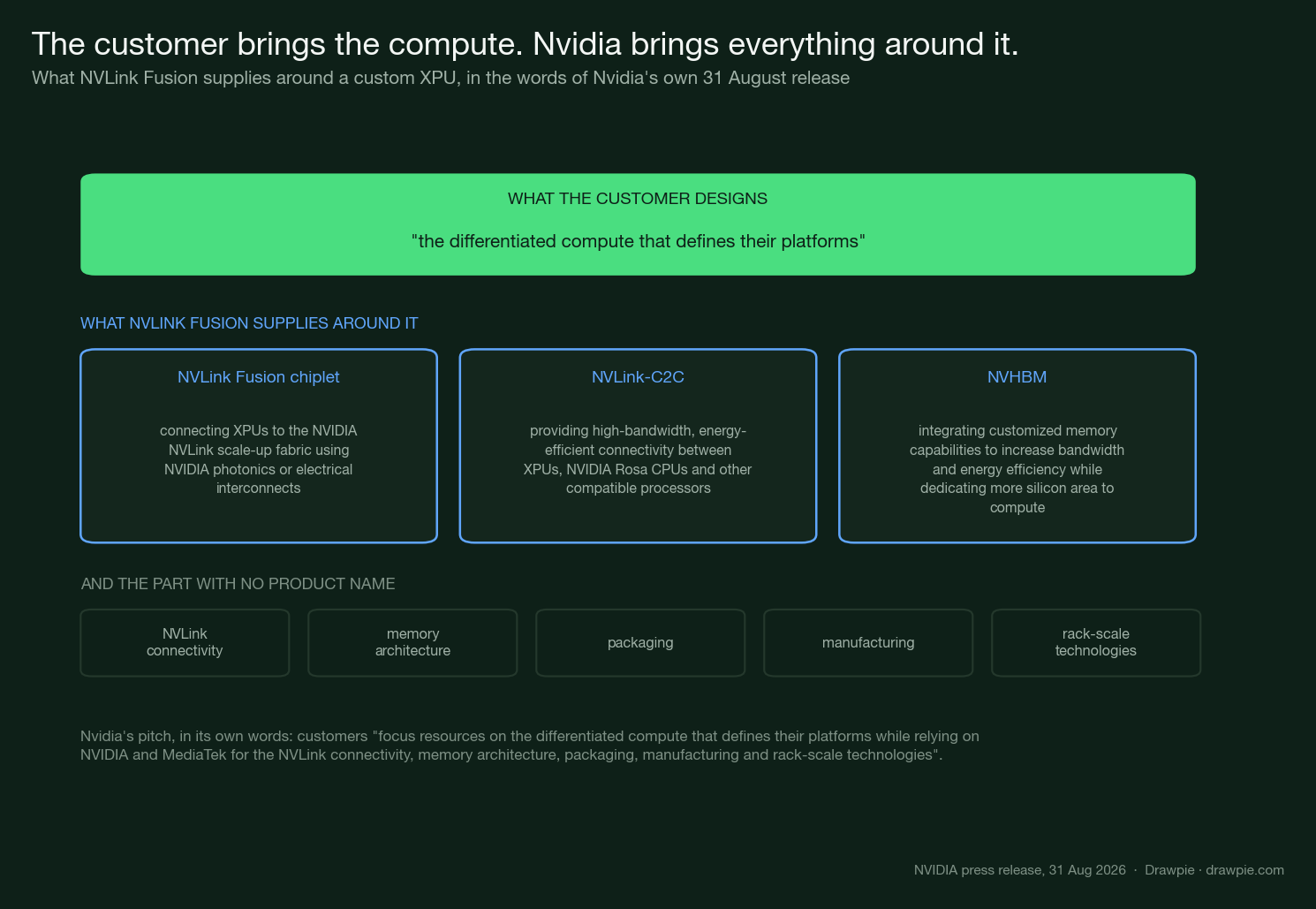
The release names three components. The NVLink Fusion chiplet connects a custom accelerator “to the NVIDIA NVLink scale-up fabric using NVIDIA photonics or electrical interconnects”. NVLink-C2C provides the link “between XPUs, NVIDIA Rosa CPUs and other compatible processors”. NVHBM supplies “customized memory capabilities to increase bandwidth and energy efficiency while dedicating more silicon area to compute”.
Around those sit the parts with no product name: packaging, manufacturing, the rack. Nvidia’s own description of why that matters is the most revealing paragraph in the release — building the accelerator, it says, “is only the beginning”, because integrating “multi-die architectures, advanced packaging, high-speed SerDes, HBM, I/O and scale-up networking into a manufacturable, production-ready system requires extensive chip-to-rack engineering, qualification and supply-chain support”.
The offer, then, is that customers “focus resources on the differentiated compute that defines their platforms” and rely on Nvidia and MediaTek for everything else.
Why would Nvidia help customers build chips that replace its GPUs?
Because under this arrangement they do not replace much.
The standard reading of custom silicon is that it is defection. A hyperscaler designing its own accelerator is a hyperscaler buying fewer Nvidia GPUs, and each such programme has been read as a subtraction from Nvidia’s addressable market.
NVLink Fusion reframes it. The customer still designs the compute die — that is the part they wanted control of, and the part they are proud of. But the interconnect is Nvidia’s, the chip-to-chip link is Nvidia’s — the release offers it for Nvidia’s own Rosa CPUs “and other compatible processors”, so the link is Nvidia’s even where the CPU is not — the memory subsystem is Nvidia’s, the rack architecture is Nvidia’s MGX, and the qualification path runs through Nvidia and MediaTek. The customer buys less GPU and more of everything else.
Whether that nets out in Nvidia’s favour depends on numbers nobody outside the companies has: what a Fusion licence costs, what NVHBM costs against merchant memory, what share of a rack’s value sits in the accelerator. This page is not going to pretend otherwise. What it can say is that the architecture is designed so that a customer leaving the GPU does not leave the platform.
How much of this partnership is actually new?
One of the three. MediaTek adopting NVLink Fusion is the new part; the PC chips and the car platforms are both work these two companies were already doing.
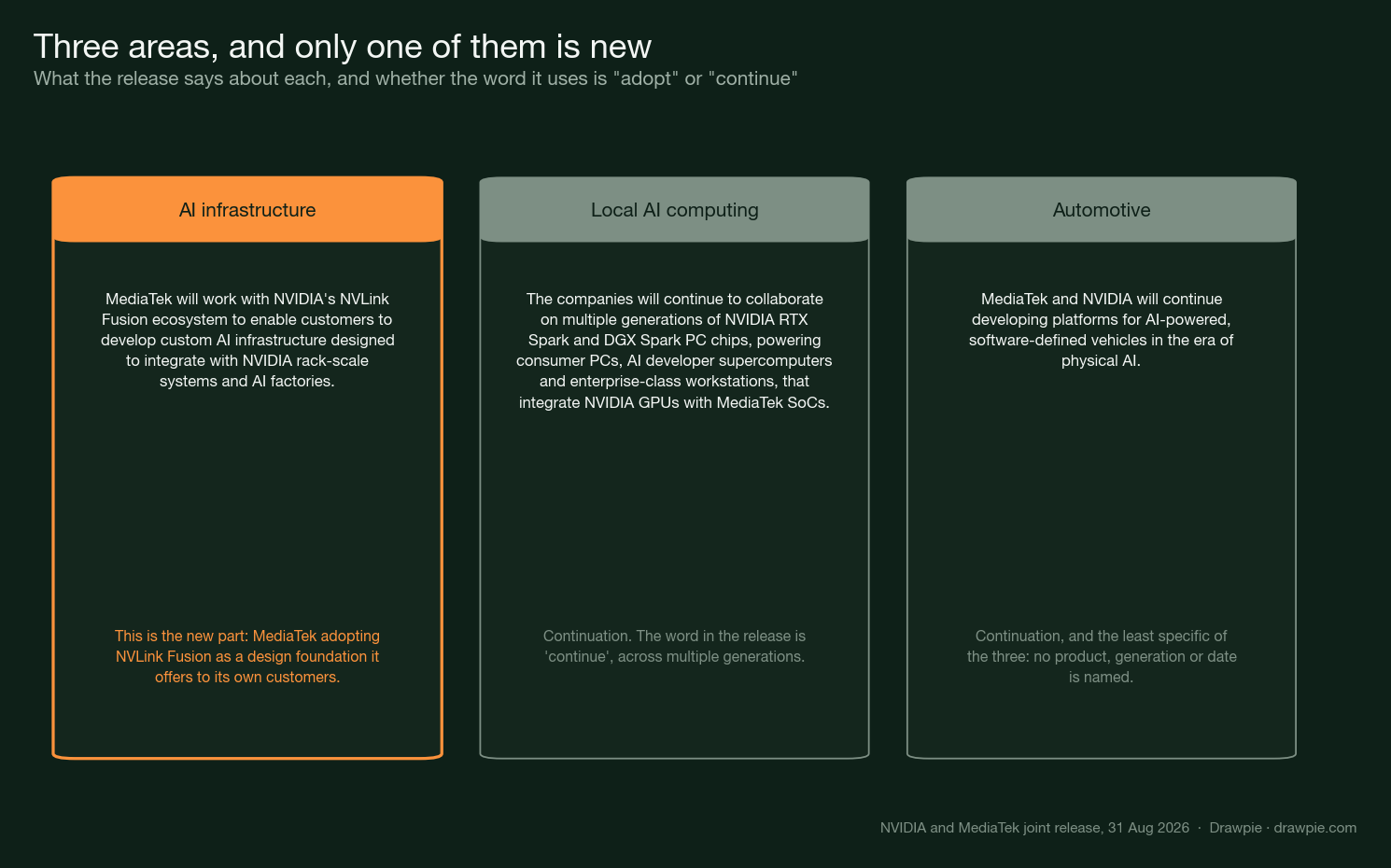
Read the verbs. On AI infrastructure, MediaTek “will adopt” the NVLink Fusion platform and “will work with” the Fusion ecosystem — that is the new thing. On PC silicon, the companies “will continue to collaborate” on multiple generations of RTX Spark and DGX Spark chips, which they were already doing. On cars, they “will continue developing platforms for AI-powered, software-defined vehicles”, with no product, generation or date attached.
None of that makes the announcement empty. It does mean the headline event is narrower than “Nvidia and MediaTek partner on AI”: the partnership already existed in two of the three areas, and what changed is that MediaTek will now sell Nvidia’s interconnect platform to its own custom-silicon customers.
What does it mean for NVDA?
We are not going to tell you what it means for the share price, and that is a rule here rather than a dodge. Nvidia is traded, this site does not publish forecasts about traded securities, and a deal this fresh is exactly where that discipline earns its keep.
What can be set out is the business logic, which is what the question is usually reaching for:
- It costs cash now. $3.5 billion left Nvidia’s balance sheet into an instrument that ranks above equity and may convert into it. Whether it also pays interest is one of the things not disclosed.
- It buys a way into rooms Nvidia is not otherwise in. The companies designing custom accelerators are already among Nvidia’s largest GPU customers — what it has not been inside is their custom-silicon programmes, and MediaTek is a supplier to those.
- It defends the interconnect, not the GPU. The moat being reinforced is NVLink, MGX and the memory architecture.
- It is not exclusive on its face. Nothing in the release says MediaTek may only offer Fusion, or that Fusion customers may not also design for other fabrics.
- The thing that would let you size it is missing. Without conversion terms, and without pricing for Fusion, the $3.5 billion is a number without a denominator.
If you want the figure that would actually settle the question, it is not Nvidia’s next earnings date. It is the conversion price on those bonds — and MediaTek is the company that would have to publish it.
The bottom line
Strip the AI vocabulary and this is a chip company lending money to another chip company on convertible terms, in exchange for that company steering its custom-silicon customers onto the lender’s interconnect.
That is a smaller claim than “Nvidia bets $3.5 billion on custom AI chips” and a more durable one. The part worth watching is not the size of the cheque but whether the Fusion ecosystem attracts a hyperscaler that was otherwise walking away — and the part worth asking about is the terms, which two of the world’s larger semiconductor companies announced a $3.5 billion transaction without disclosing.
Sources
| Source | What it supports here |
|---|---|
| NVIDIA: joint release with MediaTek, 31 August 2026 | The convertible-bond sentence, the three collaboration areas, the NVLink Fusion components, and the Huang and Tsai quotations |
| MediaTek: the same release, in its press room | That both companies published identical text, and that MediaTek added nothing about the bonds |
| MediaTek: investor relations | That the bonds are not mentioned there, which is how the absence of terms was checked |
| Digitimes: Nvidia takes US$3.5 billion of MediaTek’s convertible bond | The US$3.9 billion total, the NT$120 billion figure and the “largest overseas CB” framing |
Both releases and MediaTek’s investor pages read on 31 August 2026. No affiliate links, and no payment was received for any link on this page.
This page describes an announced transaction and the technology attached to it. It contains no forecast, target or rating for Nvidia, MediaTek or any other security, and nothing here is investment advice.
How we verified this
🔴 No share price, price target, rating or forecast for either company appears on this page. Nvidia and MediaTek are both listed and this site does not publish predictions about traded securities. Some coverage of this deal leads on how the shares moved on the day; that is not a thing we report as a consequence, because attributing a single session’s move to one announcement is a claim nobody can support.
✅ The core facts come from the two companies’ own releases, which are the same text. Nvidia’s newsroom and MediaTek’s press room carry an identical joint announcement dated 31 August 2026. Every quotation here was read from those pages rather than from coverage of them, and the instrument — “convertible bonds” — is Nvidia’s own word, not an inference.
🔴 nvidianews.nvidia.com soft-404s, so the check there is content-based. An invented release path returns HTTP 200 carrying the news-archive index at 68,549 bytes with the title “News Archive”; the real release is 82,739 bytes under its own headline and is the only one of the two containing the word “convertible”. Status codes prove nothing on that host.
⚠️ The size of the whole offering is trade reporting, not a company statement, and is attributed as such. Neither release mentions US$3.9 billion or the phrase “largest ever”. That comes from Digitimes, bylined Jay Liu in Taipei and timestamped 22:25 Taipei time on 31 August. Only its opening paragraph is outside the paywall, so nothing beyond the offering size and the “largest overseas CB” framing is taken from it — and the “largest ever” claim is Digitimes reporting what MediaTek says, which is a second remove and is written that way.
🔴 The absence of terms was checked rather than assumed. The word “convertible” appears in both releases exactly once, in the same sentence. It appears nowhere on MediaTek’s investor-relations pages. No conversion price, coupon, tenor, share count or post-conversion holding is published anywhere we could reach, which is why this page describes what the instrument is and declines to say what it is worth.
⚠️ The reading is ours; the sentence under it is Nvidia’s. That Fusion lets Nvidia monetise customers who build their own chips is an interpretation, and this page makes it in its own words — deliberately not in the word “tollbooth”, which is another outlet’s headline from the same day and is not a term either company used. What it rests on is quoted directly: customers “focus resources on the differentiated compute that defines their platforms while relying on NVIDIA and MediaTek for the NVLink connectivity, memory architecture, packaging, manufacturing and rack-scale technologies”. The chart is built from that sentence and the three component descriptions, with the script asserting the component names still match the release.
⚠️ “Only one of three is new” is a reading of the release’s own verbs. AI infrastructure is described with “will adopt” and “will work with”; local AI computing and automotive both use “will continue”. That is what the chart marks. It is a claim about how the announcement is worded, not a judgement about which area matters most.
⚠️ No perishes date is set. The deal is announced and done; what would date this page is terms being published later, and nobody has scheduled that. Every figure here carries the document it came from instead.