Northern Lights Forecast Canada: Where to See the Aurora Tonight, Best Time & Viewing Map
The Kp forecast on this page was issued at 00:30 UTC on 29 August 2026 and covers 29 to 31 August. The aurora map is a nowcast for a single moment and is out of date within the hour. From 31 August nothing here describes the present; rewrite from a fresh NOAA pull or retire.
Everything else on the page is unaffected; the figures below still say when they were read.

- The best night has already happened. NOAA forecast Kp 5.67 — a G2 storm — for 00:00 to 06:00 UTC on 29 August, which was 8pm Friday to 2am Saturday in Toronto. Tonight’s peak is Kp 3.67, two steps lower and below storm level entirely.
- Tonight’s best window is 03:00 to 09:00 UTC on 30 August: 11pm Saturday to 5am Sunday Eastern, 9pm to 3am Mountain, 8pm to 2am Pacific.
- In NOAA’s latest nowcast the leaders are Whitehorse at 28%, Fort McMurray at 26%, Yellowknife at 20% and Edmonton at 19%. Toronto, Ottawa, Montreal and Halifax are all at zero.
- Iqaluit is the northernmost city on our list at 63.8°N and seven cities further south beat it. The auroral oval is centred on the geomagnetic pole over the western Canadian Arctic, not on the geographic pole.
- The aurora reaches about 49°N over the Prairies and northwest Ontario, but pulls back to 54°N in the Yukon and 57°N over Newfoundland. The same tilt explains both.
Tonight is not the night it was. NOAA forecast a G2 geomagnetic storm for the hours around midnight on Friday — and it has passed. Tonight’s peak is Kp 3.67, two steps lower and below storm level entirely.
That is the honest headline. Here is what is still worth going outside for, where, and exactly when.
Can you see the northern lights in Canada tonight?
In the north and the Prairies, plausibly. In Toronto, Ottawa, Montreal or Halifax, no.
NOAA’s own three-day forecast, issued at 00:30 UTC on 29 August, is blunt about the shape of this event. The greatest observed 3-hour Kp over the previous 24 hours was 4, below NOAA’s storm scale. The greatest expected Kp across 29–31 August is 5.67, a G2 — and that window is the one that has already gone.
The forecaster’s rationale names the cause: “Periods of G1-G2 (Minor-Moderate) geomagnetic storming are likely on 29 Aug due to positive polarity CH HSS influences, coupled with the anticipated arrival of CMEs that left the Sun on 25-26 Aug.”
What is the best time tonight?
11pm Saturday to 5am Sunday Eastern. That is the 03:00–09:00 UTC block on 30 August, and it is the only part of tonight that reaches Kp 3.67.
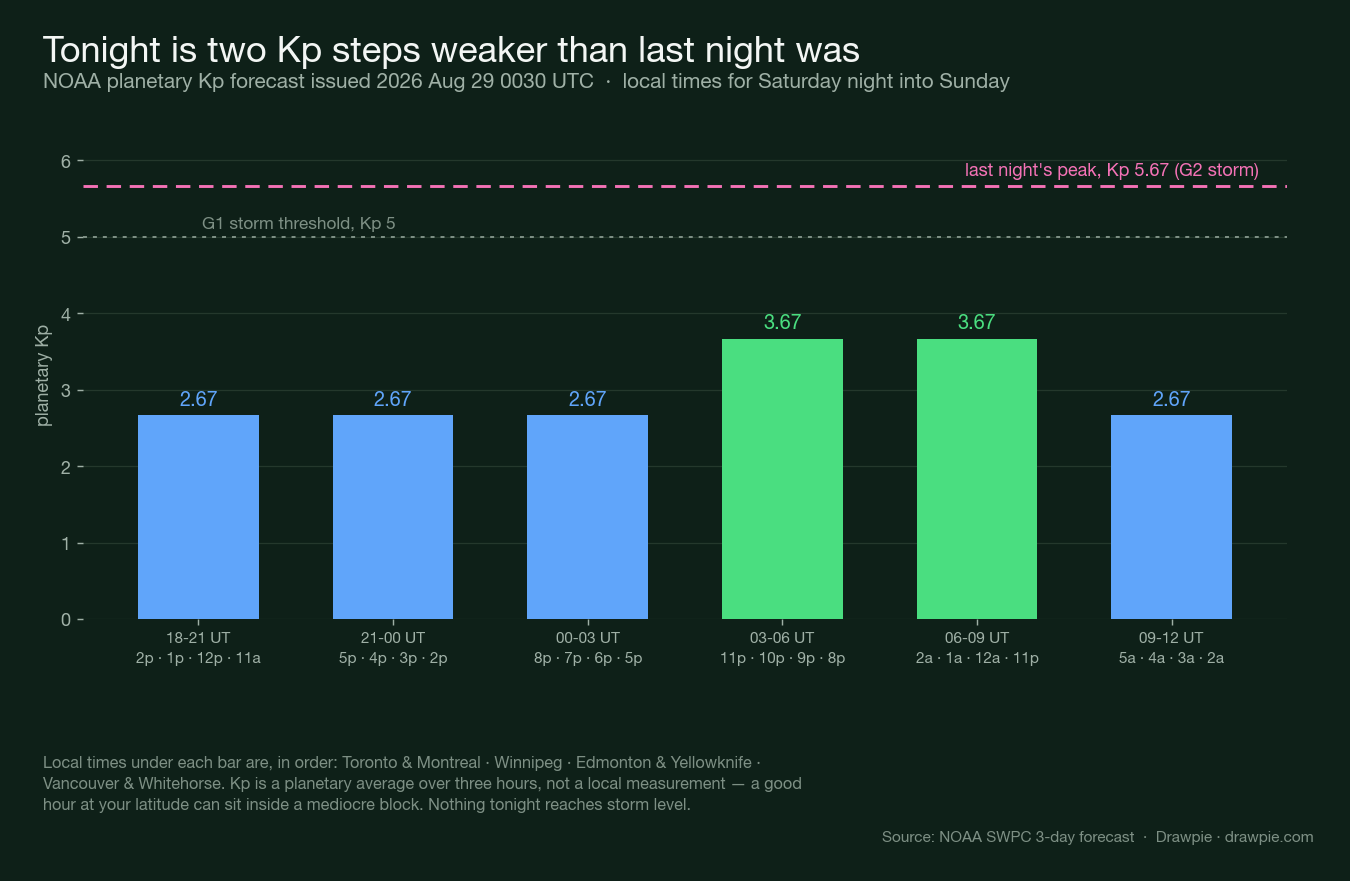
| UTC | Kp | ET | CT | MT | PT |
|---|---|---|---|---|---|
| 18–21 | 2.67 | 2p Sa | 1p | 12p | 11a |
| 21–00 | 2.67 | 5p Sa | 4p | 3p | 2p |
| 00–03 | 2.67 | 8p Sa | 7p | 6p | 5p |
| 03–06 | 3.67 | 11p Sa | 10p | 9p | 8p |
| 06–09 | 3.67 | 2a Su | 1a | 12a | 11p Sa |
| 09–12 | 2.67 | 5a Su | 4a | 3a | 2a |
UTC blocks run from 18:00 on 29 August to 12:00 on 30 August. Sa = Saturday, Su = Sunday — note that the same UTC block falls on different days east and west.
For comparison, last night’s G2 ran 00:00–06:00 UTC on 29 August — 8pm Friday to 2am Saturday Eastern, 6pm to midnight Mountain. If you were out then and saw nothing, cloud is the likeliest explanation; that was the strongest window of this event.
Nothing tonight reaches storm level. Kp 5 is the G1 threshold and tonight tops out at 3.67.
Where can you see the aurora right now?
Whitehorse, Fort McMurray, Yellowknife and Edmonton lead. Toronto, Ottawa, Montreal, Halifax and St John’s are at zero.
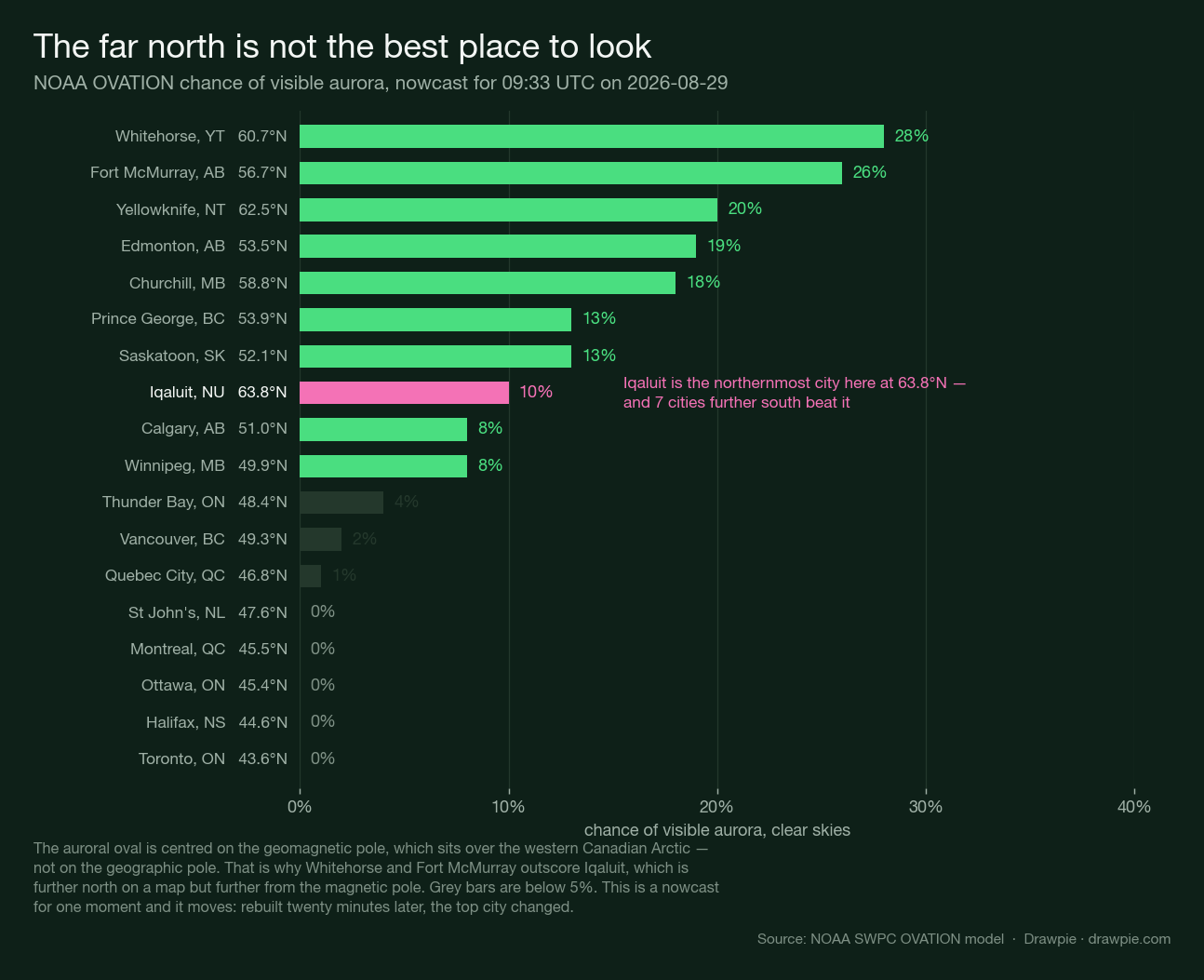
| City | Latitude | Chance |
|---|---|---|
| Whitehorse, YT | 60.7°N | 28% |
| Fort McMurray, AB | 56.7°N | 26% |
| Yellowknife, NT | 62.5°N | 20% |
| Edmonton, AB | 53.5°N | 19% |
| Churchill, MB | 58.8°N | 18% |
| Prince George, BC | 53.9°N | 13% |
| Saskatoon, SK | 52.1°N | 13% |
| Iqaluit, NU | 63.8°N | 10% |
| Calgary, AB | 51.0°N | 8% |
| Winnipeg, MB | 49.9°N | 8% |
| Thunder Bay, ON | 48.4°N | 4% |
| Vancouver, BC | 49.3°N | 2% |
| Quebec City, QC | 46.8°N | 1% |
| St John’s · Montreal · Ottawa · Halifax · Toronto | 43.6–47.6°N | 0% |
These are the chance of aurora being overhead and visible under clear skies, from NOAA’s OVATION model, for a nowcast about half an hour ahead of the moment we pulled it. They are not a forecast for tonight, and they move — we rebuilt the file twenty minutes later and the leader changed.
Why is the far north not the best place to look?
Because the aurora circles the magnetic pole, not the geographic one — and the magnetic pole is not where the map says north is.
Look at the table again. Iqaluit sits at 63.8°N, further north than anything else on the list, and seven cities south of it score higher. Saskatoon, 11.6 degrees of latitude further south, beats it 13% to 10%.
That is not an error in the model. The auroral oval is a ring centred on the geomagnetic pole, which sits over the western Canadian Arctic — well to the west of the geographic North Pole. Nunavut’s east is a long way north on a map and comparatively far from the magnetic pole; Yukon and northern Alberta are the opposite.
Practically, that means the useful question is not “how far north am I” but “how far northwest”. For most of the country, driving north-west out of city light beats driving due north.
How far south does the aurora reach?
About 49°N over the Prairies and northwest Ontario — and considerably further north at both ends of the country.
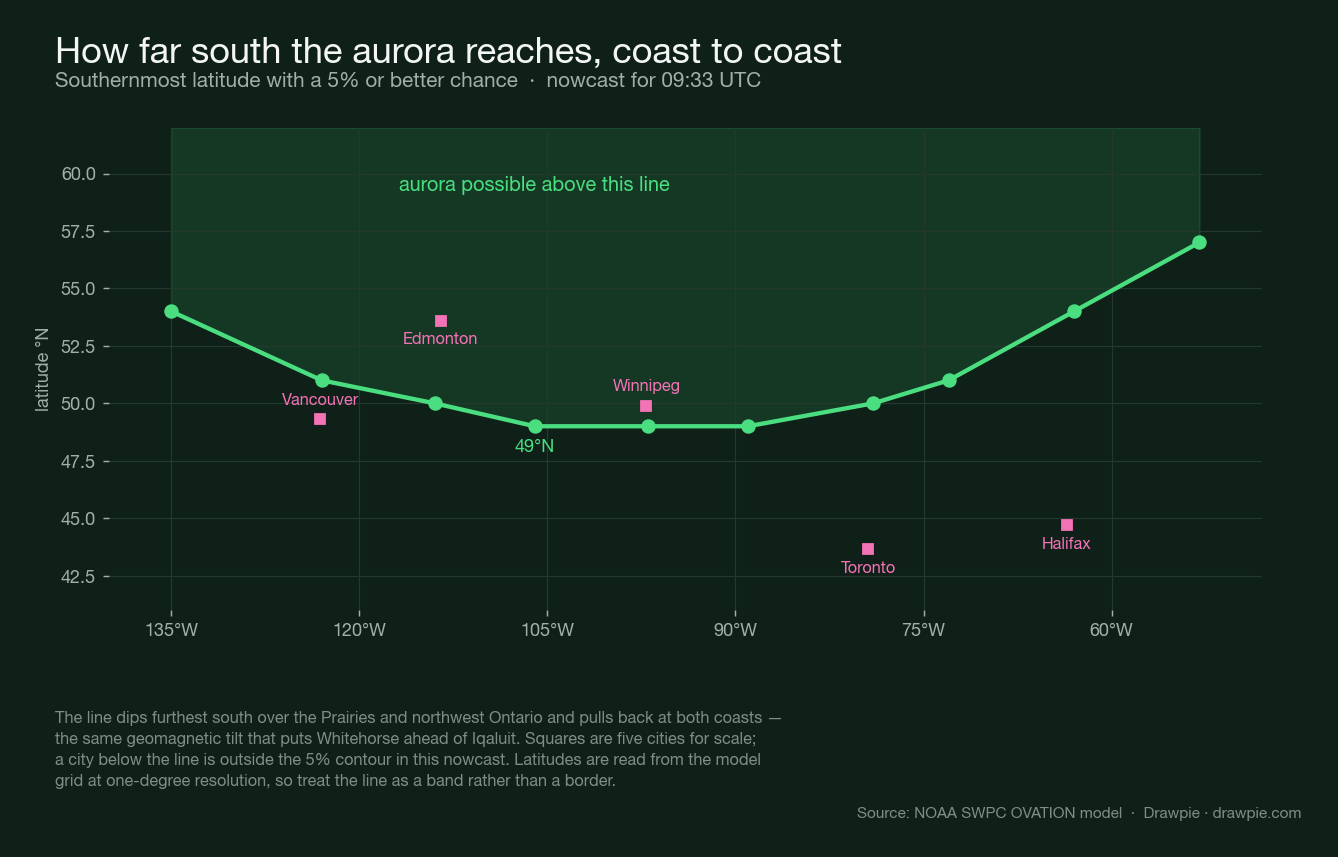
| Longitude | Reaches down to |
|---|---|
| 135°W (Yukon) | 54°N |
| 123°W (BC coast) | 51°N |
| 114°W (Alberta) | 50°N |
| 106°W to 89°W (Prairies, NW Ontario) | 49°N |
| 79°W (southern Ontario) | 50°N |
| 73°W (Quebec) | 51°N |
| 63°W (Maritimes) | 54°N |
| 53°W (Newfoundland) | 57°N |
The line bulges south across the middle of the country and pulls back at both coasts — the same geomagnetic tilt that puts Whitehorse ahead of Iqaluit, seen from a different angle.
Read it as a band rather than a border. The model grid is one degree, so a city a few tens of kilometres either side of the line is inside the noise.
What does Canada’s own forecast say?
Something usefully different, because it does not use a single number.
Space Weather Canada, run by Natural Resources Canada, described conditions at 07:02 UT on 29 August as:
| Zone | Now | Next 24 hours |
|---|---|---|
| Polar | unsettled | active + stormy intervals |
| Auroral | stormy | active + stormy intervals |
| Sub-auroral | active | unsettled + active intervals |
That “stormy” reads stronger than NOAA’s planetary Kp of about 3.3 at the same moment, and both are right. NOAA publishes one number for the whole planet. Canada publishes three, because the country spans three magnetic zones — and the zone that matters for aurora watchers is not the same as the planetary average.
For a Canadian reader that breakdown is the more useful of the two. If you are in the auroral zone — roughly the territories and the northern halves of the western provinces — the Canadian descriptor is about your sky. The planetary Kp is about everyone’s.
The Canadian Space Agency also runs AuroraMAX, a live camera pointed at the sky over Yellowknife. On a night like this it is the fastest way to find out whether anything is actually happening, without getting dressed.
What this page cannot tell you
Whether you will see anything. Every number here assumes clear skies. Cloud is not in the model, and on any given night in Canada cloud decides more aurora attempts than geomagnetic activity does. Check a normal weather forecast before you drive anywhere.
What it looks like from where you are. A 20% cell means aurora overhead somewhere in that cell. At the southern edge of the oval it often means a faint green glow low on the northern horizon rather than anything overhead — visible to a camera on a long exposure and marginal to the eye.
Anything about tomorrow night. NOAA’s forecast has Kp falling further: the highest block on 31 August is 2.00. This event is winding down.
Whether these exact numbers still hold. They will not. The nowcast is stale within the hour and the Kp forecast is reissued daily. The live sources are linked below — go to them rather than to this page if the difference matters.
Sources
| Source | Used for |
|---|---|
| NOAA SWPC — OVATION aurora nowcast | Every city percentage and the southern boundary, from the model grid directly |
| NOAA SWPC — 3-day forecast | The Kp table, the G2 window, the observed 24-hour maximum and the forecaster’s rationale |
| Space Weather Canada — current conditions | The polar, auroral and sub-auroral descriptors and the 24-hour outlook |
| Canadian Space Agency — AuroraMAX | The live camera over Yellowknife |
How we verified this
🔴 This page mixes two different NOAA products on purpose, and labels which is which every time. The map and the city percentages are the OVATION nowcast — a modelled probability for one instant about half an hour ahead, which answers “where, right now” and moves constantly. The Kp table is the 3-day forecast — planetary activity in three-hour UT blocks, which answers “when tonight” and says nothing about any particular place. Presenting them as one number would be wrong in both directions.
⚠️ The nowcast moves fast, and we can show you how fast. The data file was built twice about twenty minutes apart. Between those two pulls the top city changed from Fort McMurray to Whitehorse, and the southern edge of the 5% contour moved a degree of latitude. Every percentage here is stamped with the moment it is for. If you are reading this an hour later, the numbers have already moved.
✅ Both sources passed a control test. Invented paths on services.swpc.noaa.gov and on spaceweather.gc.ca both return 404 while the real products return 200, so a successful response there distinguishes a real product from one that does not exist.
🔴 A longitude convention nearly put every city on the wrong side of the planet. OVATION publishes longitude as 0–359 east, not −180 to +180. Yellowknife at −114.37 is column 246; passing the negative value straight in returns a cell over Asia with a perfectly plausible number attached and no error. The builder script asserts the grid’s own coordinate range before reading anything from it.
⚠️ A modelled probability is not a promise, and cloud is not in it. OVATION gives the chance of aurora being overhead and visible under clear skies. It does not know about cloud, moonlight or the streetlight outside your window. A 28% cell under solid overcast is a 0% night.
⚠️ Kp is a planetary average over three hours. It is not a measurement at your latitude and not a measurement of the minute you step outside. A good twenty minutes can sit inside a mediocre block, and a mediocre three hours can contain nothing at all.
The two national agencies describe this moment differently, and both are quoted rather than reconciled. NOAA gives one planetary number; Space Weather Canada gives three zone descriptors. Neither is wrong — see the section below on why the Canadian version is more useful here.